

Is Radium a Radioactive Element? Yes — Here's Why
On this page· 20
Yes, radium is a radioactive element because its nucleus is unstable and all of its isotopes decay spontaneously while emitting ionizing radiation. Radium-226's roughly 1,600-year half-life makes that invisible process concrete: its radioactivity persists far beyond a human lifetime.
The surprising part is that radiation outside your body and radioactive material inside it aren't equivalent hazards. Understanding that difference is more useful than imagining that every encounter with radium carries the same danger.
Is Radium a Radioactive Element
Radioactive describes what radium's nuclei do, not how an object looks or whether someone has activated it. A radium-containing material doesn't need to glow, feel warm, or show visible damage for nuclear decay to occur.
That makes the familiar image of glowing radium a poor guide to safety. The important questions concern invisible emissions and possible contamination, not brightness. Looking at an object can't tell you which radionuclides it contains or how much radiation someone might receive.
A property, not an on-off switch
Think of the difference between identifying a material and assessing an exposure. Calling something radioactive identifies a physical property. Deciding whether it presents a health concern requires more information.
For example, a material containing radium on a shelf and radium dissolved in drinking water present different questions. With the object, you'd want to understand external radiation and whether material could escape. With water, you'd want to know whether consuming it could introduce radium into the body.
Practical rule: Don't use appearance as a radiation detector. A material's identity, measured activity, and possible exposure routes matter more.
This also explains why household questions need more than a general statement about radioactivity. Someone investigating a water-test result needs information about the contaminant and treatment options, not just a warning about radioactive elements. Water Filter Advisor's guide to water filtration for radium is a useful starting point for that narrower question, alongside advice from the relevant water supplier or health authority.
Separate identity from risk
Keep these questions distinct:
- Identity: Does the material contain radium?
- Measurement: Which isotope is present, and what is its activity?
- Exposure: Can radiation reach someone, or can the material enter their body?
- Response: What testing or professional guidance would resolve the uncertainty?
The answer to “Is radium a radioactive element?” is definite. The answer to “How dangerous is this particular situation?” depends on evidence about the situation itself.
Question 1 of 6
Why can a piece of radium-containing material look like an ordinary gray rock and still be radioactive?
What Makes an Element Radioactive
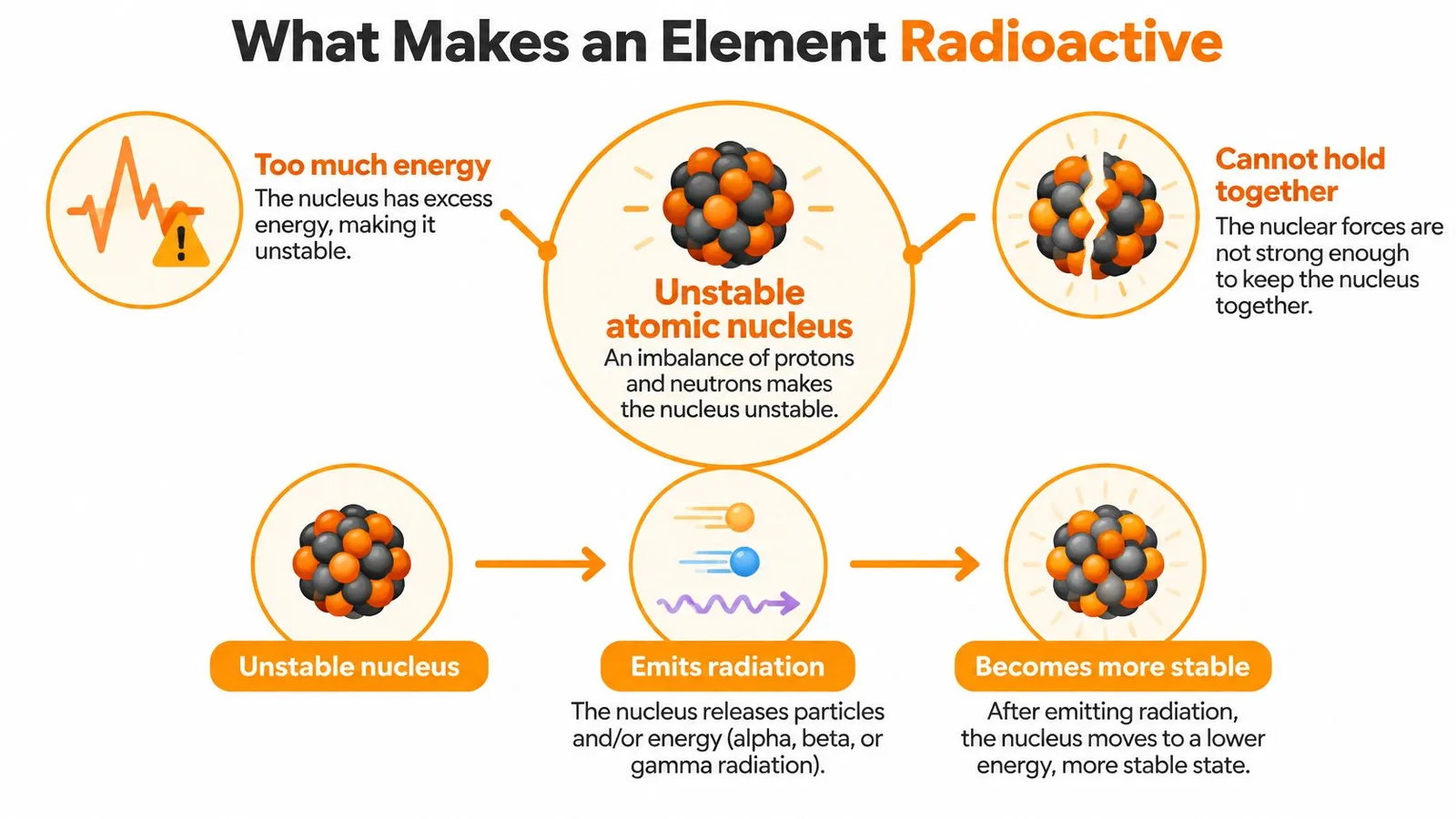
An atom has a central nucleus. In a radioactive atom, that nucleus is unstable and can transform spontaneously, releasing ionizing radiation. Radium is a clear example of this process, rather than an element that becomes radioactive only under unusual conditions.
The word ionizing matters because this radiation can change atoms in material it passes through. It isn't visible light or an invisible color surrounding an object. The nuclear transformation is a physical event, with emissions that scientists can measure.
Read half-life as a population clock
A half-life describes how a population of radioactive atoms changes, not a deadline assigned to each individual atom. You can't point to a particular nucleus and know exactly when it will decay. Across a sample, however, the pattern is predictable.
For radium-226, the half-life is approximately 1,602 years: after that interval, about 50% of the original parent atoms remain, and after 3,204 years, about 25% remain, assuming none is added or removed; its decay produces radon-222 and primarily emits alpha particles with energy reported at about 5.68 megaelectronvolts, as described in the EPA's explanation of radioactive atoms and radium decay.
The clock analogy needs a qualification: the atoms don't wait together and then decay when an alarm rings. Individual decay events occur unpredictably, while the overall population follows a consistent statistical pattern.
- Individual atom: Its exact decay time isn't something you can schedule.
- Whole sample: Its gradual reduction can be described with a half-life.
- Decay product: The original atom becomes a different nucleus, which may also be radioactive.
A transformation isn't disappearance
Saying that parent atoms have decayed doesn't mean the material has vanished. It means those atoms have transformed. Nor does a reduction in the original radium automatically describe every radioactive substance subsequently present.
That's why “half the radium remains” is clearer than “the sample is half radioactive.” The latter can hide what the decay products are doing.
This distinction belongs alongside other common science misconceptions: an everyday phrase may sound sensible while blurring a scientific definition. Half-life measures the changing parent population, not a universal countdown to harmlessness.
Question 2 of 6
Radium-226 has a half-life of about 1,602 years. What does that number actually tell you about a sample of radium-226?
How Marie Curie Discovered Radium
Marie Curie's investigation began with a mismatch between an explanation and a measurement. Pitchblende contained uranium, but its radioactivity was greater than its uranium content could explain. Rather than treating that excess as an inconvenience, she investigated what else the mineral contained.
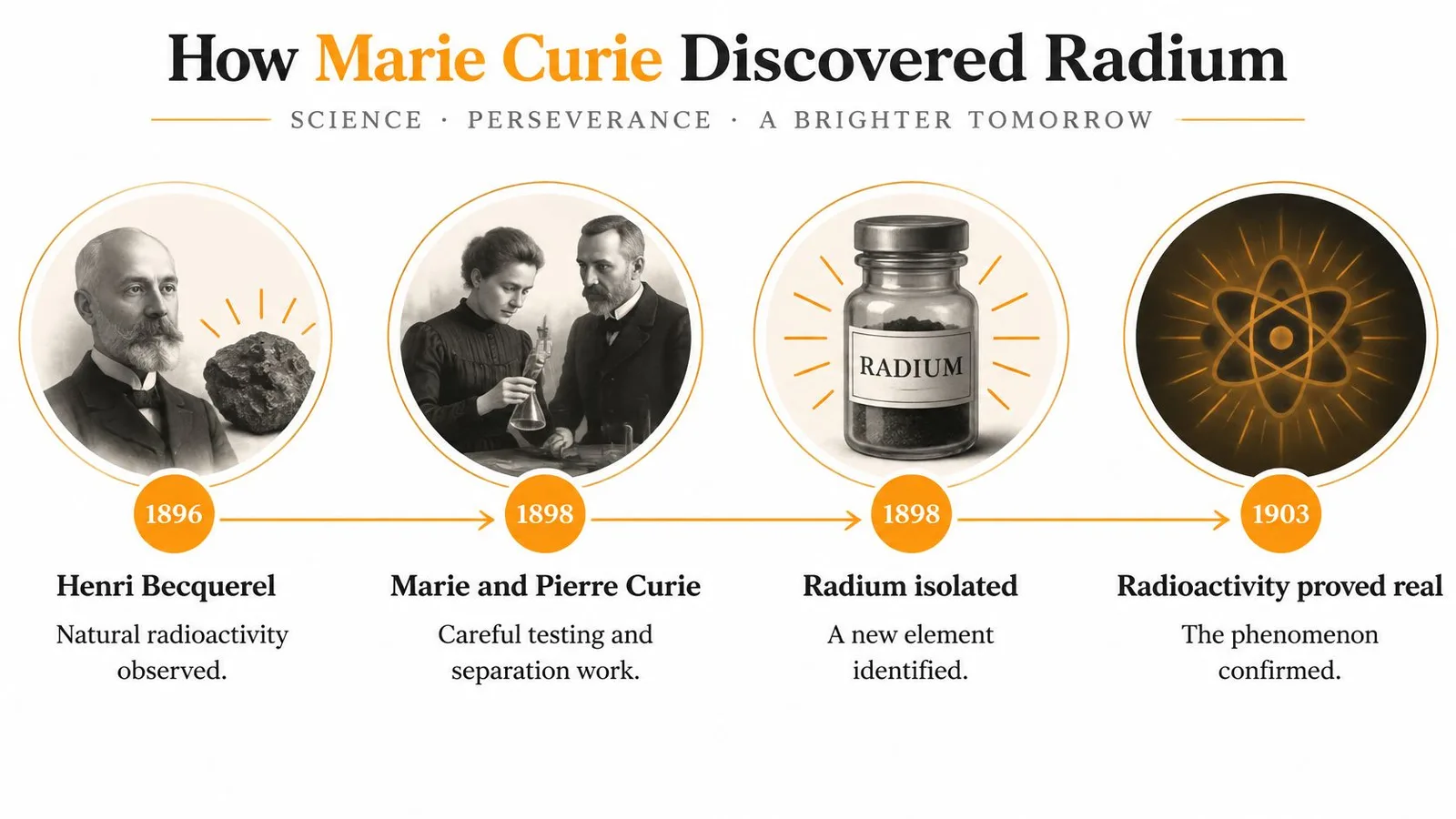
Henri Becquerel had identified natural radioactivity in uranium in 1896; Marie and Pierre Curie subsequently discovered radium in December 1898, after their earlier identification of polonium, according to Britannica's history of radium. By 1902, Marie Curie had prepared about 0.1 gram of pure radium chloride from several tons of pitchblende residues; Marie Curie and André-Louis Debierne isolated the metal in 1910, and Curie received the 1911 Nobel Prize in Chemistry for her work on radium's isolation.
Follow the unexplained signal
The reasoning resembles a detective's method, but the evidence was a measurable physical effect. If uranium alone couldn't account for the observed radiation, another explanation was needed. Separating the material allowed the researchers to connect the unexplained activity with additional substances.
The important lesson isn't just that the Curies worked hard. It's that they followed a discrepancy through repeated separation and measurement until they could identify a new element.
Discovery and isolation aren't interchangeable achievements. Recognizing that a new substance exists is different from preparing it in a purified form.
Give each achievement its proper meaning
A timeline can make discovery look like a single dramatic moment. Radium's history instead separates several accomplishments:
- Observation: Recognize that the existing explanation doesn't fit the measurement.
- Identification: Establish that an additional element accounts for the signal.
- Preparation: Obtain material pure enough for further study.
That distinction also matters when discussing modern scientific credit. IamVera.AI's discussion of evaluating scientific discoveries involving AI offers a related question about how different stages of discovery should be assessed.
Radium didn't provide the first evidence that radioactivity existed. Its discovery strengthened the connection between a measurable emission and the properties of particular atoms, helping researchers investigate the phenomenon more precisely.
Question 3 of 6
Why did several tons of pitchblende residue give Marie Curie only about 0.1 gram of pure radium chloride by 1902?
Radium Isotopes and Their Half-Lives
Key Naturally Occurring Radium Isotopes
| Isotope | Decay Series | Half-Life | Notable Decay Product |
|---|---|---|---|
| Radium-226 | Uranium-238 | About 1,600 years | Radon-222 |
| Radium-228 | Thorium-232 | Roughly 6.7 years | Radioactive progeny |
| Radium-224 | Thorium decay series | Approximately 3.5 days | Radioactive progeny |
The isotope values and decay-chain information above are drawn from the IAEA nuclear-decay data reference, which also describes the radium-226 chain passing through radon-222 before ultimately reaching stable lead-206; after ten half-lives, approximately 0.1% of the original parent activity remains.
The contrast is substantial. Some radium contamination requires a long-term perspective, while other parent isotopes decrease much more quickly. The name radium alone doesn't tell you the timescale.
Different clocks don't mean equal activity
Isotopes are forms of the same element with different nuclear compositions. Their shared chemical identity doesn't require them to have the same nuclear behavior.
Calling each isotope radioactive places it in the same broad category. It doesn't mean equal quantities have identical activity, identical persistence, or identical exposure implications. A long half-life describes slow parent decay, not an automatic safety rating.
Likewise, a short half-life doesn't justify declaring a contaminated location safe after a brief wait. A real assessment must consider what was initially present, what remains, and which decay products have formed.
Follow the products as well as the parent
A decay chain is a sequence of nuclear transformations. The first transformation may create another radioactive substance rather than a stable endpoint. For radium contamination, the possibility of a gaseous product makes that sequence especially relevant.
That leads to a practical distinction:
- Parent measurement: How much of the original radium isotope is present?
- Progeny assessment: Which radioactive products accompany it or develop from it?
- Environmental behavior: Could those products move differently from the original material?
A visual inspection can't answer those questions. Chemical identification alone also doesn't supply a complete radionuclide-specific assessment.
For a classroom exercise, pair the table with chemistry trivia questions: ask whether sharing an element name guarantees sharing a half-life. The useful answer explains why chemical identity and nuclear stability describe different features of an atom.
Question 4 of 6
What happens to radium-226 as it decays toward a stable form?
How Radium Exposure Actually Harms the Body
Location changes the significance of radiation. A particle that struggles to reach tissue from outside the body may matter much more when its source is already inside that tissue.
Alpha particles have very limited penetration through intact skin, but inhaled or swallowed radium can cause internal exposure; radium behaves chemically like calcium and can accumulate in bone, while penetrating gamma radiation can create an external hazard, according to the ATSDR overview of radium exposure and health effects. That guidance also identifies drinking water as a potential route, with typical concentrations often below 1 picocurie per liter and measurements exceeding the U.S. limit of 5 picocuries per liter for combined radium-226 and radium-228.
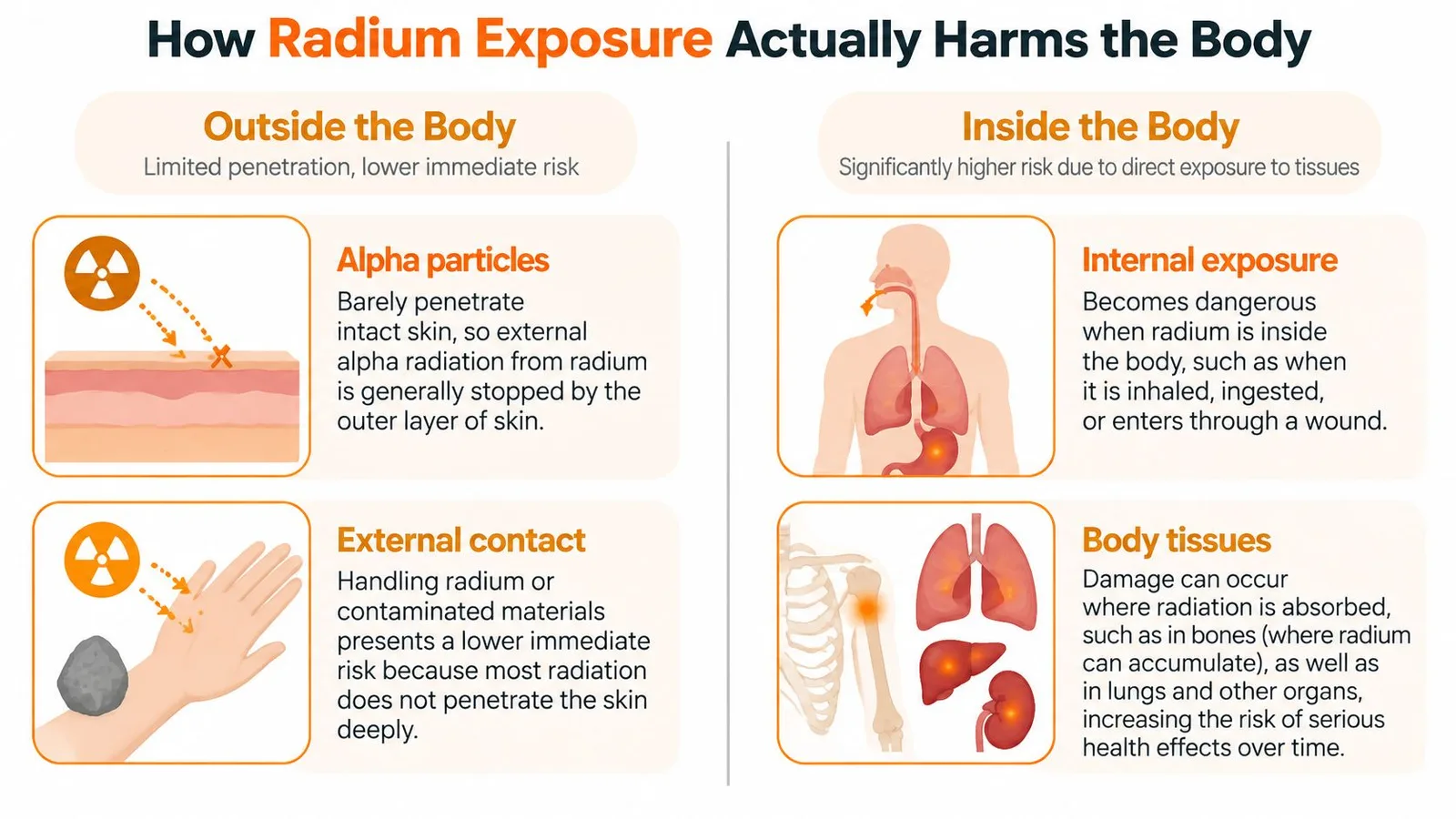
Compare the routes, not just the object
| Exposure situation | Main question |
|---|---|
| Material remains outside the body | What radiation can reach the person? |
| Material is swallowed | Where could radium be retained internally? |
| Airborne material is inhaled | Could radioactive material enter the body? |
| An object sheds contamination | Could external material become an internal exposure? |
This is why radium on a shelf and radium in a drink aren't equivalent scenarios. It isn't a promise that the shelf object is safe. External radiation, loose contamination, and decay products still require consideration.
Nor is there a universal ranking in which every internal exposure exceeds every external exposure. Amount, isotope, duration, and circumstances can change the comparison. The useful conclusion is narrower: preventing intake is especially important for an alpha-emitting material.
Shielding and containment answer different questions
Shielding concerns radiation traveling from a source toward someone. Containment concerns keeping radioactive material from spreading or entering someone. Confusing those tasks can leave an important route unaddressed.
A barrier against external radiation doesn't undo radioactive material already taken into the body.
The drinking-water unit is another source of confusion. Picocuries per liter describe activity concentration, not a person's diagnosis. A water result needs interpretation in its regulatory and exposure context.
If you're concerned about suspected radium contamination, don't experiment with opening, scraping, or cleaning the material yourself. Seek guidance from an appropriate radiation-safety or public-health professional, and use testing rather than appearance to resolve uncertainty.
Question 5 of 6
Why is a bit of radium more dangerous inside your body than the same amount sitting on your skin?
Why Natural Does Not Mean Safe
Naturally occurring doesn't mean harmless. But finding a radioactive element somewhere in the environment doesn't, by itself, establish a dangerous exposure.
ATSDR reports no clear evidence that long-term exposure at typical environmental levels, such as about 1 picocurie per gram of soil, is likely to cause harmful effects, while prolonged exposure to higher levels is associated with anemia, cataracts, dental damage, and cancer, as explained in its public-health statement for radium. The same statement describes environmental pathways and the historical harm suffered by dial painters who repeatedly ingested radium-containing paint.
A background-to-occupational risk ladder
Use this ladder to distinguish situations, not to calculate someone's dose:
- Background presence: Low concentrations in the ordinary environment aren't equivalent to a concentrated source. Detection alone doesn't establish likely harm.
- Contaminated drinking water: Repeated consumption makes measured concentration and appropriate follow-up important. A household concern deserves a water-specific assessment.
- Occupational exposure: Work involving contaminated materials can introduce repeated contact, dust, residues, or other pathways that need controlled procedures.
- Acute internal intake: A suspected significant intake calls for prompt professional assessment rather than reassurance based on the material's natural origin.
These rungs aren't rigid dose categories. Occupational exposure can include internal intake, and contaminated water can produce ongoing intake. The ladder helps separate everyday background presence from circumstances requiring investigation.
What the Radium Girls example actually teaches
The dial painters often called the Radium Girls were near a radioactive substance. Repeated ingestion introduced radium into their bodies, where its retention in bone contributed to bone cancers and other serious disease.
That history shouldn't be used to imply that any trace of environmental radium produces the same outcome. Its lesson concerns the consequences of repeated internal exposure, not the mere existence of a naturally occurring element.
Risk check: Ask what someone could take in, how much exposure could occur, and how long it could continue. Natural origin doesn't answer those questions.
Groundwater contamination, mining residues, and industrial waste therefore deserve attention without turning every environmental detection into a catastrophe. Evidence should determine the response.
A useful exercise for readers of science trivia is to challenge both shortcuts: natural means safe and radioactive means immediately deadly. Neither substitutes for an exposure assessment.
Question 6 of 6
Why did the watch-dial painters who swallowed tiny amounts of radium paint go on to develop bone cancer?
What to Remember About Radium
The most useful mental model separates the atom, the clock, and the route. The atom determines whether spontaneous nuclear transformation occurs. The clock describes how the parent population changes, while the route helps explain how a person might receive exposure.
Keep these ideas concise:
- Radium is radioactive by definition and measurement.
- Its isotopes don't all decay on the same timescale.
- A safety assessment must distinguish external radiation from radioactive material entering the body.
Those statements are more useful together than alone. Knowing only that a substance is radioactive can encourage either unnecessary alarm or misplaced reassurance. Knowing what to ask next helps you interpret the situation without pretending that a label supplies a complete answer.
Test the reasoning, not just the answer
Try explaining why a non-glowing object could still need assessment, why a shorter half-life isn't automatically a safety guarantee, or why a drinking-water result needs its own interpretation. If you can explain the reason rather than repeat a definition, you've built a stronger understanding.
Million Whys offers short interactive questions with explanations for correct and incorrect answer choices. Alongside classroom exercises and public-health reading, that format provides another way to test a prediction and examine the reasoning behind it.

A useful next question isn't merely whether you remember that radium is radioactive. It's whether you can identify the missing information when someone asks if a particular exposure is dangerous. That shift, from recalling a label to asking a precise question, is a practical science skill.
Igneous AI, LLC offers Million Whys, a micro-learning platform with short science questions and explanations for every answer choice. Visit Igneous AI, LLC to try a question, check your reasoning, and keep exploring the physics and chemistry behind everyday questions like this one.
Keep Exploring
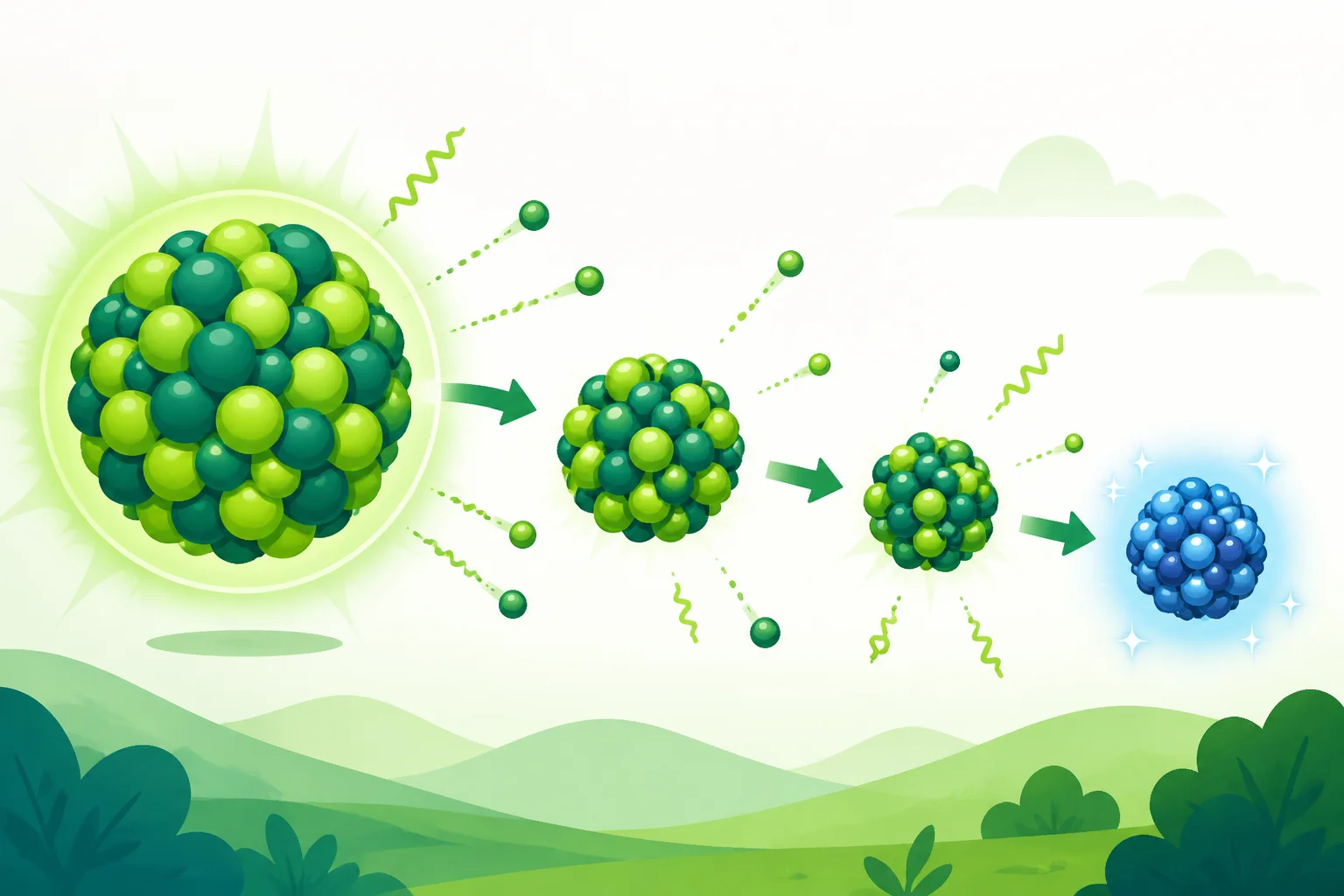
What happens to radium-226 as it decays toward a stable form?
Chemistry Around Us
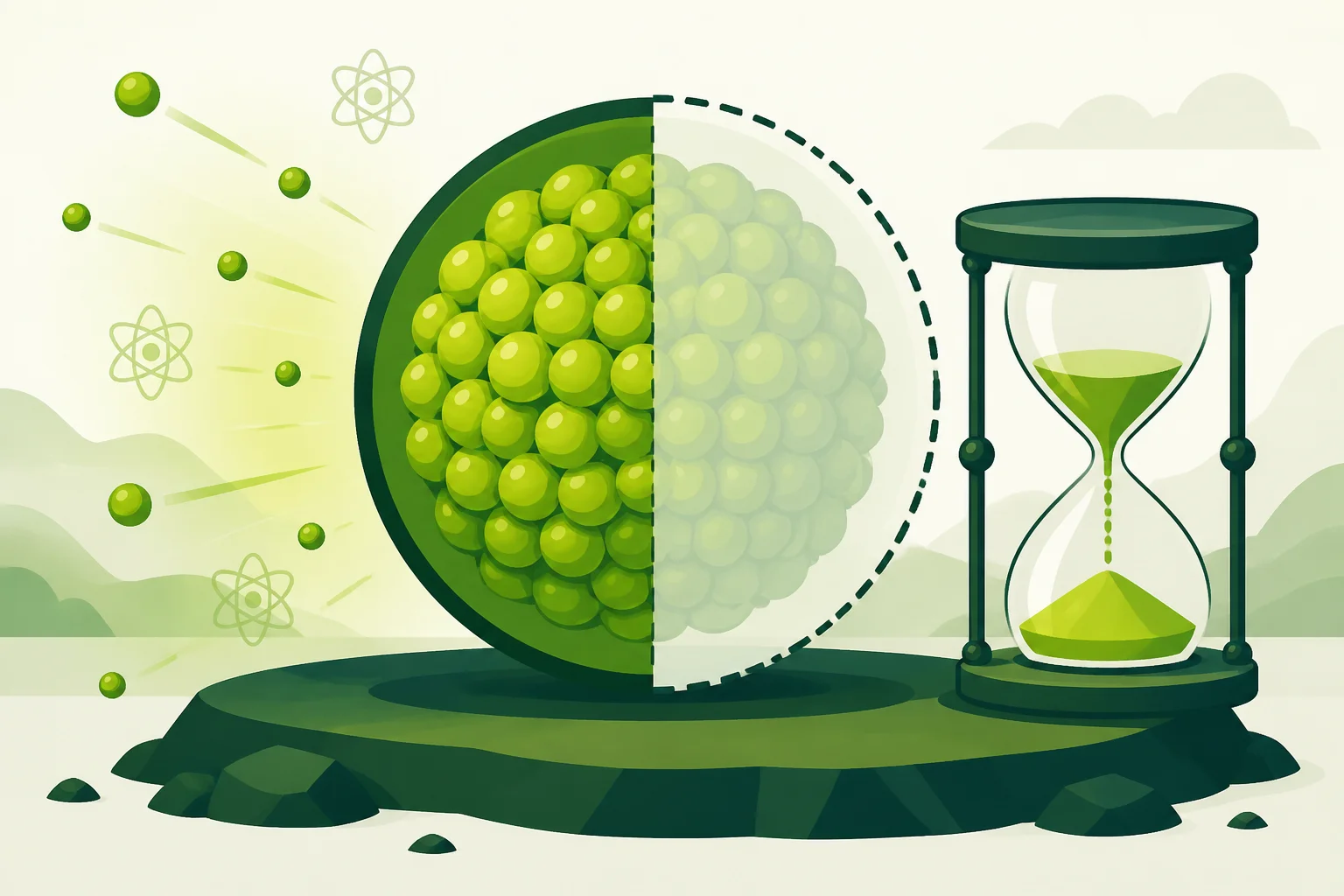
Radium-226 has a half-life of about 1,602 years. What does that number actually tell you about a sample of radium-226?
Physics in Daily Life
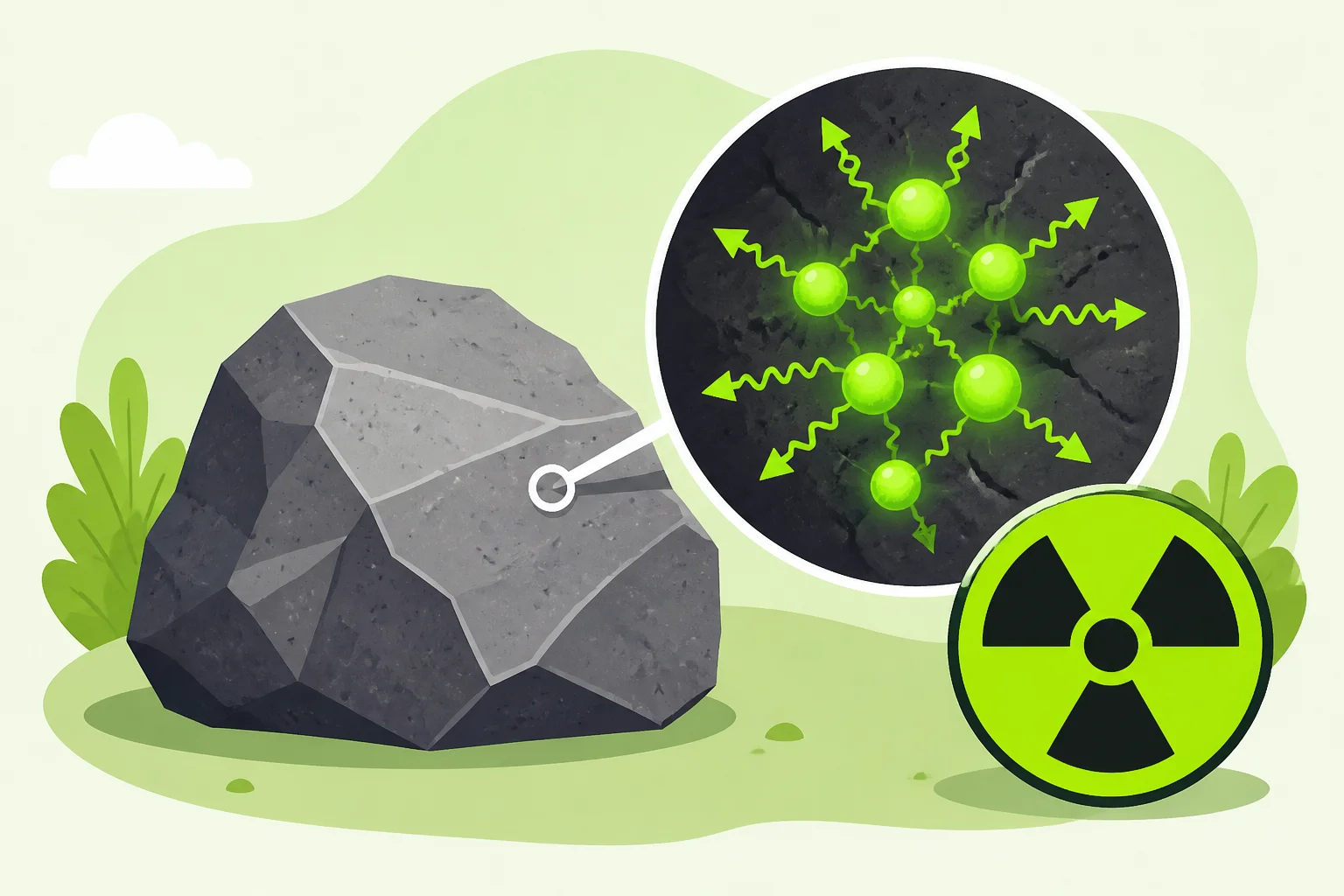
Why can a piece of radium-containing material look like an ordinary gray rock and still be radioactive?
Physics in Daily Life