Good science trivia should do more than check whether you remember a term. Each question below opens a small information gap, lets you make a prediction, and then gives the satisfying closure of why the answer works.
Easy
ASmooth surfaces reflect light rays in parallel directions
✓Correct — When light hits a smooth surface like a mirror, the microscopic flatness means all light rays bounce off at the same angle (angle of incidence equals angle of reflection). This 'specular reflection' preserves the image. Rough surfaces have tiny bumps and valleys that scatter light in random directions ('diffuse reflection'), destroying the image but making the surface visible from all angles.
BMirrors contain special chemicals that capture light
✗Not quite — Mirrors do not contain chemicals that 'capture' light. A typical mirror is simply glass with a thin aluminum or silver coating on the back. The reflection happens because of the smooth surface geometry, not chemical properties. Even polished metal or calm water can create clear reflections without special chemicals.
CRough surfaces absorb all the light that hits them
✗Not quite — Rough surfaces actually reflect most light - that is why you can see a white wall! The wall appears white because it reflects light in all directions (diffuse reflection). If it absorbed all light, it would appear black. The difference is not absorption versus reflection, but organized reflection (smooth) versus scattered reflection (rough).
Answer this question
AThe balloon becomes electrically charged and attracts the wall
✓Correct — When you rub the balloon on your hair, electrons transfer from your hair to the balloon, making it negatively charged. This charged balloon then attracts positive charges in the wall through a process called 'electrostatic induction', causing it to stick. This is the same force that makes your hair stand up or causes a spark when you touch a doorknob in winter.
BThe rubbing makes the balloon surface sticky and adhesive
✗Not quite — The rubbing does not make the balloon sticky or adhesive. If you touch the balloon after rubbing, you will notice it feels the same as before - smooth and rubbery, not sticky. The sticking to the wall is caused by electrical forces, not adhesive properties. You can test this by trying to stick an unrubbed balloon to the wall - it will not stick.
CThe balloon heats up and melts slightly to grip the wall
✗Not quite — The balloon does not heat up enough to melt or change its surface. Rubber balloons require very high temperatures (over 180 degrees Celsius) to melt, and rubbing generates only a tiny amount of heat. If melting were the reason, the balloon would feel hot to touch and would leave marks on the wall, which does not happen.
Answer this question
Medium
AIt predicts how air flows around the car to minimize drag
✓Correct — The Navier-Stokes equations describe fluid motion mathematically. Engineers use computer simulations to solve these equations and see how air flows over different car designs. This reveals areas of high drag, turbulent vortices, and pressure differences. By testing thousands of virtual shapes, they find designs that slip through air smoothly, reducing fuel consumption by up to 20% compared to boxy designs.
BIt calculates the car's weight distribution for better balance
✗Not quite — While weight distribution is important for car handling, it involves principles of mechanics and center of mass, not fluid dynamics. The Navier-Stokes equations specifically describe how fluids like air and water move and interact with surfaces. Weight calculations use Newton's laws of motion, not fluid flow equations.
CIt measures the engine temperature to prevent overheating
✗Not quite — Engine temperature management involves thermodynamics and heat transfer, not aerodynamics. While there are equations for heat flow, the Navier-Stokes equations specifically model fluid motion like air flowing around the car's exterior. Temperature sensors and cooling system designs use different physical principles than those governing aerodynamic efficiency.
Answer this question
AColor temperature adjustment soothes eyes
✗This is a common misconception. While colored tints can change color perception, the primary comfort from tinted glasses comes from reducing the overall brightness, not adjusting color temperature. Some tints like amber may improve contrast in specific conditions, but the main effect is still light reduction.
BReduced light transmission reduces glare
✓Correct — Tinted glasses absorb some of the incoming light, lowering the total light intensity that reaches the eyes. This reduces glare and the need for your pupils to constrict as much, making bright outdoor light feel much more comfortable. This is why even lightly tinted or polarized lenses can be effective.
CBlocking ultraviolet radiation protects eyes
✗Many people think UV protection is the key, but UV rays don't contribute significantly to brightness perception. While UV protection is crucial for long-term eye health, it does not affect how bright the light appears. In fact, clear glasses can block UV without reducing glare at all.
Answer this question
ADark fabric absorbs light energy and converts it to molecular vibrations (heat)
✓Correct — Dark surfaces absorb photons across most wavelengths instead of reflecting them. The absorbed electromagnetic energy causes molecules in the fabric to vibrate more rapidly. Since temperature is a measure of molecular motion, this increased vibration makes the material feel hot. White surfaces reflect most light, so less energy is available for conversion to heat.
BDark colors attract more sunlight rays like a magnet pulls metal
✗Not quite — Light does not have magnetic properties, and color cannot 'attract' more photons. The difference is that dark surfaces absorb photons that strike them, while light surfaces reflect those same photons away. Both receive equal amounts of sunlight, but dark materials keep the energy while white materials bounce it back.
CDark dye molecules generate their own heat when exposed to any light
✗Not quite — Dye molecules do not generate heat independently. They simply determine which wavelengths are absorbed versus reflected. When dark dyes absorb light photons, they transfer that incoming energy to the surrounding material structure. The heat comes from the absorbed sunlight, not from any internal chemical reaction in the dye itself.
Answer this question
AHoney's large sugar molecules and strong bonds create high viscosity
✓Correct — Honey contains large sugar molecules (like fructose and glucose) that form strong hydrogen bonds with each other. These intermolecular forces make the molecules resist sliding past one another, creating high viscosity. Water molecules are much smaller and have weaker bonds, allowing them to flow freely. This is why honey flows about 10,000 times slower than water at room temperature.
BHoney is heavier, so gravity pulls it down more slowly
✗Not quite — While honey is denser than water (about 1.4 times heavier), density does not determine flow speed. Gravity pulls on all liquids equally based on their mass. Mercury is much heavier than honey but flows quickly because it has low viscosity. The flow resistance comes from internal friction between molecules (viscosity), not weight.
CHoney has tiny air bubbles that block the flow
✗Not quite — Pure honey contains virtually no air bubbles - it is nearly 80% sugars dissolved in 20% water. Air bubbles would actually make a liquid flow slightly faster by reducing friction, not slower. Honey's slow flow is entirely due to viscosity from intermolecular forces, not trapped air. You can verify this by observing that clear, bubble-free honey still flows very slowly.
Answer this question
AMarching in step creates resonance that can amplify vibrations dangerously
✓Correct — When many people march in perfect rhythm, their footsteps create periodic forces at a specific frequency. If this frequency matches the bridge's natural resonant frequency, the oscillations amplify exponentially through resonance - like pushing a swing at just the right moment. The 1850 Angers Bridge collapse in France killed 226 soldiers due to this phenomenon, leading militaries worldwide to adopt the 'break step' rule when crossing bridges.
BThe combined weight is too heavy if they step together
✗Not quite — The total weight of soldiers is the same whether they march in step or not - weight does not change based on timing of footsteps. Modern bridges are designed to hold far more weight than a group of soldiers. The real danger comes from the rhythmic timing of forces, not the total force magnitude.
CSynchronized movement creates excessive wind resistance
✗Not quite — Wind resistance is negligible for human walking speeds and has nothing to do with bridge safety. The danger comes from mechanical resonance - when periodic forces match a structure's natural frequency. This is a vibration phenomenon, not an aerodynamic one. Even in still air with no wind, marching in step remains dangerous on certain bridges.
Answer this question
AThe escaping CO2 removes carbonic acid that balanced the sweetness
✓Correct — When CO2 dissolves in water, it forms carbonic acid (H2CO3), which gives soda a tangy, slightly sour taste. This acidity balances the high sugar content. When soda goes flat, CO2 escapes, removing this acid and making the drink taste cloyingly sweet. The fizzy sensation also stimulates nerve endings that make the drink feel more refreshing.
BSugar molecules break down and become sweeter over time
✗Not quite — Sugar molecules (sucrose) are actually quite stable in soda and do not break down or become sweeter over time. The amount of sugar remains constant whether the soda is fizzy or flat. What changes is our perception: without the tangy carbonic acid to balance it, the existing sugar tastes more prominent and overly sweet.
CThe bubbles physically block sugar from reaching taste buds
✗Not quite — Bubbles do not block taste buds from detecting sugar. In fact, the bubbles burst on your tongue and release CO2 gas. The popping sensation and carbonic acid they create actually enhance flavor perception by stimulating both taste receptors and touch receptors (the trigeminal nerve), making the drink taste more complex and less one-dimensionally sweet.
Answer this question
AVitamins break down in air
✗Not quite — While vitamins do degrade over time, that's not what causes browning. The brown color comes from enzymatic oxidation of phenolic compounds, not vitamin breakdown. Vitamin loss is a separate, slower process.
BEnzymes react with oxygen
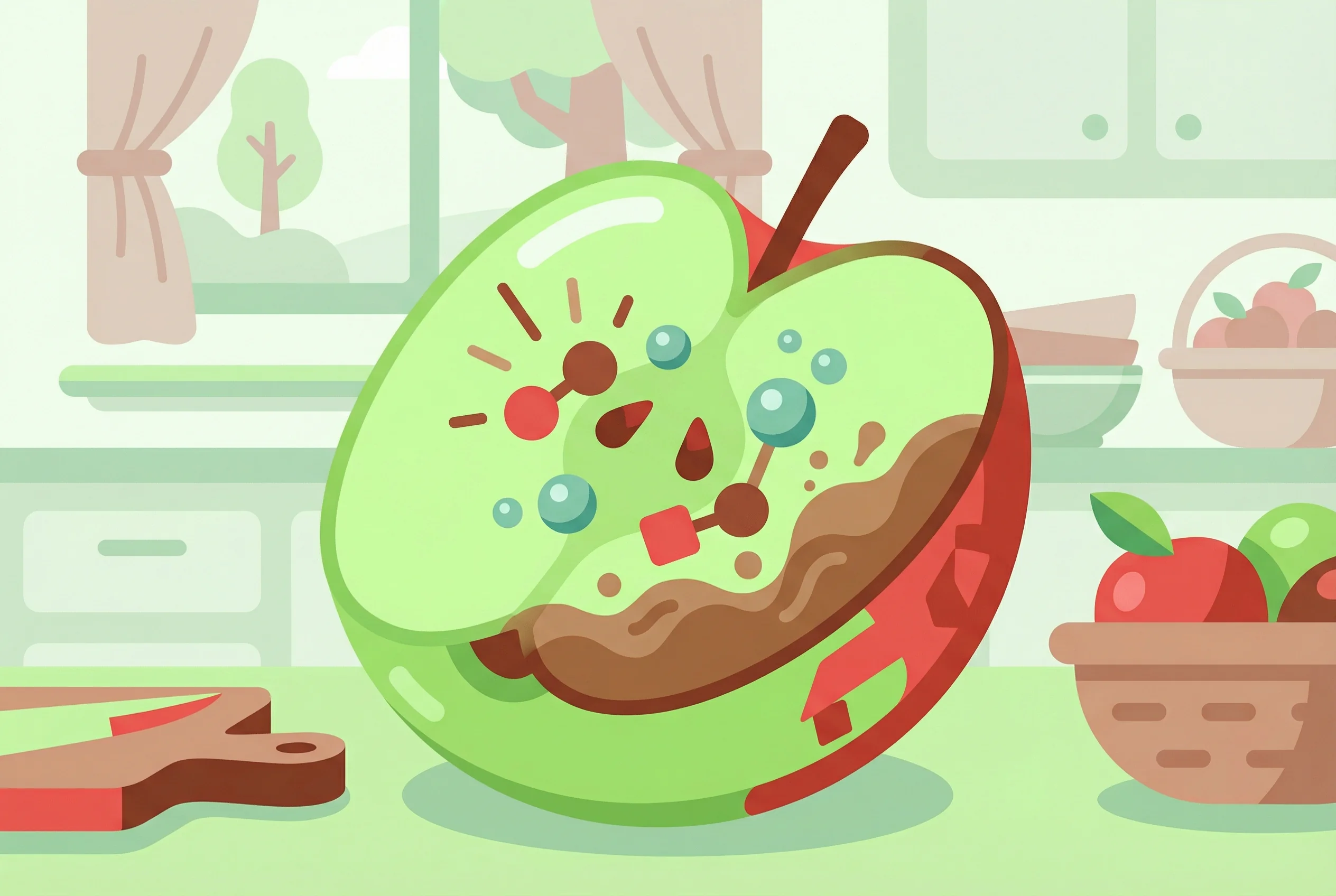
✓Correct — Apples contain enzymes called polyphenol oxidase and compounds called phenols. When you cut an apple, these enzymes mix with oxygen in the air and oxidize the phenols, creating brown melanin pigments. This is the same process that makes bruises brown! Lemon juice prevents this by lowering pH.
CCells die and decay
✗Not quite — While cells are damaged when cut, the browning is specifically from enzymatic oxidation, not decay. The process happens in minutes, far too fast to be decay. It's a chemical defense mechanism, not decomposition.
Answer this question
ASugar molecules are polar and bond with water molecules, sand is not
✓Correct — Sugar (sucrose) has many -OH groups making it polar. These form hydrogen bonds with polar water molecules, allowing sugar to dissolve. Sand (silicon dioxide) has a strong crystalline lattice that water's polarity cannot break apart, so it remains solid.
BSugar particles are smaller than sand grains so they fit between water
✗Not quite — Particle size is not the key factor. Even powdered sand won't dissolve in water. Dissolving depends on molecular attraction, not physical size. Large sugar crystals still dissolve because of chemical bonds with water.
CWater is sweet like sugar so they attract, but water and sand repel
✗Not quite — Water has no taste and dissolving has nothing to do with sweetness or flavor. It's about molecular structure and polarity. The 'like dissolves like' principle refers to polar substances dissolving polar substances, not similar tastes.
Answer this question
Hard
AIncrease signal strength
✗Not quite — More satellites don't strengthen signal. Multiple satellites are needed for trilateration—calculating distance from each to pinpoint your location.
BCover more geographic area
✗Not quite — Constellation coverage matters, but even in one area, your device needs signals from 4+ satellites simultaneously for 3D positioning.
CCalculate precise position
✓Correct — GPS uses trilateration. Each satellite transmits time-stamped signals. Your device calculates distance from signal travel time (light speed). 3 satellites determine 2D position (latitude, longitude), 4th adds altitude. More satellites improve accuracy. The GPS constellation has 24-32 satellites ensuring 4+ are always visible anywhere on Earth. Math requires multiple measurements!
Answer this question
AThey all undergo similar heat or aging reactions that create melanoidins
✓Correct — Coffee roasting, wine aging, and cheese maturation all involve Maillard reactions and oxidation processes. These chemical transformations break down proteins and sugars into complex brown compounds called melanoidins, which have antioxidant properties. This is why all three develop darker colors and richer flavors over time while gaining similar health-protective compounds.
BThey are all made from fermented plant seeds
✗Not quite — While wine involves grape fermentation, coffee beans are roasted (not fermented), and cheese comes from milk (not plant seeds). The similarity comes from chemical aging reactions, not their biological origins. Fermentation is just one type of aging process, but heat-based reactions like coffee roasting can create similar antioxidant compounds.
CThey all contain the same original antioxidants from milk proteins
✗Not quite — Cheese does contain milk proteins, but coffee and wine do not. The shared antioxidants (melanoidins) are not original ingredients but are created during processing. These compounds form when heat or time breaks down simpler molecules. The similarity is in the chemical transformation process, not in shared starting ingredients.
Answer this question
Want to play these for real?
Turn science questions like these into a 10-second daily curiosity habit. Make a guess, get the explanation, and leave knowing one more thing about how the world works.
Play live on AIgneous Million WhysFrequently Asked Questions
What makes good science trivia?
Good science trivia asks about mechanisms, not just labels. The best questions make you notice a gap, guess, and then understand the cause behind the answer.
Are these science trivia questions for adults?
Yes. The questions are short enough for anyone to try, but the explanations are written for curious adults who want the why behind the fact.
Can I use these science trivia questions for a quiz night?
Yes. Each card includes choices and an answer explanation, so you can use them as quick prompts and then read the reason after people guess.
Why does AIgneous Million Whys use trivia cards?
A trivia card is a small closure loop: predict, reveal, understand. That is the core MillionWhys rhythm, built around curiosity rather than exam practice.