
Does the Moon Have a Dark Side? Far Side Facts Explained
On this page· 10
The Moon doesn't have a permanently dark side. Its far side, the hemisphere we never see from Earth, is lit by the Sun exactly when the near side is in shadow, and the Moon turns once on its axis every 27.3 days, the same time it takes to complete one orbit.
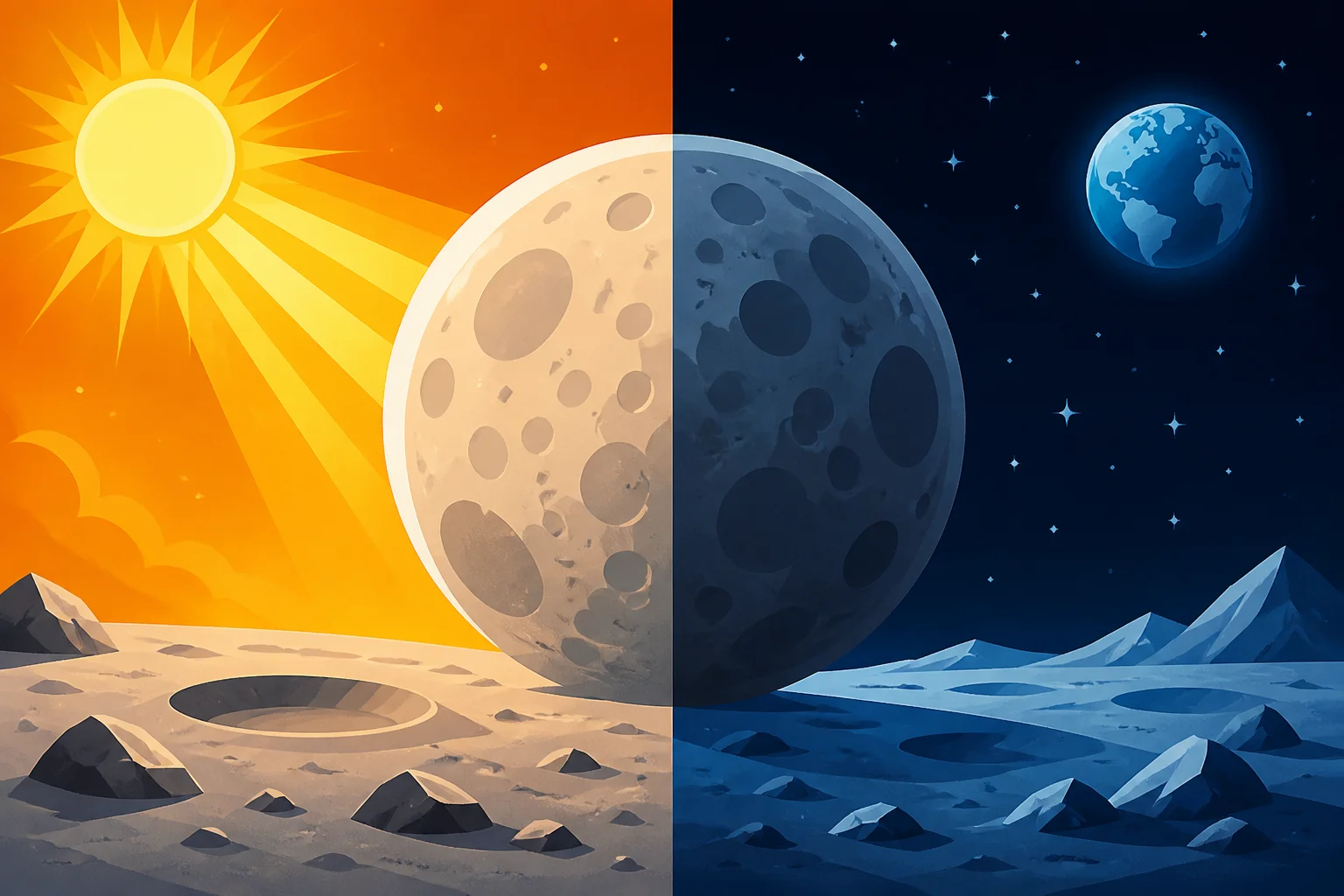
New Moon is the cleanest proof. On that night there's nothing to see from Earth, because the hemisphere pointed at us is in lunar night, while the hemisphere pointed away from us is in full daylight. The far side has been sunlit during every month of human history, including all the centuries when nobody on the planet had ever laid eyes on it.
Ask whether the Moon has a dark side and the honest answer is no, not permanently. The confusion isn't carelessness. English has used "dark" to mean hidden or unrecorded for a very long time, the way the Dark Ages describes a stretch of thin historical records rather than a stretch without sunshine. Separate hidden from unlit and the whole question opens up.
Why the Moon Has No Permanently Dark Side
Three different ideas get bundled into the phrase "dark side." There's the far side, the hemisphere that never faces Earth. There's the night side, whichever half is currently turned away from the Sun. And there's the near side, whose lit fraction changes with the phases. NASA's account of the Apollo 8 far side observations keeps them apart: the Moon is tidally locked, rotating once on its axis in the same time it takes to orbit Earth, about 27.3 days, and that lock does nothing to stop sunlight reaching the hidden hemisphere. Sunlight illuminates roughly half the lunar surface at any moment, except during an eclipse.
The Chair Walk That Explains Tidal Locking
Put a chair in the middle of a room. Keep your eyes on it and walk one full circle around it. You finish with your face on the chair the entire time, and yet you turned exactly once, and you passed through both the lamp-lit half of the room and the shadowed half.
That's the Moon's situation. One turn per lap keeps the same hemisphere pointed at Earth, while each hemisphere sweeps through sunlight and shadow on its own schedule.
The calendar has a wrinkle worth knowing. NASA's Watch the Skies explainer on traveling to the dark side notes that the 29.5-day stretch from one new Moon to the next runs longer than the 27.3-day orbit. Earth keeps moving along its own path around the Sun during that lap, so the Moon has to travel a little further to realign with the Sun and Earth geometry.
What Each Phase Means for Each Hemisphere
The phases describe how much of the near side is lit. They say nothing about whether the far side is lit, and that's where the popular picture goes wrong.
| Moon phase | Near side (faces Earth) | Far side (hidden from Earth) |
|---|---|---|
| New Moon | Mostly dark | Mostly sunlit |
| First quarter | About half lit | About half lit |
| Full Moon | Mostly sunlit | Mostly dark |
| Third quarter | About half lit | About half lit |
Read the rows as a mirror. At Full Moon the face we admire is brightly lit while the far side sits in lunar night. At New Moon the reverse is true, which is why spacecraft parked behind the Moon see brilliant illumination at the very moment we see nothing.
There's a second visibility wrinkle. The Moon wobbles slightly as it orbits, a motion called libration, so observers on Earth see around the edges over time. Roughly 59% of the lunar surface becomes visible from here eventually, leaving about 41% that no one on Earth can ever see directly, as NASA's tidal locking overview explains. That 41% is a visibility figure. It says nothing about whether those craters are in daylight.
Small vocabulary fix, big payoff. Say near side and far side. Keep night side in reserve for the half turned away from the Sun at this moment.
Question 1 of 5
Why can we only see one side of the Moon?
The Moon's Key Timings at a Glance
The Moon's spin, orbit, and phase cycle each measure a different motion. Keeping them separate makes the timing easier to follow.
- Rotation on its axis: about 27.3 days. The Moon completes one spin in about the same time it takes to orbit Earth. That synchronization is tidal locking.
- Orbit around Earth: about 27.3 days. The Moon completes one trip around Earth in this time, keeping roughly the same hemisphere facing us.
- Synodic month: about 29.5 days. This is the time from one New Moon to the next. It is longer than the orbital period because Earth moves around the Sun as the Moon orbits Earth.
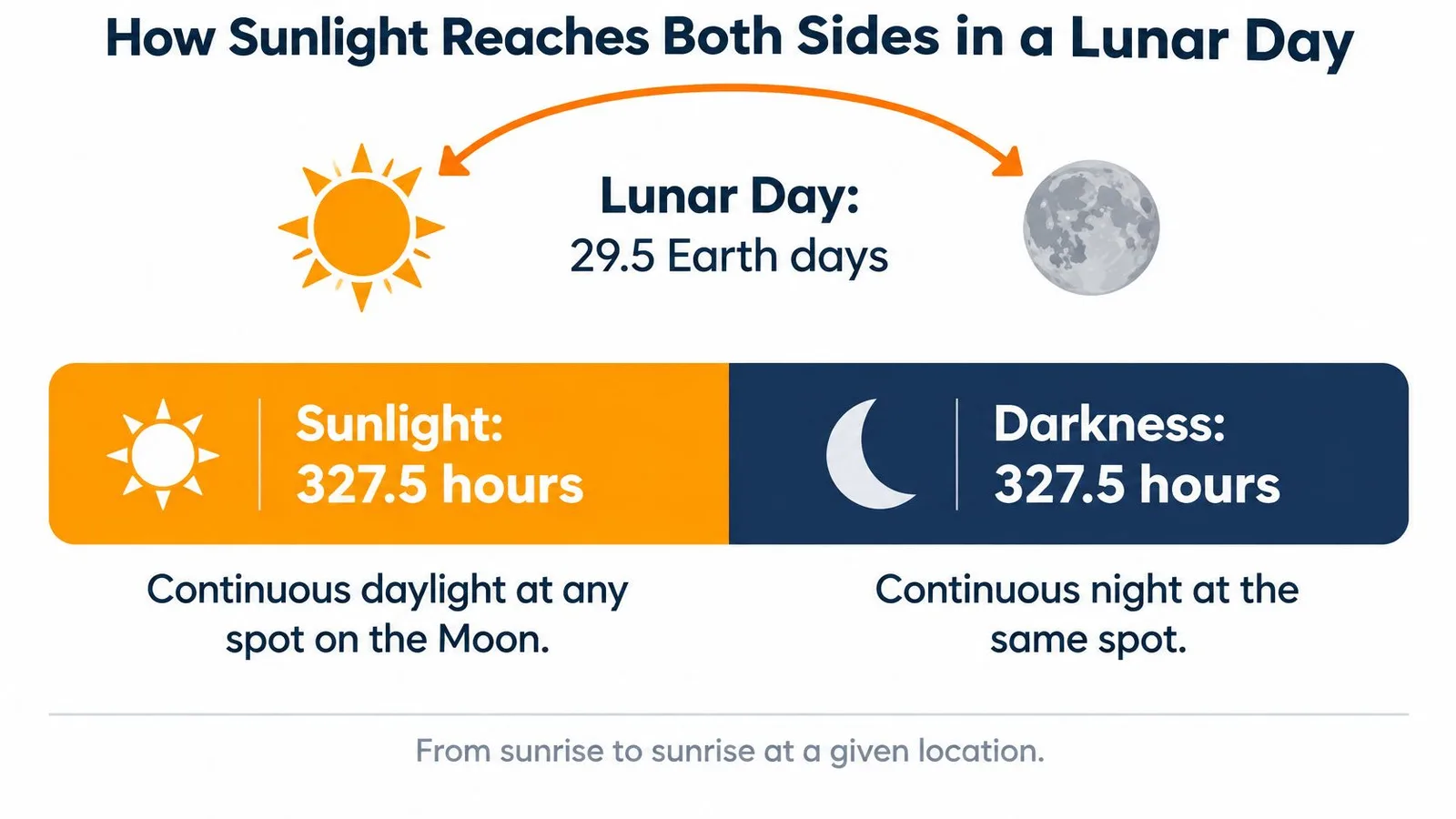
A fourth measure tracks daylight at a particular spot. From sunrise to sunrise, a lunar day-night cycle lasts about 29.5 Earth days. NASA's Glenn Research Center guide to the Moon describes the cycle as approximately 354 hours of sunlight followed by 354 hours of darkness. That split is approximate and can vary slightly by location, especially near the poles.
| Measure | Length | What it tracks |
|---|---|---|
| Rotation on its axis | About 27.3 days | One full spin, matching the orbital period |
| Orbit around Earth | About 27.3 days | One trip around Earth |
| Synodic month | About 29.5 days | New Moon to New Moon, longer because Earth moves around the Sun |
| Day-night cycle at one location | About 29.5 days | About 354 hours of sunlight, then about 354 hours of darkness; the split varies slightly by location |
A lunar day is long compared with an Earth day. The same basic idea appears in the effects of Earth stopping its spin: stretching a planet's day would also stretch the time each place spends in sunlight and darkness.
Question 2 of 5
Why does a single stretch of daylight at one spot on the Moon last about 354 hours?
What Apollo 8 Revealed About the Far Side
December 1968. Apollo 8 swung into lunar orbit, and when the spacecraft slipped behind the Moon its radio link to Earth cut out. Down in that blind spot, Frank Borman, James Lovell and William Anders became the first humans to look directly at the far side, as NASA's Apollo 8 mission record describes.
They flew about 96.6 kilometres (60 miles) above the surface, low enough to photograph terrain that robotic cameras had only caught from far greater distances. What they saw settled the vocabulary argument without a debate: portions of that hidden hemisphere were sunlit as the spacecraft passed over them.
If sunlight is falling on the far side while a crewed spacecraft flies across it, the hemisphere isn't dark. It's out of sight from home, which is a different property.
On 24 December 1968, during the mission's fourth lunar orbit, the crew photographed Earth rising above the lunar horizon. The Earthrise image became one of the most reproduced photographs of the century, and it fixed the geometry in the public mind: the far side is hidden from Earth, not from the Sun.
Lunar spacecraft have mapped the whole surface since. The far side turns out to be a distinct neighborhood, with extensive cratered terrain and far fewer of the broad dark basalt plains traditionally called maria. Scientists treat it as its own region rather than a shadowed twin of the face we know.
The lesson from that December is short. Hidden from Earth and dark are unrelated properties. One is geometry. The other is lighting, and it flips every month.
Question 3 of 5
Why were the Apollo 8 astronauts the first people to see the Moon's far side, even though robotic spacecraft had already photographed it?
How Sunlight Reaches Both Sides in a Lunar Day
A lunar day splits evenly, and it doesn't care which hemisphere you're standing on. Every spot on the Moon spends roughly half the cycle in continuous sunlight and half in continuous night, from one sunrise to the next across about 29.5 Earth days.
Here's the split as a single picture.
Why the Temperature Swings So Hard
The consequence shows up on a thermometer. With no substantial atmosphere and no oceans to move heat around, the lunar surface reaches about 127 °C (260 °F) in full sunlight and about −173 °C (−280 °F) in darkness, according to NASA's Moon facts page. Illumination sets the surface temperature at any given moment. Hemisphere has no vote.
That means a far-side crater at local noon is brutally hot, and a near-side crater at local midnight is cold enough to crack rock. The same numbers apply to both, in the same order, on the same timetable.
Light behaves just as evenly. Earth's air scatters short wavelengths and makes the Sun look yellow, a phenomenon explained in this piece on why the sun looks yellow. Lunar sunlight arrives with no air to filter it, so shadows on the Moon drop off sharply instead of fading gently.
So the far side's strange look isn't a lighting effect at all. Its rougher, crater-heavy surface traces back to geology, including a thicker crust that kept ancient basalt from flooding the terrain the way it did on the near side. The practical difficulty of working there comes from something else entirely.
Question 4 of 5
Why does the Moon's surface reach about 127 °C in sunlight but about -173 °C in darkness?
Why the Far Side Is Hard to Reach and Study
Landing on the far side isn't harder because it's dark. It's harder because Earth is physically in the way. Whenever a spacecraft sits behind the Moon, the lunar bulk blocks its radio link to ground stations, so missions either park a relay satellite where it can see both the far side and Earth, or fly trajectories that keep the spacecraft in view at critical moments.
Here's the distinction that clears up most of the confusion.
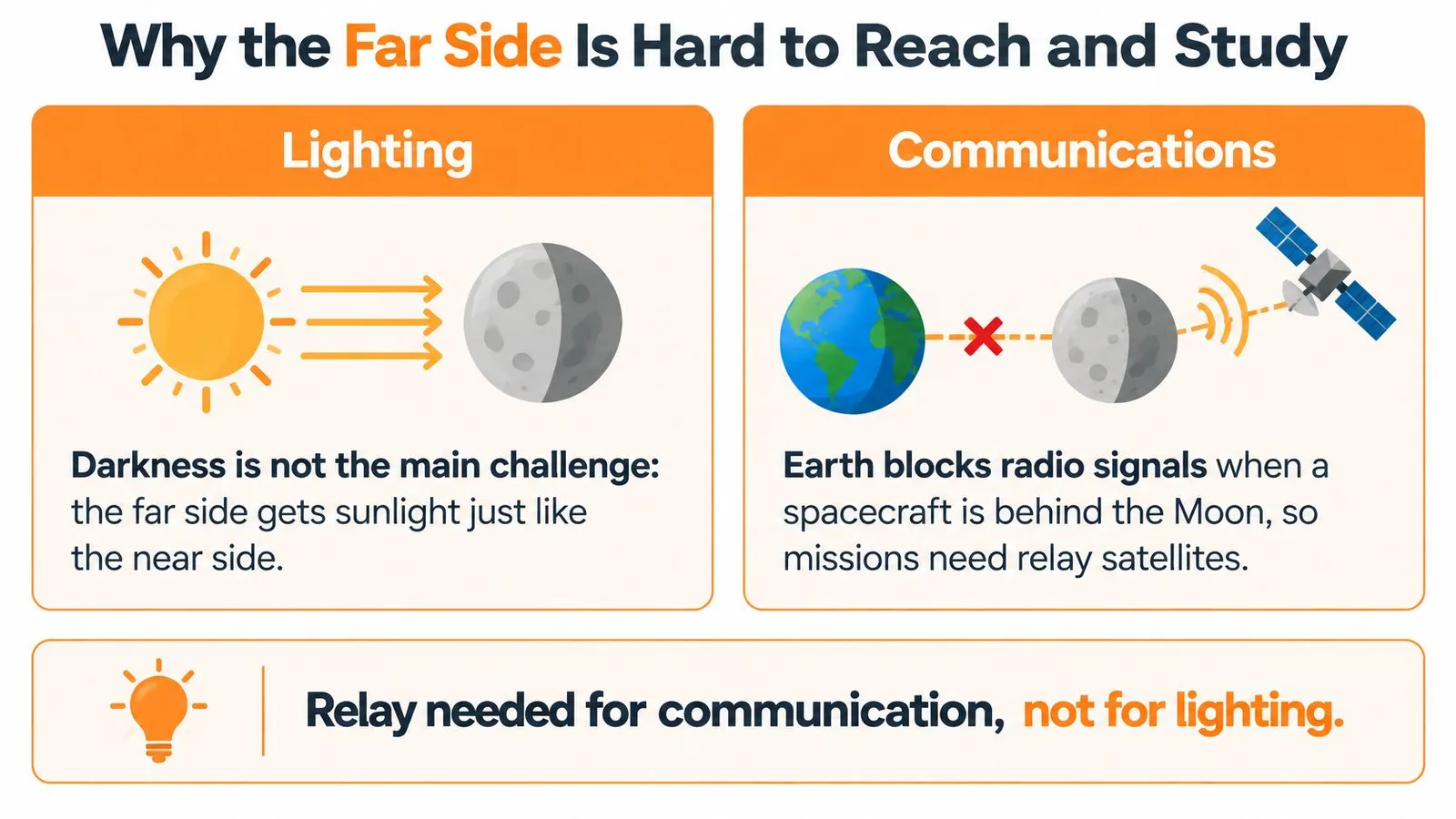
The far side has been mapped by orbiters, but it stays operationally difficult for exactly that reason, and the scale of current activity reflects it. NASA's lunar missions overview describes deliveries involving the far side and the lunar South Pole, with more than 50 instruments planned across 11 awarded commercial lunar deliveries.
The Advantage Hidden in the Blackout
The trade worth understanding: the same lunar bulk that blocks a radio link also blocks Earth's radio noise, which makes the far side the quietest listening post within reach for radio astronomy.
That shielding is why researchers want instruments there, to catch faint signals from the early universe without interference from every transmitter on Earth. The obstacle and the opportunity come from one geometry.
The challenges are practical rather than poetic. Direct contact with Earth is unavailable without a relay, the terrain offers more craters and fewer smooth plains to target, and the thicker crust that shaped the surface also shapes what instruments can sample.
Timing adds another layer. Rocket launches need a launch window tied to orbital geometry, and a far-side arrival carries the extra constraint of when a relay spacecraft can see both the lander and the ground station.
Ask the follow-up question that separates the two ideas: if sunlight reaches the far side, why is it harder to land there? Because darkness was never the obstacle. Earth's obstruction is.
Question 5 of 5
Why does a spacecraft lose direct signal behind the Moon?
Check the Lit Side Yourself Before the Next Full Moon
The next full Moon is a test you can run with your eyes. Inside one lunar month, three looks separate the hidden far side, the night side at that moment, and the Earth-facing side whose lighting changes with the phases.
- Find the date of the next New Moon. That night the Earth-facing side sits in darkness, so the Moon disappears from the sky. The far side is sunlit then, and still hidden behind the Moon's own body.
- Look again at First Quarter, about a week later. Half the visible disc is lit and half is dark. The boundary between them, the terminator, marks where lunar sunrise is crossing the near side right then.
- Check Full Moon about two weeks after New Moon. The near side is now the day side, fully lit. The far side is in the middle of its long night. That night ends on the next lunar day, when sunlight returns to that hemisphere.
Line those three nights up with the phase table. The lighting moves. The face pointed at Earth does not.
Check the phase before you check the weather. On a new Moon, a perfectly clear sky still gives you nothing to look at.
A still diagram leaves the motion flat. In 2024, NASA's Lunar Reconnaissance Orbiter team and Arizona State University released a 24-second visualization of a rotating Moon that compresses an entire lunar month and shows the far side alongside the near side. The lit half sweeps around the body while the same face keeps pointing at Earth.
If a compact version suits you better, Million Whys offers a daily 10-second why-question across science and everyday topics, with an explanation attached to every answer choice so a wrong guess still teaches you something.
One habit finishes the lesson. Every time the Moon is up, name which side is lit: the near side in daylight, the near side in night, or a slice of both along the terminator. Two or three nights of that, and tidal locking is a picture you can check, not a phrase you only remember.
Understanding the Moon is a habit built from small questions, not a single long read. Million Whys covers science, nature, history and everyday phenomena, so visit Million Whys and try its daily why-question.
Keep Exploring
Related Posts
Space Quiz Questions and Answers, Explained
Space quiz questions and answers on the planets, black holes and why space is dark and silent — guess why Venus runs hotter than Mercury, then see why.
10 Crazy Facts About the World, Explained by Science
Discover 10 crazy facts about the world, from honey that never spoils to lightning hotter than the Sun. Each one comes with a clear, science-backed explanation.
Fun Facts About the Earth: Why It Never Sits Still
Fun facts about the earth: why Earth bulges, moves plates, shifts its magnetic field, loses air, trades tides with the Moon, and stays hot inside.