Why is space pitch black when it is full of blazing stars? Why would an astronaut drifting past the station and a coin dropped off a cliff fall in exactly the same way? These space quiz questions and answers run from the planets next door to black holes and the far edge of physics — guess each one first, then tap to see why.
Space Trivia: The Planets and the Solar System
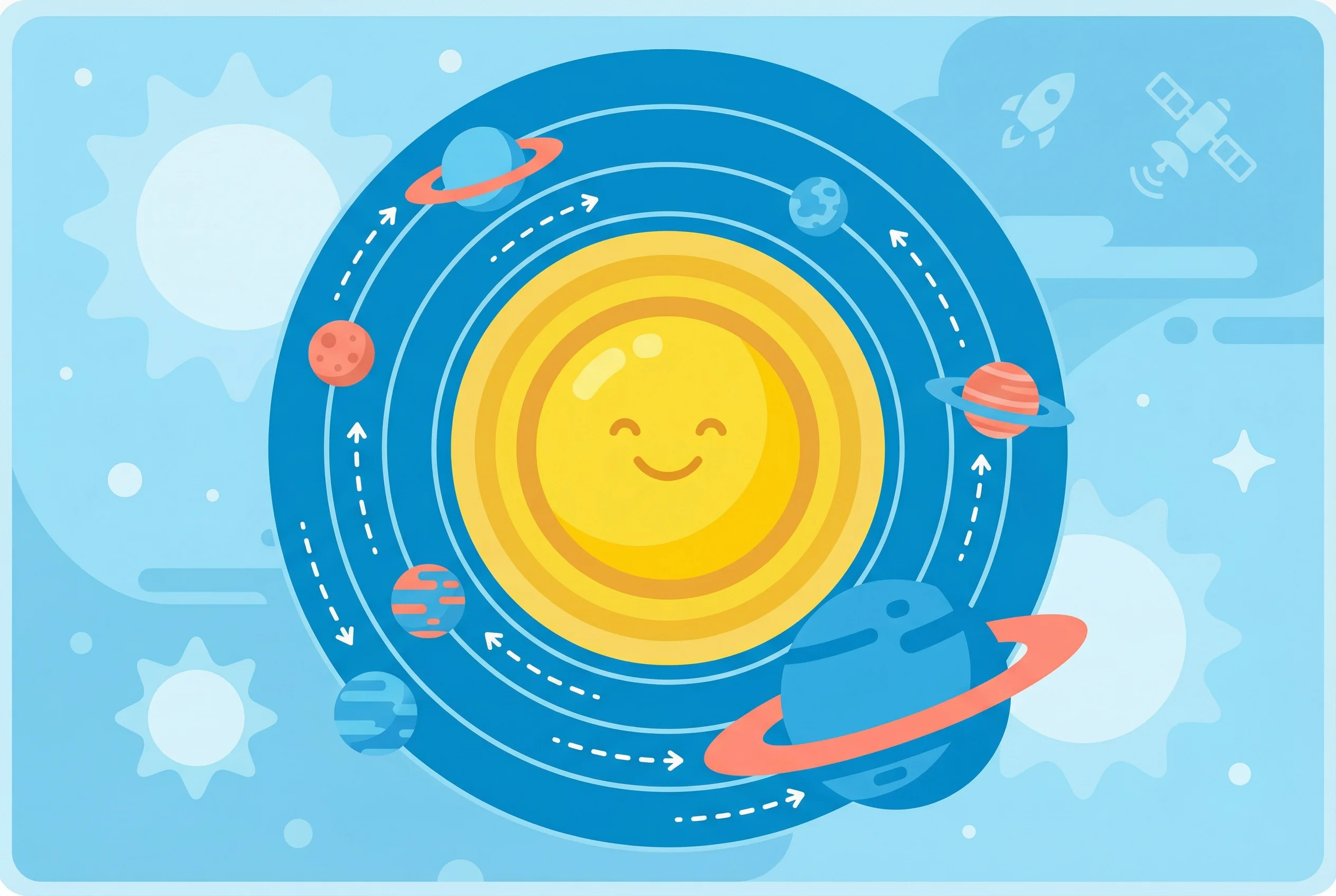
ASun's gravity pulls them
✓Correct! The Sun contains 99.8% of our solar system's mass, creating enormous gravitational pull. Planets would fly off in straight lines, but the Sun's gravity constantly pulls them inward. The result is a balance: the planet's forward motion combined with inward gravitational pull creates a curved orbit. The stronger the Sun's gravity and the closer the planet, the faster it must move to maintain orbit. This is why Mercury orbits in 88 days while Neptune takes 165 years.
BMagnetic forces attract them
✗Wrong. While the Sun and planets have magnetic fields, these forces are extremely weak compared to gravity. Magnetic forces affect charged particles and some spacecraft, but they don't control planetary orbits. Gravity is the dominant force keeping planets in orbit.
CSpace vacuum pulls them inward
✗Wrong. Vacuum doesn't pull or push anything—it's simply empty space. Planets orbit because the Sun's gravity attracts them, not because space itself exerts any force.
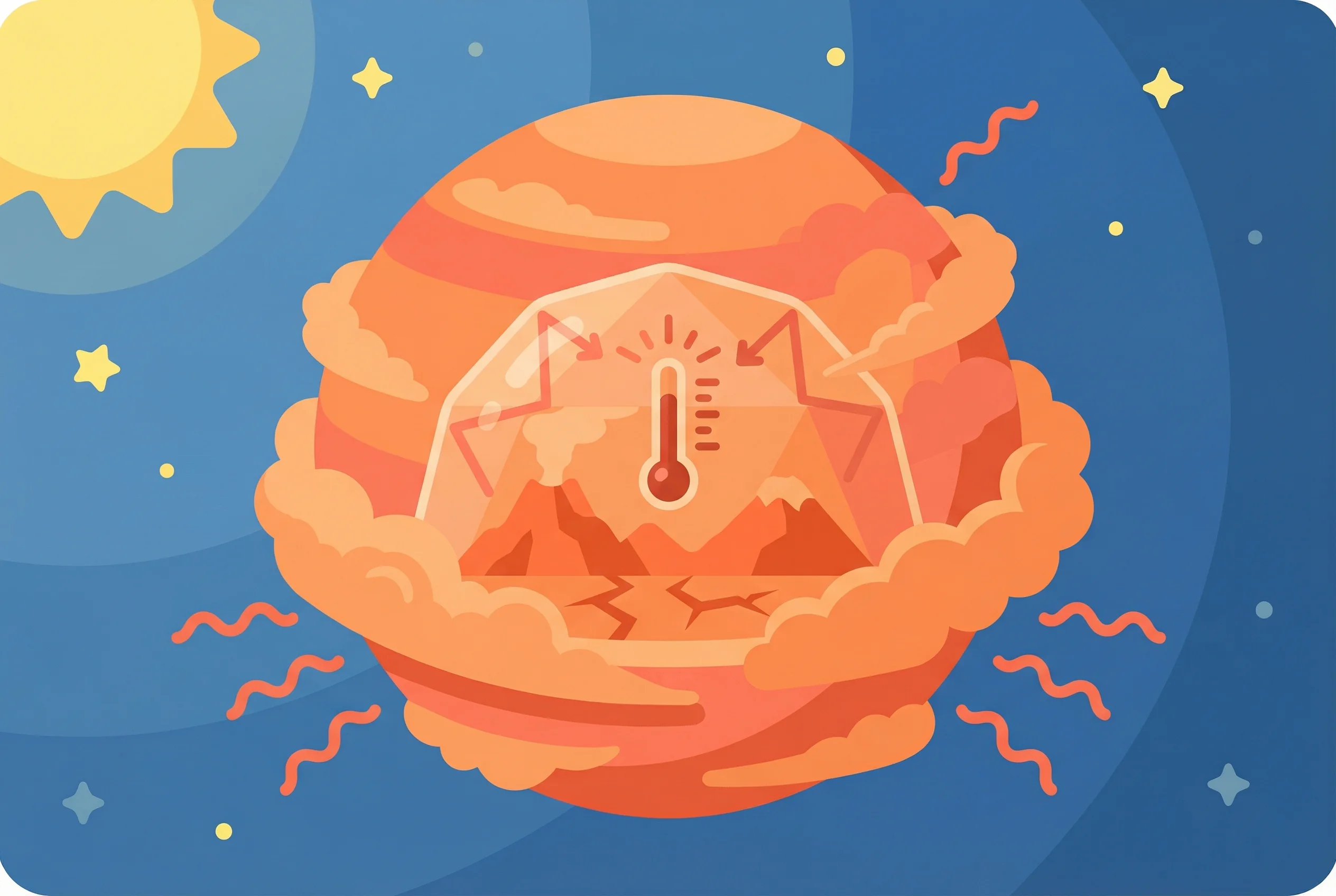
AThick CO₂ atmosphere traps heat
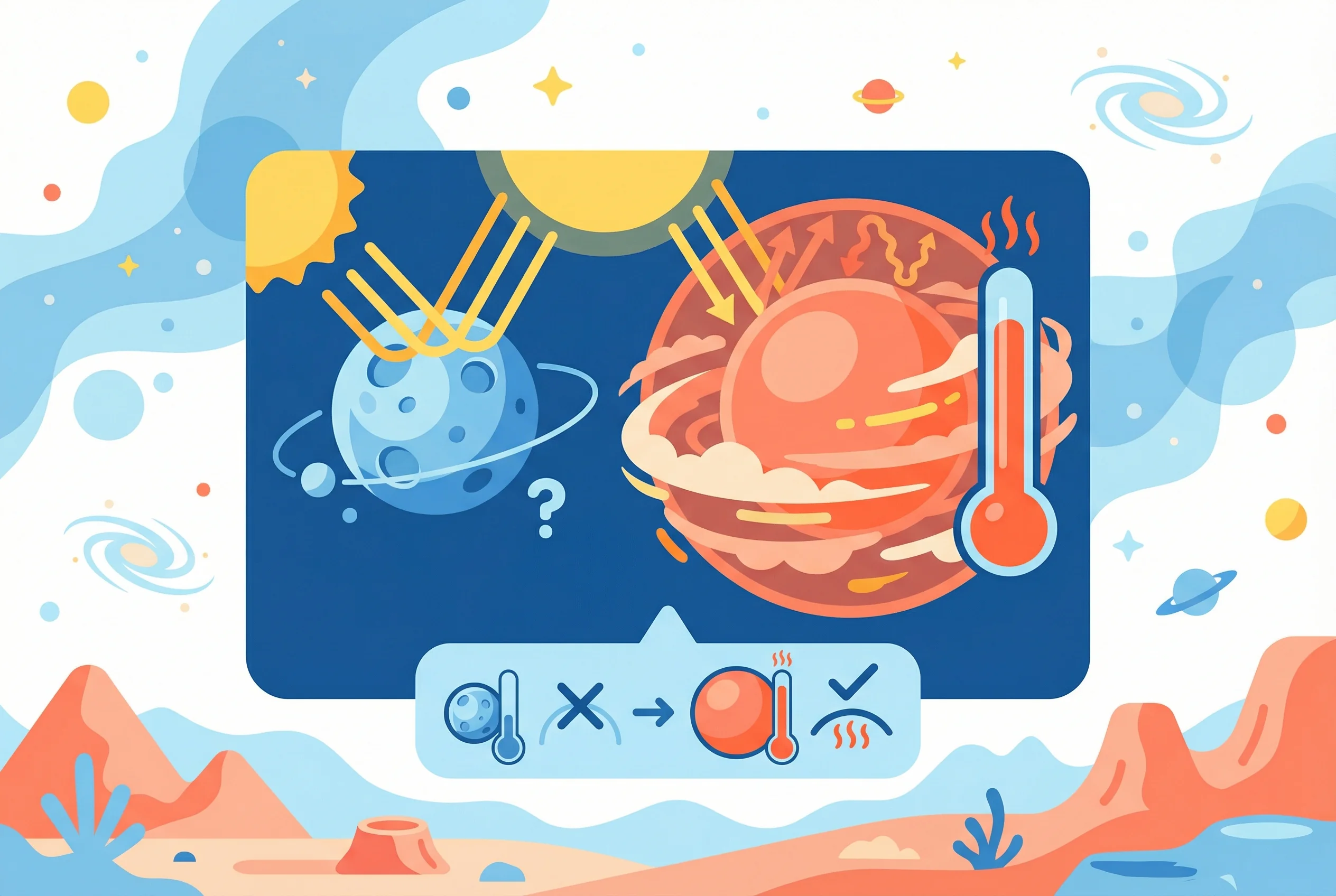
✓Correct! Venus has a runaway greenhouse effect. Its atmosphere is 96% carbon dioxide and 90 times thicker than Earth's - like being 900 meters underwater! Sunlight passes through but heat can't escape. This trapped heat raises surface temperature to 464°C (867°F) - hot enough to melt lead. The thick clouds of sulfuric acid reflect sunlight but also trap heat. Even though Mercury is closer to the Sun, Venus is hotter because of this extreme atmospheric insulation.
BVolcanoes heat the surface
✗Wrong. While Venus may have some volcanic activity, active volcanoes don't significantly contribute to its extreme surface temperature. The heat comes from solar energy trapped by the thick CO₂ atmosphere (greenhouse effect), not from internal volcanic heat.
CIts core is extremely hot
✗Wrong. All planets have hot cores, but core heat doesn't significantly warm the surface. Venus's extreme 464°C surface temperature is caused by its thick CO₂ atmosphere trapping solar heat (greenhouse effect), not by heat from its interior rising to the surface.
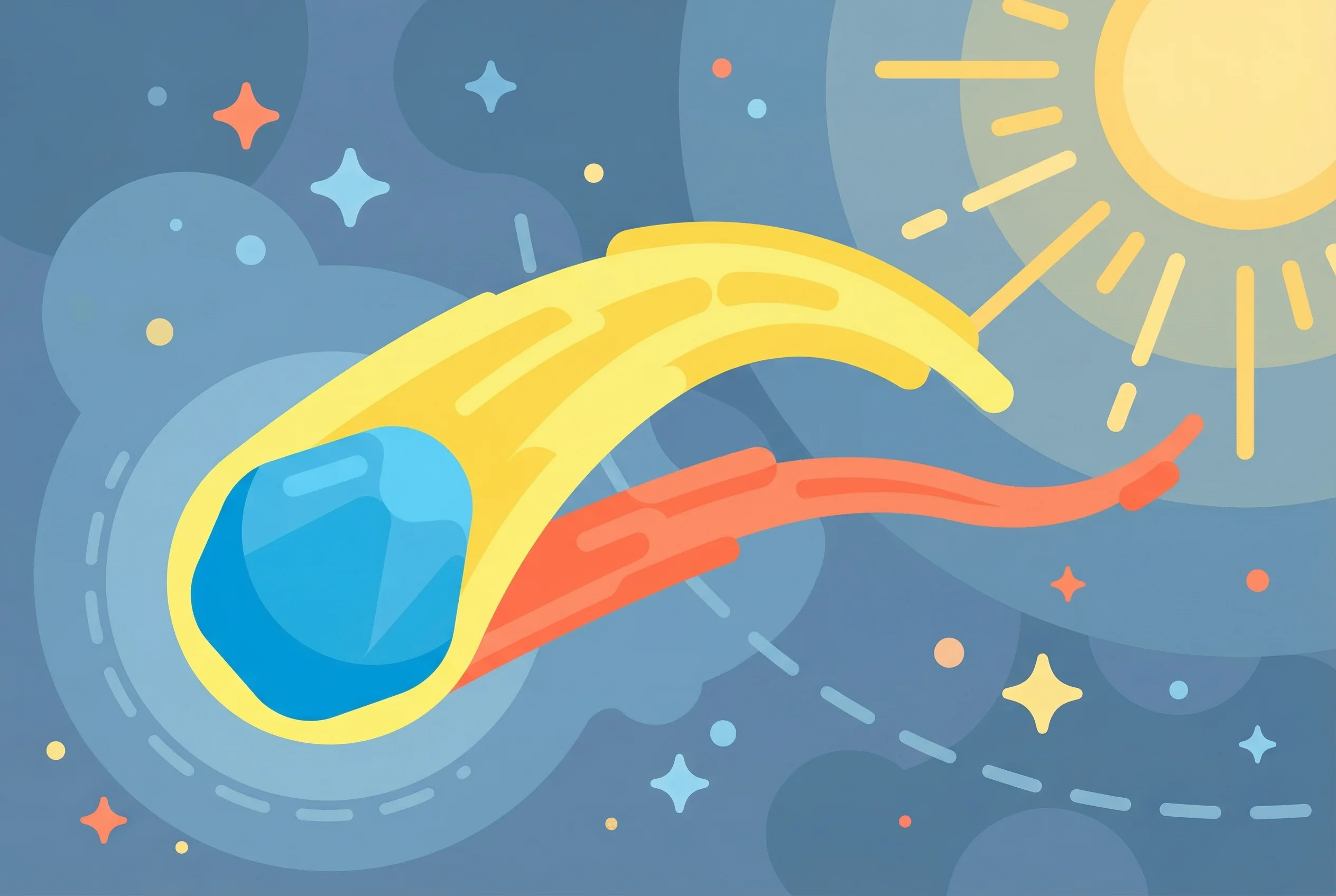
ASolar wind and heat create them
✓Correct! Comets are 'dirty snowballs' made of ice, dust, and rock. Far from the Sun, they're frozen and tailless. When they approach the Sun, solar heat vaporizes the ice, releasing gas and dust. Solar radiation pushes dust particles away, creating a yellowish dust tail. Solar wind (charged particles) blows gas away, creating a blue ion tail. Both tails always point away from the Sun, not behind the comet's motion. As the comet moves away from the Sun, it freezes again and the tail disappears.
BThey leave debris behind
✗Wrong. Comets do leave some debris along their orbits (causing meteor showers when Earth passes through), but this scattered debris isn't what we see as the comet's tail. The visible tail is gas and dust actively being blown away from the comet by solar wind and radiation, forming streams that point away from the Sun.
CGravity pulls material out
✗Wrong. Gravity doesn't pull material out to form tails - gravity would pull material inward, not outward. The tails form because solar radiation pressure and solar wind (stream of charged particles from the Sun) push gas and dust away from the comet, creating tails that point away from the Sun.
ALocation and size differences
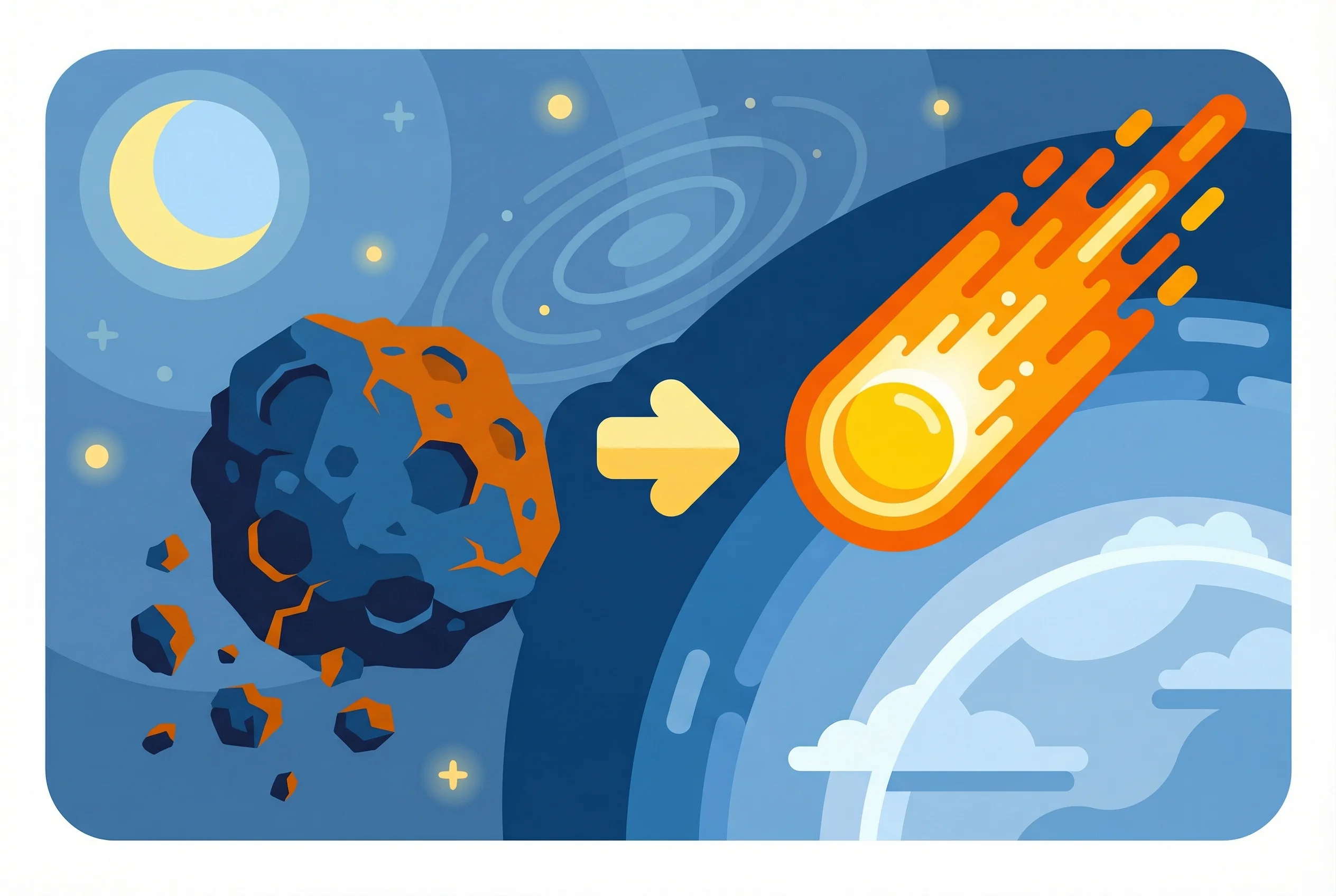
✓Correct! Asteroids are large rocky objects orbiting the Sun, mostly between Mars and Jupiter. Meteors are the light streaks when space debris burns in Earth's atmosphere. The same rock could be called different names depending on where it is!
BMeteors are hotter
✗Wrong. Meteors appear bright because they're burning up in our atmosphere, but that's a result of entry, not an inherent property.
CDifferent chemical composition
✗Wrong. Both can be made of similar materials (rock, metal, ice). The terms describe location and state, not chemical makeup. The same object could be an asteroid in space and a meteor when entering atmosphere.
ADestroyed moon or comet debris
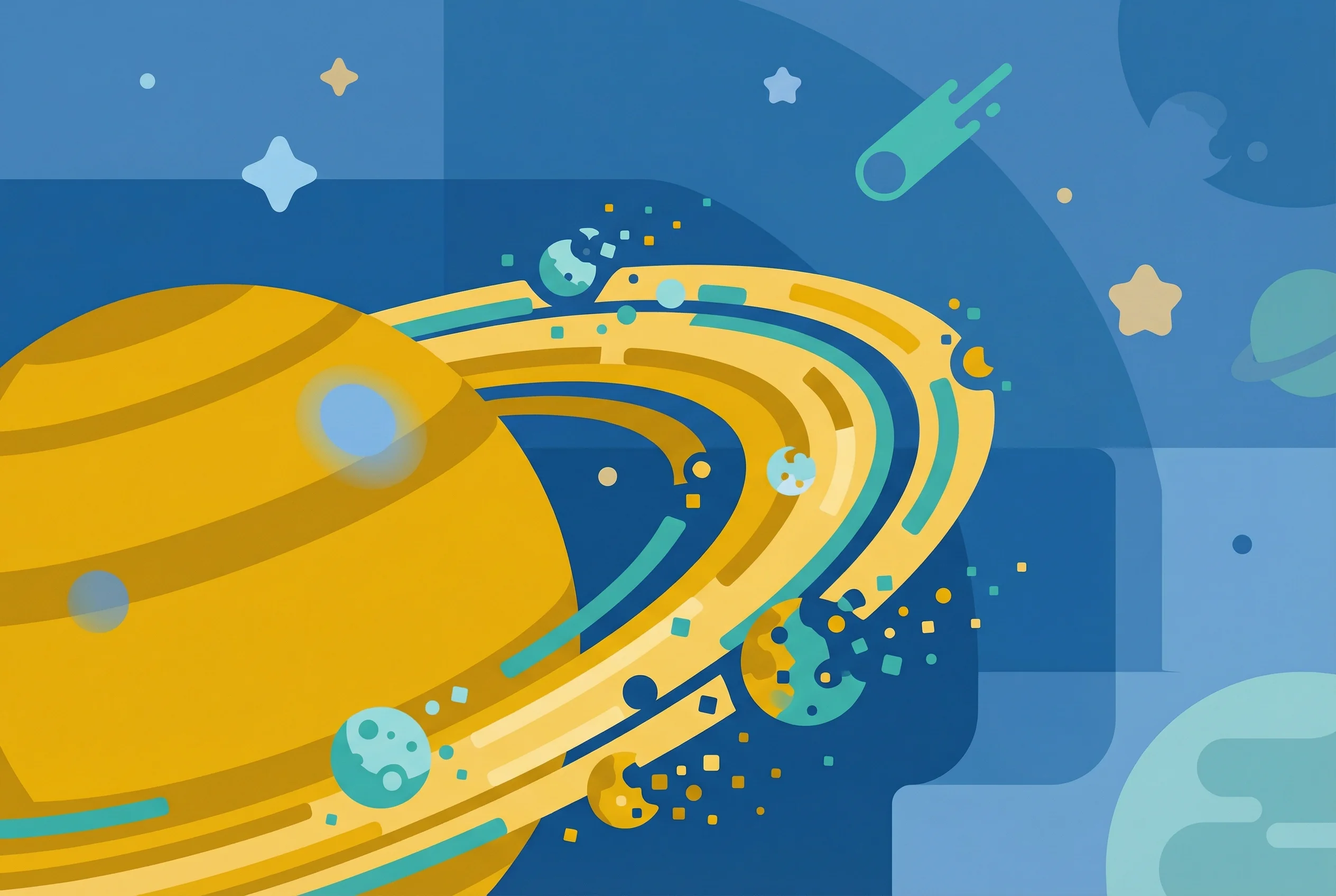
✓Correct! Saturn's rings likely formed when a moon or comet got too close and was torn apart by gravity. The rings are mostly ice particles, from tiny grains to house-sized chunks, all orbiting Saturn. They're surprisingly thin—only about 30 feet thick!
BSaturn spins extremely fast
✗Wrong. While Saturn does spin fast, rotation doesn't create rings. They're debris from destroyed objects.
CMagnetic field traps particles
✗Wrong. Magnetism doesn't hold the rings. Gravity keeps the particles in orbit around Saturn.
AEarth's wobble causes movement
✗Wrong. Earth's axial precession is too slow. Retrograde motion happens because Earth and planets orbit at different speeds—creating apparent backward loops.
BMagnetic fields push them
✗Wrong. Magnetic fields don't affect planetary motion. Retrograde motion is an optical illusion from Earth's faster orbit passing slower outer planets.
CRelative motion creates patterns
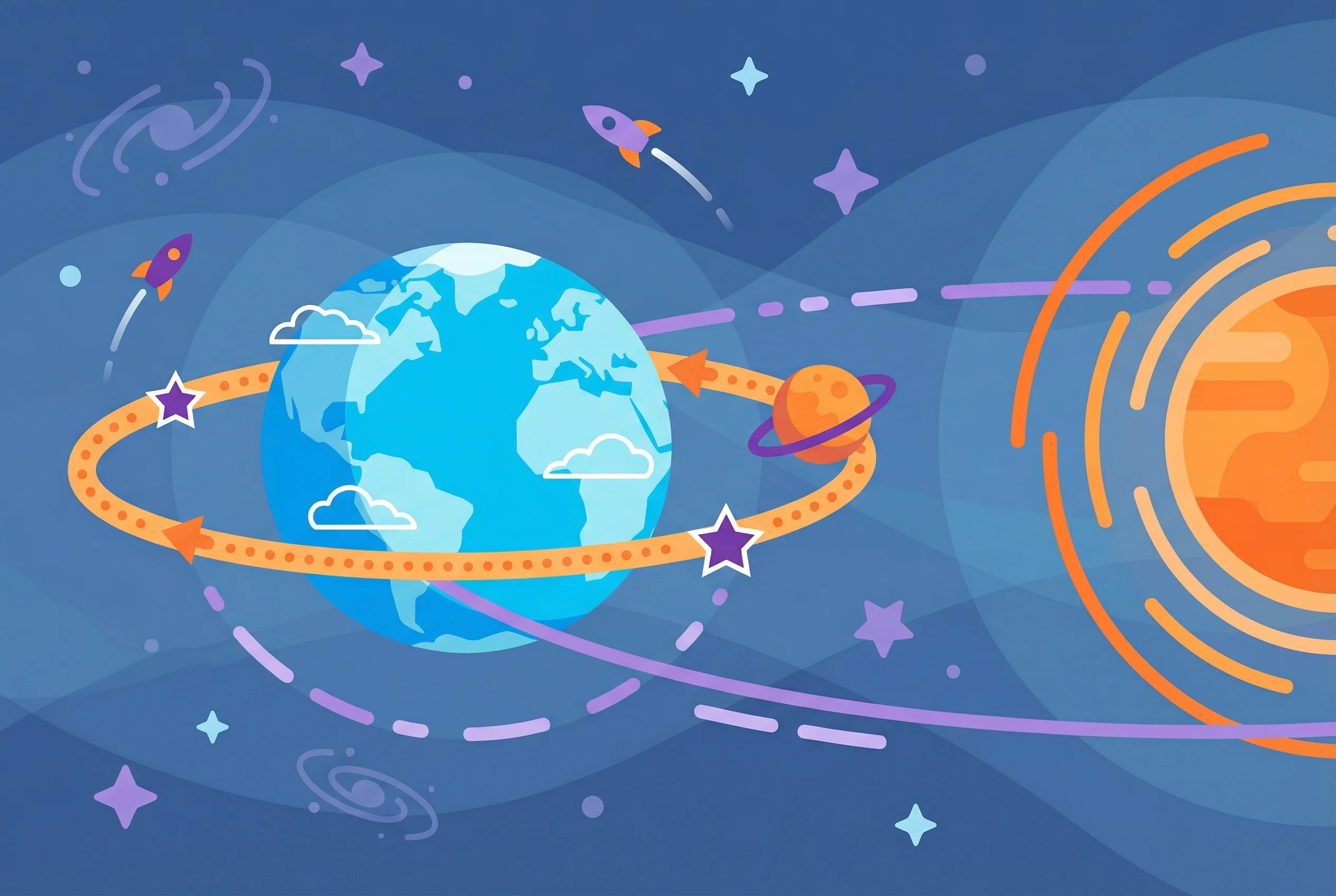
✓Correct! Ancient Greeks called them 'wanderers' (planetes). From Earth, planets usually move eastward against stars (prograde). But when Earth passes slower outer planets (or faster inner ones pass us), they appear to move backward (retrograde). It's like passing a slower car—it seems to move backward! Copernicus' heliocentric model explained this perfectly!
Quiz on Space: Stars, Black Holes and Why Space Is Dark
AWe are inside it
✓Correct! The Milky Way is our galaxy—we're inside it! The band of light we see is looking edge-on through the galactic disk (100,000 light-years across). We're in a spiral arm ~26,000 light-years from the center. Dense star concentrations appear as milky band across the night sky. Best viewed from dark locations away from light pollution. Ancient cultures saw it as celestial river!
BIt's brightest galaxy
✗Wrong. We see the Milky Way brightly because we're inside it—viewing our own galaxy from within. Other galaxies appear dimmer due to distance.
CReflects sunlight to Earth
✗Wrong. Galaxies don't reflect sunlight—they emit light from billions of stars. We see the Milky Way because we're part of it.
ANeutron stars rotate with beams
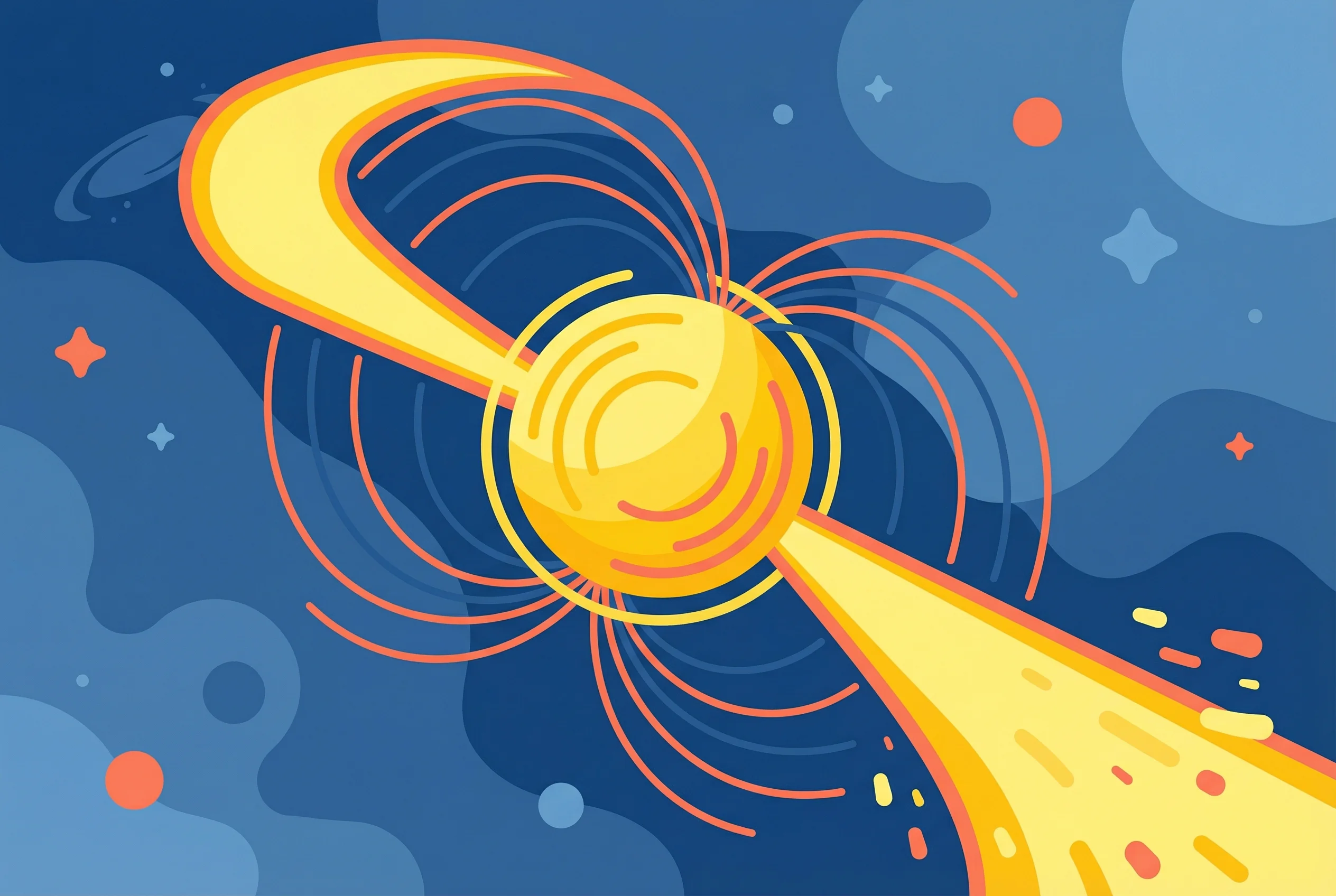
✓Correct! Pulsars are rapidly rotating neutron stars (collapsed star cores, ~20km diameter). They have powerful magnetic fields with radiation beams emitted from magnetic poles (not aligned with rotation axis). As the star rotates (milliseconds to seconds per rotation), beams sweep across space like lighthouse. When beam points at Earth, we detect a pulse. Incredibly precise—used for testing relativity, detecting gravitational waves!
BMagnetic fields oscillate naturally
✗Wrong. Magnetic fields are strong but don't oscillate to create pulses. Pulses come from rotation—beams sweep past Earth as neutron star spins.
CGravitational waves create pulses
✗Wrong. Gravitational waves don't cause pulses (though pulsars help detect them!). Pulses result from rotating neutron star's beamed radiation sweeping past Earth.
AStars are too far apart
✓Correct! Although there are billions of stars, they're incredibly far apart. Space is about 99.9999999999999% empty vacuum. Light from stars spreads out in all directions, getting dimmer with distance. Most light from distant stars is too faint to see. Also, the universe has a finite age (13.8 billion years), so light from the most distant stars hasn't reached us yet. The vast emptiness between stars makes space appear dark.
BThere aren't enough stars
✗Wrong. There are hundreds of billions of stars just in our galaxy alone, and billions of galaxies in the observable universe. The number of stars is enormous. The darkness comes from their vast separation and the finite age of the universe, not insufficient quantity.
CDark matter blocks light
✗Wrong. Dark matter doesn't block or absorb light - it doesn't interact with light at all, which is why it's called 'dark.' Dark matter only interacts through gravity. The darkness of space is due to the vast distances between stars and limited observable universe.
ANuclear fuel depletes
✓Correct! Stars shine through nuclear fusion—hydrogen fusing to helium in cores. Eventually fuel exhausts. Low-mass stars (like sun): become red giants, shed outer layers (planetary nebulae), leave white dwarf cores. Massive stars (>8 solar masses): fuse heavier elements up to iron, then collapse explosively—supernovae—leaving neutron stars or black holes. Stellar death depends on mass!
BSpace friction slows them
✗Wrong. Space is nearly a vacuum—no friction. Stars die when nuclear fuel exhausts and can't support themselves against gravity.
CBlack holes consume them
✗Wrong. Some stars are consumed by black holes, but most die from fuel depletion—becoming white dwarfs, neutron stars, or black holes.
AThey absorb light energy
✗Wrong. Black holes don't absorb light like dark paint. The mechanism involves gravity and spacetime.
BGravity bends space too much
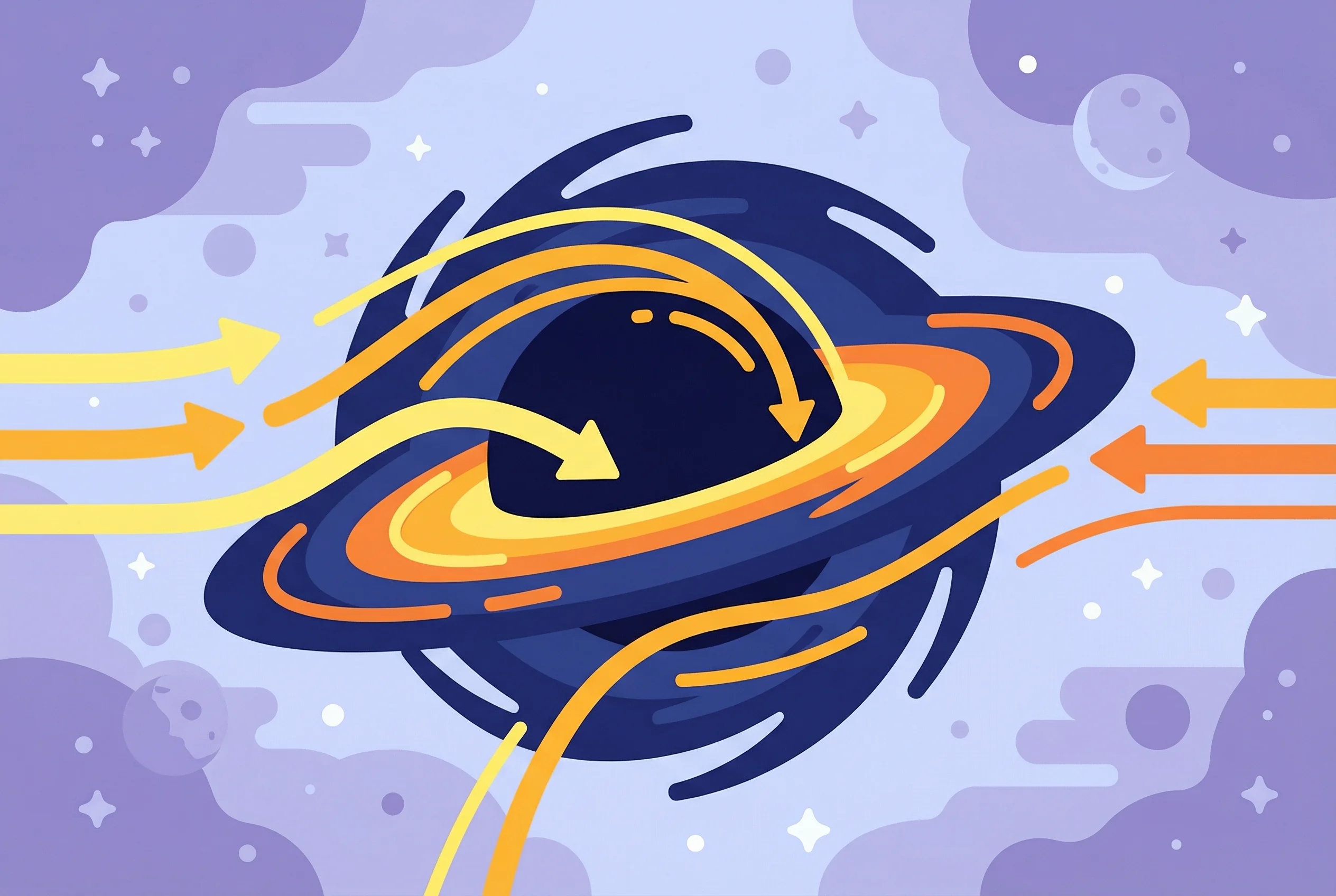
✓Correct! Black holes have such extreme gravity that they curve spacetime completely around themselves. Light follows the curved space and can't escape. The boundary where this happens is called the event horizon—nothing can return from beyond it!
CBlack holes are very dark
✗Wrong. Being dark is the result, not the cause. Light can't escape because of extreme gravitational spacetime curvature.
ASpace is too cold for sound
✗Wrong. Temperature doesn't prevent sound. The Arctic is cold but sounds travel fine there.
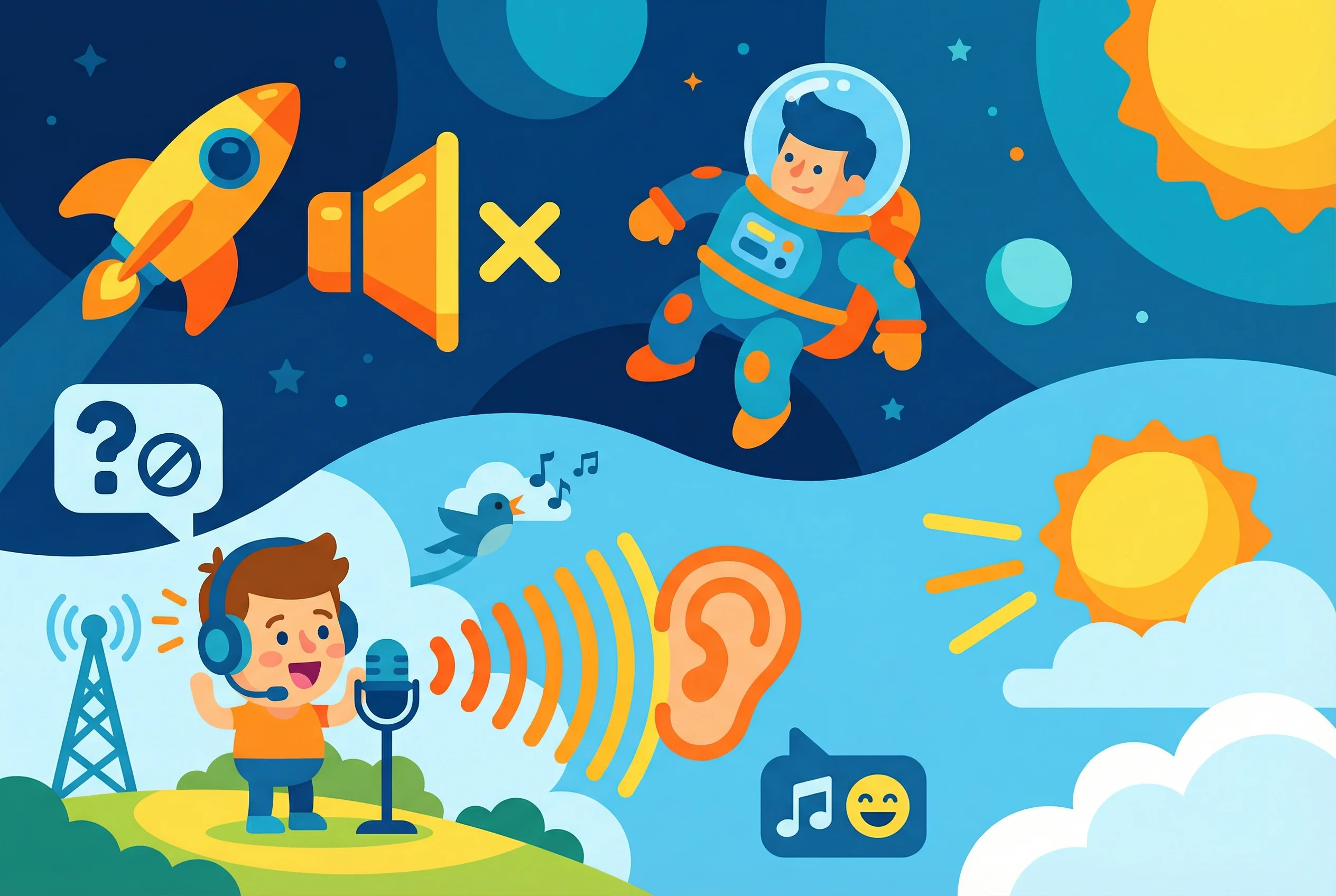
BNo air molecules to vibrate
✓Correct! Sound waves need molecules to vibrate and carry the wave. Space is a near-perfect vacuum with almost no molecules. Explosions in space are silent! Astronauts communicate by radio waves, which don't need air.
CHelmets block all sound
✗Wrong. Helmets don't block sound—astronauts can hear inside suits. The issue is no air outside to carry sound.
Interesting Facts About Earth, the Moon and the Seasons
AEarth's axis is tilted
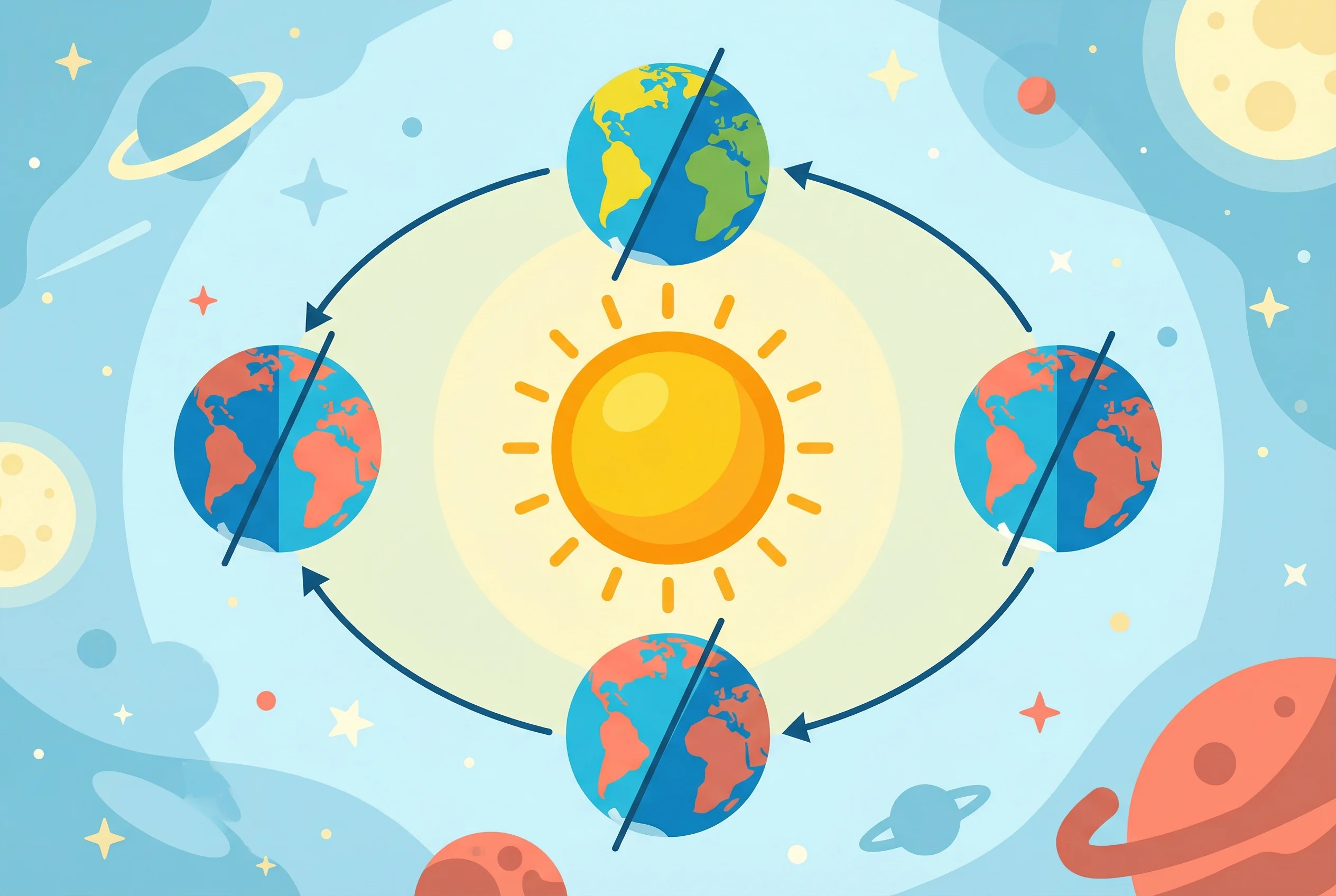
✓Correct! Earth's axis is tilted 23.5° from vertical. As Earth orbits the Sun, this tilt means the Northern Hemisphere points toward the Sun in June (summer there) and away in December (winter). When tilted toward the Sun, that hemisphere gets more direct sunlight and longer days, creating summer. The opposite hemisphere experiences winter. This tilt causes seasons.
BThe Sun's heat output changes
✗Wrong. The Sun's energy output is remarkably constant over short timescales like years. Small variations (about 0.1%) follow an 11-year solar cycle, but this doesn't cause our annual seasons.
CEarth's speed varies in orbit
✗Wrong. Earth's orbital speed doesn't cause seasons—Earth moves at nearly constant speed throughout its orbit. The 23.5° axial tilt is responsible for the dramatic seasonal temperature and daylight changes we experience.
AEarth rotates 365 times yearly
✗Wrong. Earth actually rotates about 366 times during one orbit of the Sun, not 365. We count 365 days because a 'day' is based on the Sun's position in the sky, which is affected by Earth's orbit as well as rotation.
BTime for Earth to orbit the Sun
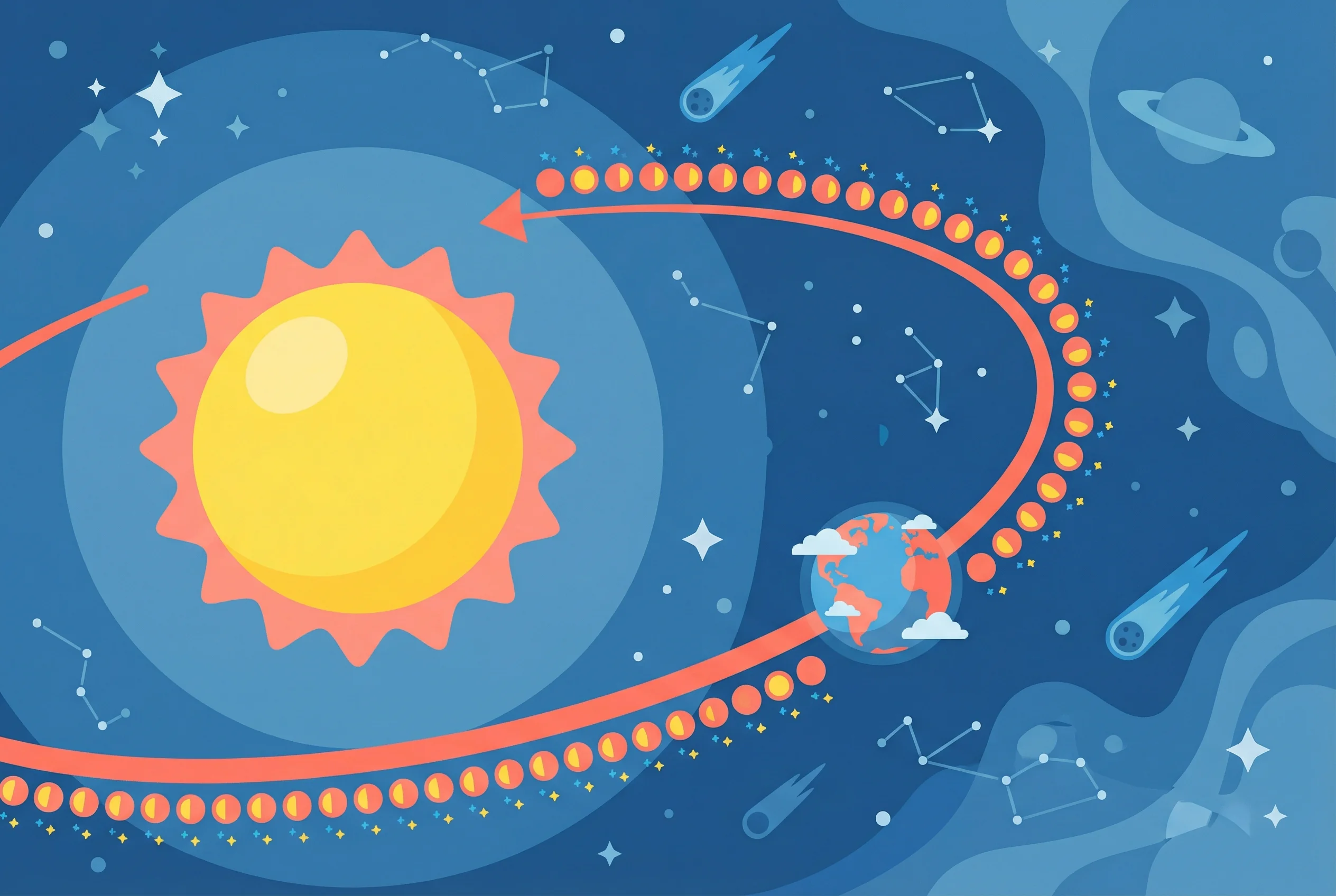
✓Correct! A year is defined by how long Earth takes to complete one full orbit around the Sun - approximately 365.25 days. This is determined by Earth's orbital distance (93 million miles) and speed (67,000 mph). We round to 365 days for convenience, adding a leap day every 4 years to account for the extra 0.25 days. This orbital period is a natural astronomical fact, not a human invention.
CThe Moon's cycle determines it
✗Wrong. The Moon's cycle (29.5 days) doesn't determine Earth's year. Some ancient calendars were lunar-based, but Earth's year is determined by its orbit around the Sun. The Moon's orbit around Earth and Earth's orbit around the Sun are independent cycles.
AMoon blocks or enters shadow
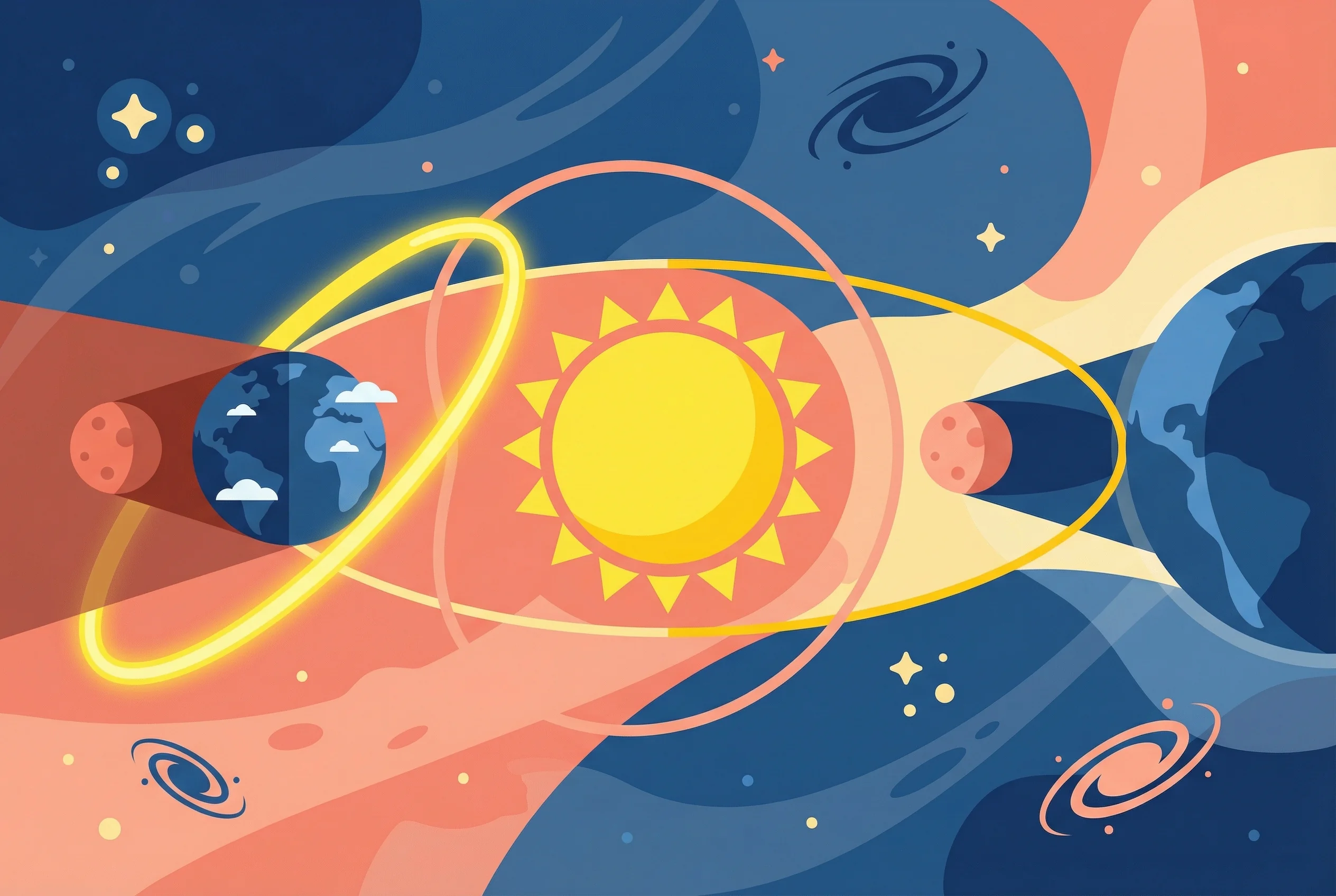
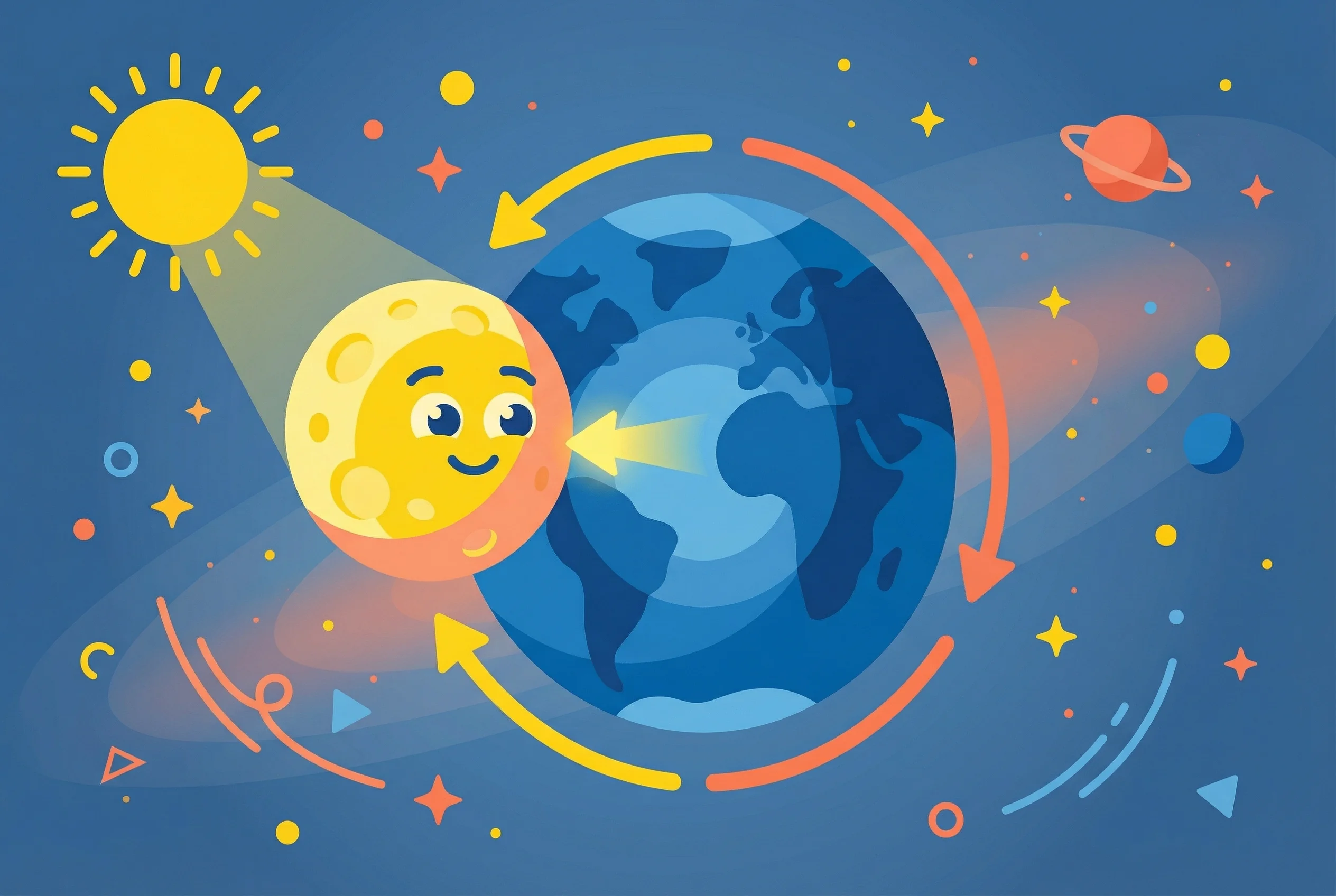
✓Correct! Solar eclipse: Moon passes between Sun and Earth, blocking sunlight and casting a shadow on Earth. This only happens at new moon when all three align. Lunar eclipse: Earth passes between Sun and Moon, and Earth's shadow falls on the Moon. This only happens at full moon. We don't get eclipses every month because the Moon's orbit is tilted 5° to Earth's orbit, so alignment is rare.
BSun's light dims periodically
✗Wrong. The Sun's brightness is remarkably constant. It doesn't dim on a predictable schedule. Eclipses are caused by the Moon blocking the Sun's light (solar eclipse) or Earth's shadow falling on the Moon (lunar eclipse), not by changes in the Sun itself.
CEarth's rotation causes them
✗Wrong. Earth's rotation causes day and night but doesn't cause eclipses. Eclipses require the Sun, Moon, and Earth to align in specific ways during the Moon's orbit around Earth. This alignment only happens occasionally, not daily as rotation would suggest.
AMoon's light heats the water
✗Wrong. Moonlight is just reflected sunlight and is very weak - it doesn't heat the ocean significantly. Temperature changes don't cause the regular twice-daily tides we observe. The tides are caused by gravitational forces, not thermal effects.
BMoon's gravity pulls the water
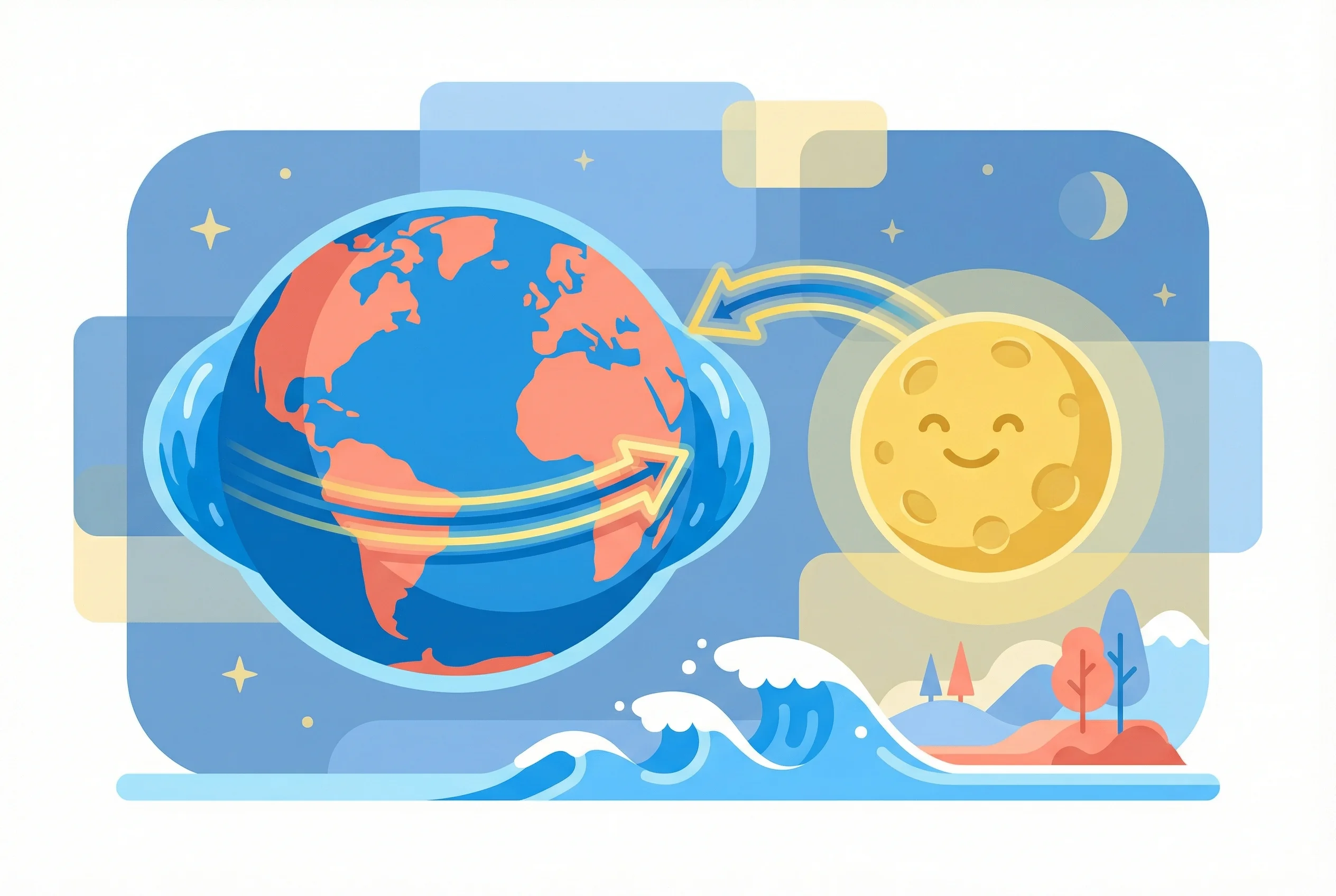
✓Correct! The Moon's gravity pulls on Earth's oceans. The side of Earth facing the Moon experiences stronger pull, creating a bulge of water (high tide). Surprisingly, the opposite side also gets high tide because Earth itself is pulled more than that distant water, leaving it 'behind' in a bulge. As Earth rotates, locations pass through these bulges, experiencing two high tides daily (every 12.4 hours). The Sun also affects tides but less strongly due to greater distance.
CMoon's magnetism attracts water
✗Wrong. The Moon has no significant magnetic field, and water isn't magnetically attracted anyway. Tides are caused by gravitational pull, not magnetism.
AEarth's shadow covers parts
✗Wrong. Earth's shadow creates lunar eclipses, not phases. Phases occur because we see different portions of the sun-lit half as the moon orbits Earth.
BSun lights different moon sides
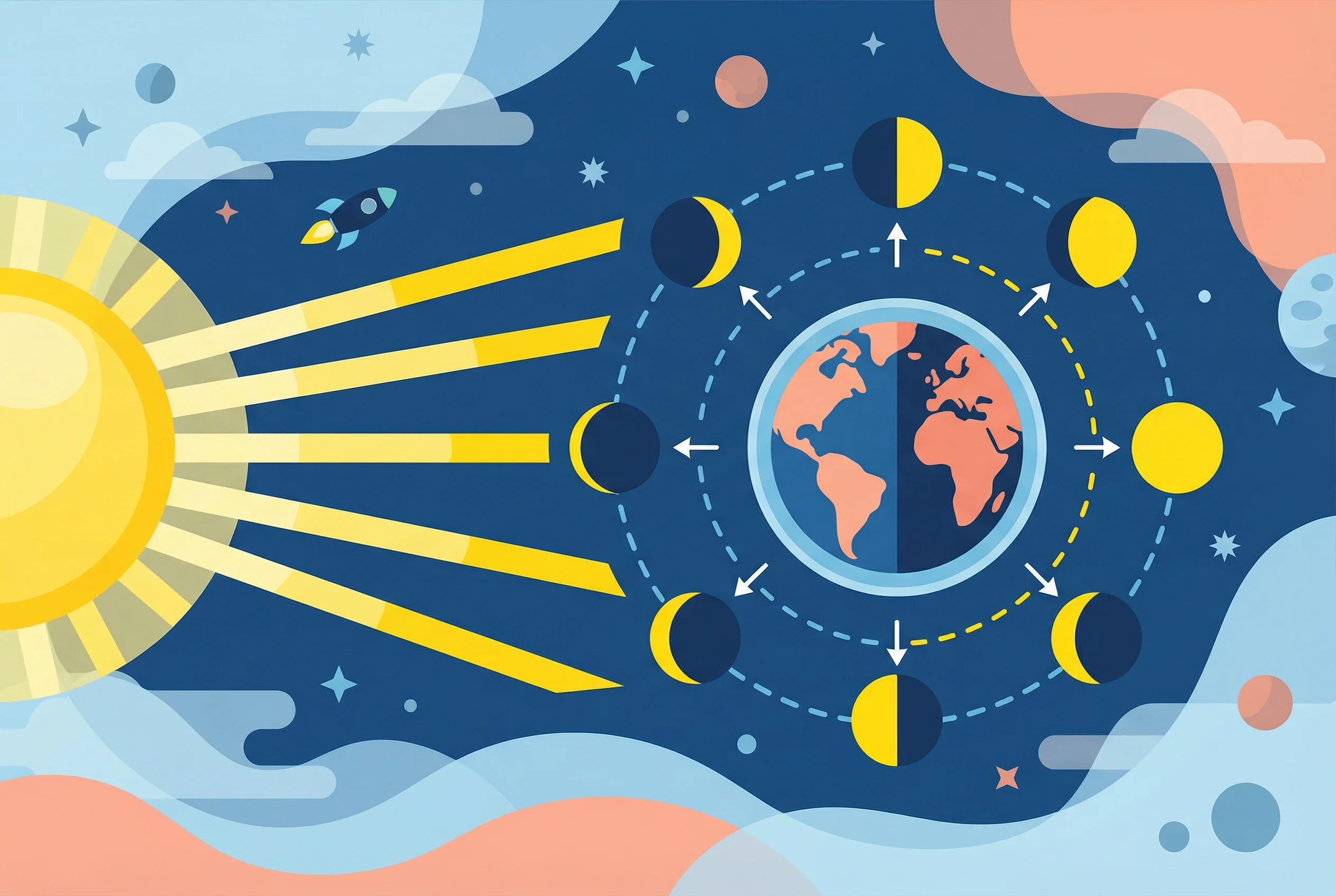
✓Correct! The moon doesn't produce light—it reflects sunlight. As the moon orbits Earth (~29.5 days), the angle between sun, moon, and Earth changes. We see varying amounts of the lit half: new moon (dark), crescent, first quarter (half), gibbous, full moon (fully lit), and back. Phases result from changing viewing angles!
CAtmosphere distorts moonlight
✗Wrong. Atmosphere doesn't create phases. Phases occur because the moon orbits Earth, changing how much of its sun-lit surface we see.
AMoon doesn't rotate at all
✗Wrong. The moon does rotate—once per orbit (~27.3 days). We see the same face because its rotation period equals its orbital period (tidal locking).
BTidal locking synchronizes rotation
✓Correct! Tidal locking (synchronous rotation) means the moon's rotation period equals its orbital period around Earth. Earth's gravity created tidal bulges on the moon long ago. These bulges experienced torque, gradually slowing the moon's rotation until it matched the orbit. Now the same face always points Earthward. Many moons are tidally locked to their planets!
CMoon is perfectly spherical
✗Wrong. Shape doesn't determine this. Tidal locking occurs when gravitational interactions synchronize rotation and orbital periods over time.
Frequently Asked Questions
What’s a good space trivia question to stump your friends?
The counter-intuitive ones land best — why a black hole can trap light itself, or why space looks pitch black even though it is packed with stars. Both are in the quiz above with the why.
What are some fun facts about the planets in our solar system?
Venus is hotter than Mercury even though it sits farther from the Sun, Saturn’s rings are mostly ice, and Jupiter’s Great Red Spot is a storm bigger than Earth. The planets section walks through each one.
Why do astronauts float in space if there is still gravity up there?
Gravity is still pulling on them — they are just in constant free-fall around the Earth, falling and missing the ground at the same time, so nothing presses them against the floor. The full answer is one tap away above.