

If the Earth Stopped Spinning: What Would Happen First
On this page· 12
You are sitting still. The chair is quiet, the floor is quiet, and nothing in the room feels like it is racing. That calm is a trick of shared motion. You, the building, the air, and the ground are all carried east together, so the spin does not shove you sideways the way a turning carousel does.
The interesting question is not a single movie-style freeze. If the Earth stopped spinning, the result depends on how fast the change happens. An abrupt halt is a problem of leftover speed. A slow decline is a problem of climate, oceans, and a day that no longer fits a human schedule. The final picture can look similar. The path to it does not.
How Fast the Ground Moves Under Your Feet
At the equator, the surface travels east at approximately 465.1 meters per second, or 1,674 kilometers per hour. That figure comes from Earth's equatorial circumference of about 40,074 kilometers divided by the sidereal rotation period of 86,164 seconds, as set out in this archived NASA rotation explainer. The same note puts the speed of sound near the surface at about 335 meters per second, so equatorial ground speed is faster than sound.
The arithmetic is ordinary. Distance around the widest circle, divided by the time for one turn relative to the stars, gives speed along that circle. You do not need a new instrument. You need the size of the circle you are standing on.
Why speed falls toward the poles
Earth spins once in that same period everywhere. A latitude circle is smaller than the equator, so the same turn covers less distance and the eastward speed is lower. Rotational speed depends on distance from the spin axis. At the poles that distance is zero, so the sideways speed is zero. Nothing there is being carried east by the spin.
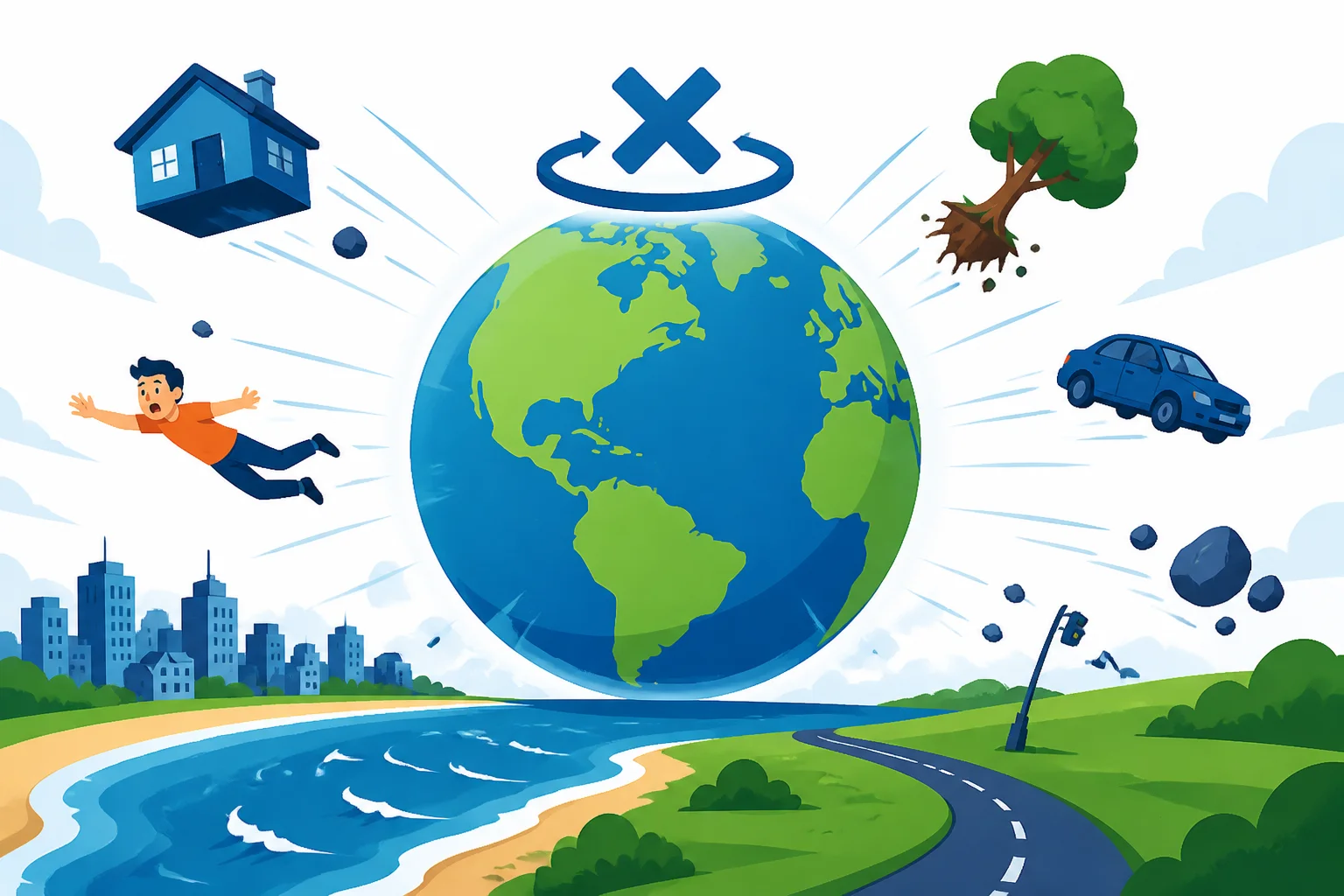
A sudden halt is about relative motion, not about gravity switching off. The ground would stop. The atmosphere, oceans, people, vehicles, and loose structures would initially keep their eastward velocity. The immediate result would be extreme winds and global-scale ocean surges, and those effects would depend on latitude. An instantaneous stop also sits outside the gradual pace of ordinary geological change, which is why it produces the violent inertial case. A slow stop would skip that first blast and still rewrite climate, winds, and the length of the day.
| Location | Compared with sound (about 335 m/s) |
|---|---|
| Equator | Faster than sound |
| Miami | Faster than sound |
| New York City | Faster than sound |
| London | Slower than sound |
| Reykjavik | Slower than sound |
| North Pole | No sideways motion |
Exact speeds in this comparison are the equatorial figure and the polar zero. The city rows are latitude estimates from that equatorial speed, not separate measurements, and they only answer a yes-or-no against sound. Find your latitude, or the closest row, and read off what your surroundings would still be carrying if the ground stopped under you. A wider set of fun facts about the Earth is a useful place to pin down where you sit on the planet.
Question 1 of 5
How fast does the ground at Earth's equator actually travel eastward as the planet spins?
Why Everything Keeps Moving When the Ground Stops
Think of a city bus that brakes hard. Your feet stop with the floor. Your body does not, until the pole, the seat, or another passenger pushes back. That leftover motion is inertia. Earth's surface is the bus. Air, water, and anything not tied down are the standing passengers.
The diagram below is the same idea in three beats: the brake, the bodies that keep their speed, and the force that finally changes that speed.
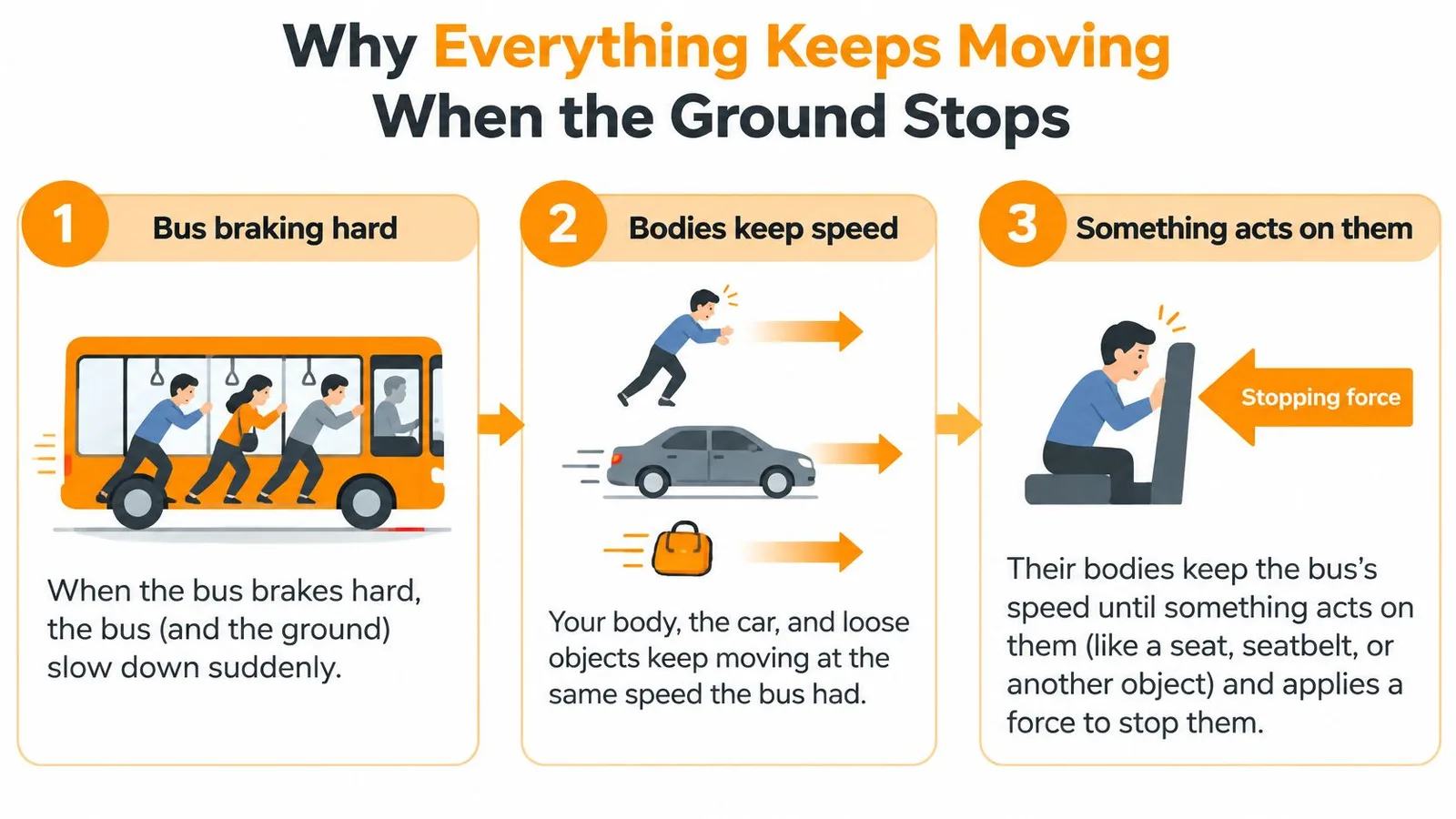
The sequence after the ground stops
Solid ground is braked. Rock that is locked to the crust stops with it. The reason is the assumption of the scenario itself: the crust is the thing being halted. The common slip is to picture the whole planet, core included, as one rigid brick. This story only brakes the surface you stand on. It does not model the interior, the earthquakes, or the heat such a brake would dump into rock.
Loose things keep going east. People, cars, trees, and unanchored objects continue with the speed the ground just had. The reason is the bus again. Nothing has pushed on them yet. The slip is to treat "stopped Earth" as "everything stopped." Only the braked part has stopped.
The air keeps its eastward run. Relative to the new, still ground, that moving air is a wind, and near the equator it is supersonic compared with the surface. The reason is that air has mass and was already moving with the planet. The slip is to imagine one brief gust, like a storm front that passes. In this setup the whole atmosphere has to be slowed by friction against a planet that is no longer matching it.
The oceans keep going east. Water surges into coasts that now sit in its path. The reason is the same inertia, in a fluid that can pile up. The slip is to think only of the surface chop. The surge is the ocean's old motion meeting a coastline that no longer shares it.
Practical rule: Gravity still holds the air, the water, and you. The danger is violent relative motion, friction, and impact, not being flung into space.
What to keep: the damage comes from the mismatch. The ground's motion and everything else's motion are no longer the same number.
Question 2 of 5
What would happen to objects on Earth's surface if it suddenly stopped spinning?
From the First Seconds to a Changed Climate
Rate is the whole argument. A world that no longer rotates is one end state. Reaching it in a second, or across geological time, produces different dominant effects and hits different people first. Sorting those timelines is the same habit as how to conduct scenario analysis: name the path, then name who is exposed on that path.
A NASA cosmic-ray Q&A puts equatorial surface speed at about 1,000 mph and stresses that the immediate danger depends strongly on latitude. People at the poles would feel little or no sideways launch. Everyone else would still have eastward momentum.
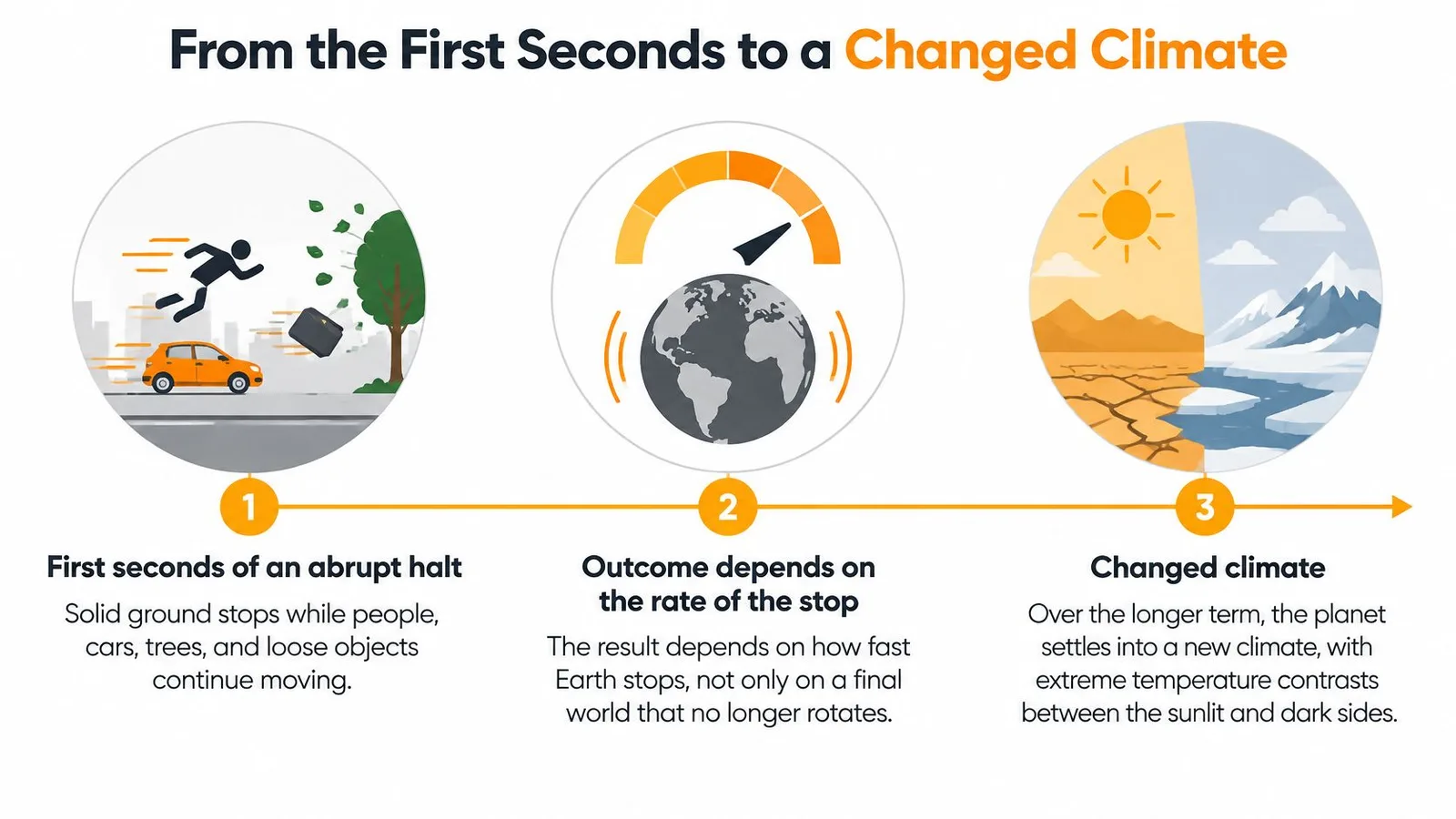
The sudden stop, hour by hour
In the first seconds, solid ground stops while people, cars, trees, loose objects, and the air keep moving east. The danger is that mismatch, largest where the old surface speed was largest.
In the first hours, those winds do not behave like one gust that passes and dies. Near the equator they can strip structures and vegetation across whole regions. Ocean water keeps moving east, floods coasts, displaces ships, and drives waves far inland. Deep water shifts more slowly than the surface layer, so the surge is not one neat wall. Name the timeline, then name the coast the eastward flow would hit. An Atlantic-facing shore on a continent's eastern side meets water that is still running toward it. A west-facing shore is more exposed to water leaving than to water arriving, until the displaced ocean sloshes back.
Over the first days to months, the inertial blast is no longer the main stress. Sunlight stays on one face for far longer than a normal day, then leaves it. Farming, power, food supply, and living systems built around a daily cycle take the hit. Recent modeling of slower rotation points the other way for a gentle change: stronger ocean circulation and wind-driven upwelling can recycle nutrients, raise photosynthetic productivity, and improve deep-ocean oxygenation when the atmosphere allows it. That is a model result for a slower spin under suitable conditions, not a promise that an abrupt halt is survivable.
A slow decline
Stretch the same stop over thousands to millions of years and the initial global blast does not happen. Coastlines and organisms could adjust as the change accumulated. What still changes is circulation. Trade winds and the large cells that carry heat from the equator toward the poles would be reorganized. Rainfall belts, storm tracks, and regional climates would move with them. The central question becomes circulation, not inertia.
Slower rotation is not a synonym for an uninhabitable Earth. The rate decides whether you are talking about a blast or about a climate the living world might track. The ecosystems that could adapt are the ones given time. The ones asked to survive the first hours are not.
| Timescale | Dominant effect | Most exposed |
|---|---|---|
| First seconds (sudden stop) | Objects and air keep moving east while the ground stops | Anything not anchored, people outdoors, vehicles |
| First hours (sudden stop) | Global supersonic winds and ocean surges | Coastlines, ships, low-lying cities |
| First days to months (sudden stop) | Day and night cycle becomes extremely long | Agriculture, ecosystems, power and food supply |
| Thousands to millions of years (gradual slowdown) | Changes in ocean and atmospheric circulation, slower day | Climate systems, ecosystems that can adapt over time |
Question 3 of 5
In climate models where Earth spins more slowly, why do the ocean's algae grow more abundantly?
Day and Night Stretch Into a Year-Long Cycle
Today's solar day is 24 hours, the gap from one noon to the next. One full turn relative to the stars is a little shorter, about 23 hours and 56 minutes, because Earth also creeps along its orbit while it spins. That small difference is why the stars rise earlier each night. It is not why noon feels regular. The Sun, not the stars, sets the clock you live by.
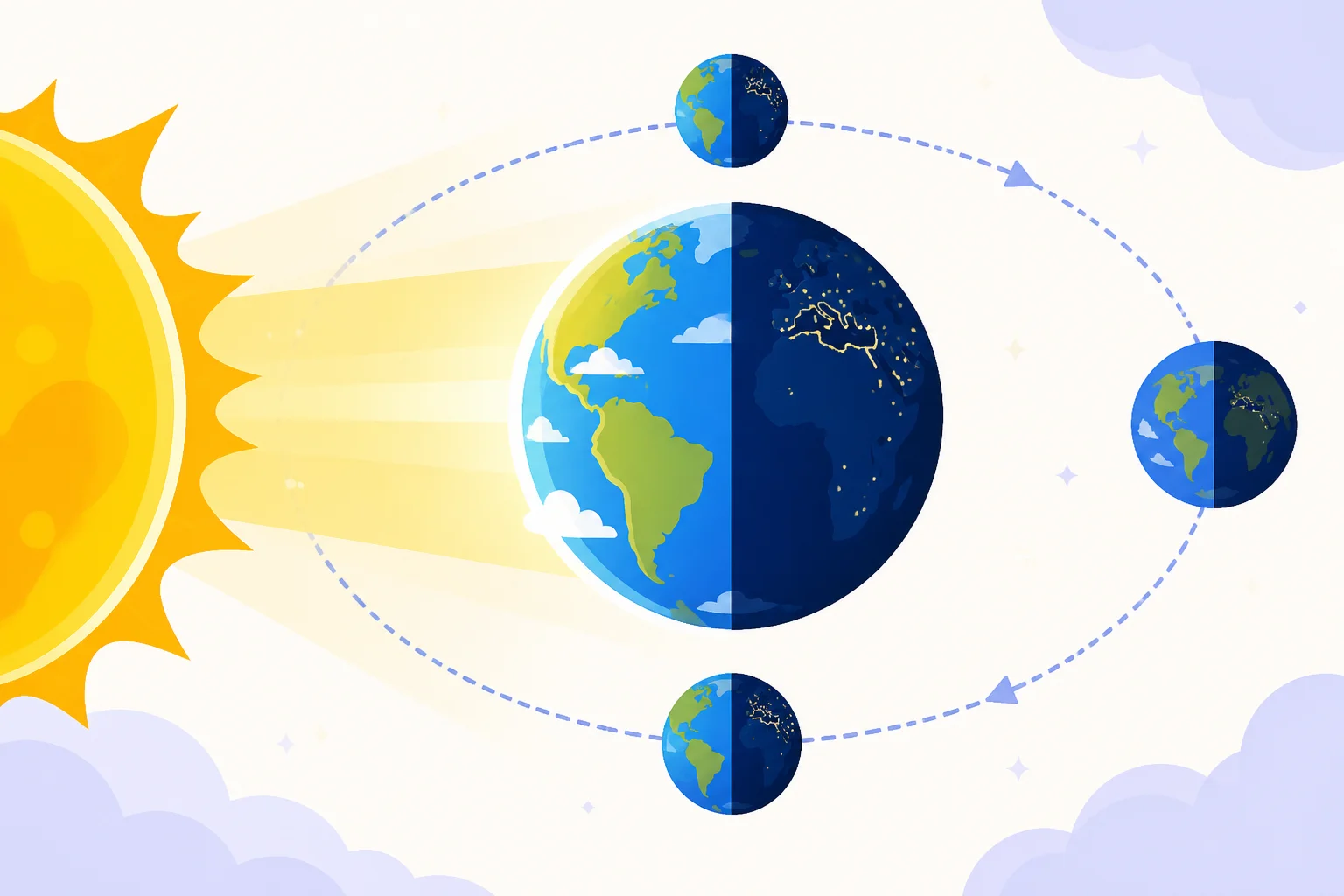
If rotation stopped, the Sun would no longer rise and set once a day. Earth would still orbit the Sun once a year, so the Sun would cross the sky on that yearly trip. One hemisphere would face the Sun for roughly six months, then sit in darkness for about six months. Each place would get one sunrise and one sunset per year.
A tiny real change in day length
That yearly cycle is a thought experiment. A measured day-length change we can talk about is tiny. In a climate FAQ updated in 2026, NASA states that complete melting of the Greenland ice sheet would raise global sea level by about 7 meters and lengthen the day by approximately 2 milliseconds. Those figures are for that hypothetical complete-melt case, not for a planet that has stopped spinning. They show how stubborn the day is under real mass shifts.
- Today's day: 24 hours from noon to noon, with the star-relative turn a few minutes shorter.
- Greenland's complete melt: about 7 meters of global sea level, and a day longer by about 2 milliseconds.
- A stopped rotation: one sunlit stretch of roughly six months, then about six months of dark, and a single sunrise and sunset each year.
A two-millisecond longer day would not move your alarm. A six-month day would retire the alarm, the time zone, and the idea of a daily schedule.
Work shifts, school bells, and the line between "today" and "tomorrow" all assume the Sun returns on a human timescale. In this end state they would not.
Question 4 of 5
If Earth stopped spinning on its axis but kept orbiting the Sun, how would day and night change at any given spot?
How Gravity and Your Weight Would Change
Gravity is mainly the pull of Earth's mass. Stopping the spin would not switch that pull off. You would not float, and you would not fly off the surface.
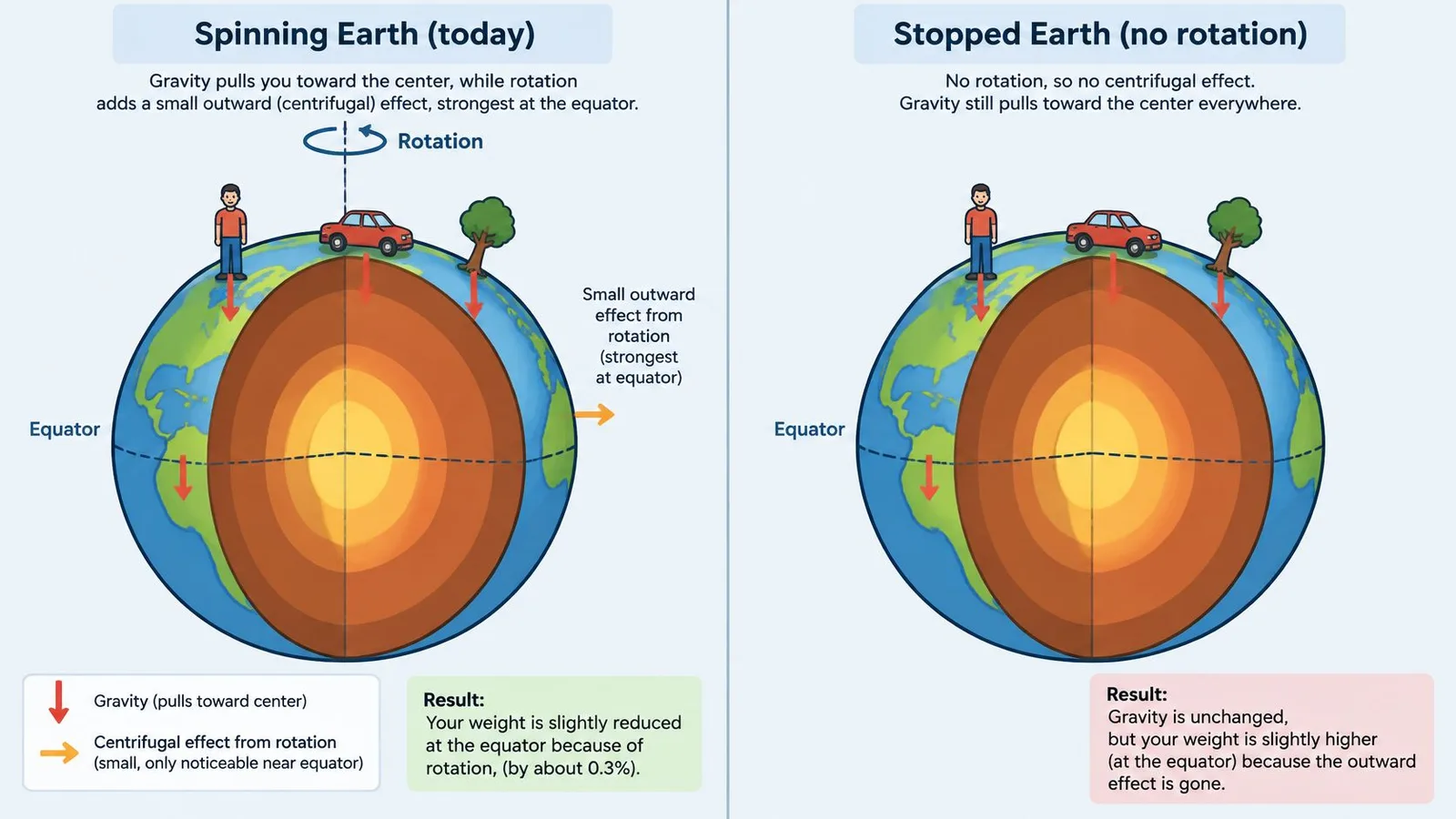
Rotation adds a small outward centrifugal effect that slightly reduces apparent gravity. It is strongest at the equator, where you are farthest from the spin axis, and it falls to nothing at the poles. Remove the spin and that outward push disappears, so apparent gravity rises by the amount the push had been shaving off.
A classroom split of that effect is about 0.034 m/s² at the equator, roughly 0.35 percent of surface gravity. For a 70 kg person that is only about a quarter of a kilogram of extra apparent weight. At the poles the change is zero, because there was no outward push to remove.
| Latitude | Gravity increase (m/s²) | Extra apparent weight for 70 kg person |
|---|---|---|
| Equator (0°) | 0.034 | About 0.24 kg |
| Poles | 0 | None |
The equatorial bulge and the seas
The longer change is shape, not the number on a bathroom scale. Earth has an equatorial bulge on the order of 21 km. Without the spin that helps support it, the bulge would slowly flatten. Ocean water would migrate toward the poles. Over a long period, sea level would fall near the equator and rise nearer the poles. New dry ground would appear in low equatorial latitudes, and polar coasts would take the water. That reshaping is slow compared with the inertial blast. It belongs with the gradual story, not with the first minute.
The comparison below is the rotating case against a non-rotating one: a slightly lighter apparent weight at the equator while the planet spins, and a rounder figure once that outward effect is gone.
If you want the pull itself, separate from this spin correction, how gravity works on Earth is the right next step. For this scenario, the action is simple. Do not treat a stopped spin as weightlessness. The change in what the scale reads is small.
Question 5 of 5
If Earth suddenly stopped spinning, how would a 70 kg person's weight change at the equator compared with the poles?
Three Questions for Any Stopped Earth Claim
You can test the next dramatic version without replaying the disaster. Three questions do the sorting.
How fast does the change happen? An instantaneous halt is the inertial blast: ground stops, air and oceans do not. A slowdown over thousands to millions of years skips that blast. Circulation and a lengthening day become the story. If a clip never says which rate it means, it is mixing two different events.
Where on Earth are you? Sideways speed is largest at the equator and falls with distance from the spin axis. Lower latitudes sit on the fast side of sound, near 335 m/s. London and Reykjavik sit on the slow side. The poles have no sideways launch at all. A claim that "everyone is thrown east at the same speed" has already failed this question.
What keeps moving relative to what? Air, oceans, and loose objects keep their old velocity only if the ground stops first. Gravity does not switch off. Apparent weight at the equator rises by that small fraction of a percent, near a quarter of a kilogram on a 70 kg person, which is a scale change, not an escape.
Use the timeline and the latitude before you trust the picture. A sudden-stop story and a later, non-rotating orbit are not the same event.
Once the spin is gone, and Earth continues orbiting the Sun, the light cycle is yearly: about six months bright, about six months dark, one sunrise and one sunset a year. Predict that split, and predict who feels the first minute, before you read another version of the same what-if. The rate, the place, and the mismatch will tell you which sentence in the claim is doing real work.
Million Whys turns questions like this into a 10-second why, with a short explanation on every answer choice, not only the right one. If the Earth stopped spinning is exactly the kind of everyday physics puzzle the daily question and the quiz are built for. Try a round at Million Whys and see which assumption you were carrying.
Keep Exploring
Related Posts
Fun Facts About the Earth: Why It Never Sits Still
Fun facts about the earth: why Earth bulges, moves plates, shifts its magnetic field, loses air, trades tides with the Moon, and stays hot inside.
How Does Gravity Work on Earth? Causes and Examples
How does gravity work on Earth? Mass, distance and the 9.8 m/s² pull explained, with everyday examples from falling objects to ocean tides.
Earth Day 2026: 12 Weird Whys About the Planet You Live On
From a 19.5-hour day stuck for 1.5 billion years to a mantle-wind black hole beneath Tibet, 12 mechanism-rich, verifiably true facts about Earth — each a 'small why' that changes how you see the planet. Earth Day 2026 edition.