

What Are the Ecosystems? Types, Parts and Examples
On this page· 17
An ecosystem is all the living organisms in an area together with the nonliving environment they depend on, linked by energy flow and nutrient cycles. Look outside at a garden, a street tree, or a puddle after rain, and you can start noticing those connections: leaves catching light, insects feeding, and water soaking into soil.
You don't need to visit a wilderness reserve to find one. The useful question is how the organisms and their surroundings work together, and whether those relationships are still functioning well.
What an Ecosystem Actually Is
Stand beside a backyard pond. You might notice a frog, floating leaves, and insects moving across the surface. Less obvious are the bacteria in the mud, dissolved gases in the water, and sunlight that supports plant growth.
Together, these make a working system, not just a collection of wildlife. British ecologist Arthur George Tansley introduced the modern ecosystem concept in 1935, arguing that organisms and their physical surroundings should be studied together, according to The Cambridge History of Science.
Think of a house. Knowing who lives there doesn't explain how the household works. You also need to understand the plumbing, heating, food supply, and connections between rooms. Likewise, a pond's inhabitants depend on conditions beyond the presence of other animals.
Ecosystem, habitat, and biome aren't interchangeable
- Habitat means the place where a particular organism lives. A frog's habitat might include a pond's shallow, sheltered edge.
- Biome describes a broad ecological region, such as desert or tundra, associated with characteristic climate and vegetation.
- Ecosystem means the interacting system of organisms and their physical environment. Its scale can range from a temporary pond to a forest, coral reef, or the whole biosphere.
A simple test for any place
When you ask, “What are the ecosystems around me?” use these questions:
- Is there a living community? Include tiny organisms, not just visible animals.
- Is there a physical setting? Identify water, air, soil, temperature, or other environmental conditions.
- Do energy or materials move between them? Look for feeding, growth, decay, or nutrient uptake.
If the answers are yes, you can study the place as an ecosystem. Its boundaries are chosen to suit the question you're asking, rather than marked by an absolute line in nature.
Question 1 of 6
When British ecologist Arthur Tansley introduced the word 'ecosystem' in 1935, what was the main change he was arguing for in how nature should be studied?
The Living and Nonliving Parts That Work Together
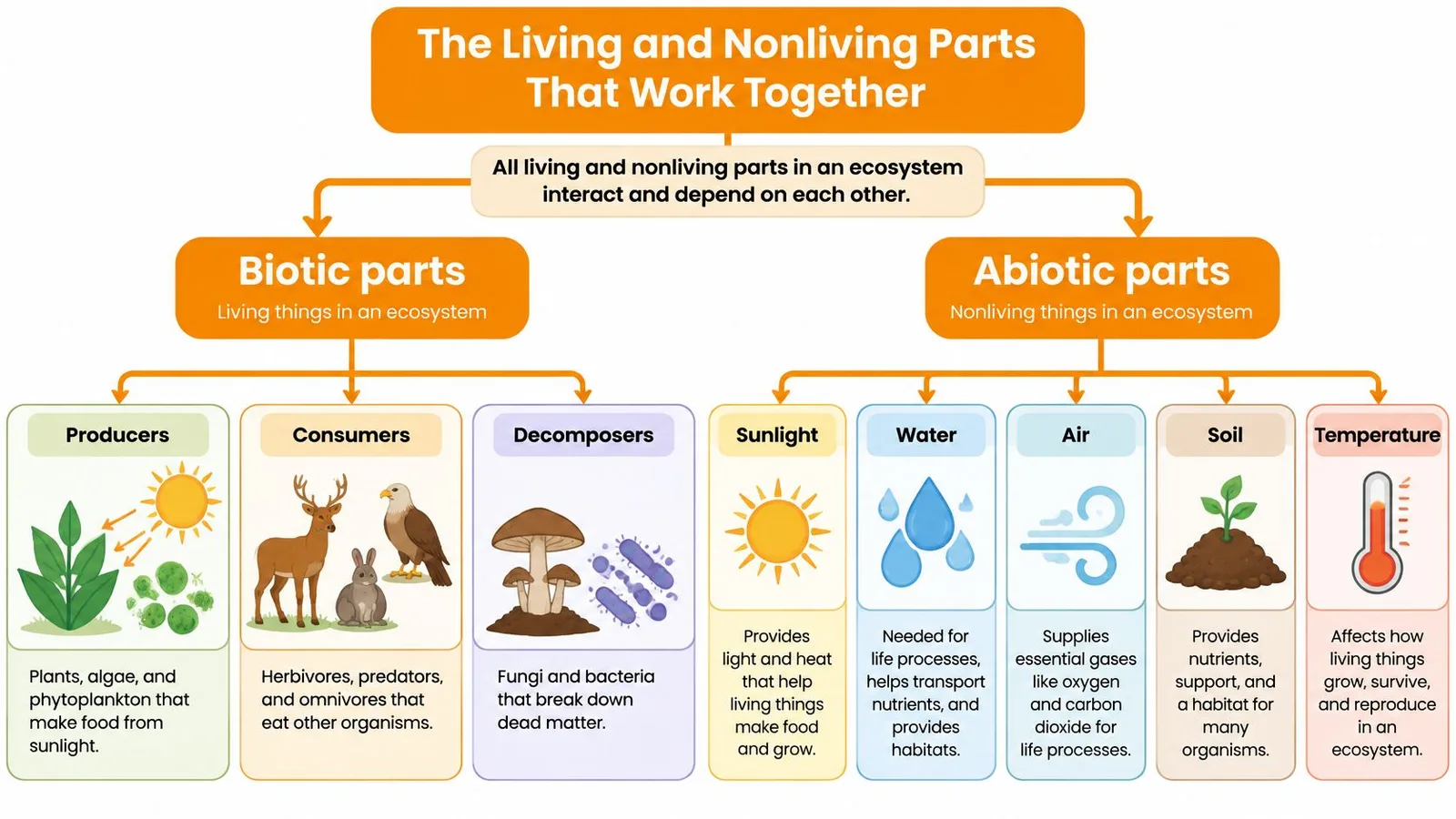
Ecologists separate ecosystem components into biotic, meaning living, and abiotic, meaning nonliving. These labels help you sort what's present, but the connections between the groups explain how the ecosystem works.
Living organisms have different roles
Producers, including plants, algae, and phytoplankton, use sunlight to build food. Consumers obtain food by eating other organisms: snails graze, fish hunt, and omnivores eat both plant and animal material.
Decomposers, especially fungi and bacteria, break down dead organic matter. Earthworms help by fragmenting and processing dead material, making it more accessible to microbes.
A fallen leaf shows why these roles matter. As organisms break it down, nutrients become available in the surrounding soil. Plant roots can then absorb those nutrients. For a closer look at the ground beneath that exchange, Barefoot Organics' guide to natural care for layered soil provides useful context.
The physical setting shapes those roles
In a freshwater pond, algae need sufficient light, snails need food, and fish depend on suitable oxygen conditions. Light fades with depth, while water temperature changes with weather and season. A pond can therefore offer very different conditions near its surface and muddy bottom.
Air, water, minerals, sunlight, and temperature aren't merely background scenery. They help determine which organisms can survive and what those organisms can do. Even a familiar observation, such as why bees buzz, can become a starting point for examining an animal's activities within its surroundings.
NOAA's ecosystem science overview supports examining composition, structure, and function together. Composition concerns which organisms are present; structure concerns how habitats are arranged; function concerns processes such as feeding, soil formation, and nutrient movement.
Practical rule: A species list tells you who is present. It doesn't tell you whether they have the conditions and connections they need.
Use this observation checklist locally:
- Living parts: Name a producer, a consumer, and evidence of decomposition.
- Nonliving parts: Note moisture, light, temperature, and soil or water conditions.
- Arrangement: Look for shelter, vegetation layers, and connected patches of habitat.
- Interactions: Record something feeding, growing, decomposing, or moving between habitats.
Question 2 of 6
In a compost heap or a forest floor, what is the actual division of labor between earthworms and microbes like fungi and bacteria when dead leaves break down?
Types of Ecosystems From Ponds to Cities
Main ecosystem types and what limits life in each
| Type | Examples | Defining feature | Main limit |
|---|---|---|---|
| Forest | Tropical rainforest, temperate woodland | Dense tree canopy | Rainfall and light reaching the forest floor |
| Grassland | Prairie, savanna, steppe | Grasses dominate with few trees | Rainfall and grazing pressure |
| Desert | Sahara, Atacama | Very low rainfall and sparse plants | Water |
| Tundra | Arctic tundra, alpine meadows | Short growing season; permafrost in many Arctic areas | Cold and short season |
| Freshwater | Lakes, rivers, wetlands | Low salt; still or flowing water | Oxygen, nutrients, and flow |
| Marine | Open ocean, coral reefs, kelp forests | Salty water; sunlight concentrated in upper waters | Light, nutrients, and temperature |
| Estuary | Where rivers meet the sea | Mix of fresh and salt water | Changing salinity |
| Urban | Parks, street trees, gardens, rooftops | Shaped by buildings and people | Space, soil quality, and pollution |
| Temporary | Tide pools, seasonal puddles, ponds that dry | Conditions periodically reset | Drying out or tides |
These types fit broadly into terrestrial, freshwater, marine, and human-shaped ecosystems. The categories aren't sealed boxes. A coastal city can contain gardens, streams, wetlands, and an estuary within the same area.
One useful question makes the table easier to understand: What limits life here? Desert organisms must cope with scarce water. Tundra plants face cold and a brief growing season. In the open ocean, producers need access to both light and nutrients, which aren't always abundant in the same place.
Boundaries and exceptions matter
Estuaries blend fresh and salt water, so their inhabitants must tolerate changing conditions. Wetlands connect land and water, while a tide pool may become isolated from the sea between tides. Temporary doesn't mean unimportant, and small doesn't mean simple.
Marine environments also differ substantially from one another. Exploring fun facts about the ocean can help replace the idea of a single uniform ocean habitat with a more varied picture. When visiting coastal wildlife, practical guidance such as Snorkel Turtle Canyon's respectful snorkeling around honu helps connect observation with care for the animals using that habitat.
To classify a place, begin with its water: fresh, salty, mixed, or usually absent. Then examine dominant vegetation, temperature conditions, and human alterations. Treat the result as a useful description, not a requirement to squeeze every place into a single category.
Question 3 of 6
Why do vast stretches of the open tropical ocean stay clear and nearly empty of visible plankton despite abundant sunlight?
How Energy and Nutrients Move Through an Ecosystem
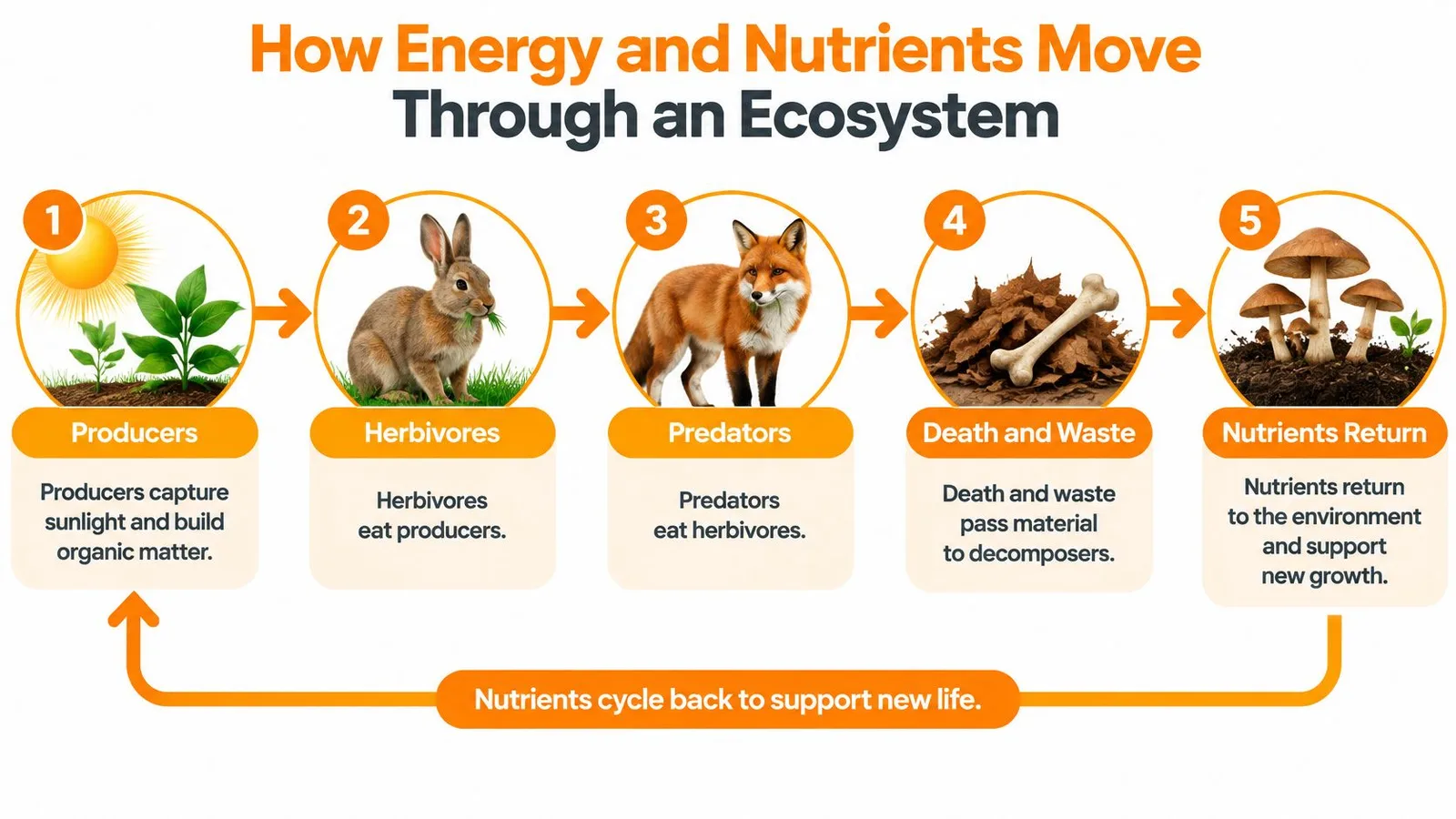
Follow a leaf through a food web, and an important distinction appears: energy flows through the system, while nutrients circulate within and across it. An ecosystem needs continuing energy input because organisms release energy as heat as they live.
- Producers capture sunlight. Plants and algae use that energy to build organic matter.
- Herbivores eat producers, gaining some of the energy stored in their tissues.
- Predators eat other consumers. A fish might eat an insect that previously fed on plant material.
- Death and waste supply material to decomposers.
- Decomposition releases nutrients into soil or water.
- Producers take up available nutrients, supporting new growth.
Why less energy reaches higher feeding levels
A trophic level is a feeding position in a food web. Energy doesn't pass intact from one level to the next: some material isn't eaten, some isn't digested, and organisms use energy for maintenance and activity.
| Feeding position | Example | What happens to available energy |
|---|---|---|
| Producer | Pond algae | Captures external energy in organic matter |
| Primary consumer | Grazing snail | Receives only part of producer production |
| Higher consumer | Predatory fish | Receives a further reduced share |
| Decomposer pathway | Bacteria and fungi | Uses dead material and waste from across the web |
The familiar 10% transfer rule is a shortcut, not a universal law: a synthesis available through NOAA's repository examined 2,052 estimates from 122 studies and reported mean terrestrial transfer around 1.5%.
Food quality, consumer physiology, temperature, and food-web arrangement all affect transfer. A neat classroom pyramid can illustrate the direction of change, but it can't supply a reliable local transfer rate.
Nutrients can support new growth after decomposition. Energy released as heat can't simply be recycled by plants.
This distinction matters for management. Low transfer efficiency means less predator biomass can be supported by a given amount of primary production. Fisheries and wildlife managers therefore need local productivity estimates rather than assuming that every ecosystem can replace harvested consumers at the same rate.
Question 4 of 6
Why does the familiar 10% rule of thumb badly overestimate how much energy moves between feeding levels on land?
Ecosystem Services, Human Impacts and Trade-offs
Suppose a town has a wetland upstream. Vegetation and soils can slow runoff, retain some pollutants, and provide habitat for fish and wildlife. If developers fill that wetland, residents may need engineered drainage or water-treatment measures to replace some of those functions.
These benefits are called ecosystem services. They connect ecological processes to food, safety, livelihoods, and places people value.
Benefits come in different forms
- Provisioning services supply tangible resources, including food, freshwater, fish, and timber.
- Regulating services include water purification, flood moderation, climate regulation, and pest control.
- Cultural services include recreation, cultural connections, and the value people place on particular natural settings.
The 2005 Millennium Ecosystem Assessment found that 15 of the 24 ecosystem services assessed globally were being degraded or used unsustainably, according to its synthesis hosted by the United Nations. This was a global assessment, not a diagnosis of every local wetland, forest, or coastline.
Growing demand for food, freshwater, timber, fiber, and fuel creates pressure to increase some benefits at the expense of others. Draining a wetland may create farmland, for example, while reducing water filtering and flood storage.
Ask who gains and who loses
Calling a project beneficial doesn't settle the question. A landowner may gain productive acreage while downstream households face greater flood exposure. Decisions about ecosystems therefore involve governance and economics as well as biology.
Urban residents encounter similar choices through tree cover, paving, and the urban heat island effect. Coastal visitors face another version: recreation can depend on healthy reefs while visitor behavior can damage them. Kona Snorkel Trips' guidance on protecting reefs while exploring Hawaii offers a practical entry point for considering that responsibility.
A useful decision question: Which benefit increases, which ecological function might decline, and who experiences each consequence?
There isn't always a solution with no costs. Better decisions make those costs visible, protect essential functions, and involve the people whose homes, food supplies, or livelihoods depend on the place.
Question 5 of 6
In the 2005 Millennium Ecosystem Assessment, what did scientists find when they assessed 24 ecosystem services around the world?
How to Judge Health and Test a Place
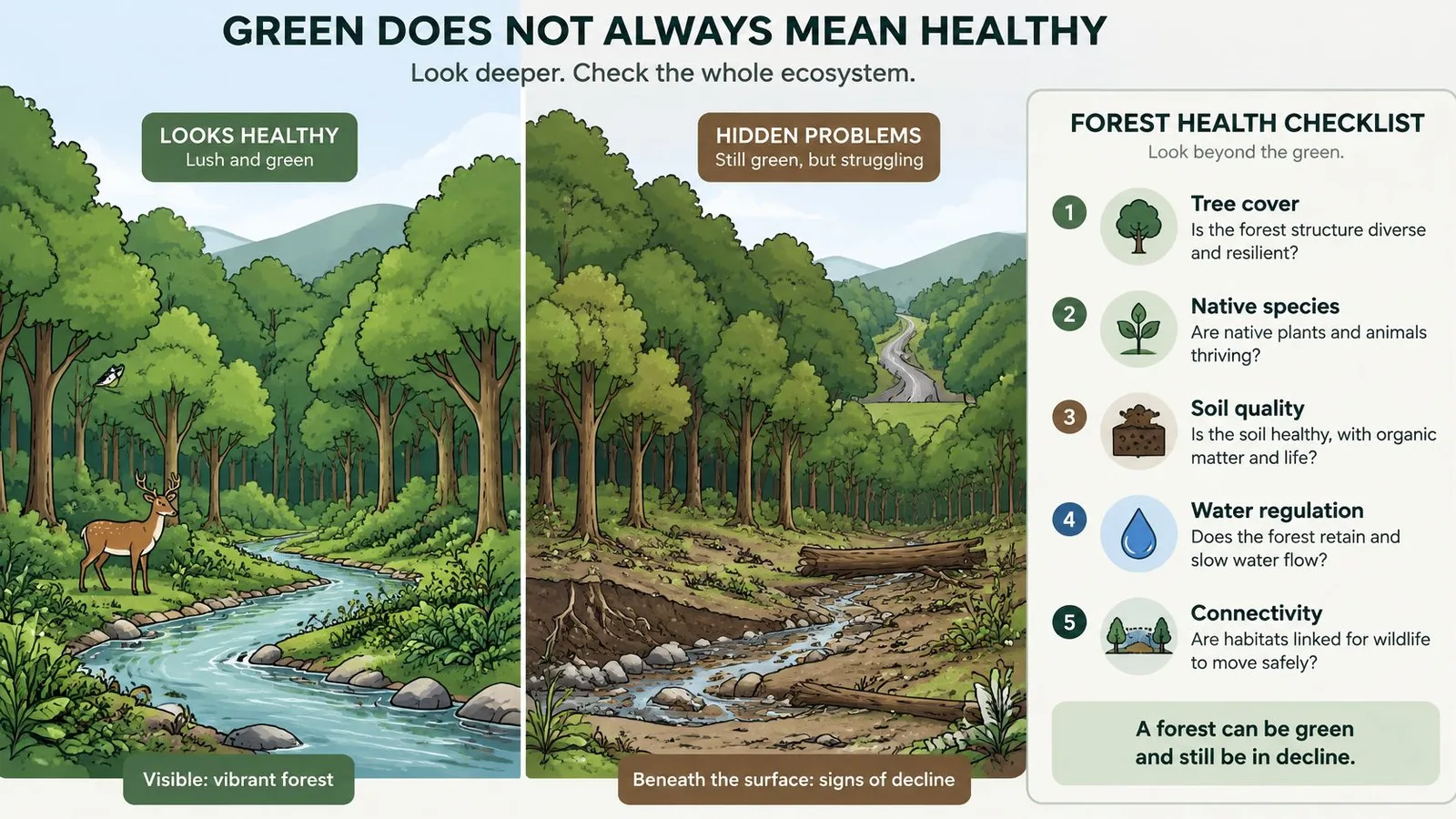
Green doesn't automatically mean healthy. A forest can regain tree cover while lacking native understory plants, suitable nesting sites, healthy soils, or connections to nearby habitat. A photograph of leaves can't reveal all of those conditions.
Look for functioning relationships over time
Use these questions to guide observation, rather than treating any single answer as a final diagnosis:
- Are native species replacing themselves? Look for seedlings, young animals, or other evidence of successful reproduction, not merely surviving adults.
- Are abundance and diversity stable over time? Compare observations made in similar seasons and conditions. A seasonal absence isn't necessarily a decline.
- Is habitat structure appropriate and varied? A woodland may need canopy, understory, dead wood, and ground cover. Don't judge a grassland by how many trees it has.
- Are water and nutrient processes functioning? Persistent erosion, compacted soil, or unusual runoff can indicate problems, although visual clues alone don't establish their cause.
- Can the ecosystem recover after disturbance? Recovery after drought, flood, or fire should be judged against the place's ecological character, not an expectation that it never changes.
- Do people retain important benefits? Consider water quality, food, recreation, cultural relationships, and access, alongside biodiversity.
Reliable answers require repeated observation. The Convention on Biological Diversity's global reporting overview notes that 50% of national biodiversity reports provide a snapshot of natural-ecosystem extent, while fewer than 1% provide time-series data. Knowing how much habitat exists at a moment in time isn't the same as knowing whether its condition is improving.
Restoration activity isn't proof of recovery
A planted site needs follow-up: Are plants surviving, reproducing, and supporting other organisms? Has the original pressure been reduced? Counting an area as under restoration doesn't answer those questions.
A UN Environment Programme account of restoration reporting describes approximately 252 million hectares documented under restoration across 149 countries in 2026, while freshwater ecosystems had reached only 5% of the relevant restoration target. Those figures describe reported activity and uneven progress, not confirmed ecological recovery across every site.
Local knowledge matters here. Indigenous and local stewardship can help identify historical conditions, seasonal patterns, and resource needs that a short survey misses. Protection imposed without community participation can also restrict access to land or resources.
Try a ten-minute field exercise
Choose a park, pond, garden, or street tree and bring a notebook. Stay on paths and observe without collecting organisms or disturbing shelter.
- Inventory the place: Record living organisms and nonliving conditions you can identify.
- Trace a connection: Follow a possible route from plant to consumer, then look for dead material and decomposer activity.
- Name a benefit and pressure: Shade and soil compaction, for example, give you something concrete to investigate.
- Give a provisional verdict: Separate what you observed from what remains unknown, then plan a comparable return visit.
Finish with a human question: Who benefits if this place is protected or restored, and who bears the costs? A responsible assessment considers both ecological functioning and the people who depend on it.
At Million Whys, we turn everyday questions into short learning opportunities across science, nature, psychology, technology, economics, history, and internet culture. Visit Million Whys to keep exploring the questions your local ecosystem raises, from how animals find food to why environments change.
Question 6 of 6