A daily general knowledge quiz works when it gives you one small gap and then closes it cleanly. This set is broad on purpose: space, animals, your body, food, physics, and technology, each with the answer and the why in the card. For the live habit, use Trivia Question of the Day: one free question a day, no signup, and the quickest way to let curiosity compound instead of turning learning into homework. If you want the science-only sibling, try Daily Science Quiz, or browse the broader Daily Quiz page.
Space, Time, and the Sky
AWe are inside it
✓Correct — Correct! The Milky Way is our galaxy—we're inside it! The band of light we see is looking edge-on through the galactic disk (100,000 light-years across). We're in a spiral arm ~26,000 light-years from the center. Dense star concentrations appear as milky band across the night sky. Best viewed from dark locations away from light pollution. Ancient cultures saw it as celestial river!
BIt's brightest galaxy
✗Not quite — Wrong. We see the Milky Way brightly because we're inside it—viewing our own galaxy from within. Other galaxies appear dimmer due to distance.
CReflects sunlight to Earth
✗Not quite — Wrong. Galaxies don't reflect sunlight—they emit light from billions of stars. We see the Milky Way because we're part of it.
Answer this question

AStars are too far apart
✓Correct — Correct! Although there are billions of stars, they're incredibly far apart. Space is about 99.9999999999999% empty vacuum. Light from stars spreads out in all directions, getting dimmer with distance. Most light from distant stars is too faint to see. Also, the universe has a finite age (13.8 billion years), so light from the most distant stars hasn't reached us yet. The vast emptiness between stars makes space appear dark.
BThere aren't enough stars
✗Not quite — Wrong. There are hundreds of billions of stars just in our galaxy alone, and billions of galaxies in the observable universe. The number of stars is enormous. The darkness comes from their vast separation and the finite age of the universe, not insufficient quantity.
CDark matter blocks light
✗Not quite — Wrong. Dark matter doesn't block or absorb light - it doesn't interact with light at all, which is why it's called 'dark.' Dark matter only interacts through gravity. The darkness of space is due to the vast distances between stars and limited observable universe.
Answer this question
AEarth's axis is tilted
✓Correct — Correct! Earth's axis is tilted 23.5° from vertical. As Earth orbits the Sun, this tilt means the Northern Hemisphere points toward the Sun in June (summer there) and away in December (winter). When tilted toward the Sun, that hemisphere gets more direct sunlight and longer days, creating summer. The opposite hemisphere experiences winter. This tilt causes seasons.
BThe Sun's heat output changes
✗Not quite — Wrong. The Sun's energy output is remarkably constant over short timescales like years. Small variations (about 0.1%) follow an 11-year solar cycle, but this doesn't cause our annual seasons.
CEarth's speed varies in orbit
✗Not quite — Wrong. Earth's orbital speed doesn't cause seasons—Earth moves at nearly constant speed throughout its orbit. The 23.5° axial tilt is responsible for the dramatic seasonal temperature and daylight changes we experience.
Answer this question
AEarth rotates 365 times yearly
✗Not quite — Wrong. Earth actually rotates about 366 times during one orbit of the Sun, not 365. We count 365 days because a 'day' is based on the Sun's position in the sky, which is affected by Earth's orbit as well as rotation.
BTime for Earth to orbit the Sun
✓Correct — Correct! A year is defined by how long Earth takes to complete one full orbit around the Sun - approximately 365.25 days. This is determined by Earth's orbital distance (93 million miles) and speed (67,000 mph). We round to 365 days for convenience, adding a leap day every 4 years to account for the extra 0.25 days. This orbital period is a natural astronomical fact, not a human invention.
CThe Moon's cycle determines it
✗Not quite — Wrong. The Moon's cycle (29.5 days) doesn't determine Earth's year. Some ancient calendars were lunar-based, but Earth's year is determined by its orbit around the Sun. The Moon's orbit around Earth and Earth's orbit around the Sun are independent cycles.
Answer this question

AMoon blocks or enters shadow
✓Correct — Correct! Solar eclipse: Moon passes between Sun and Earth, blocking sunlight and casting a shadow on Earth. This only happens at new moon when all three align. Lunar eclipse: Earth passes between Sun and Moon, and Earth's shadow falls on the Moon. This only happens at full moon. We don't get eclipses every month because the Moon's orbit is tilted 5° to Earth's orbit, so alignment is rare.
BSun's light dims periodically
✗Not quite — Wrong. The Sun's brightness is remarkably constant. It doesn't dim on a predictable schedule. Eclipses are caused by the Moon blocking the Sun's light (solar eclipse) or Earth's shadow falling on the Moon (lunar eclipse), not by changes in the Sun itself.
CEarth's rotation causes them
✗Not quite — Wrong. Earth's rotation causes day and night but doesn't cause eclipses. Eclipses require the Sun, Moon, and Earth to align in specific ways during the Moon's orbit around Earth. This alignment only happens occasionally, not daily as rotation would suggest.
Answer this question
Animals Doing Things That Need an Explanation
AAttracting mates with scent
✗Not quite — Wrong. The spray is extremely unpleasant and repels all animals, including potential mates. Skunks use completely different, milder scents for attraction.
BLast-resort predator defense
✓Correct — Correct! Chemical warfare defense! Skunk spray: last resort against threats. Composition: sulfur-containing thiols (mercaptans)—extremely pungent. Process: (1) Warning signals first—stomping, tail raising, hissing. (2) If threat persists—spray from anal glands. (3) Accurate aim up to 10ft. Effects on predators: temporary blindness, nausea, intense smell (lasts days-weeks). Limited supply (5-6 sprays)—takes 10 days to replenish. Effective deterrent—most predators learn avoidance. Great horned owls (no smell sense) are main predators!
CKeeping their fur clean
✗Not quite — Wrong. Spray doesn't clean fur—it's an oily, foul-smelling substance that animals try to avoid. Skunks groom themselves like other mammals.
Answer this question
AReaching deep into ant nests
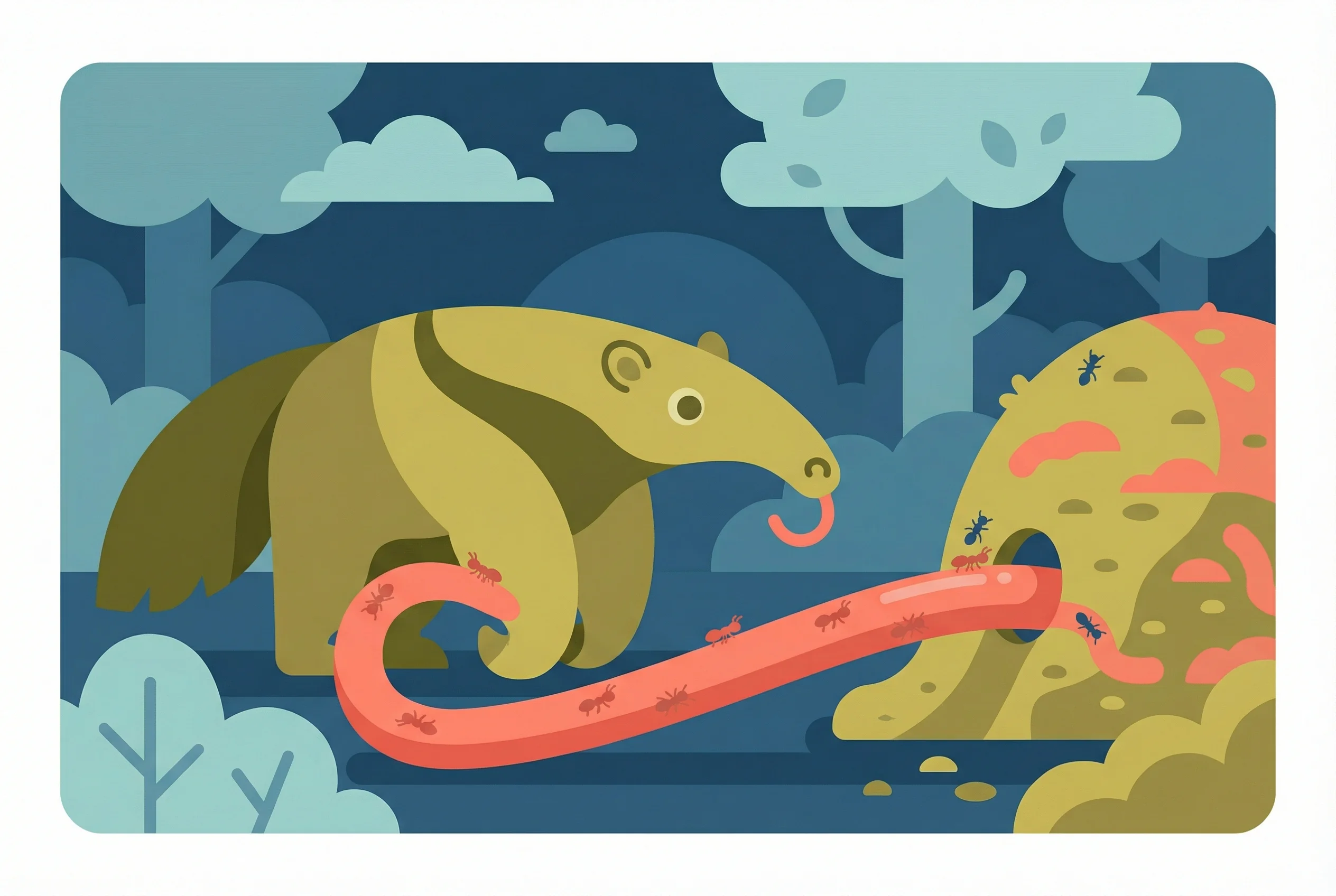
✓Correct — Correct! Specialized feeding! Giant anteater tongue: 2ft long! Adaptations: (1) Length—reaches deep into ant/termite tunnels. (2) Sticky saliva—insects adhere to tongue. (3) Rapid flicking—160 times/minute! (4) Attached to sternum—extends far. No teeth—swallows insects whole. Strong stomach grinds food. Eats 30,000 ants/termites daily! Also: powerful claws rip open nests. Narrow snout fits in tunnels. Specialized myrmecophage (ant-eater). Tongue moves so fast it's nearly invisible!
BIt helps regulate body temperature
✗Not quite — Wrong. Tongue doesn't regulate temperature. It's specialized feeding tool—extremely long and sticky for extracting ants/termites from nests.
CFighting off predators
✗Not quite — Wrong. Anteaters use powerful claws for defense, not tongues. Long tongue is feeding adaptation—reaching deep into insect colonies.
Answer this question
AEscaping ocean predators
✗Not quite — Wrong. Ocean has predators, but upstream migration is for reproduction—returning to natal streams to spawn.
BSpawning in birthplace
✓Correct — Correct! Natal homing! Salmon return to birthplace to spawn: (1) Imprinting—remember birth stream's chemical signature. (2) Olfactory navigation—follow scent upstream. (3) best conditions—gravel beds for eggs. Incredible journey: hundreds of miles, swimming against current, jumping waterfalls. Anadromous life cycle—born in freshwater, mature in ocean, return to spawn. Most Pacific salmon die after spawning (semelparous). Exhausting migration—use all energy reserves. Magnetic sense aids ocean navigation!
CSearching for more food
✗Not quite — Wrong. Salmon don't feed during spawning migration—use stored energy. Upstream journey is reproduction-driven, not foraging.
Answer this question
ACooling system in Arctic
✗Not quite — Wrong. Arctic doesn't need cooling—needs insulation! White fur provides camouflage. Black skin underneath actually absorbs heat.
BCamouflage in snow and ice
✓Correct — Correct! Arctic camouflage! Polar bear fur appears white: (1) Camouflage—blends with snow/ice during seal hunting (stalking). (2) Individual hairs are transparent, hollow—scatter light (appears white). (3) Skin underneath is black—absorbs heat. Fur isn't actually white—light reflection creates color. Can appear yellow/brown from oxidation/algae. Dense undercoat + guard hairs insulate. Cubs born with white fur. Excellent stealth predator—seals don't see approach!
CWhite attracts prey animals
✗Not quite — Wrong. White doesn't attract prey—it conceals predator. Polar bears hunt seals, using white fur as camouflage on ice.
Answer this question
AMulti-purpose tool for survival
✓Correct — Correct! Versatile appendage! Elephant trunk: fusion of nose + upper lip, 40,000 muscles (no bones)! Functions: (1) Feeding—grasp food, strip leaves, pick up small items. (2) Drinking—suck water (12 liters), squirt into mouth. (3) Communication—touch, smell, trumpeting sounds. (4) Cooling—spray water/dust on body. (5) Tool use—move objects, dig. (6) Social bonding—caressing. (7) Defense—can lift 350kg! Incredibly sensitive—detect seismic vibrations. African elephants: 2 'fingers' at tip; Asian: 1.
BCooling system only
✗Not quite — Wrong. Trunk does cool through water/dust spray, but primary functions are feeding, drinking, breathing, communication—multi-purpose tool.
CStoring water inside trunk
✗Not quite — Wrong. Trunk doesn't store water (common myth). It draws water then squirts into mouth. Trunk is tool for feeding, drinking, sensing, communication.
Answer this question
Your Body, Senses, and Everyday Biology
AReleasing germs via exhaled carbon dioxide
✗Not quite — Not quite. Carbon dioxide is a gas and does not carry germs. Germs are carried in moisture droplets expelled during coughs. In fact, regular breathing spreads far fewer germs than a single cough, which propels droplets at high speed.
BMixing germs with saliva for better spread
✗Not quite — Almost! Saliva does contain germs, but the key mechanism is the high-speed airflow from the lungs. A cough involves a deep breath and violent contraction of abdominal muscles, propelling droplets at over 100 km/h, far beyond simple mixing.
CExpelling infectious droplets into the air
✓Correct — That's right! Coughing uses your diaphragm and chest muscles to forcefully expel air, carrying tiny germ-filled droplets. These droplets can travel up to 2 meters and linger in the air, making inhalation by others likely.
Answer this question
AExpulsion of airway irritants
✓Correct — Yes! When an irritant touches sensitive nerve endings in the airways, they send signals to the brainstem which coordinates a cough. This explosive expulsion clears the threat. Fun fact: even dust in your ear can trigger a cough via the Arnold's nerve.
BLow blood oxygen levels
✗Not quite — Almost. Low oxygen does not directly cause coughing. Instead, low oxygen triggers gasping or hyperventilation, not the coordinated cough reflex. Coughing is specifically designed to remove physical irritants from the airways.
CVoluntary throat clearing
✗Not quite — Not exactly. Coughing is typically an involuntary reflex, though you can partially suppress or mimic it. The reflex is controlled by the brainstem without conscious thought. In fact, voluntary coughing uses different brain pathways than reflex coughing.
Answer this question
ATo spread tears and keep eyes moist and clean
✓Correct — Correct! Each blink spreads a thin layer of tears across the cornea, keeping it lubricated and washing away dust and microorganisms. Without blinking, our eyes would dry out in seconds and become vulnerable to infection and damage.
BTo exercise the eye muscles and prevent weakness
✗Not quite — Wrong. While blinking does involve eye muscles, this is not its primary purpose. The muscles around our eyes are already constantly active for eye movements and focusing. Blinking serves the critical function of maintaining eye moisture and cleanliness.
CTo reset our vision like refreshing a camera lens
✗Not quite — Wrong. Our vision does not need 'resetting' like a device. Between blinks, our brain maintains continuous visual perception. Blinking is actually so fast (100-150 milliseconds) that our brain fills in the gap, so we do not notice the darkness during each blink.
Answer this question
ATo deliver more oxygen to muscles
✓Correct — Correct! During exercise, your muscles need more oxygen to produce energy. Your heart beats faster to pump oxygen-rich blood to muscles more quickly. The sympathetic nervous system releases adrenaline, which increases heart rate. Working muscles also produce carbon dioxide that must be removed. Your heart rate can double or triple to meet these demands!
BHeart muscles need warming up
✗Not quite — Wrong. The heart doesn't beat faster to warm itself up—it's already continuously working. The increased rate is driven by your muscles' oxygen demands, not by the heart's own needs.
CTo remove sweat faster
✗Not quite — Wrong. Sweat is produced by sweat glands, not the heart. Heart rate increases to pump oxygen-rich blood to muscles and remove metabolic waste like carbon dioxide.
Answer this question
ABlood sugar drops trigger brain
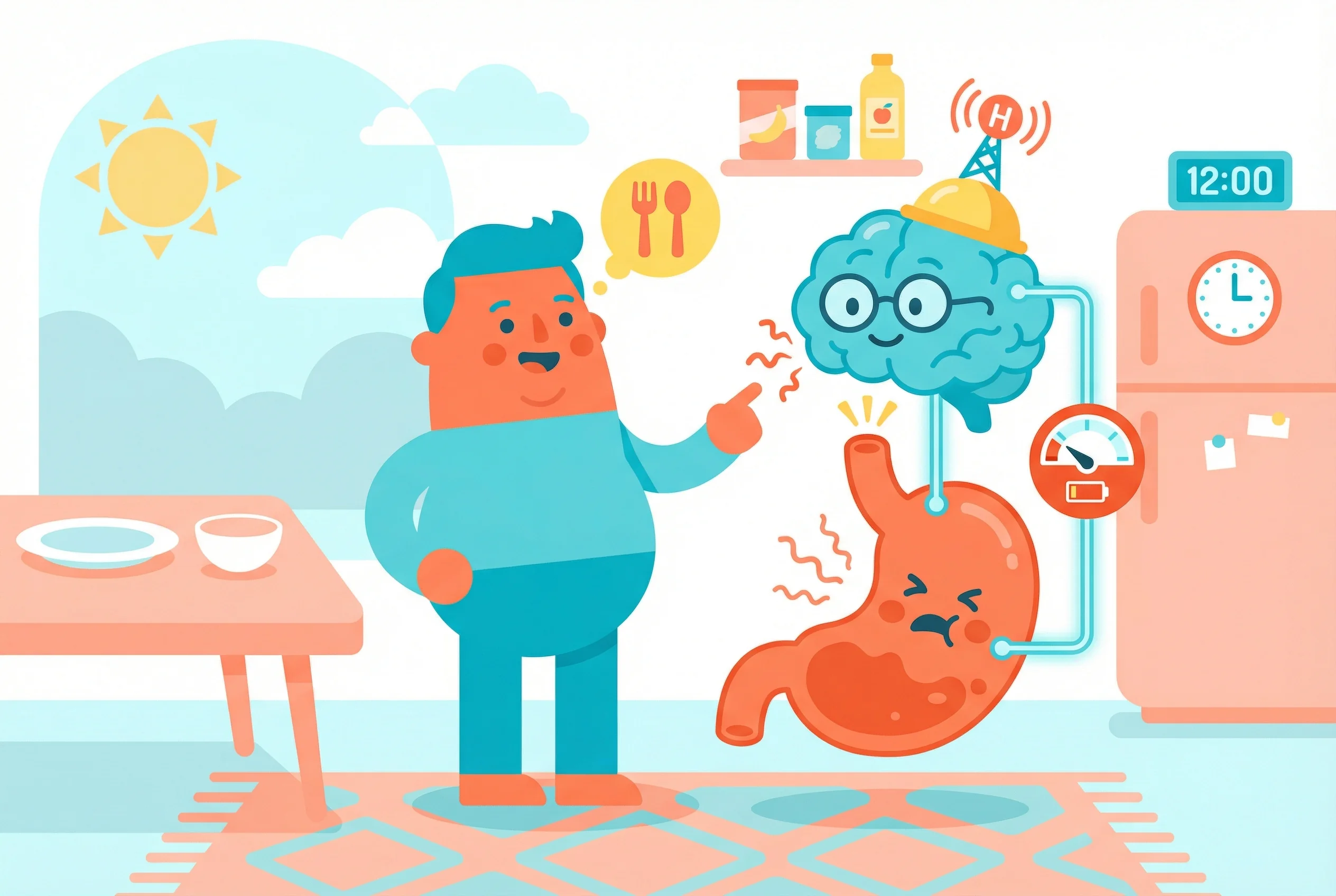
✓Correct — Correct! Hunger is controlled by your brain, not your stomach. When blood sugar levels drop, your brain detects this change. It releases hormones like ghrelin that signal hunger. Your stomach may growl, but that's just movement, not emptiness. This system ensures your body gets energy before reserves run too low.
BDigestive system needs work
✗Not quite — Wrong. The digestive system doesn't need to work constantly. Hunger signals come from the brain detecting low blood sugar, not from the digestive system needing activity.
CBody temperature decreases
✗Not quite — Wrong. While body temperature affects metabolism, hunger is primarily triggered by the brain detecting drops in blood sugar levels, not temperature changes.
Answer this question
Food, Taste, and Kitchen Chemistry
AIt aligns gluten proteins into elastic networks
✓Correct — Correct! When you knead dough, two wheat proteins (gliadin and glutenin) combine with water to form gluten. The mechanical action of kneading aligns these gluten strands into organized, springy networks that can stretch and trap gas bubbles produced by yeast. This is why bread dough becomes smooth, elastic, and can be stretched thin without tearing - the gluten network acts like tiny springs throughout the dough.
BIt adds air bubbles that make the dough expand
✗Not quite — Wrong. While kneading does incorporate some air, this is not what creates stretchiness. The air bubbles you see are mainly produced later by yeast fermentation. Kneading's main job is developing gluten proteins into elastic networks. Without proper gluten development, dough would tear easily even if it contained air bubbles.
CIt breaks down starch into sticky sugar chains
✗Not quite — Wrong. Kneading does not break down starch molecules. Starch breakdown happens during fermentation when enzymes convert starch to sugars that feed the yeast, but this is a chemical process, not a mechanical one. The stretchy quality comes from gluten protein development, not starch transformation. In fact, over-kneading can eventually break down the gluten network you worked to build.
Answer this question
AMilder acidity prevents rapid clumping
✗Not quite — This is a common misconception. While acidity does cause curdling (lower pH precipitates casein), ginger's pH is around 6.0-6.5, similar to milk, so it's not acidic enough. The real mechanism is enzymatic, not acidic.
BGinger proteases create smooth curd
✓Correct — Correct! Ginger contains the enzyme zingibain, a protease that specifically cleaves casein proteins, forming a fine, smooth gel. Unlike acid coagulation which causes large, grainy clumps, enzymatic coagulation creates a nanoscale network. This is why ginger milk curd has its signature silky texture.
CNatural starches thicken the milk
✗Not quite — Almost! Ginger does contain starch, but at only about 1-2% by weight, it's far too little to thicken milk. The gel you see is purely from protein coagulation. Interestingly, this is similar to how rennet works in cheese making, but with a plant protease.
Answer this question
ASugar balances sour taste on tongue, acidity stays same
✓Correct — Correct! Sugar does not change the actual acid content or pH of tomato sauce. Instead, it works through taste perception. Our tongue has different taste receptors for sweet and sour. When both are present, the sweet signals partially mask the sour signals sent to our brain, making the sauce taste less acidic even though the acidity remains unchanged. This is why a squeeze of lemon on bitter greens or a pinch of salt on watermelon enhances flavor - taste interaction, not chemistry!
BSugar neutralizes citric acid through chemical reaction
✗Not quite — Wrong. Sugar (sucrose) does not chemically react with the citric acid or malic acid in tomatoes under normal cooking conditions. A true neutralization reaction requires a base (like baking soda) to react with acid, producing water and a salt. Sugar is neither acidic nor basic - it is pH-neutral. If sugar actually neutralized the acid, the tomatoes would lose their characteristic tangy flavor entirely, which does not happen.
CSugar raises pH level making sauce less acidic
✗Not quite — Wrong. Adding sugar does NOT change the pH of tomato sauce. Tomatoes typically have a pH of 4.2-4.9, and this remains the same whether sugar is added or not. You can test this with pH strips - sugared and unsugared tomato sauce will show identical pH readings. Only adding a base like baking soda would raise pH. The perceived reduction in sourness is purely a sensory effect happening on your taste buds and in your brain's flavor processing.
Answer this question
ARaw onions are less ripe
✗Not quite — Wrong. Raw and cooked onions are the same ripeness. Heat chemically transforms the compounds responsible for onion flavor.
BHeat converts sulfur compounds
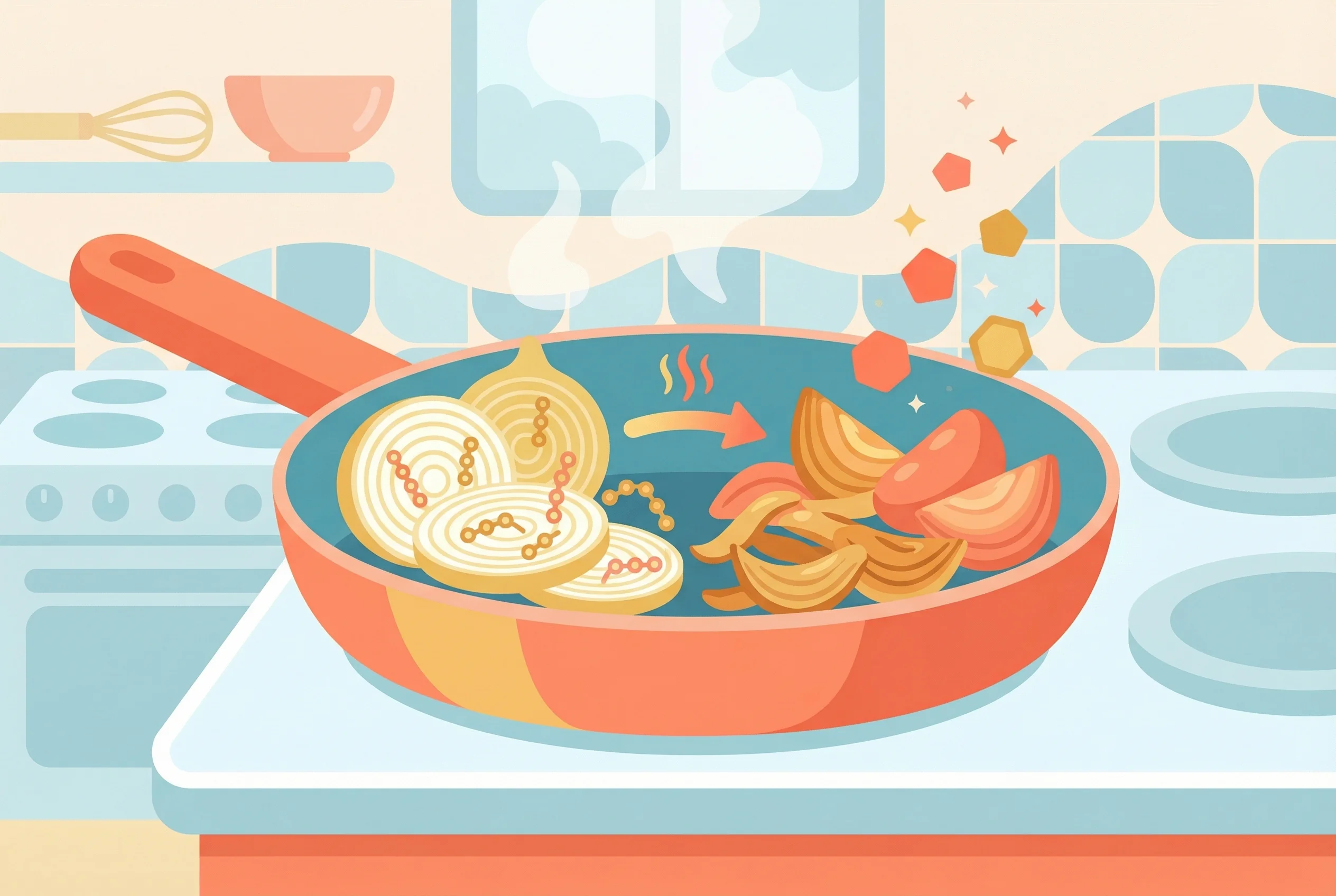
✓Correct — Correct! Raw onions contain sulfur compounds that taste sharp and make you cry. When cooked, heat breaks down these harsh sulfurs (like propanethial S-oxide) and converts them into sweeter, milder compounds. Caramelization of onion sugars also adds sweetness. Same onion, completely different chemistry!
CCooking adds salt and seasoning
✗Not quite — Wrong. Even plain cooked onions without seasoning taste different from raw. The change is chemical transformation from heat, not added ingredients.
Answer this question
AFat melts and lubricates muscle fibers while releasing flavor compounds
✓Correct — Correct! Marbling is intramuscular fat that melts at around 130-140°F during cooking. As it melts, it physically separates and lubricates the muscle fibers, making them easier to chew. The fat also contains flavor compounds and amino acids that create rich, savory tastes when heated, producing the characteristic 'beefy' flavor we love in well-marbled steaks.
BWhite fat strands make the meat look prettier so it tastes better psychologically
✗Not quite — Wrong. While presentation affects perception, marbling's benefits are physical and chemical, not psychological. The fat actually melts during cooking and cannot be seen in the finished steak. The tenderness and flavor improvements are real biochemical effects from fat interacting with muscle tissue and heat, not just visual appeal.
CFat absorbs more heat so the steak cooks faster and stays juicier
✗Not quite — Wrong. Fat actually conducts heat more slowly than muscle tissue, not faster. Additionally, fat melting does not make steak cook quicker. The tenderness comes from fat lubricating fibers as it melts, and juiciness is maintained because the melted fat coats the meat, but this is different from cooking speed or heat absorption.
Answer this question
Physics You Can Feel in Real Life
ADark fabric absorbs light energy and converts it to molecular vibrations (heat)
✓Correct — Correct! Dark surfaces absorb photons across most wavelengths instead of reflecting them. The absorbed electromagnetic energy causes molecules in the fabric to vibrate more rapidly. Since temperature is a measure of molecular motion, this increased vibration makes the material feel hot. White surfaces reflect most light, so less energy is available for conversion to heat.
BDark colors attract more sunlight rays like a magnet pulls metal
✗Not quite — Wrong. Light does not have magnetic properties, and color cannot 'attract' more photons. The difference is that dark surfaces absorb photons that strike them, while light surfaces reflect those same photons away. Both receive equal amounts of sunlight, but dark materials keep the energy while white materials bounce it back.
CDark dye molecules generate their own heat when exposed to any light
✗Not quite — Wrong. Dye molecules do not generate heat independently. They simply determine which wavelengths are absorbed versus reflected. When dark dyes absorb light photons, they transfer that incoming energy to the surrounding material structure. The heat comes from the absorbed sunlight, not from any internal chemical reaction in the dye itself.
Answer this question
AHoney's large sugar molecules and strong bonds create high viscosity
✓Correct — Correct! Honey contains large sugar molecules (like fructose and glucose) that form strong hydrogen bonds with each other. These intermolecular forces make the molecules resist sliding past one another, creating high viscosity. Water molecules are much smaller and have weaker bonds, allowing them to flow freely. This is why honey flows about 10,000 times slower than water at room temperature.
BHoney is heavier, so gravity pulls it down more slowly
✗Not quite — Wrong. While honey is denser than water (about 1.4 times heavier), density does not determine flow speed. Gravity pulls on all liquids equally based on their mass. Mercury is much heavier than honey but flows quickly because it has low viscosity. The flow resistance comes from internal friction between molecules (viscosity), not weight.
CHoney has tiny air bubbles that block the flow
✗Not quite — Wrong. Pure honey contains virtually no air bubbles - it is nearly 80% sugars dissolved in 20% water. Air bubbles would actually make a liquid flow slightly faster by reducing friction, not slower. Honey's slow flow is entirely due to viscosity from intermolecular forces, not trapped air. You can verify this by observing that clear, bubble-free honey still flows very slowly.
Answer this question
AMarching in step creates resonance that can amplify vibrations dangerously
✓Correct — Correct! When many people march in perfect rhythm, their footsteps create periodic forces at a specific frequency. If this frequency matches the bridge's natural resonant frequency, the oscillations amplify exponentially through resonance - like pushing a swing at just the right moment. The 1850 Angers Bridge collapse in France killed 226 soldiers due to this phenomenon, leading militaries worldwide to adopt the 'break step' rule when crossing bridges.
BThe combined weight is too heavy if they step together
✗Not quite — Wrong. The total weight of soldiers is the same whether they march in step or not - weight does not change based on timing of footsteps. Modern bridges are designed to hold far more weight than a group of soldiers. The real danger comes from the rhythmic timing of forces, not the total force magnitude.
CSynchronized movement creates excessive wind resistance
✗Not quite — Wrong. Wind resistance is negligible for human walking speeds and has nothing to do with bridge safety. The danger comes from mechanical resonance - when periodic forces match a structure's natural frequency. This is a vibration phenomenon, not an aerodynamic one. Even in still air with no wind, marching in step remains dangerous on certain bridges.
Answer this question
AThe balloon becomes electrically charged and attracts the wall
✓Correct — Correct! When you rub the balloon on your hair, electrons transfer from your hair to the balloon, making it negatively charged. This charged balloon then attracts positive charges in the wall through a process called 'electrostatic induction', causing it to stick. This is the same force that makes your hair stand up or causes a spark when you touch a doorknob in winter.
BThe rubbing makes the balloon surface sticky and adhesive
✗Not quite — Wrong. The rubbing does not make the balloon sticky or adhesive. If you touch the balloon after rubbing, you will notice it feels the same as before - smooth and rubbery, not sticky. The sticking to the wall is caused by electrical forces, not adhesive properties. You can test this by trying to stick an unrubbed balloon to the wall - it will not stick.
CThe balloon heats up and melts slightly to grip the wall
✗Not quite — Wrong. The balloon does not heat up enough to melt or change its surface. Rubber balloons require very high temperatures (over 180 degrees Celsius) to melt, and rubbing generates only a tiny amount of heat. If melting were the reason, the balloon would feel hot to touch and would leave marks on the wall, which does not happen.
Answer this question
ATheir moment of inertia decreases, so spin speed increases to conserve angular momentum
✓Correct — Correct! Angular momentum (L = Iω) stays constant. When moment of inertia (I) decreases by pulling mass closer to the rotation axis, angular velocity (ω) must increase proportionally. This is why skaters can control their spin speed by changing arm position.
BPulling arms in creates more air resistance that pushes them around faster
✗Not quite — Wrong. Air resistance actually opposes rotation and slows the skater down. Pulling arms in reduces the surface area exposed to air, slightly decreasing drag rather than increasing it. The speed increase comes from physics principles, not air flow.
CThe muscle force from pulling generates extra rotational energy
✗Not quite — Wrong. While pulling arms in requires muscle force, this does not add rotational energy to the system. The total angular momentum was established by the initial push-off. The skater is simply redistributing existing rotational energy by changing body configuration.
Answer this question
Everyday Technology and Built-World Whys
AIt predicts how air flows around the car to minimize drag
✓Correct — Correct! The Navier-Stokes equations describe fluid motion mathematically. Engineers use computer simulations to solve these equations and see how air flows over different car designs. This reveals areas of high drag, turbulent vortices, and pressure differences. By testing thousands of virtual shapes, they find designs that slip through air smoothly, reducing fuel consumption by up to 20% compared to boxy designs.
BIt calculates the car's weight distribution for better balance
✗Not quite — Wrong. While weight distribution is important for car handling, it involves principles of mechanics and center of mass, not fluid dynamics. The Navier-Stokes equations specifically describe how fluids like air and water move and interact with surfaces. Weight calculations use Newton's laws of motion, not fluid flow equations.
CIt measures the engine temperature to prevent overheating
✗Not quite — Wrong. Engine temperature management involves thermodynamics and heat transfer, not aerodynamics. While there are equations for heat flow, the Navier-Stokes equations specifically model fluid motion like air flowing around the car's exterior. Temperature sensors and cooling system designs use different physical principles than those governing aerodynamic efficiency.
Answer this question
ASmooth surfaces reflect light rays in parallel directions
✓Correct — Correct! When light hits a smooth surface like a mirror, the microscopic flatness means all light rays bounce off at the same angle (angle of incidence equals angle of reflection). This 'specular reflection' preserves the image. Rough surfaces have tiny bumps and valleys that scatter light in random directions ('diffuse reflection'), destroying the image but making the surface visible from all angles.
BMirrors contain special chemicals that capture light
✗Not quite — Wrong. Mirrors do not contain chemicals that 'capture' light. A typical mirror is simply glass with a thin aluminum or silver coating on the back. The reflection happens because of the smooth surface geometry, not chemical properties. Even polished metal or calm water can create clear reflections without special chemicals.
CRough surfaces absorb all the light that hits them
✗Not quite — Wrong. Rough surfaces actually reflect most light - that is why you can see a white wall! The wall appears white because it reflects light in all directions (diffuse reflection). If it absorbed all light, it would appear black. The difference is not absorption versus reflection, but organized reflection (smooth) versus scattered reflection (rough).
Answer this question
AColor temperature adjustment soothes eyes
✗Not quite — This is a common misconception. While colored tints can change color perception, the primary comfort from tinted glasses comes from reducing the overall brightness, not adjusting color temperature. Some tints like amber may improve contrast in specific conditions, but the main effect is still light reduction.
BReduced light transmission reduces glare
✓Correct — Correct! Tinted glasses absorb some of the incoming light, lowering the total light intensity that reaches the eyes. This reduces glare and the need for your pupils to constrict as much, making bright outdoor light feel much more comfortable. This is why even lightly tinted or polarized lenses can be effective.
CBlocking ultraviolet radiation protects eyes
✗Not quite — Many people think UV protection is the key, but UV rays don't contribute significantly to brightness perception. While UV protection is crucial for long-term eye health, it does not affect how bright the light appears. In fact, clear glasses can block UV without reducing glare at all.
Answer this question
AShared irrigation systems required precise coordination between farms
✓Correct — Correct! Japanese rice paddies used terraced fields where water flowed from higher to lower plots. Each farmer controlled water gates that affected downstream neighbors. If one person used too much water or released it at the wrong time, entire villages could face crop failure. This physical interdependence made cooperation (wa) essential for survival, not just a philosophical ideal. Communities developed detailed schedules and rules for water sharing that required constant communication and compromise.
BRice plants grow better when farmers meditate together in the fields
✗Not quite — Wrong. While some agricultural rituals existed, rice plants respond to water, sunlight, and nutrients, not human meditation. The practical need for 'wa' came from the engineering reality of shared water systems. One farmer's gate control could flood or dry out neighboring fields, making technical coordination far more important than spiritual practices. The cultural value emerged from solving real irrigation problems.
CAncient emperors mandated teamwork through religious ceremonies
✗Not quite — Wrong. Though emperors influenced culture, 'wa' developed organically from farming communities facing shared challenges. The terraced paddy system meant water management required village-wide cooperation long before central authority could enforce it. Farmers created 'wa' principles themselves because their irrigation networks physically connected their fates. Religious ceremonies came later to reinforce already-existing practical cooperation habits born from hydraulic necessity.
Answer this question
AInterlocking of wedge-shaped teeth
✓Correct — The zipper slider forces the teeth together, causing the wedge-shaped protrusions to interlock securely. This design distributes stress evenly, making it stronger than a single latch or friction-based fastener.
BFriction between angled surfaces
✗Not quite — While friction does help keep the zipper closed, the primary mechanism is geometric interlocking. Without the wedge shape, friction alone would be insufficient to hold fabric edges under tension. Similarly, Velcro is often mistaken for friction-based but actually uses hook-and-loop interlocking.
CMagnetic attraction of metal teeth
✗Not quite — Most zipper teeth are made of non-magnetic materials like brass, nickel, or aluminum. The locking comes from mechanical interlocking, not magnetic forces. Plastic zippers further prove this, as they have no magnetic properties yet lock just as well.
Answer this question
Want tomorrow's question?
Open one free question a day, see the answer, and keep the explanation in your head longer than a fact you only skimmed.
Try Trivia Question of the DayFrequently Asked Questions
What is a daily general knowledge quiz?
It is a short mixed-topic quiz you can use every day, usually with questions from science, animals, history, food, space, and everyday life. The best version gives the answer plus a short explanation, not just a score.
Where can I find a free daily quiz with answers?
AIgneous Million Whys has a free Trivia Question of the Day page with one question, answer, and explanation. This article gives you a larger set when you want more than one round.
Is a general knowledge question of the day better than a long quiz?
Often, yes. A single question creates a clean information gap. If you get it wrong and then read why, the closure can stick better than skimming a long list of facts.
Can I use these questions for a team or pub quiz?
Yes. The sections are broad enough for a casual mixed round, and each card includes the answer plus the reason, so the host can explain the point instead of just reading a letter.
What does this have to do with AIgneous Million Whys?
Million Whys is built around tiny curiosity loops: notice a gap, choose an answer, get real closure, then let the next question appear. A daily quiz is not a study chore here; it is a 10-second spark that compounds.