
Why Is Snow White? the Scattering Answer
On this page· 17
Snow is white because a snowpack is a crowd of mostly clear ice crystals that scatter every visible color back to your eye at nearly the same strength, not because white pigment is mixed into it. A typical grain has a radius of about 100 micrometers, and a few centimeters of the stuff is already enough to hide whatever sits underneath.
So why does a snowball look like a scoop of paint? That's the gap the usual explanation leaves open. People accept that snow reflects light, then picture white paint doing the reflecting, and that picture is wrong in a way that matters.
An ice cube on the counter is clear. A frozen puddle is clear. The ice in a glass of water is clear. Snow is the same water, frozen the same way, and it comes out the color of a blank page. The arrangement is doing the work, not the material.
The Short Answer for Why Snow Is White
Name the wrong guess first, because it shapes everything after it. White paint is white because it holds pigments such as titanium dioxide that absorb most wavelengths and reflect a broad mix. Snow holds no such pigment. Its ice is transparent to visible light, and a melted snowball gives you clear water, not white water.
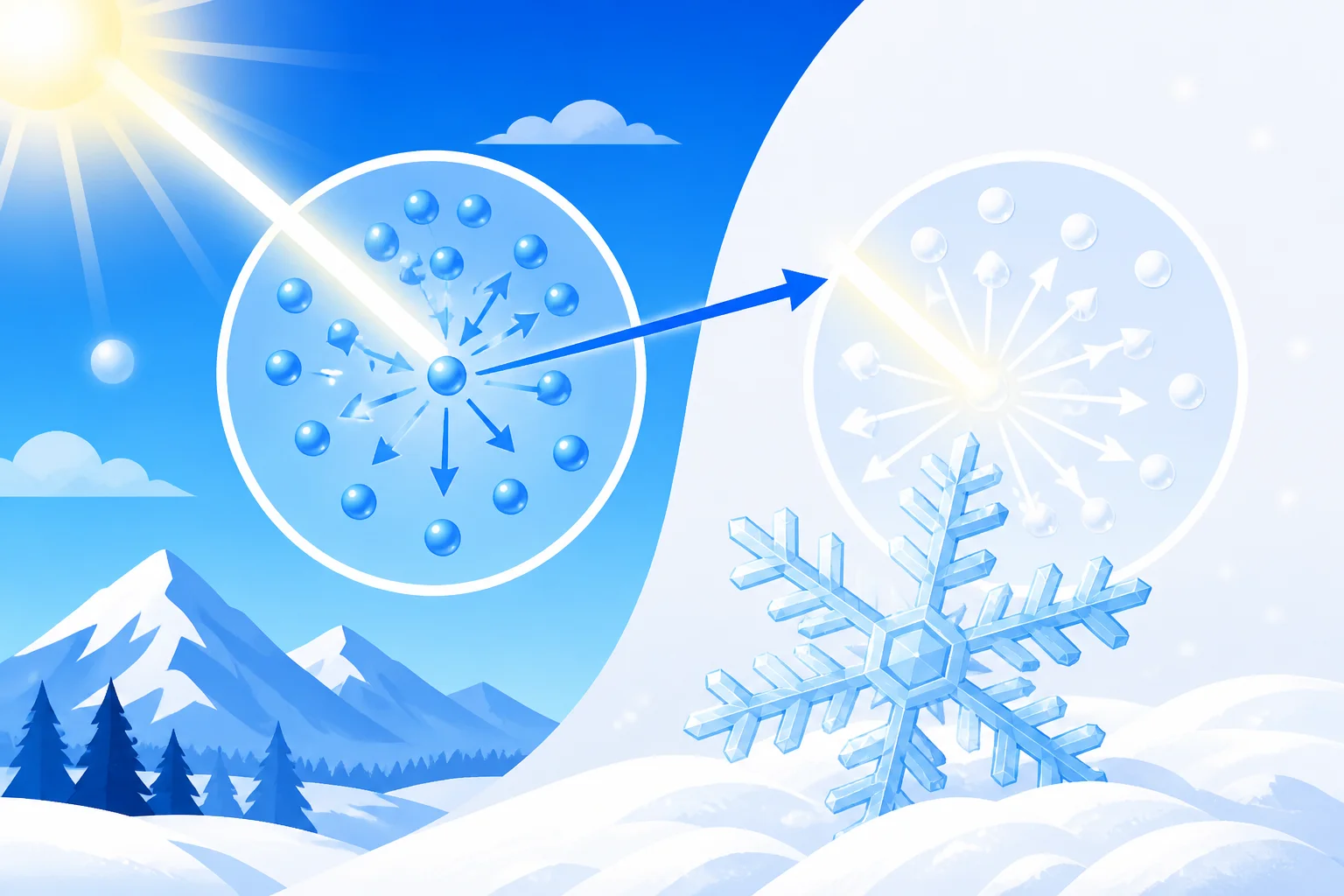
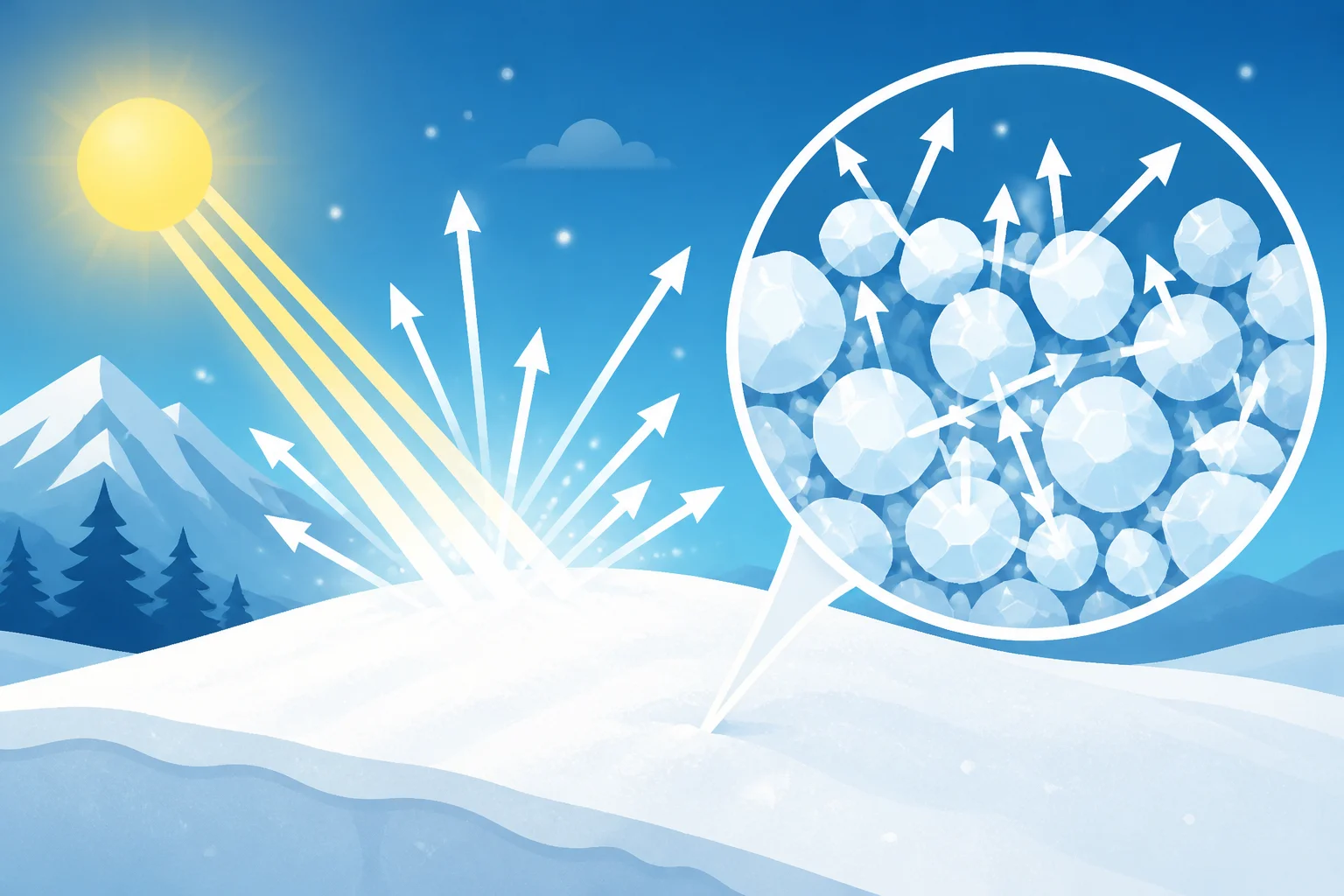
What snow has instead is surface area, multiplied a few million times over. One ice crystal is a solid shape with a handful of faces, so light entering one side mostly keeps going and leaves the other. A snowpack is a loose heap of those crystals with air in the gaps, and every gap is a boundary where light changes speed and direction. The California Institute of Technology snow crystal FAQ compares the result to crushed glass: the many interfaces stop light from passing straight through, so it gets thrown back out toward whoever is looking.
The mental swap: stop thinking of snow as a white solid and start thinking of it as clear ice cut into thousands of tiny lenses sitting in air.
Why is snow white at all, if the ice is clear? Because sunlight arrives already carrying violet through red in roughly balanced amounts, and a mass of ice grains returns those colors with broadly similar efficiency. The mixture that reaches your eye reads as white.
Once that lands, two puzzles appear. Deep snow sometimes looks blue, and dirty snow sometimes looks pink, gray, or green. Neither needs a new substance to explain, and both come back to how far light travels before it escapes.
Question 1 of 6
What causes the white color of a snowpack?
How Clear Crystals Scatter Every Color
Follow one sunbeam down onto fresh snow and the ray does something odd for a transparent material. It hits the top grain, meets an ice-air boundary, and most of it turns back up. The small share that gets inside crosses a grain a tenth of a millimeter wide, hits another boundary, and is redirected again, sometimes downward, often sideways.
That redirection is scattering, and snow does a lot of it because the refractive index of ice differs sharply from the refractive index of the air in the gaps. Each boundary bends or bounces the ray. The snow optics study indexed in PubMed Central puts typical grain radii around 100 micrometers, large compared with the wavelength of visible light, so the process is ordinary reflection and refraction at surfaces rather than the tiny-particle scattering that colors the sky.
Why This Isn't the Sky's Blue Trick
Plenty of people reach for the sky explanation when they hear the word scattering, and it doesn't fit. Air molecules are far smaller than a wavelength of light, and that geometry scatters short blue wavelengths much more than long red ones. Snow grains are hundreds of times larger than a molecule and roughly a hundred times larger than a wavelength, so they scatter red, green, and blue with nearly equal efficiency. The same size difference is why the sky is blue while a cloud, which is also made of water, is white. Clouds and snow are optical cousins.
The Numbers on the Return Path
Because the scattering is broad and even, the light that leaves is a mixture rather than a hue. The albedo figures from that same snow optics work show how flat the curve runs across the visible band.
| Benchmark | Value | What it tells you |
|---|---|---|
| Typical grain radius | About 100 micrometers | Grains are large compared with visible wavelengths |
| Refraction events before much absorption | About 1,000 | Light is redirected many times among grains |
| Cumulative path inside ice | About 20 centimeters | Visible absorption stays limited |
| Antarctic surface albedo at 400 nm | About 0.99 | Blue light is almost fully returned |
| Antarctic surface albedo at 700 nm | About 0.96 | Red light is returned nearly as well |
| Depth that can already look white | A few centimeters | Enough bounces to block a straight path |
Pure ice absorbs very little visible light, which is why the bounces don't drain color out along the way. After roughly 1,000 refraction events, the distance a photon has covered inside solid ice can still be only about 20 centimeters, and 20 centimeters of ice is nowhere near enough to swallow red or green. The colors arrive together, and human vision reads that balanced mixture as white.
Here's where one crystal and a whole snowbank part company. Hold a single clear crystal and it looks like glass, because light crosses it in one or two straight passes. Look at a drift and you're seeing the sum of thousands of escapes from a porous network, each carrying a slightly different path length and direction. The white lives in the sum, not in any one grain.
Question 2 of 6
Why does snow look white when the sky, also made of tiny scatterers, looks blue?
How Much Sunlight Fresh Snow Sends Back
Turn the color question into an energy question and the number gets big. NASA Earthdata reports that fresh snow's albedo, the fraction of incoming sunlight a surface reflects, can reach 0.9, so clean new snow may send up to 90 percent of the sunlight hitting it back toward space (NASA Earthdata on albedo). That's the planetary-scale version of the same near-surface bouncing.
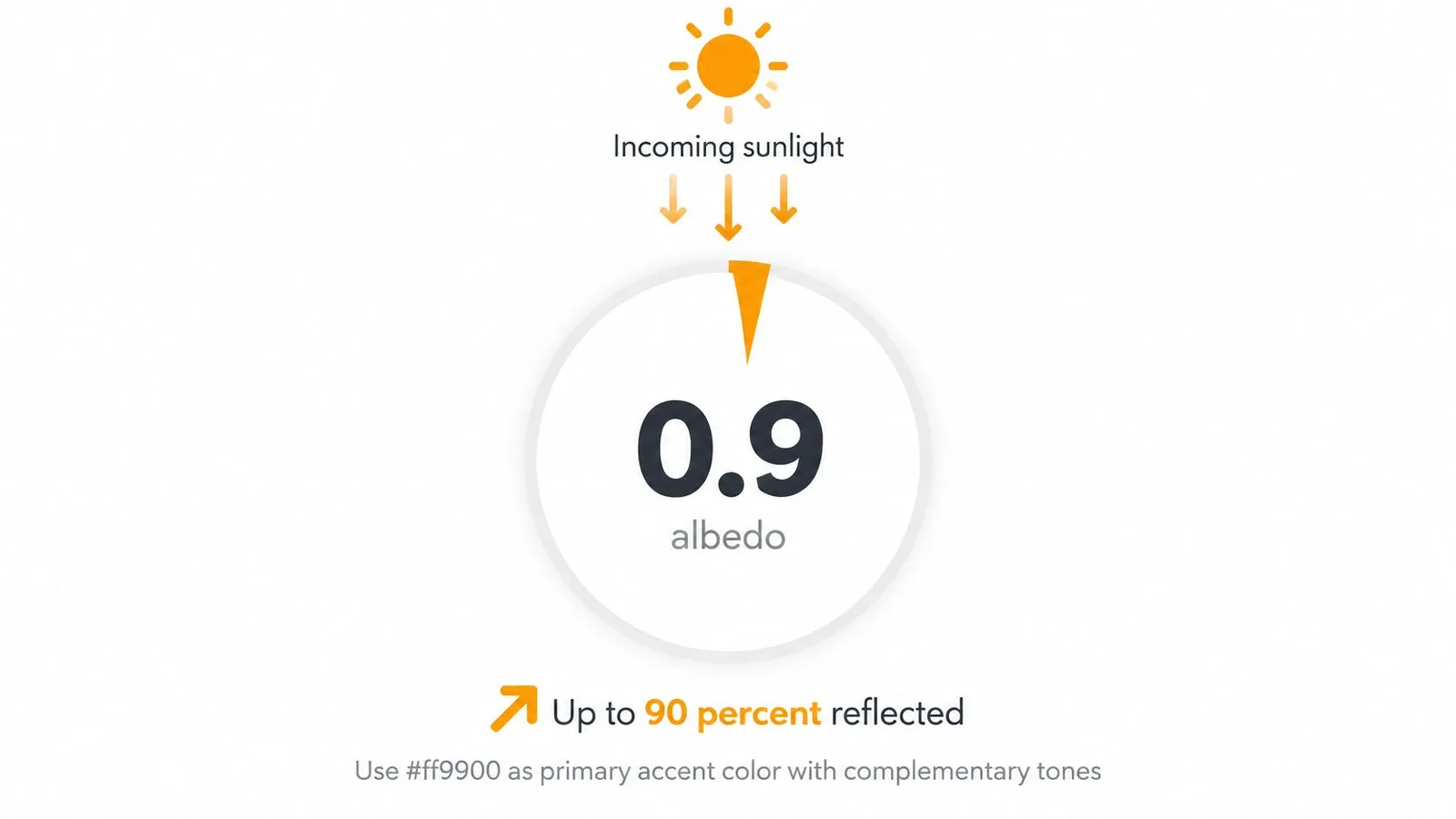
Two fences sit around that 90 percent. It fits clean, fresh snow under suitable illumination. It does not describe a wet, grimy, wind-packed spring snowfield, and it doesn't describe the gray slush at the edge of a parking lot.
What Aging Does to the Bounce
Wind, melting, refreezing, and compression all grow the grains and weld them together. Bigger, rounder grains mean fewer ice-air boundaries per unit of depth, so more light gets inside the ice and stays long enough to be absorbed. The surface looks duller and the albedo falls. Dirt, soot, algae, and liquid water add their own damage, shifting the appearance toward gray, brown, green, or blue.
The Wavelength Split Your Eyes Can't See
Visible brightness hides a second story in the near-infrared. Snow optics measurements show that a 10-centimeter layer transmits only about 5 percent of incident irradiance near 500 nanometers, while transmission near 800 nanometers can drop below 1 percent (snow optics reference from the University of Colorado). Ice absorption climbs toward longer wavelengths, so the near-infrared band reacts far more sharply to grain size and age than the visible band does.
That split matters for anyone modeling a surface. A snowpack can look convincingly white in a photograph and still behave quite differently in the infrared, so energy-balance work keeps visible and near-infrared albedo apart. Satellite retrieval and melt models depend on it, and so does any honest account of why the sun looks yellow to human eyes while carrying invisible energy past the red end.
One consequence scales up. When bright snow covers more ground, more solar energy returns to space. When it melts or darkens, the ground beneath keeps more of that energy, and the loss feeds itself.
Question 3 of 6
Fresh clean snow can reflect up to about what share of the sunlight that hits it?
Why Deep Snow and Glacier Ice Look Blue
A glacier guide will tell you the ice is blue and the snow on top of it is white, and both statements are true of the same water. The temptation is to assume the blue ice must be a different material, or that minerals worked their way in. Neither is needed. Path length does the whole job.
Start at the surface. Light entering the top few centimeters bounces a handful of times and exits while red, green, and blue are still roughly in balance. Short return path, white result. Now look into a crevasse or a melt hole a meter deep. A photon that penetrates that far gets scattered many more times before it finds a way out, and each pass through ice costs it a little. Ice absorbs red somewhat more strongly than blue, so the longer the trip, the more the escaping light leans blue or cyan.
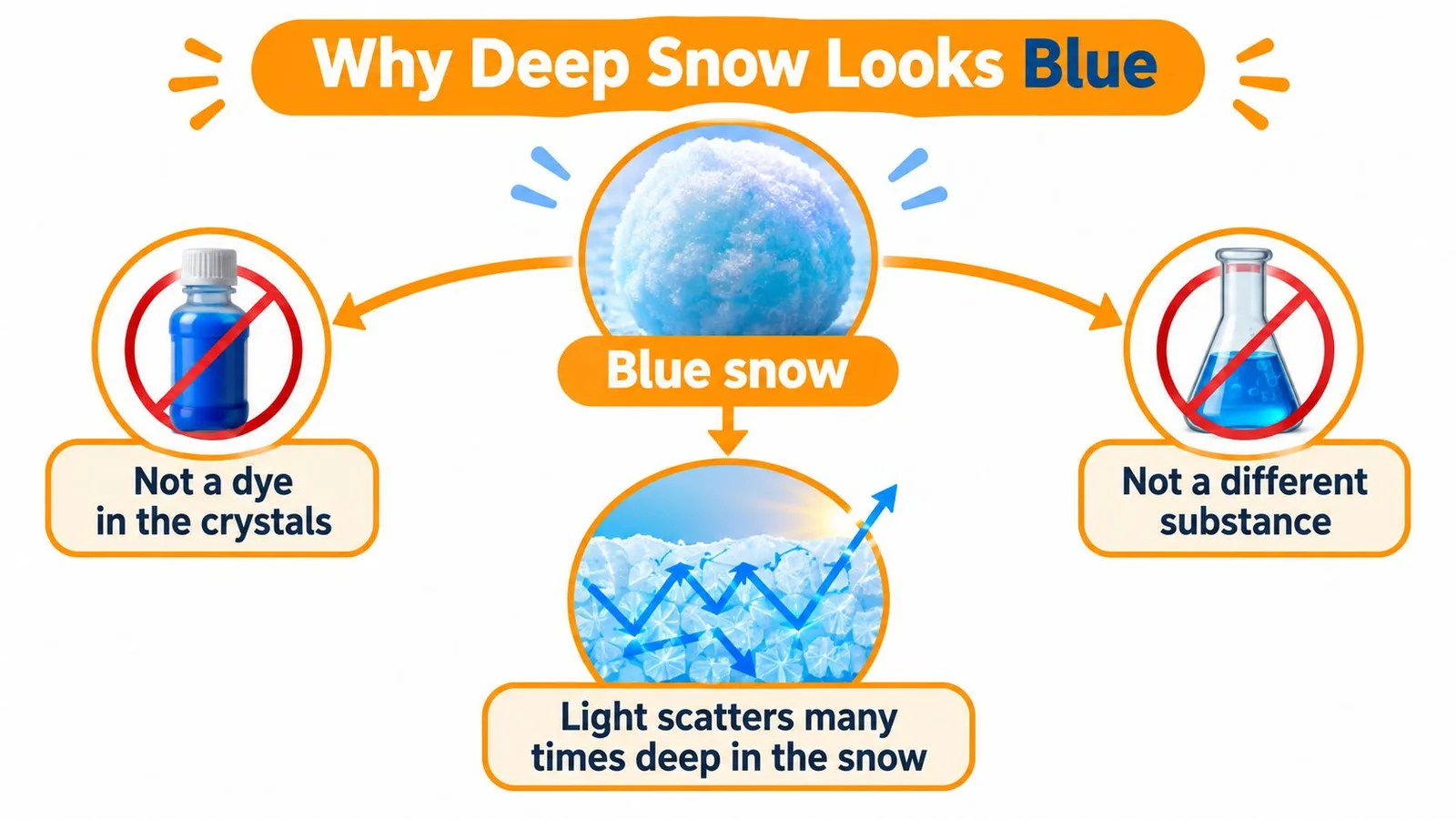
The snow sparkle and optics paper from Montana State University describes the same transition, noting that blue tints become more likely over distances of roughly a meter or more, while a few centimeters of snow can already look white because light scatters back quickly. Nothing about the temperature changes at that depth. Only the distance.
Same Ice, Different Path
Ordinary white snow and blue-looking snow can share identical clear ice. Thickness, compaction, and viewing geometry decide which one you see.
Compaction matters because dense ice has fewer air gaps and longer uninterrupted stretches between scattering events, so light travels further through the absorbing material before it escapes. The density difference between ice and water is the same property behind why ice floats on water, and inside a snowpack it changes how far a ray gets between bounces. Shadow and viewing angle matter too, because they change how much of the escaping light reaches your eye.
The Glacier and the Iceberg
Deep icebergs and glacier ice look blue for exactly this reason, and you can test it from a boat. A berg that has thinned near the waterline shows paler blue where the light path is shorter and a saturated blue in the thick interior. Loose snow on the same shoreline, a few centimeters thick, stays white. Color tracks geometry, not chemistry.
What Sparkle Is Not
Sunlight glinting off individual grains on a cold morning is a surface effect, one facet catching the light and throwing it at you. It isn't evidence of a different pigment, and it isn't the same phenomenon as the blue of deep ice. If the tint in front of you is pink, brown, or gray rather than blue, path length has stopped being the main cause.
Question 4 of 6
Why do glaciers appear blue?
Other Colors and What They Actually Mean
No single explanation covers every colored snowbank. Blue is a path-length effect in clean ice. Most other colors are an added ingredient, and which ingredient shows up changes what the surface does with sunlight.
| Color you notice | Usual cause | Same clear ice? | What to check |
|---|---|---|---|
| Bright white | Short path and many ice-air surfaces | Yes | A few centimeters of clean fresh snow |
| Blue or cyan | Longer path, ice absorbs more red than blue | Yes | Look deep into a drift, melt hole, or glacier face |
| Pink or red | Algae with red carotenoid pigments | No | Patchy watermelon snow in cold alpine snow |
| Brown or gray | Mineral dust, soil, smoke, or soot | No | A dirty film or a recent dust or smoke event |
| Green | Algal pigments or liquid water | Sometimes | Wet snow or green biological patches |
| Dull white or grayish | Larger bonded grains after aging | Yes | Melt, refreeze, wind packing, fewer surfaces |
Reading the Color in Front of You
Treat those rows as tests rather than trivia.
- Blue. Often confirmable without touching the snow. Check the depth you're seeing into. If the color deepens in a crevasse or a cut drift and fades at the surface, path length explains it.
- Pink or red. Alive, not mineral. Watermelon snow comes from cold-adapted algae carrying red carotenoid pigments, and it shows up in patches at high elevation or late in the melt season, often with a faint watermelon smell.
- Brown or gray. Usually something that landed: windblown dust, soil splashed from a road edge, smoke, or soot. You can often date the arrival by the layer it sits in.
- Green. The messiest category. Algal pigments tint snow, and so does liquid water, which changes how light moves through the surface layer. Wet greenish snow at the edge of a melt pond is telling you about water content as much as about biology.
- Dull white. No additive at all. Aged, bonded, wind-packed snow has fewer scattering surfaces per unit of depth, so less light comes back and more is absorbed on the way through.
A caution worth keeping: a pink patch and a gray patch can look equally dark in a photo and share nothing. One is biology, one is combustion or dust, and they carry different implications for melt, ecology, and air quality.
None of this is a curiosity to file away. Once you know which cause is in front of you, the useful follow-up is a prediction about energy.
Question 5 of 6
What gives watermelon snow its pink or red colour?
What Darker Snow Does to Sunlight and Melt
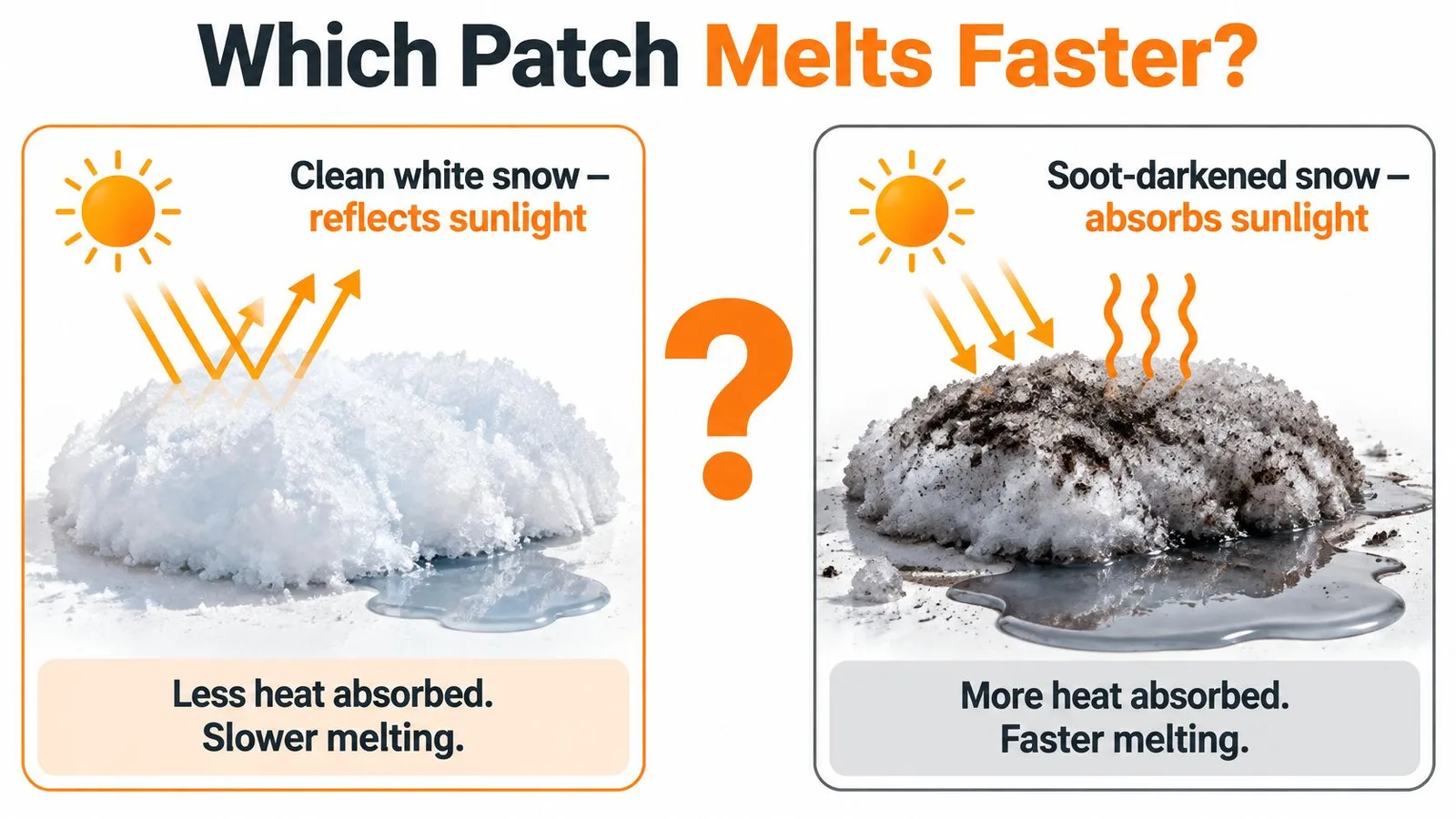
Two patches of snow, same sun, same air temperature, same slope. One is clean and white. One is gray with a week of traffic film or a dust fall. Which melts first?
The gray one. Clean snow sends most of the sunlight back, so it keeps very little of that energy. Once dust, soot, soil, smoke, mineral particles, or algal pigments sit on the grains, the surface absorbs more of what arrives and turns it into heat. The warmed layer melts faster, exposes darker ground or older darker ice, and that surface absorbs even more. The National Snow and Ice Data Center lays out the reflectivity side plainly: clean snow reflects most visible sunlight, and soot, dust, soil, smoke, mineral particles, or biological pigments reduce that reflectivity.
One Measurement Won't Do
A single white-looking sample can't show how much light a dirty layer is losing. That's why NOAA's 2024 snow-albedo campaign collected spectral albedo measurements at seven solar wavelengths, including a 415-nanometer blue channel, to examine how dust and black carbon affect snow's visible reflectance (NOAA snow-albedo campaign abstracts). Spectral data separates the wavelengths, so a small drop in the blue that no camera would catch becomes obvious in the numbers.
Distinct Causes, Shared Energy Result
A thin algal film and a heavy black carbon deposit both darken snow, and they don't carry the same load. One is a biological bloom with its own ecology, the other is combustion particles with air-quality consequences. Treating every colored patch as one phenomenon gets the science wrong and the public health question wrong with it.
That feedback runs through the larger picture of what climate change actually means: snow cover is a vast reflective sheet that either sends solar energy away or, once it darkens and shrinks, lets the ground keep it.
You can run a comparison yourself after a storm. Look at two roofs or two trail cuts at the same air temperature. The bright one still holds its snow while the one filmed with traffic grime has sagged and pulled back from the edges. Absorbed sunlight made the difference, not the air.
Snow color belongs in the surface energy budget. It isn't decoration.
Question 6 of 6
Two patches of snow sit under the same sun at the same air temperature, but one is speckled gray with dust and soot. Why does the gray patch melt first?
Predict the Next Patch Before You Look
A three-part check works on a sidewalk, a ski slope, or a photo a friend sends you. Make the call before you read the caption.
Clean and shallow. If the snow is clean, a few centimeters deep, and sitting on something bright, call it white. The return path is short and the spectrum comes back balanced. This is the case you'll meet most mornings in a city park after a storm.
Deep and dense. If you're looking into a drift cut, a melt hole, or the face of a glacier, call it blue. Light is traveling far enough for ice to remove more red than blue on the way back out. Same water, longer trip.
Something added. If the surface is gray near a road, brown after a windy day on open ground, or pink in a high alpine patch, call it an absorber. You're looking at soot, dust, or algae rather than a new kind of ice, and that patch will keep more of the incoming sunlight than the clean snow beside it.
Then check yourself. Scrape a wall into the drift and watch whether the blue deepens as you go in. Note whether the gray layer sits on top or hides in a buried band. Predict, look, compare.
That habit is the point of a why-question. A Million Whys example starts with why a prism splits light into colors and follows the connection to rainbows or camera lenses, and the same move works here: one question about something you've seen a hundred times opens onto scattering, albedo, and melt.
Two more to try next. Why is the sky blue, and which of two snow patches melts first?
Million Whys is built for exactly this kind of everyday puzzle. The Daily Wonder gives you one featured question each day with a curated knowledge card, an image, and a detailed explanation, so a ten-second guess about snow turns into a working grasp of scattering and albedo. Visit Million Whys and try today's question, then let the follow-up pull you into the next one.
Keep Exploring

Related Posts
Why Is the Sky Blue? The Science of Light Scattering
Why is the sky blue? Follow sunlight through air molecules to see why noon turns blue, sunsets redden, Mars flips the palette, and blue oceans differ.
Why Does the Sun Look Yellow from Earth
why does the sun look yellow? Blue light scatters in air, so the disk looks pale yellow, nearer white at noon, and orange or red when the path is long.
Facts About Light: Color, Shadows, Refraction
Facts about light get easier when you see the mechanism: visible wavelengths, refraction, scattering, shadows, and why color is a question your eyes answer.