

Why Do Stars Die? How Mass Decides the Ending
On this page· 20
If dying stars explode, why won't the Sun end in a supernova? The familiar picture of stellar death leaves out the most common ending: a star shedding its outer layers and leaving a compact, slowly cooling core.
To understand why stars die, start with what keeps them alive. A star must continually release energy to resist its own gravity. Its ending depends on how long it can maintain that support, what happens inside its core, and whether a companion changes its course.
How Starting Mass Sets a Star's Fate
Starting mass is the best first guide to a star's ending. It determines how strongly gravity compresses the interior, how quickly the star uses fuel, and which kinds of fusion its core can sustain.
The NASE guide to stellar evolution describes the broad division at roughly eight times the Sun's mass or less, where stars generally leave white dwarfs, and explains that massive stars can live only millions of years, while low-mass stars may last tens of billions of years.
Starting mass, late-stage event and final remnant
| Starting mass | Late-stage event | Final remnant | Typical lifetime |
|---|---|---|---|
| Sun-like | Expansion into a giant, followed by loss of outer layers | White dwarf | Long-lived compared with massive stars |
| Low- to intermediate-mass | Giant phases and envelope loss | White dwarf | Lower-mass stars generally survive longer |
| Massive | Iron-core collapse, potentially followed by a supernova | Neutron star or black hole | Short-lived because fuel consumption is rapid |
| White dwarf in a binary, gaining material | Possible runaway carbon fusion | A Type Ia supernova can destroy the white dwarf | Timing is set by its companion and mass-transfer history |
The last row is deliberately different. It describes what can happen after a star has already become a remnant, rather than a separate starting-mass category. A quiet ending isn't always the end of the story.
Read the table from the Sun outward
A Sun-like star doesn't have the conditions needed to keep fusing successively heavier elements all the way to an iron core. Its outer layers eventually separate from the compact material left inside. That remaining core becomes a white dwarf.
Stars with greater starting masses can reach more demanding fusion stages. But a larger fuel supply doesn't guarantee a longer life, because the rate of consumption rises dramatically.
Think of fuel tanks attached to different engines. A larger tank can empty sooner if its engine consumes fuel much faster. The same distinction matters in stars: fuel supply and fuel-use rate are different quantities.
Why more mass means less time
More mass produces stronger inward compression. Higher temperatures and pressures then allow much more intense fusion, so a massive star releases energy at a much greater rate.
That gives us a useful reversal of everyday intuition. The biggest stars aren't the longest-lasting ones. They consume their resources rapidly, while less massive stars can maintain a slower, steadier energy supply.
Practical rule: Use starting mass to choose the likely path, then check whether mass loss or a companion could change it.
Find a star's broad mass band and read across to the likely remnant. Treat that result as a well-grounded prediction, not an unbreakable promise about every individual star.
Question 1 of 6
Why does a star born with about eight times the Sun's mass or less end up as a white dwarf, while a heavier star can explode?
Why Fusion Stops and Gravity Takes Over
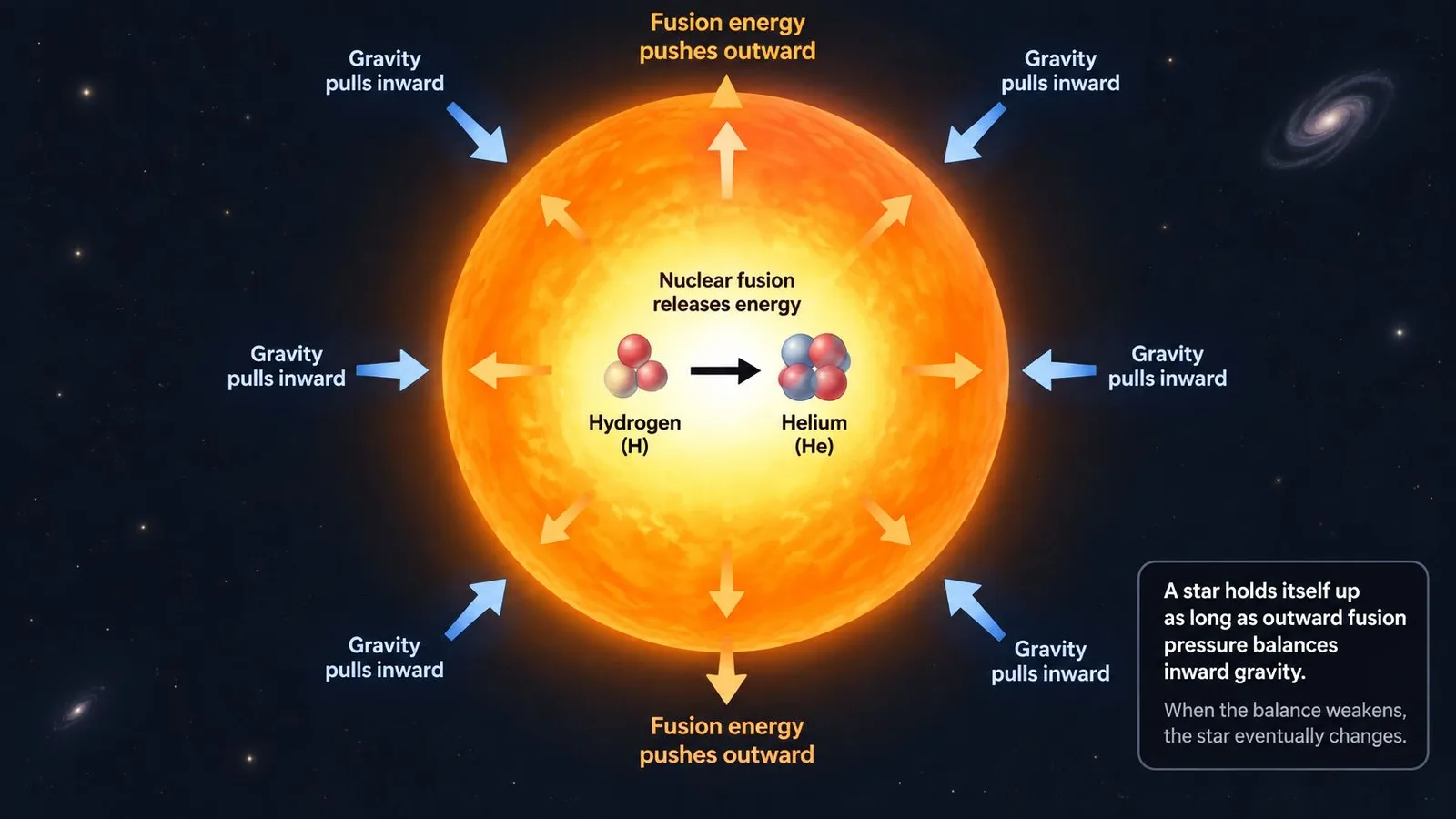
A star spends most of its active life in a balance between inward gravity and outward pressure. Fusion supplies the energy that keeps the interior hot enough to maintain that pressure.
Gravity acts throughout the star, not just at its surface. The same attraction discussed in how gravity works on Earth pulls stellar material inward, although a star's internal conditions are very different from those around us.
Follow the changes inside the core
During the long, stable part of a Sun-like star's life, hydrogen nuclei combine to form helium. This nuclear fusion releases energy, helping the star resist compression.
Eventually, the core's hydrogen supply becomes depleted. That doesn't mean every part of the star has run out of hydrogen. It means the central region can no longer continue its previous energy-producing process.
The core then contracts. Compression raises its temperature, so a shrinking core can become hotter rather than colder.
- Fuel becomes depleted in the core. The previous source of support weakens.
- The core contracts and heats. Gravity compresses the central material.
- The outer layers expand. Changes in the star's internal energy production allow the envelope to swell.
- Another fusion stage may begin. If conditions become suitable, helium can serve as the next fuel.
The apparent contradiction is important: the core can shrink while the star's outer layers grow. A star isn't a solid ball that must expand or contract everywhere at once.
A star isn't a candle
A candle burns through a chemical reaction involving wax and oxygen. A star's energy comes from changes in atomic nuclei, not ordinary combustion.
Nor does exhausting core hydrogen automatically mean the star has finished producing energy. A star can enter another stage, with fusion occurring in a different region or using different fuel.
Stellar death means the end of sustained core fusion as the main source of support, not the disappearance of the star's material.
That distinction explains why an aging star may remain bright, and why a remnant can continue glowing after its main fusion-powered life has ended. Light alone doesn't tell you whether the original energy-producing process is still operating.
The reusable model is simple: core fuel becomes depleted, the core contracts, and the star's mass determines which changes can follow.
Question 2 of 6
Why does a Sun-like star's core shrink while its outer layers expand when it becomes a red giant?
How Sun-Like Stars Fade Into White Dwarfs
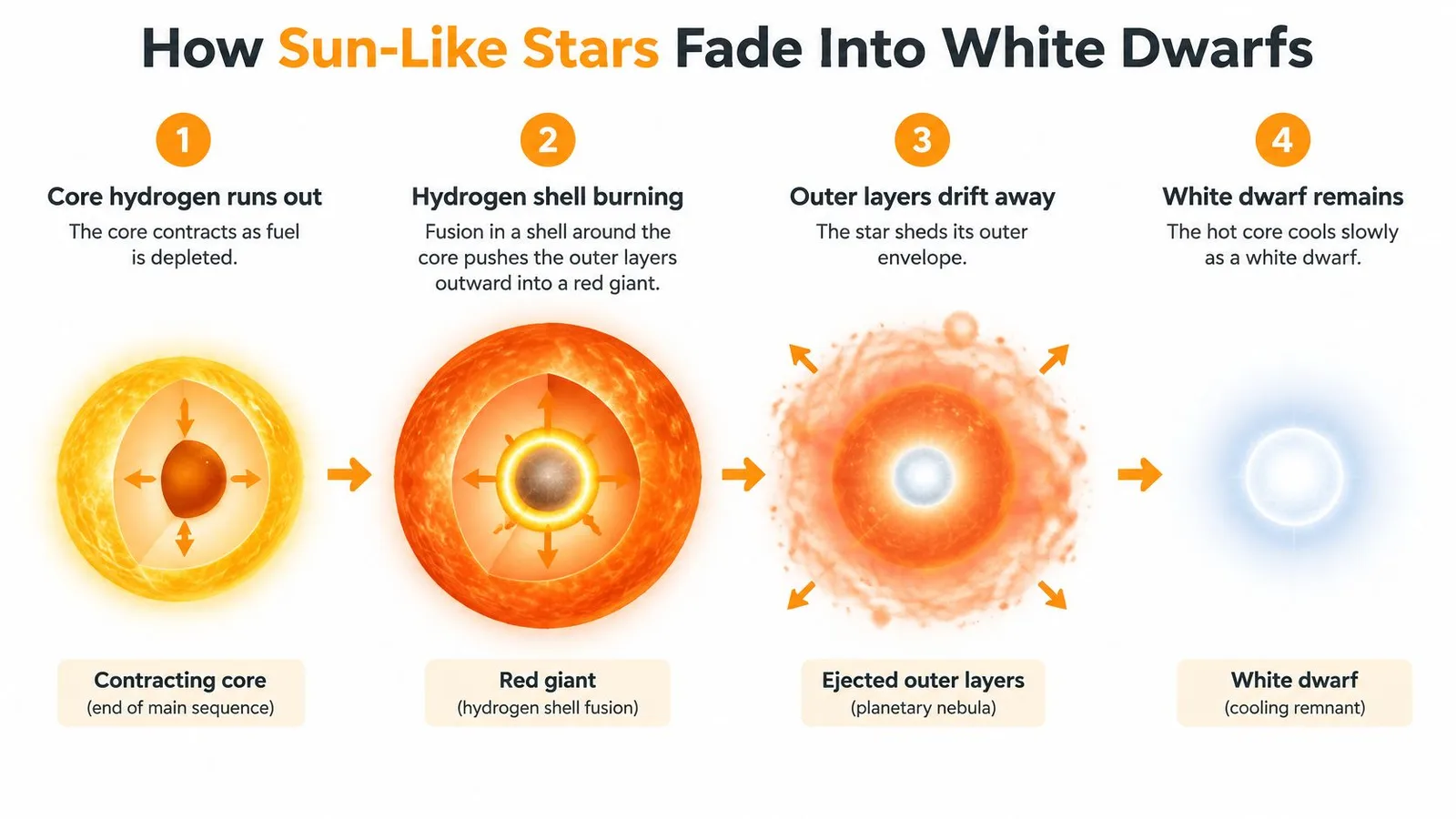
Follow a Sun-like star after its stable hydrogen-fusing stage, and its ending looks less like an explosion than a gradual separation. The envelope expands and eventually escapes, while the central material remains behind.
Fusion can continue in a shell around the contracting core. Later, helium fusion produces carbon and oxygen, changing the composition of the material that will become the remnant.
From giant envelope to exposed core
The red-giant stage can sound like a star just getting larger. Inside, however, different regions are changing in different ways: the central material is compact, while the outer envelope becomes extended.
Eventually, the star sheds that envelope into space. What remains is a white dwarf, a hot, dense remnant rather than an ordinary fusion-powered star.
An ember is a useful analogy. After a fire stops being fed, an ember can still glow because it retains heat. A white dwarf also releases stored heat, although its internal physics is nothing like that of burning wood.
- The envelope is gone. The remnant isn't the original star squeezed down with all its material intact.
- The core remains hot. It can shine without sustained core fusion.
- A different kind of pressure supports it. Its stability no longer relies on the same energy-producing process as before.
What holds a white dwarf up?
The answer is electron degeneracy pressure, a quantum effect that resists squeezing electrons into increasingly crowded conditions. You don't need the mathematics to grasp the distinction: this support comes from the behavior of matter under compression, not from a continuing fusion furnace.
There's a limit to that support. NASA's Webb star-lifecycle guide gives the Chandrasekhar limit as approximately 1.4 solar masses and describes how material gained from a companion can trigger runaway carbon fusion in less than a second, producing a Type Ia supernova that destroys the white dwarf.
That limit concerns the white dwarf's remaining mass, not the original star's starting mass. Confusing those quantities makes stellar evolution seem contradictory, because a star can lose substantial material before its remnant forms.
A companion therefore introduces a possible second ending. The white dwarf may first form without disturbance, then later undergo a destructive explosion if its circumstances change.
For the Sun's ordinary evolutionary path, the expected result is a white dwarf after its giant phases, not a core-collapse supernova. Its ending will leave both an exposed remnant and material returned to space.
Question 3 of 6
What actually happens to a white dwarf when it pulls in enough material to approach about 1.4 times the Sun's mass?
How Massive Stars End in Supernovae
A massive star can continue to fusion stages that a Sun-like star cannot reach. Each stage changes the core's composition, but none provides an unlimited energy supply.
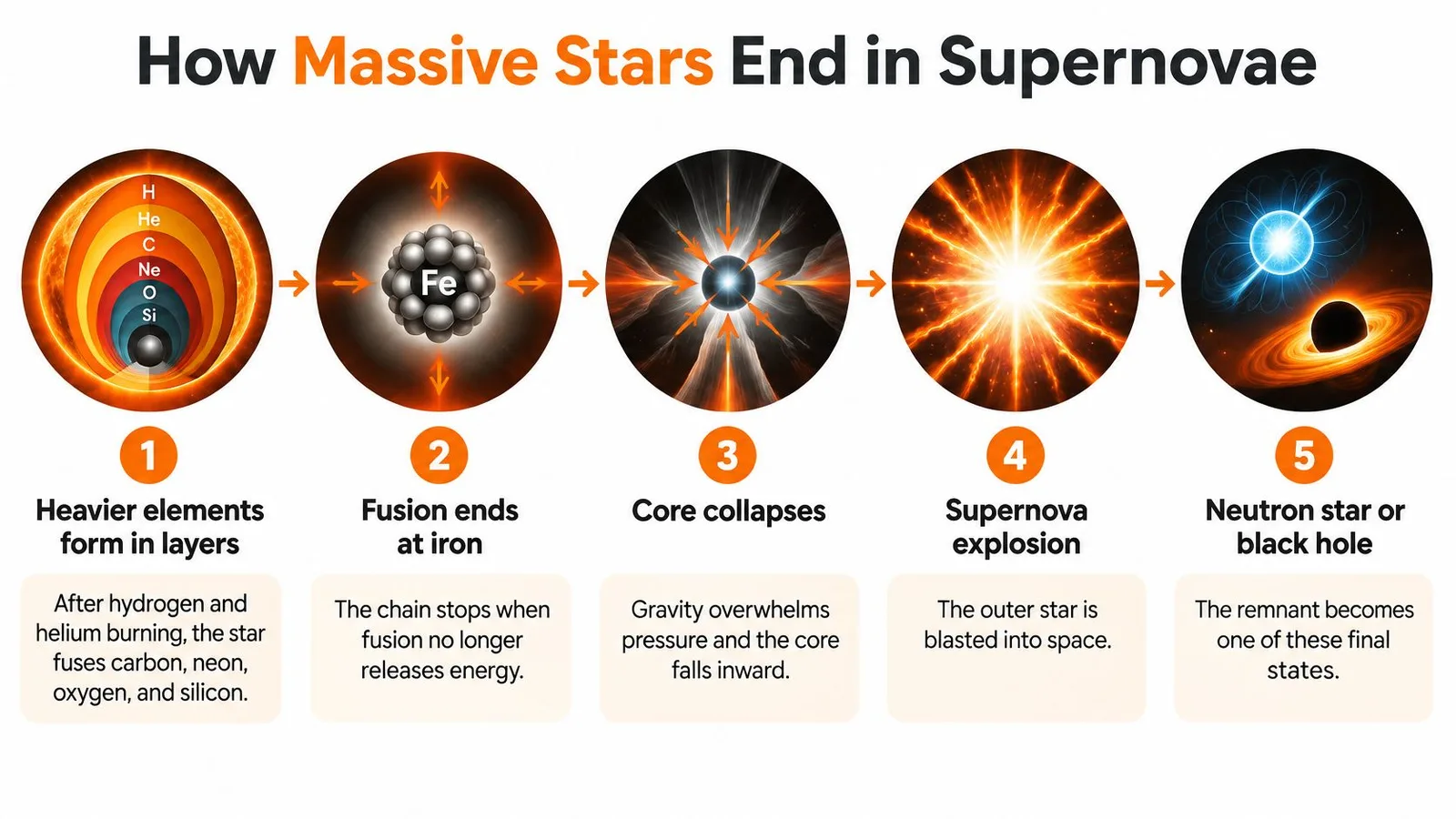
NASA's account of stellar lives and deaths describes an iron core collapsing in less than a second and estimates that only about 1% of stars are massive enough to explode as supernovae. Spectacular explosions are therefore a minority outcome, not the standard ending for every point of light in the sky.
The sequence from heavy elements to collapse
Heavier elements form. After hydrogen and helium burning, a massive star can sustain fusion involving progressively heavier nuclei. Different burning regions can form a layered interior, rather than a uniform mixture.
An iron core develops. Fusing iron and heavier nuclei doesn't provide the net energy needed to maintain support. The star can't solve the problem by switching to iron as another fuel.
The core loses its balance. Once the core can no longer resist gravity, it collapses and matter becomes compressed to nuclear density. The change is a physical collapse of the central region, not merely a fading light.
A compact remnant forms. The surviving core can become a neutron star. If the remaining core is too massive to stabilize that way, it can form a black hole.
An outward shock disrupts the envelope. In a successful core-collapse supernova, the shock travels through the surrounding star and ejects its outer layers. The outward explosion and the inward collapse are connected parts of the same event.
Ejected material enters interstellar space. Newly formed and pre-existing elements mix into the surroundings. Some of that material can later become part of stars, planets, asteroids, and living systems.
What the explosion does, and doesn't, tell you
A supernova doesn't necessarily mean that every part of the star has been destroyed. In a core-collapse event, a compact central object can remain after the envelope has been expelled.
That makes it different from the destructive white-dwarf pathway. The word supernova describes an explosive event, but it doesn't by itself identify the mechanism or guarantee the same remnant.
A useful distinction: Ask both what exploded and what remained.
The iron-core stage identifies a different problem from the one facing a cooling white dwarf. The massive star has reached the end of its useful fusion sequence, and the central material can no longer maintain its previous structure.
To predict the remnant, however, you need more than the knowledge that the star was large. You need to know how much material remains in the core and whether that material can settle into a stable compact object.
Question 4 of 6
Why can't stars fuse iron?
Why Some Stars Die Quietly and Others Explode
The usual small-star-versus-big-star explanation is useful, but incomplete. The National Academies discussion of stellar populations and evolution puts the expected white-dwarf outcome at roughly 95% of stars, making a quiet ending the common case.
That doesn't make stellar evolution a rigid sorting exercise. Starting mass is the first variable, not the only one. A star can lose material, gain material, exchange it with a companion, or arrive at collapse with a different internal structure from another star of similar birth mass.
Factors that change a star's ending
| Factor | Effect on the ending | Example outcome |
|---|---|---|
| Initial mass | Sets the broad fusion sequence and fuel-use rate | White dwarf path or massive-core collapse |
| Companion star | Can transfer material or remove an envelope | A white dwarf may undergo a Type Ia supernova |
| Stellar winds and mass loss | Remove outer material and shape the surroundings | A stripped star reaches collapse without its original envelope |
| Rotation | Can alter internal mixing and the star's mass-loss history | A different core and envelope configuration before collapse |
| Core structure at collapse | Affects whether a compact remnant stabilizes | Neutron star or black hole |
The envelope matters before the explosion
A star's surroundings preserve evidence of its earlier behavior. Material blown away before death can sit around the star when an explosion reaches it, influencing what astronomers detect.
A study published in The Astrophysical Journal examined 325 core-collapse supernovae and found that about 22% were detected in the radio, while highlighting how pre-explosion stellar-wind mass loss shapes surrounding material. That detection fraction describes the study's sample, not the fraction of all stars that explode.
The practical lesson is that an explosion's appearance depends partly on what the star did beforehand. Losing an envelope changes the material the shock encounters; retaining it produces a different setting.
Similar starting points can produce different endings
Rotation and internal mixing also matter because the core's condition at collapse isn't determined by birth mass alone. A companion can further change that history by removing or supplying material.
You therefore shouldn't assume that every massive star produces an identical explosion, or that every collapse leaves the same object. Neutron-star formation, black-hole formation, envelope stripping, and explosive ejection describe different parts of a branching process.
Try a prediction: a star has lost its envelope to a companion. Is that enough information to declare that it will explode? No. You still need to know the core's condition and whether you're considering an active star or an already-formed white dwarf.
Question 5 of 6
Why do some collapsing massive stars blaze in radio waves while others are never seen in radio at all?
What Happens to the Sun and Famous Stars
Familiar stars make these pathways easier to distinguish, provided we separate what a star is now from what it may become. Brightness, apparent color, and a familiar name don't supply a complete evolutionary history.
The Sun is especially useful because it gives us a nearby example of a fusion-powered star whose expected ending isn't a supernova. Other recognizable objects illustrate a remnant that already exists and a massive star that hasn't yet reached its final collapse.
- The Sun represents the quiet pathway. It is still producing energy through core hydrogen fusion. Its expected future includes giant phases, loss of its outer layers, and a white dwarf remnant.
- Sirius B represents the remnant stage. The white dwarf companion of Sirius illustrates what remains after a star has shed its envelope. A white dwarf isn't a dimmer version of an ordinary star; it has a different source of support.
- Betelgeuse represents an evolved massive star. This red supergiant in Orion is expected eventually to undergo core collapse. Its present appearance doesn't give observers a dependable date for that event.
Don't mistake a visible clue for a countdown
These examples answer different questions. The Sun illustrates an expected path, Sirius B illustrates an existing remnant, and Betelgeuse illustrates a massive star in an advanced stage.
Color can help identify a star's surface conditions, but it doesn't independently reveal its mass, internal fuel supply, or remaining lifetime. Even a familiar observation needs interpretation, as the explanation of why the Sun looks yellow shows.
For a family exploring these distinctions, Queens Online School's a parent's guide to primary science offers a broader starting point for discussing observations and scientific explanations. A useful activity is to ask a child or adult learner which claims are observations and which are predictions.
Seeing a star's color is an observation. Inferring its eventual remnant requires a physical model.
When checking a star's likely future, look for a reliable mass estimate, an identified evolutionary stage, and information about companions. Those details tell you more than its prominence in the night sky.
Question 6 of 6
Why can't astronomers use Betelgeuse's current brightness to predict when it will explode?
Work Out a Star's Likely End From Its Mass
You can make a useful prediction without memorizing every stellar classification. The aim is to identify the broad pathway, then recognize which missing information could change your answer.
Start with a published description from a reputable astronomy resource. Keep starting mass, present mass, and remnant mass separate in your notes, because they describe different moments in the star's history.
A repeatable prediction checklist
Find the starting mass or its best estimate. Use that to decide whether you're considering a lower-mass star or a star capable of advanced heavy-element fusion. Don't substitute apparent brightness for mass.
Identify its current stage. A hydrogen-fusing star, an expanded giant, and a white dwarf aren't interchangeable cases. The question you ask must match the object you're studying.
Check for a companion. Look for evidence of mass transfer or envelope stripping. A companion's mere presence doesn't guarantee an explosion, but interaction can change the likely pathway.
Choose a provisional remnant. Select a white dwarf for the ordinary lower-mass route, or consider a neutron star or black hole for a collapsing massive core. Leave room for uncertainty when the core's final condition isn't known.
Check whether the timing makes sense. Massive stars consume their fuel quickly, whereas lower-mass stars generally persist longer. An advanced-looking stage still doesn't provide a precise explosion date.
Make the prediction before reading the answer
Test yourself on a Sun-like star, an isolated white dwarf, and a massive star with a stripped envelope. Write down both your predicted ending and the evidence you used, then identify what additional fact would most improve your confidence.
In each Million Whys session, we use that same prediction-first approach: you make a choice, then explore why each answer makes sense or falls short. For stellar death, that habit helps distinguish a sound causal explanation from a remembered label.
Starting mass sets the broad path; the star's subsequent history shapes the final remnant.
At Million Whys, you can turn questions like why stars die into short prediction-and-explanation sessions. Make your choice before revealing the explanation, then examine why the other answers fall short. Visit with a question about the Sun's future and use your prediction to test what you've learned.
Keep Exploring

Related Posts
Why Does Heat Kill? The Body's Cooling Limit
Why does heat kill? Your body survives heat by moving and evaporating water; death begins when humidity, time, and physiology stop that cooling loop inside.
Space Quiz Questions and Answers, Explained
Space quiz questions and answers on the planets, black holes and why space is dark and silent — guess why Venus runs hotter than Mercury, then see why.