Why do the coastlines of Africa and South America look like two pieces of the same puzzle? Why is some lake water salty when every river feeding it is fresh? These geography quiz questions and answers span the planet’s landforms, weather and the restless rock underneath — guess each one first, then tap for the why.
Geography Trivia: Landforms, Oceans and Continents
ACoincidence in shapes
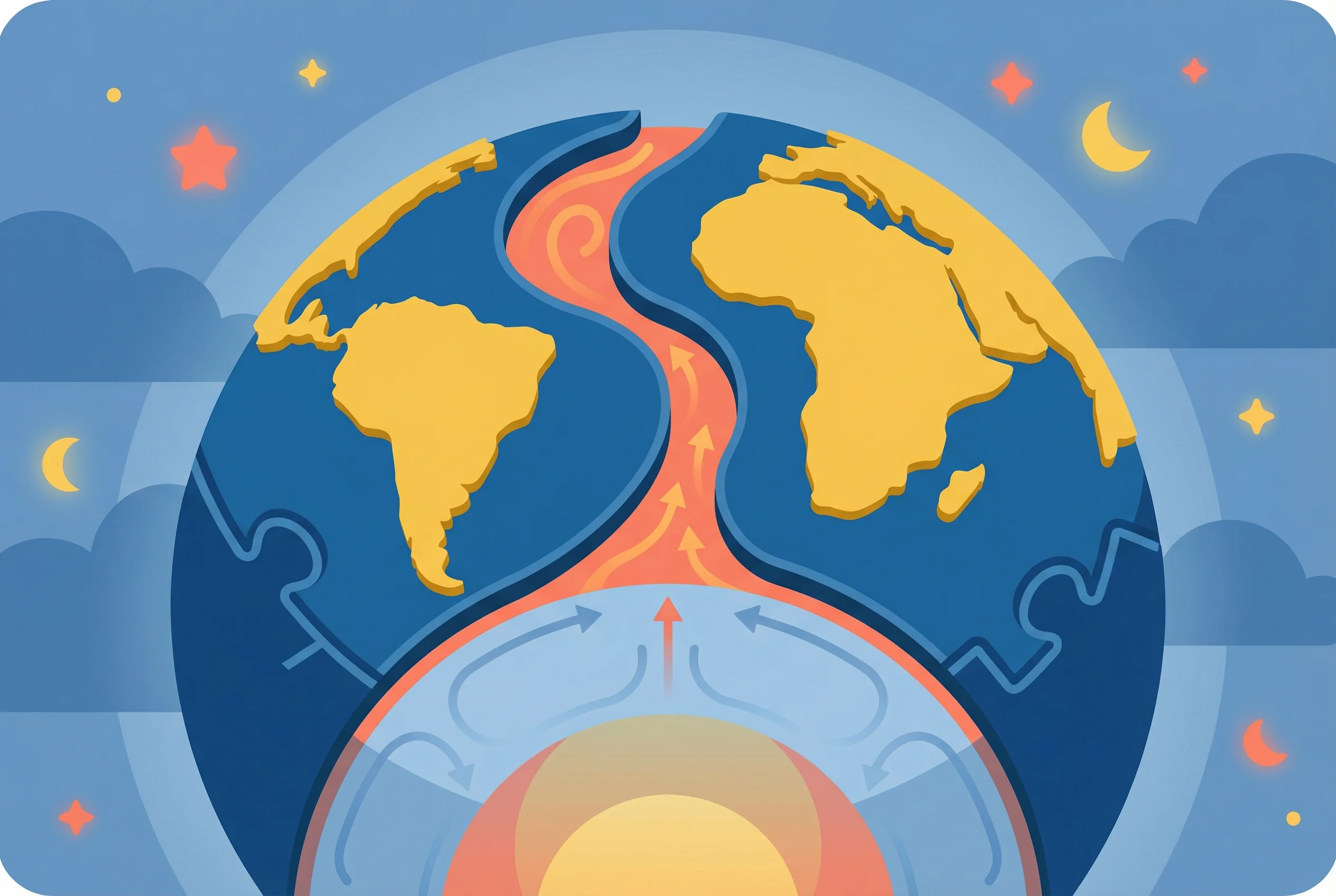
✗Wrong. It's not coincidence. Continental shapes match because they were once joined as the supercontinent Pangaea before plate tectonics split them apart.
BOnce joined supercontinent
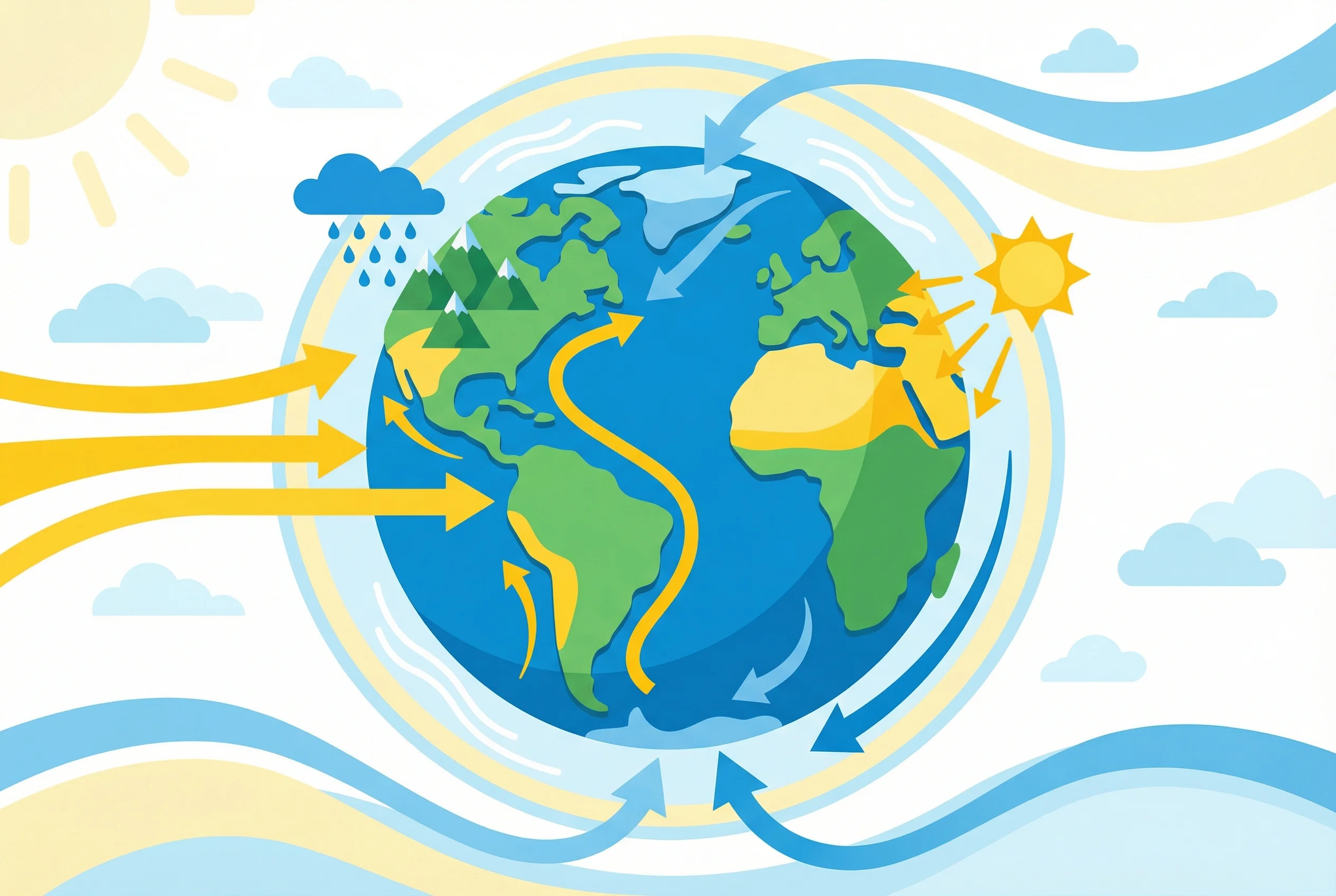
✓Correct! About 200 million years ago, all continents formed one supercontinent called Pangaea. Plate tectonics (driven by mantle convection) split it apart. Africa and South America's coastlines fit together because they were once connected! Fossil evidence, rock formations, and matching coastlines prove continental drift!
COcean erosion shaped edges
✗Wrong. Erosion doesn't create the fit. Continents match because they split from Pangaea through plate tectonics, not from coastal shaping.
ASun directly overhead year-round
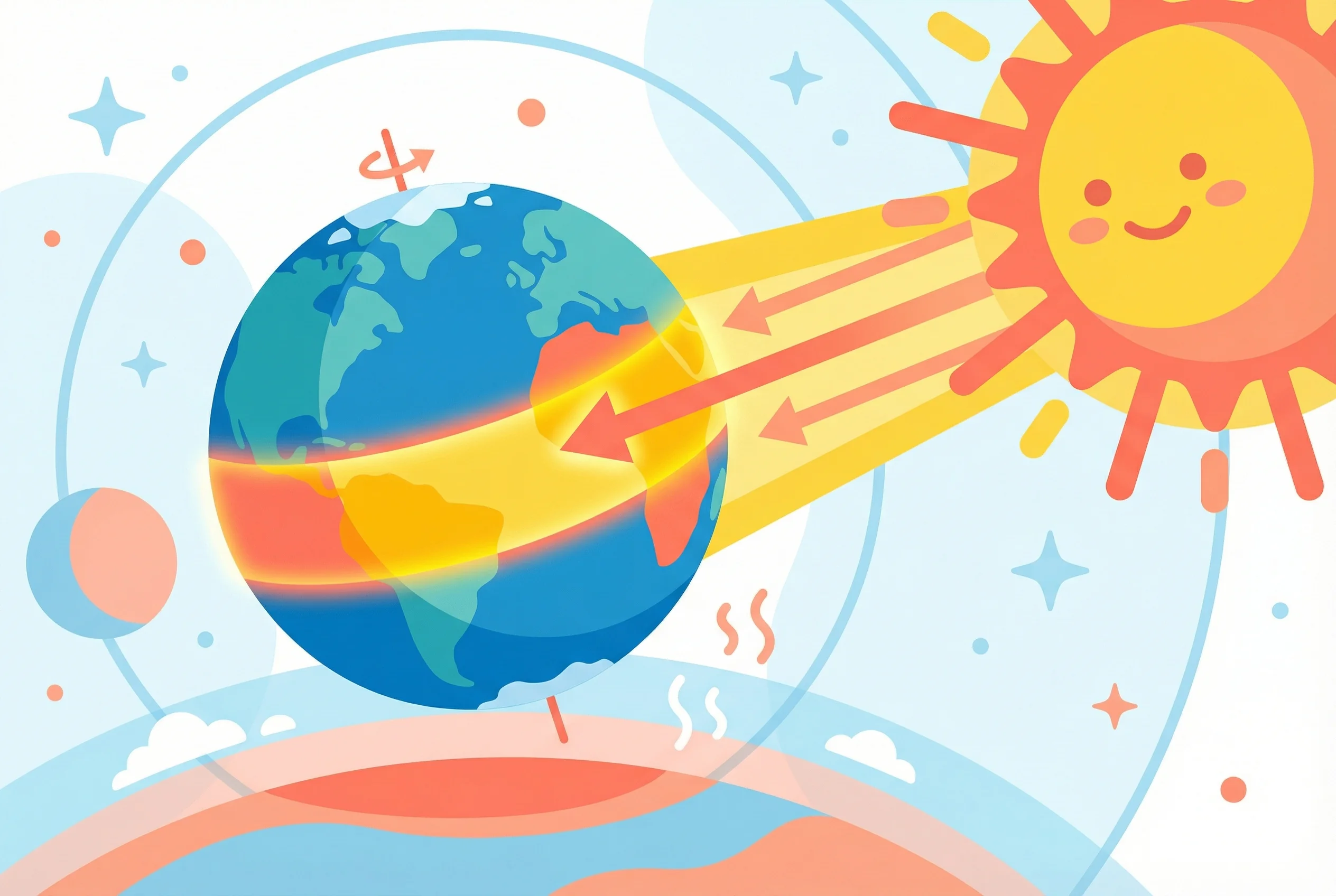
✓Correct! The equator receives direct (near-90°) sunlight year-round. Solar rays hit perpendicular to Earth's surface, concentrating energy per square meter. At poles, sunlight arrives at low angles, spreading over larger areas—less intense. Earth's tilt gives temperate zones seasons, but the equator always gets direct sun. Maximum solar concentration = perpetual warmth!
BCloser to the sun
✗Wrong. The equator isn't closer to the sun (Earth-sun distance varies minimally). It's warm because it receives direct overhead sunlight concentrating solar energy.
COcean currents bring heat
✗Wrong. Ocean currents do distribute heat, but the equator is warm mainly because it receives direct overhead sunlight year-round.
AAir circulation patterns
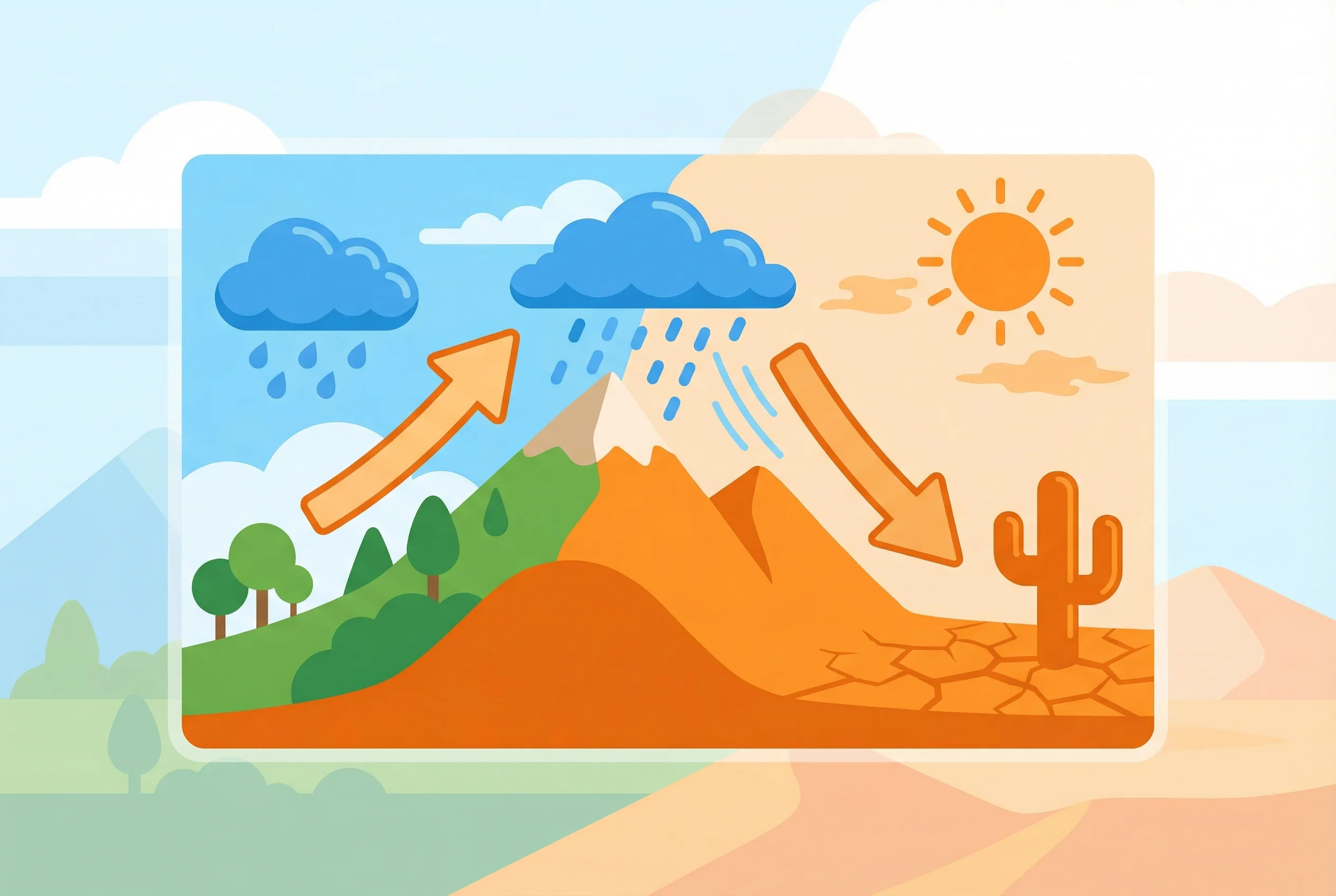
✓Correct! Most deserts form around 30° latitude where atmospheric circulation creates high-pressure zones. Air rises at the equator (releasing moisture as rain), flows toward poles, cools and descends at 30°, warming as it falls. Warm descending air can't form rain clouds. This creates arid zones like Sahara, Arabian, and Australian deserts!
BToo much sun evaporates water
✗Wrong. Evaporation is high, but deserts exist primarily because atmospheric circulation brings dry descending air that prevents rain cloud formation.
CSand absorbs all moisture
✗Wrong. Sand doesn't absorb moisture to create deserts. Deserts form because of atmospheric circulation patterns that bring dry air, not sand properties.
AFollowing underground rocks
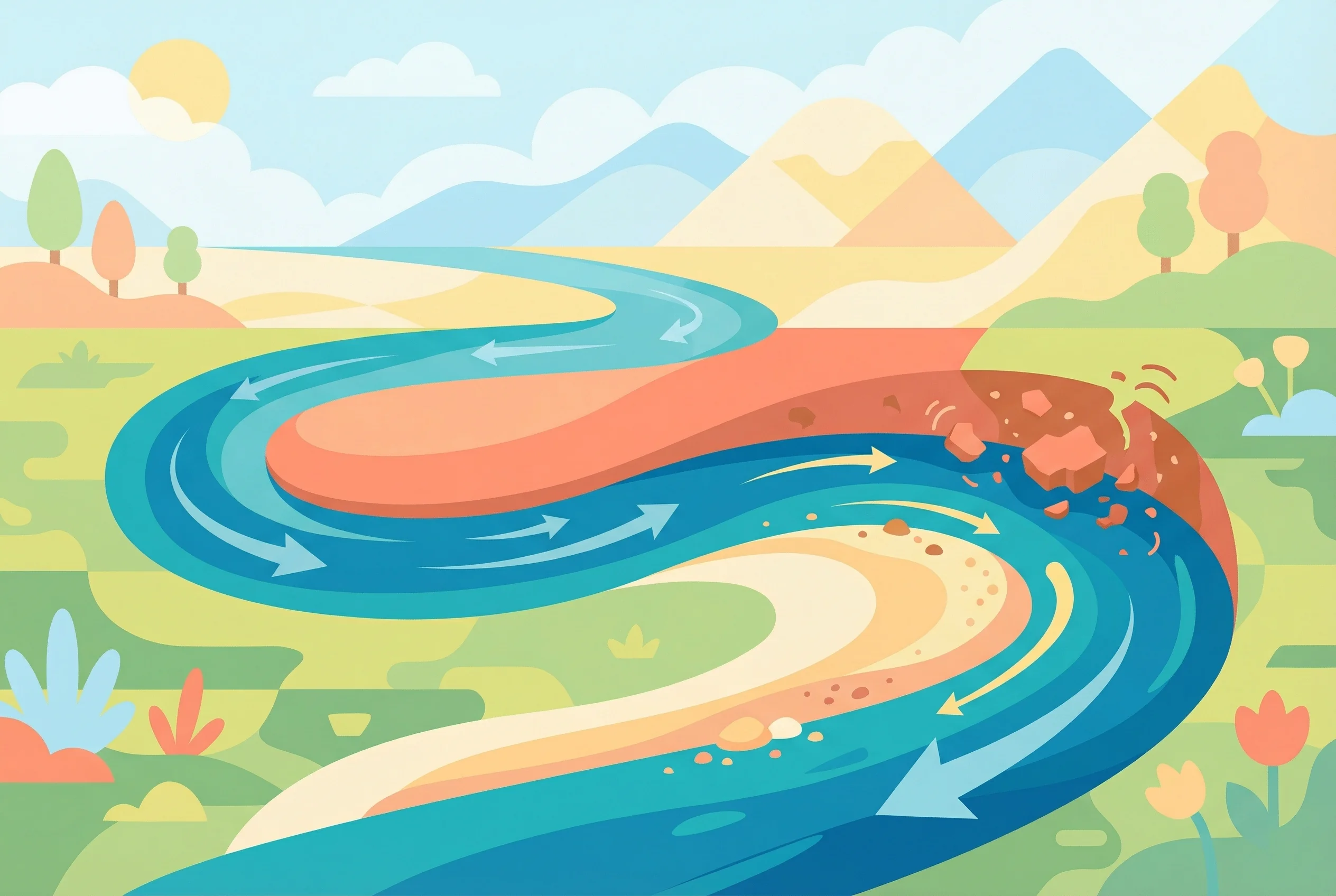
✗Wrong. Rivers don't follow underground rocks. Meanders form because water flows faster on the outside of bends, eroding banks and creating curves.
BErosion on outside of bends
✓Correct! Water flows faster on the outside of river bends (longer path), eroding banks there. Inside bends have slower water, depositing sediment. Over time, this differential erosion amplifies curves, creating snake-like meanders. Eventually, curves can become so extreme they cut through, forming oxbow lakes!
CEarth's rotation deflects flow
✗Wrong. Coriolis effect does deflect large rivers slightly, but meanders form primarily from differential erosion on bend outsides versus deposition on insides.
AWind blows snow upward
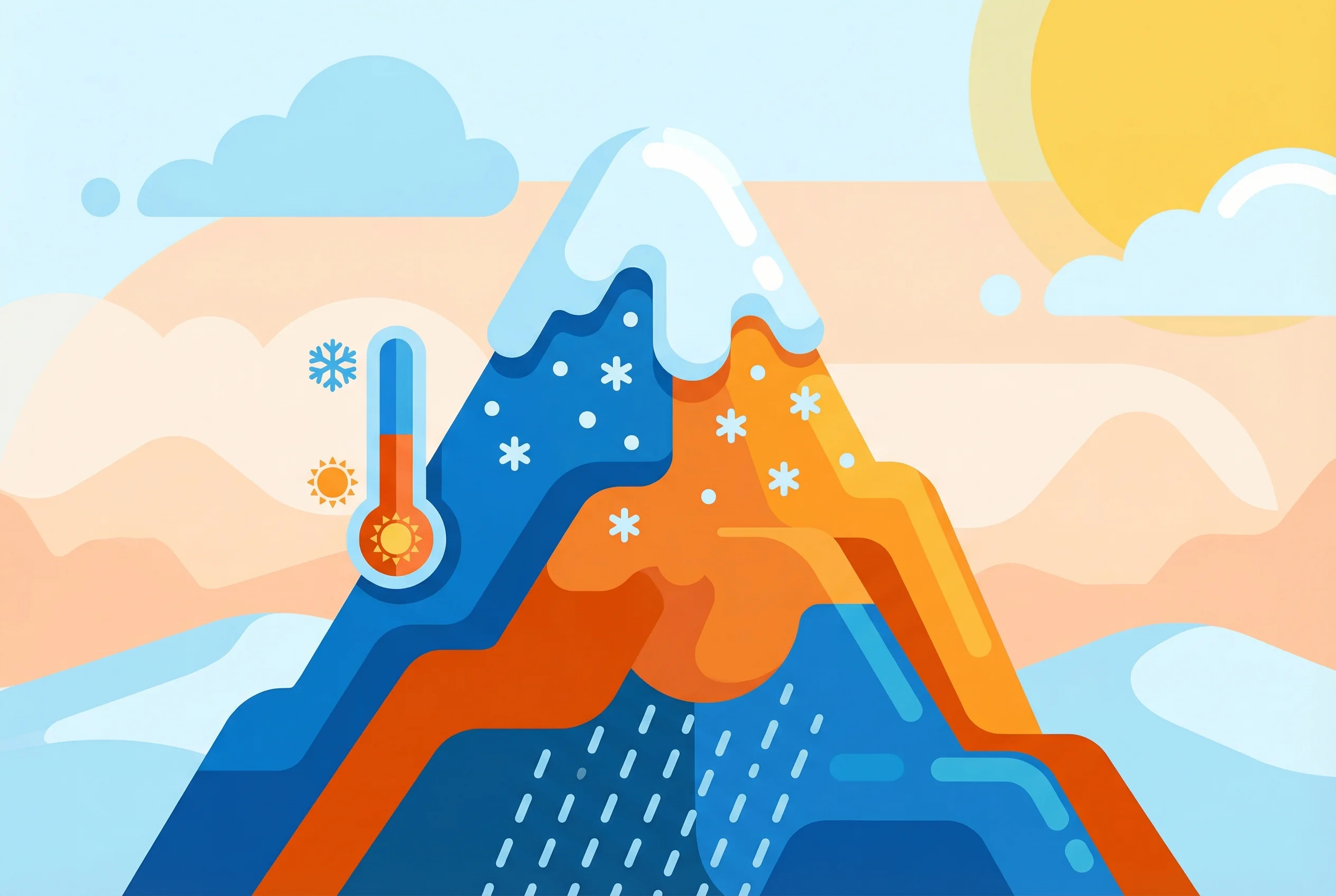
✗Wrong. Wind doesn't blow snow upward. Mountains have snow because temperature decreases with altitude—about 6.5°C per 1000m. High peaks stay below freezing.
BMountains attract cold air
✗Wrong. Mountains don't attract cold air. Snow caps form because temperature drops with altitude (lapse rate), keeping peaks below freezing even when valleys are warm.
CTemperature drops with altitude
✓Correct! Atmospheric temperature decreases with altitude (about 6.5°C per 1000 meters). High mountain peaks are so cold that snow never melts, even in summer. The snow line varies by latitude—near equator it's ~5000m, at poles it's sea level. That's why tropical mountains like Kilimanjaro have snow!
AVolcanic activity builds up
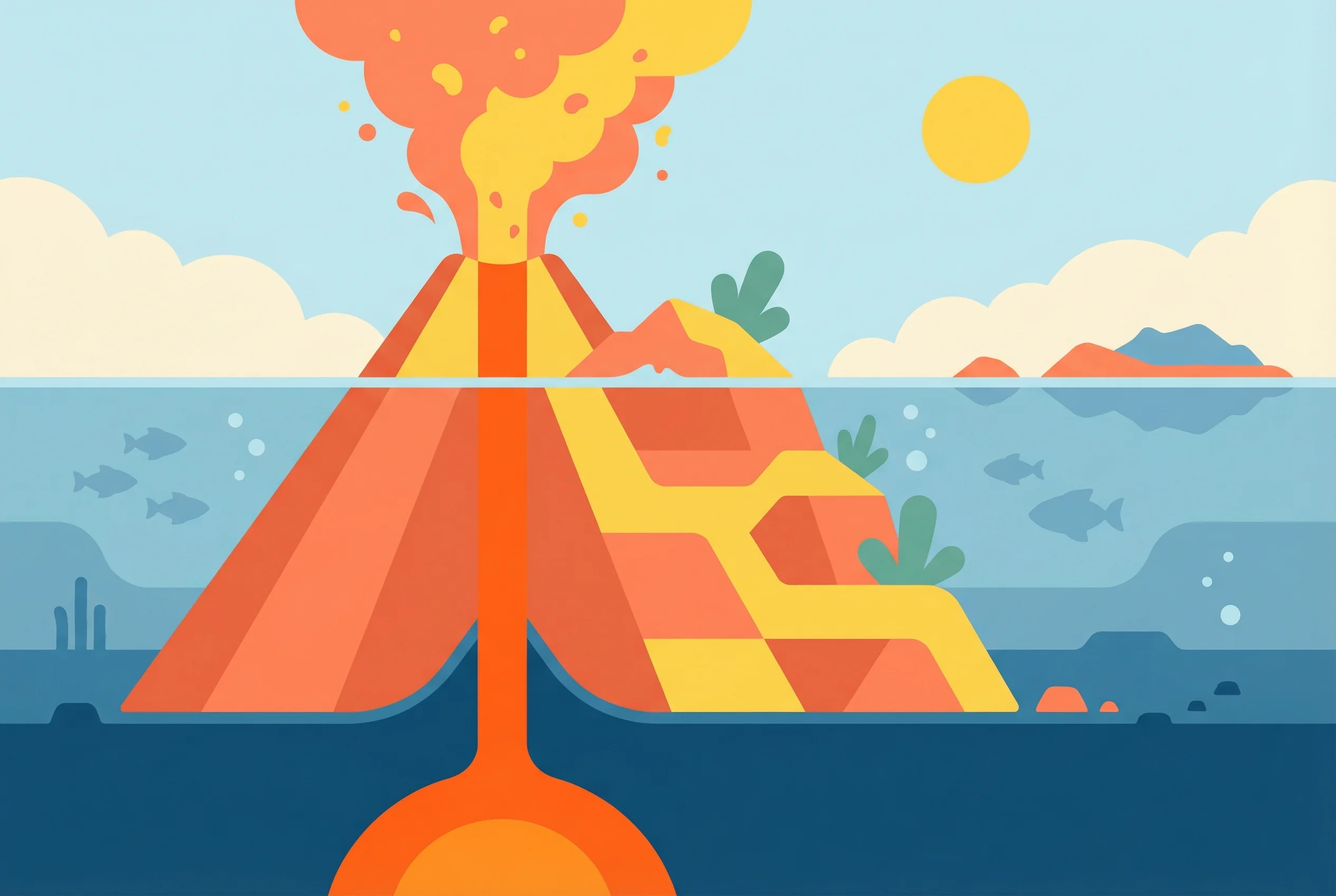
✓Correct! Most oceanic islands form from underwater volcanic eruptions. Magma builds up over millions of years until it breaks the surface. Hawaii formed this way over a hotspot. Some islands form from coral reefs growing in shallow water. Continental islands (like Britain) are parts of continents separated by rising sea levels!
BCoral piles create land
✗Wrong. Coral atolls do form from reef growth, but most oceanic islands form from volcanic activity building up from the seafloor.
COcean floor rises randomly
✗Wrong. The ocean floor doesn't rise randomly. Islands form through specific processes: volcanic activity, coral reef building, or continental separation.
Fun Facts About Weather and Climate
AIndoor moisture on cold glass
✓Correct! Indoor air contains water vapor from breathing, cooking, and other activities. When this warm, moist air touches a very cold window (below 0°C), the vapor deposits directly as ice crystals, skipping the liquid phase - a process called deposition. The beautiful frost patterns form because ice grows along scratches and imperfections in the glass!
BCold air contains ice crystals
✗Wrong. Cold air can hold very little moisture. The ice on windows comes from indoor water vapor that freezes when it contacts the cold glass surface.
CGlass attracts frozen particles
✗Wrong. Glass doesn't attract ice particles. Ice forms when water vapor in warm indoor air deposits directly onto the cold window surface, creating frost crystals.
AStrong sustained winds create whiteout conditions by lifting existing snow, making visibility dangerous even without new snowfall
✓Correct! The defining danger of a blizzard is not just snowfall, but the combination of wind and reduced visibility. Winds of 35+ mph pick up already-fallen snow from the ground and suspend it in the air, creating 'ground blizzards' where visibility drops to near zero even on sunny days. The 3-hour duration threshold distinguishes life-threatening blizzards from brief snow squalls. This sustained whiteout condition makes travel extremely dangerous, as drivers cannot see the road, other vehicles, or even their own car hood.
BWinds above 35 mph are needed to keep snowflakes frozen in the air and prevent them from melting
✗Wrong. Wind speed does not affect whether snowflakes remain frozen - temperature determines that. Snow stays solid well below 32°F (0°C) regardless of wind speed. In fact, strong winds can actually cause some surface melting through friction. The 35 mph threshold is specifically about creating dangerous whiteout conditions through blowing snow, not preserving snowflake integrity.
CThe 3-hour wind requirement ensures enough snow accumulates on the ground to block roads completely
✗Wrong. While blizzards do cause snow accumulation that blocks roads, the official definition focuses on visibility and safety during the storm, not total snowfall amounts. Some blizzards are 'ground blizzards' with little new snow but extremely dangerous conditions from blowing existing snow. The wind and duration requirements define the immediate danger to people caught outside, not the aftermath of blocked roads.
AWind removes warm air near skin
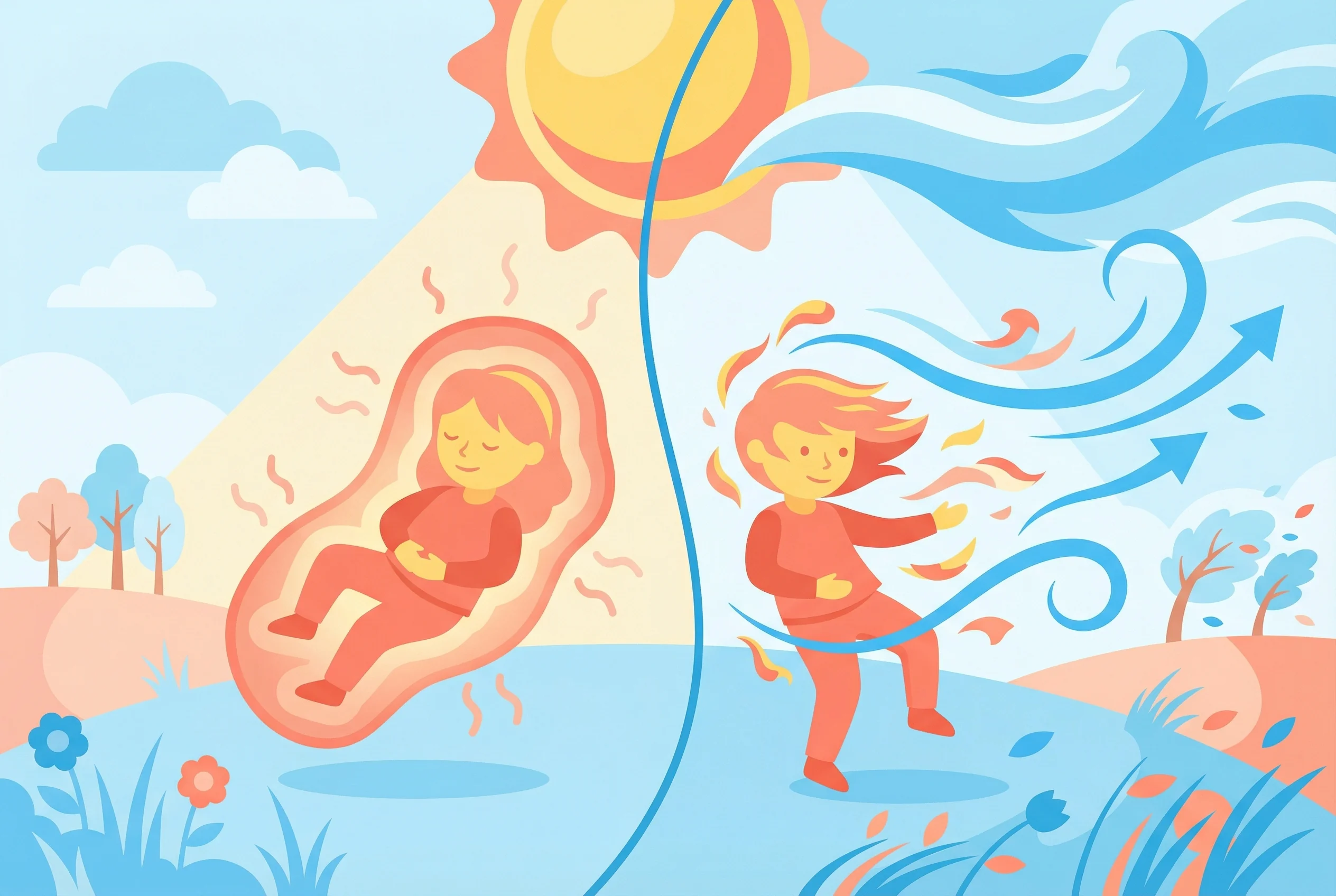
✓Correct! Your body warms a thin layer of air next to your skin. In still air, this warm layer insulates you. But wind constantly blows this warm air away and replaces it with cooler air, forcing your body to work harder to stay warm. This 'wind chill' effect makes 10°C with wind feel much colder than 10°C without wind!
BMoving air has less heat
✗Wrong. Moving air doesn't have less heat than still air at the same temperature. Wind feels colder because it removes the warm insulating layer of air around your body faster than still air.
CWind increases air pressure
✗Wrong. Wind doesn't increase air pressure in a way that affects temperature sensation. Wind feels colder because it removes the warm air layer your body creates, increasing heat loss.
AWater molecules bond hexagonally
✓Correct! Water molecules bond at 120-degree angles due to hydrogen bonding. When ice crystals form, this angle creates six-fold symmetry. Each snowflake branch grows differently based on temperature and humidity it encounters—that's why each is unique!
BSix is nature's lucky number
✗Wrong. Six isn't lucky—it's physics! Water's molecular bonding angle naturally creates hexagonal structures.
CWind creates six-sided patterns
✗Wrong. Wind doesn't create the six-sided shape. The structure is determined by water's molecular bonding angles.
AThunder causes lightning flash
✗Wrong. Lightning causes thunder, not vice versa. Electrical discharge heats air explosively—rapid expansion creates thunder shockwave.
BLight faster than sound waves
✓Correct! Speed difference! Lightning and thunder occur simultaneously, but perceived separately: (1) Lightning—see instantly (light: 300,000 km/s). (2) Thunder—hear delayed (sound: 343 m/s in air). (3) Count seconds between flash and boom—divide by 3 ≈ distance in km (or by 5 for miles). Thunder: rapid air heating from lightning bolt (30,000°C)—explosive expansion creates shockwave. Close lightning: immediate crack. Distant: low rumble (sound waves refract). Can't hear thunder beyond ~25km!
CLightning and thunder are unrelated
✗Wrong. Thunder is direct result of lightning—electrical discharge superheats air channel, creating explosive expansion we hear as thunder.
AWater droplets refract sunlight
✓Correct! Light refraction and dispersion! Rainbows form when: (1) Sunlight enters raindrop—refracts (bends). (2) Disperses—different wavelengths bend differently (red least, violet most). (3) Reflects off back of droplet. (4) Exits droplet—refracts again. (5) Separated colors reach eyes. Conditions needed: sun behind observer, rain ahead. Rainbow angle: 42° from antisolar point. Double rainbows—second reflection inside droplet (reversed colors). Circular rainbow (from airplane). Moonbows exist! Each person sees unique rainbow—depends on viewing angle. ROYGBIV order!
BClouds reflect colorful light
✗Wrong. Rainbows form inside individual raindrops—sunlight refracts, disperses into colors, then reflects back to observer's eyes.
CChemical reaction in rainwater
✗Wrong. No chemical reaction—purely physical optics. Light refracts and disperses through water droplets, separating into visible spectrum.
Cool Geography Facts About the Restless Earth
AChaotic flows in molten iron core reorganize and flip polarity
✓Correct! Earth's magnetic field is generated by a 'geodynamo' - the movement of electrically conducting molten iron in the outer core. These flows are turbulent and chaotic, like weather patterns. Occasionally, the flow patterns reorganize into the opposite configuration, causing the magnetic poles to flip. This process typically takes 1,000 to 10,000 years and has happened hundreds of times throughout Earth's history.
BThe Sun's gravity pulls and twists Earth's magnetic field
✗Wrong. While the Sun does produce a magnetic field and solar wind, it does not control Earth's internal magnetic field. Earth's magnetism is generated deep inside our planet by movements in the molten iron core, independent of external influences. The Sun's magnetic field actually interacts with Earth's field to create phenomena like auroras, but cannot cause pole reversals.
CContinental drift pushes magnetic rocks to opposite hemispheres
✗Wrong. Continental drift moves tectonic plates at the surface, but Earth's magnetic field originates from the liquid outer core about 3,000 kilometers below the surface. While rocks can record the direction of past magnetic fields (providing evidence of reversals), the movement of magnetic rocks at the surface cannot influence or cause the deep core processes that generate the magnetic field.
AThe Pacific Plate has heavy edges sinking into the mantle, pulling it along
✓Correct! The Pacific Plate moves about 7-11 cm per year because it has subduction zones where heavy oceanic crust sinks into the mantle. This 'slab pull' force is the strongest driver of plate motion, much more powerful than the push from mid-ocean ridges. The African Plate, surrounded mostly by mid-ocean ridges with little subduction, moves only 2-3 cm per year.
BThe Pacific Plate is smaller and lighter, so it floats faster
✗Wrong. Size and weight do not determine plate speed. In fact, the Pacific Plate is actually one of the largest plates on Earth, yet it moves fastest. What matters is the driving forces acting on the plate, particularly whether it has subducting edges that pull it forward through 'slab pull' force.
COcean water on the Pacific Plate makes it more slippery
✗Wrong. Ocean water has no significant effect on plate movement. Plates move because of forces deep in the Earth's mantle, not surface conditions. The tectonic plates themselves are made of solid rock (oceanic or continental crust plus upper mantle), and they move through convection and gravitational forces, not sliding friction.
AThey contain iron bands that only form in oxygen-poor conditions
✓Correct! Banded iron formations contain layers of iron that could only accumulate in ocean water when oxygen was scarce. Iron dissolves easily in oxygen-free water but immediately rusts and sinks when oxygen is present. These distinctive red and black bands formed before cyanobacteria filled the atmosphere with oxygen about 2.4 billion years ago, creating a chemical 'snapshot' of ancient air.
BThey are darker in color, showing lack of sunlight back then
✗Wrong. Rock color can change due to many factors like mineral content and heat, not atmospheric conditions. Dark rocks exist in both oxygen-rich and oxygen-poor environments. Scientists determine ancient oxygen levels by studying specific chemical reactions in minerals, not by looking at color alone.
CThey contain fossils of animals that did not need oxygen
✗Wrong. The oldest rocks with these oxygen clues are 3.8 billion years old, but complex animals did not appear until about 600 million years ago. Early Earth had only simple single-celled organisms. Scientists read atmospheric history from rock chemistry, not from fossils of oxygen-breathing creatures that came much later.
APlate motion over hotspot
✓Right. The plume or hotspot is relatively steady while the Pacific Plate moves over it, so old volcanoes are carried away and new ones form above the heat source. USGS gives the Pacific Plate motion as about 6 cm per year. A chain of islands becomes a slow-motion speedometer for a plate.
BA westward lava river
✗Lava does not flow thousands of kilometers and then freeze into a timed island chain. Individual Hawaiian flows are local; the age pattern comes from plate motion over a heat source. The useful clue is that the youngest volcanoes sit near the active hotspot, while older seamounts trail away.
CErosion choosing old rock
✗Erosion changes the height and shape of old islands, but it does not create the age progression. Kauai is older and more eroded because it has been carried away from the magma source longer. Erosion is the after-effect; plate motion is the clock.
AOnly underwater earthquakes that move the seafloor vertically can displace enough water
✓Correct! Tsunami generation requires three key factors: the earthquake must occur underwater or very close to the ocean, it must be relatively shallow (usually less than 70km deep), and most importantly, it must cause vertical movement of the seafloor. When tectonic plates thrust upward or drop downward during an earthquake, they displace enormous volumes of water above them. This displaced water then travels outward as tsunami waves. Horizontal sliding earthquakes, even if powerful, typically do not generate tsunamis because they do not lift or drop water masses. The 2004 Indian Ocean tsunami was caused by a magnitude 9.1 earthquake where one plate thrust under another, lifting the seafloor by several meters.
BOnly earthquakes above magnitude 8.0 have enough power to create tsunamis
✗Wrong. While larger earthquakes are more likely to cause tsunamis, magnitude 8.0 is not a strict threshold. Tsunamis have been generated by earthquakes as small as magnitude 6.5 when conditions are right. What matters more than raw magnitude is the location (underwater), depth (shallow), and type of fault movement (vertical displacement). A magnitude 7.5 underwater earthquake with strong vertical movement can create a devastating tsunami, while a magnitude 8.5 earthquake on land or with only horizontal movement will not. The key is how much water gets displaced, not just the earthquake's total energy.
CEarthquakes during high tide push more water and create tsunamis
✗Wrong. Tides have no significant effect on tsunami generation. Tsunamis are caused by the sudden vertical displacement of the ocean floor during underwater earthquakes, not by the amount of water present. A tsunami can be generated equally during low tide or high tide. The ocean is so deep (average 3,800 meters) that tidal variations of 1-2 meters make no practical difference to tsunami formation. What matters is whether the earthquake moves the seafloor up or down, displacing the entire water column above it from the bottom to the surface. Tides may slightly affect tsunami wave height when it reaches shore, but they do not determine whether a tsunami forms.
AThe continental crust crumples and buckles upward because neither plate can sink
✓Correct! Continental crust is made of light, granite-like rock that floats on the denser mantle below. When two continents collide, neither can sink (subduct) beneath the other. Instead, the tremendous compressional forces cause the crust to fold, buckle, and thrust upward like a slow-motion car crash. This process created the Himalayas when India crashed into Asia about 50 million years ago, and the mountains are still rising today at about 5 millimeters per year!
BThe collision creates volcanic eruptions that pile up lava into mountains
✗Wrong. While volcanic mountains do exist, they typically form at ocean-continent collision zones where one plate sinks beneath another, not at continent-continent collisions. The Himalayas, Alps, and Appalachians formed through crustal compression and folding, not volcanism. These collision-zone mountains are made of folded and uplifted sedimentary and metamorphic rocks, not volcanic material.
COne continent slides smoothly over the other, lifting it higher
✗Wrong. Continental collisions are anything but smooth! Both plates are made of buoyant, low-density rock that resists sinking. Rather than one sliding over the other, they crumple together like two pieces of paper being pushed from opposite sides. The collision zone becomes intensely deformed with rocks folding, faulting, and thrusting over each other. This creates the complex, fractured geology we see in collision mountain ranges.
Frequently Asked Questions
What’s a good geography trivia question?
The ones that explain the map you already know — why continents look like they fit together, or why deserts are bone dry. Both are in the landforms section above with the reason behind them.
What are some cool facts about planet Earth?
Earth’s magnetic poles have flipped many times, mountain ranges rise where two continents slowly crash together, and a tsunami is a wall of water set off by the seafloor itself moving. The Earth section covers each.
Why are some lakes salty when the rivers feeding them are fresh?
Rivers carry tiny amounts of dissolved salt in; if a lake has no outlet, water leaves only by evaporation and the salt stays behind, concentrating over time. The full answer is one tap away above.