Good Christmas trivia is more than remembering movie quotes or counting reindeer. The best questions open a little information gap, then close it with a satisfying answer. This set uses real AIgneous Million Whys question-bank cards, so each answer comes with the why behind it and a live question link you can play in the app.
The theme is Christmas-adjacent on purpose: winter science, holiday economics, snowy weather, animals, pine trees, and the December weirdness of celebrating Christmas in summer in the Southern Hemisphere. It is trivia for the part of the party where someone says, "wait, why does that happen?"
Easy
ATo camouflage with their surroundings in different seasons
✓Correct - Arctic foxes change color for camouflage protection. In winter, their white fur helps them blend into the snowy landscape, making it easier to sneak up on prey like lemmings and harder for predators to spot them. In summer, when snow melts, their brown-gray fur matches the rocky tundra terrain. This seasonal molting is triggered by changes in daylight hours.
BWhite fur keeps them warmer in winter cold
✗Not quite - the answer is A. To camouflage with their surroundings in different seasons. Wrong. Fur color does not significantly affect insulation or warmth. Both white winter fur and brown summer fur have the same thickness and insulating properties. The color change is purely for camouflage purposes. In fact, the Arctic fox's fur is one of the warmest in the animal kingdom regardless of color, with dense underfur that traps air for insulation.
CTo attract mates during different breeding seasons
✗Not quite - the answer is A. To camouflage with their surroundings in different seasons. Wrong. Arctic foxes mate in early spring (April-May) when they are transitioning from white to brown fur, so color is not related to mate attraction. Both male and female foxes change colors at the same time based on seasonal daylight changes, not reproductive needs. Their mating behavior relies more on scent marking and vocalizations than visual appearance.
Answer this question
ATo conserve energy when food is scarce in cold months
✓Correct - Hibernation is an amazing survival strategy. During winter, food becomes very scarce and searching for it would burn more energy than the animal could gain. By lowering their body temperature (sometimes to just above freezing) and slowing their heart rate dramatically, hibernating animals can survive months without eating. A bear's heart rate drops from 40 beats per minute to just 8-10 beats per minute during hibernation!
BTo avoid predators that are more active in winter
✗Not quite - the answer is A. To conserve energy when food is scarce in cold months. Wrong. While avoiding predators might seem logical, this is not why animals hibernate. In fact, hibernating animals are more vulnerable to predators because they are in a deep sleep and cannot escape quickly. The real reason is energy conservation - winter brings food scarcity, not increased predator activity. Most predators also struggle to find food in winter.
CTo grow thicker fur in a deep sleep state
✗Not quite - the answer is A. To conserve energy when food is scarce in cold months. Wrong. Animals do not hibernate to grow thicker fur. Fur growth happens before winter begins as a response to decreasing daylight and temperature changes. Hibernation is about surviving food scarcity by dramatically reducing energy needs - their metabolism slows to just 2-5% of normal rates. The thick fur is actually grown while the animal is still active and eating well in autumn.
Answer this question
Medium
AOne hemisphere tilts toward the Sun while the other tilts away
✓Correct - Earth's axis is tilted 23.5 degrees. During December, the Southern Hemisphere (including Australia) tilts toward the Sun, receiving more direct sunlight and experiencing summer. Meanwhile, the Northern Hemisphere (including Canada) tilts away, receiving less direct sunlight and experiencing winter. Six months later, the situation reverses.
BAustralia is closer to the Sun than Canada throughout the year
✗Not quite - the answer is A. One hemisphere tilts toward the Sun while the other tilts away. Wrong. Earth's distance from the Sun varies by only about 3% throughout the year, and this actually makes Earth slightly closer to the Sun during the Northern Hemisphere's winter! The seasons are caused by the tilt of Earth's axis, not by distance from the Sun. Both hemispheres are essentially the same distance from the Sun at any given time.
CThe Sun's heat takes 6 months to travel between hemispheres
✗Not quite - the answer is A. One hemisphere tilts toward the Sun while the other tilts away. Wrong. Sunlight travels from the Sun to Earth in just 8 minutes and 20 seconds at the speed of light (300,000 km/s). The Sun's energy reaches both hemispheres simultaneously. The difference in seasons is not about timing of sunlight arrival, but about the angle and duration of sunlight each hemisphere receives due to Earth's axial tilt.
Answer this question
APine needles have a waxy coating that prevents freezing and water loss
✓Correct - Evergreen needles have a thick waxy cuticle that waterproofs them and prevents ice crystal formation inside cells. Their small surface area and narrow shape also reduce water loss through evaporation. This allows them to photosynthesize year-round, even during cold winters when water is scarce.
BPine trees have deeper roots that provide warmth to the needles
✗Not quite - the answer is A. Pine needles have a waxy coating that prevents freezing and water loss. Wrong. While pine trees do have extensive root systems, roots do not generate heat or 'warm' the needles above ground. The key adaptation is in the needle structure itself - the waxy coating and compact shape that resist cold damage, not warmth from below.
CPine needles contain antifreeze chemicals that melt surrounding snow
✗Not quite - the answer is A. Pine needles have a waxy coating that prevents freezing and water loss. Wrong. Pine needles do not contain antifreeze chemicals or melt snow around them. While some organisms produce antifreeze proteins, evergreen trees survive winter through physical leaf adaptations like waxy coatings and reduced surface area, not chemical snow-melting substances.
Answer this question
AThey adjust prices based on demand to maximize revenue from limited rooms
✓Correct - This is called 'dynamic pricing' or 'yield management.' Hotels have a fixed number of rooms that cannot be stored or saved. When many people want rooms (holidays, events), hotels can charge more because customers are willing to pay. When few people travel, they lower prices to avoid empty rooms. Airlines, ride-sharing apps, and concert tickets use the same strategy. The goal is maximizing total revenue, not just covering costs.
BThey need extra money to pay staff overtime during busy periods
✗Not quite - the answer is A. They adjust prices based on demand to maximize revenue from limited rooms. Wrong. While some staff may work extra hours during peak seasons, overtime costs are relatively small compared to the price increases. Hotels primarily raise prices because customers are willing to pay more when demand is high, not because their operating costs increase significantly. Dynamic pricing is about capturing consumer willingness to pay, not covering additional expenses.
CGovernment regulations require higher taxes during peak travel seasons
✗Not quite - the answer is A. They adjust prices based on demand to maximize revenue from limited rooms. Wrong. Hotel taxes and fees are typically a percentage of the room rate, not fixed higher amounts during certain seasons. Governments do not mandate that hotels charge more during holidays. The price increases are a business decision by hotels using 'yield management' to earn more revenue when demand exceeds supply. If anything, the same tax rate applies year-round.
Answer this question
AWater molecules bond hexagonally
✓Correct - Water molecules bond at 120-degree angles due to hydrogen bonding. When ice crystals form, this angle creates six-fold symmetry. Each snowflake branch grows differently based on temperature and humidity it encounters—that's why each is unique!
BSix is nature's lucky number
✗Not quite - the answer is A. Water molecules bond hexagonally. Wrong. Six isn't lucky—it's physics! Water's molecular bonding angle naturally creates hexagonal structures.
CWind creates six-sided patterns
✗Not quite - the answer is A. Water molecules bond hexagonally. Wrong. Wind doesn't create the six-sided shape. The structure is determined by water's molecular bonding angles.
Answer this question
AThe Sun travels a higher, longer arc across the sky in summer
✓Correct - Due to Earth's 23.5-degree tilt, during summer the Sun rises earlier in the northeast, climbs higher in the sky at noon, and sets later in the northwest. This longer path means the Sun stays above the horizon for more hours. In winter, the Sun takes a lower, shorter path, rising later and setting earlier, creating shorter days.
BEarth moves closer to the Sun during summer months
✗Not quite - the answer is A. The Sun travels a higher, longer arc across the sky in summer. Wrong. Earth is actually slightly farther from the Sun during Northern Hemisphere summer (about 5 million km farther in July than January). Seasons are caused by axial tilt, not distance. When it is summer in the north, it is winter in the south, even though both are the same distance from the Sun.
CThe Sun produces more light energy in summer
✗Not quite - the answer is A. The Sun travels a higher, longer arc across the sky in summer. Wrong. The Sun's energy output remains virtually constant year-round. What changes is the angle and duration of sunlight reaching different parts of Earth. The tilt of Earth's axis determines how long the Sun appears in our sky, not how much light the Sun produces.
Answer this question
AIce floats and insulates the water below, keeping it liquid
✓Correct - Water has a unique property: it expands when freezing, making ice less dense than liquid water. This causes ice to float on top rather than sinking. The floating ice layer acts as an insulating blanket, preventing heat loss from the water below. Even in harsh winters, the water beneath stays liquid (around 4°C at the bottom), allowing fish, turtles, and other aquatic creatures to survive. If ice sank like most frozen substances, lakes would freeze solid from bottom to top, killing all life inside.
BIce provides oxygen that fish can breathe through the surface
✗Not quite - the answer is A. Ice floats and insulates the water below, keeping it liquid. Wrong. While oxygen is crucial for fish survival, ice does not provide it. In fact, ice cover can reduce oxygen levels by blocking gas exchange with the atmosphere and limiting photosynthesis from underwater plants. Fish rely on oxygen dissolved in the water from before the freeze, and some species can slow their metabolism to cope with lower oxygen levels during winter.
CIce reflects sunlight to warm the deep water underneath
✗Not quite - the answer is A. Ice floats and insulates the water below, keeping it liquid. Wrong. Ice actually reflects most sunlight away (high albedo), and does not warm the water below. Instead, ice acts as an insulator, reducing heat loss to the cold air above. The warmest water in a frozen lake is typically at the bottom (around 4°C), not at the top near the ice. This temperature stratification happens because water is most dense at 4°C, causing it to sink to the bottom.
Answer this question
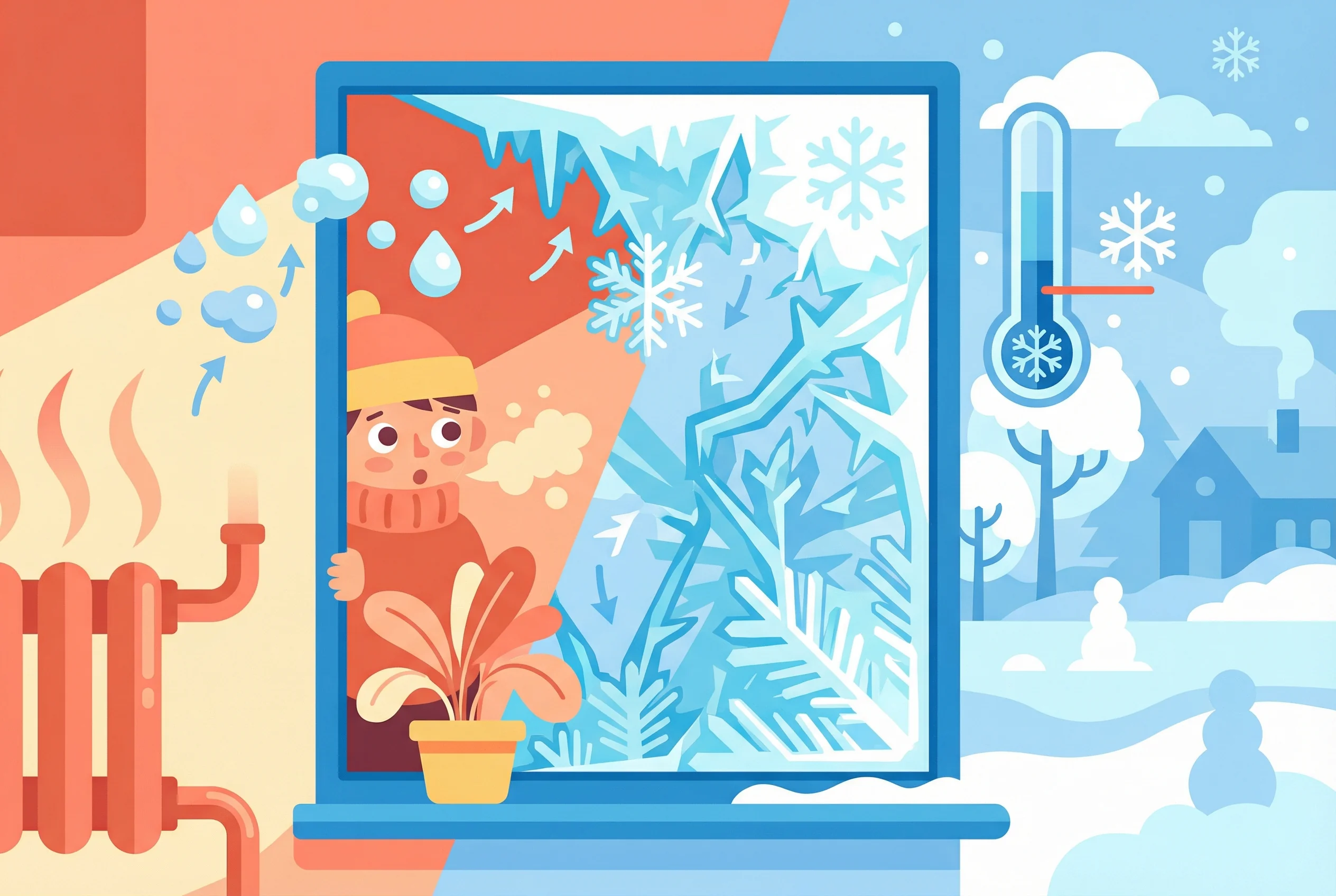
AIndoor moisture on cold glass
✓Correct - Indoor air contains water vapor from breathing, cooking, and other activities. When this warm, moist air touches a very cold window (below 0°C), the vapor deposits directly as ice crystals, skipping the liquid phase - a process called deposition. The beautiful frost patterns form because ice grows along scratches and imperfections in the glass!
BCold air contains ice crystals
✗Not quite - the answer is A. Indoor moisture on cold glass. Wrong. Cold air can hold very little moisture. The ice on windows comes from indoor water vapor that freezes when it contacts the cold glass surface.
CGlass attracts frozen particles
✗Not quite - the answer is A. Indoor moisture on cold glass. Wrong. Glass doesn't attract ice particles. Ice forms when water vapor in warm indoor air deposits directly onto the cold window surface, creating frost crystals.
Answer this question
ASalt lowers water's freezing point, so ice melts even in cold weather
✓Correct - When salt dissolves in the thin water layer on ice, it disrupts the formation of ice crystals. This lowers the freezing point from 0°C to as low as -21°C depending on salt concentration. So ice melts at temperatures where it would normally stay frozen. This is called 'freezing point depression' and is why we use salt on winter roads.
BSalt creates heat through a chemical reaction that warms the ice
✗Not quite - the answer is A. Salt lowers water's freezing point, so ice melts even in cold weather. Wrong. Salt does not create heat or cause an exothermic reaction when mixed with ice. In fact, dissolving salt in water is slightly endothermic, meaning it actually absorbs a tiny bit of heat. The melting happens because salt changes the temperature at which water freezes, not because it generates warmth.
CSalt is rough and scratches the ice surface, breaking it apart
✗Not quite - the answer is A. Salt lowers water's freezing point, so ice melts even in cold weather. Wrong. While salt crystals are solid, they do not melt ice by physical abrasion or scratching. Sand is spread on icy roads for traction, but it does not melt ice. Salt works through a chemical process where it dissolves in water and prevents ice crystals from forming, not through mechanical grinding.
Answer this question
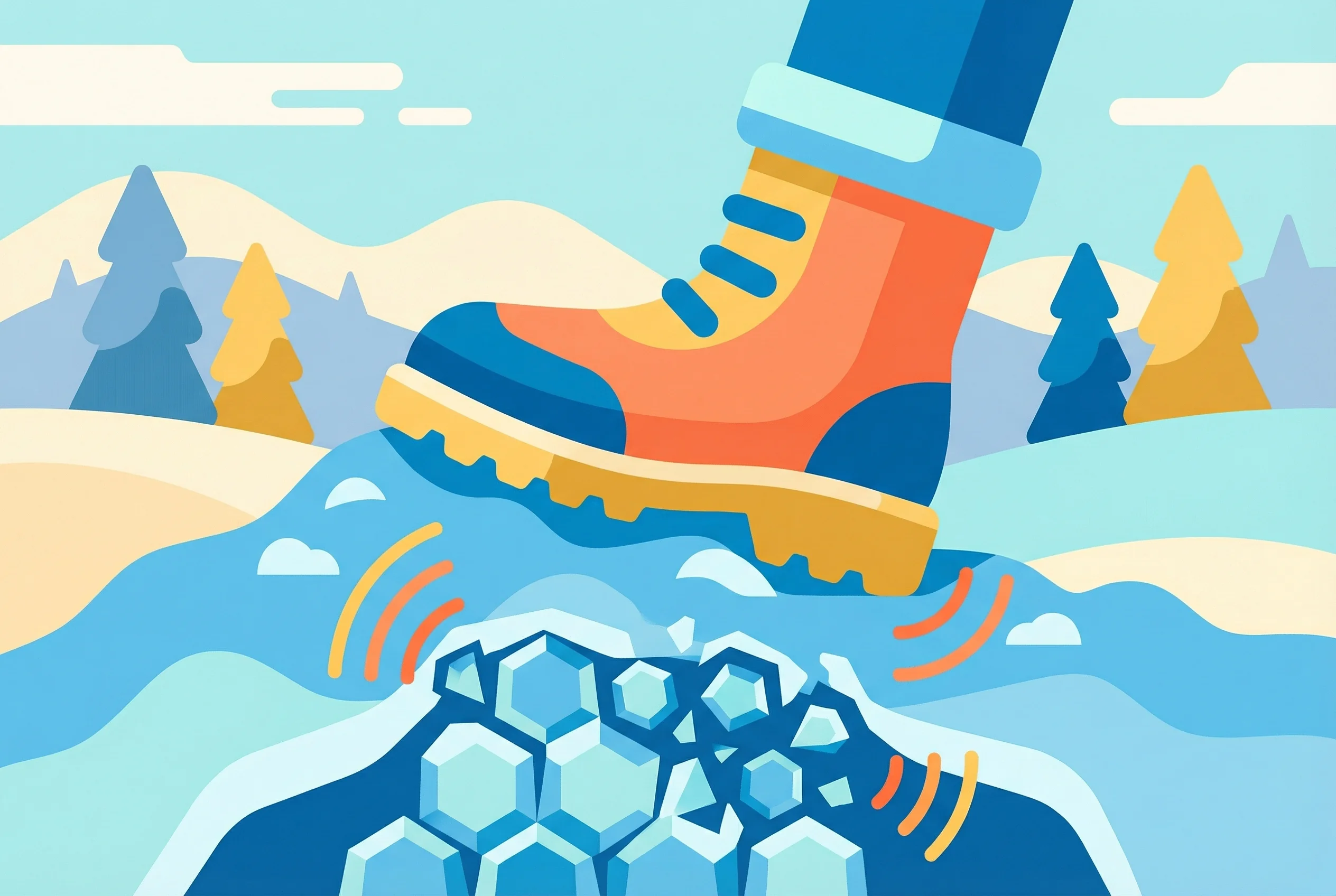
AAir pockets collapse loudly
✗Not quite - the answer is B. Crystals fracture under pressure. Wrong. Air spaces exist between crystals, but crunch sound from crystals breaking/fracturing under pressure, not air collapse.
BCrystals fracture under pressure
✓Correct - Crystal fracture! Snow crunches because: (1) Snow: complex ice crystals loosely bonded. (2) Step on snow—pressure applied. (3) Crystals fracture/break—bonds snap. (4) Thousands of tiny breaks = crunching sound. (5) Temperature matters—colder = more brittle, louder crunch. Below -15°C: very crunchy. Near 0°C: wet, quiet (crystals bend/compress). Fresh powder: loud (delicate crystals). Old packed snow: quieter (rounded grains). Same physics as breaking glass—brittle fracture releases acoustic energy. Quieter on warm days—crystals have water film (lubricates)!
CFrozen water squeaks naturally
✗Not quite - the answer is B. Crystals fracture under pressure. Wrong. Water doesn't inherently squeak—snow crunches from ice crystal fracturing under pressure. Temperature affects brittleness and sound volume.
Answer this question
ASunlight hits at a shallow angle, spreading energy over a larger area
✓Correct - When sunlight arrives at a shallow angle (like in winter), the same beam spreads across a larger surface area, similar to how a flashlight beam becomes wider and dimmer when you tilt it. This means each square meter receives less solar energy, making it feel colder. Direct overhead sunlight (summer) concentrates more energy into a smaller area.
BThe Sun produces less energy during winter months
✗Not quite - the answer is A. Sunlight hits at a shallow angle, spreading energy over a larger area. Wrong. The Sun is a stable star that produces constant energy output throughout the year. Its nuclear fusion reactions do not change with Earth's seasons. The difference in temperature we experience is due to how that constant energy is distributed across Earth's surface, not changes in the Sun's power.
CEarth moves farther from the Sun in winter
✗Not quite - the answer is A. Sunlight hits at a shallow angle, spreading energy over a larger area. Wrong. In fact, Earth is closest to the Sun in January (Northern Hemisphere winter)! Distance plays only a minor role compared to the angle of sunlight. The seasons are caused by Earth's tilted axis, not its orbital distance. If distance were the key factor, both hemispheres would have summer simultaneously.
Answer this question
Want to play these for real?
Turn small seasonal questions into 10-second curiosity sparks. No streak guilt, no exam mode - just one answer that makes the next question easier to notice.
Play live on AIgneous Million WhysFrequently Asked Questions
What makes these Christmas trivia questions different?
They are built from real Million Whys question-bank cards, so each item includes an answer, a reason, and a live play link instead of a bare fact.
Are these only about Christmas?
No. The page is framed for Christmas trivia, but the questions cover the winter world around the holiday: snow, daylight, pine trees, hibernation, holiday travel, and Christmas in different hemispheres.
Can I use these for a holiday party?
Yes. Read the question first, let people guess, then open the answer details to reveal the explanation. The explanations are the point: they give the satisfying closure after the guess.
Are these questions suitable for adults?
Yes. The set is written for general curiosity rather than classroom drills. Some questions are easy, but the explanations still give adults something worth learning.
What does this have to do with AIgneous Million Whys?
AIgneous Million Whys turns tiny information gaps into playable questions. A holiday trivia set is the same loop in public: notice the gap, make a guess, get real closure, and leave with one more thing connected.