

Beer 101: What Ale, Lager, IPA, Draft, and “Skunked” Really Mean
On this page· 18
You're at the bar. The menu says pale ale, pilsner, IPA, draft, stout, lager. Someone warns you a bottle is "skunked." You nod like you understand, order whatever's coldest, and quietly admit you've never actually known what any of these words mean. Good news: the entire confusing vocabulary of beer comes down to just four hidden levers — and once you can see them, the menu reads like a map instead of a wall of jargon.
TL;DR
Ale vs. lager is decided by the yeast, not the color. IPA isn't a third category — it's a style of ale. "Draft" is a serving method, and "raw" beer just means unpasteurized. "Skunked" is a light-triggered chemical reaction, not old age. And dark beer is usually weaker than the pale lager next to it. Four levers run the whole show: yeast, hops, heat, and light/air.
Curious? Try one 👇
Why is the sky blue?
Jump into the daily quiz →The short answer
Almost every beer word you've ever been confused by maps onto one of four things: the yeast that ferments it (ale or lager), the hops that flavor it (bitter, aromatic, IPA), the heat used to stabilize and serve it (pasteurized vs. raw, bottle vs. draft), and the light and air that wreck it (skunked, stale, flat). Learn the four levers and you can decode any tap list on earth.
Lever 1: The yeast decides if it's an ale or a lager

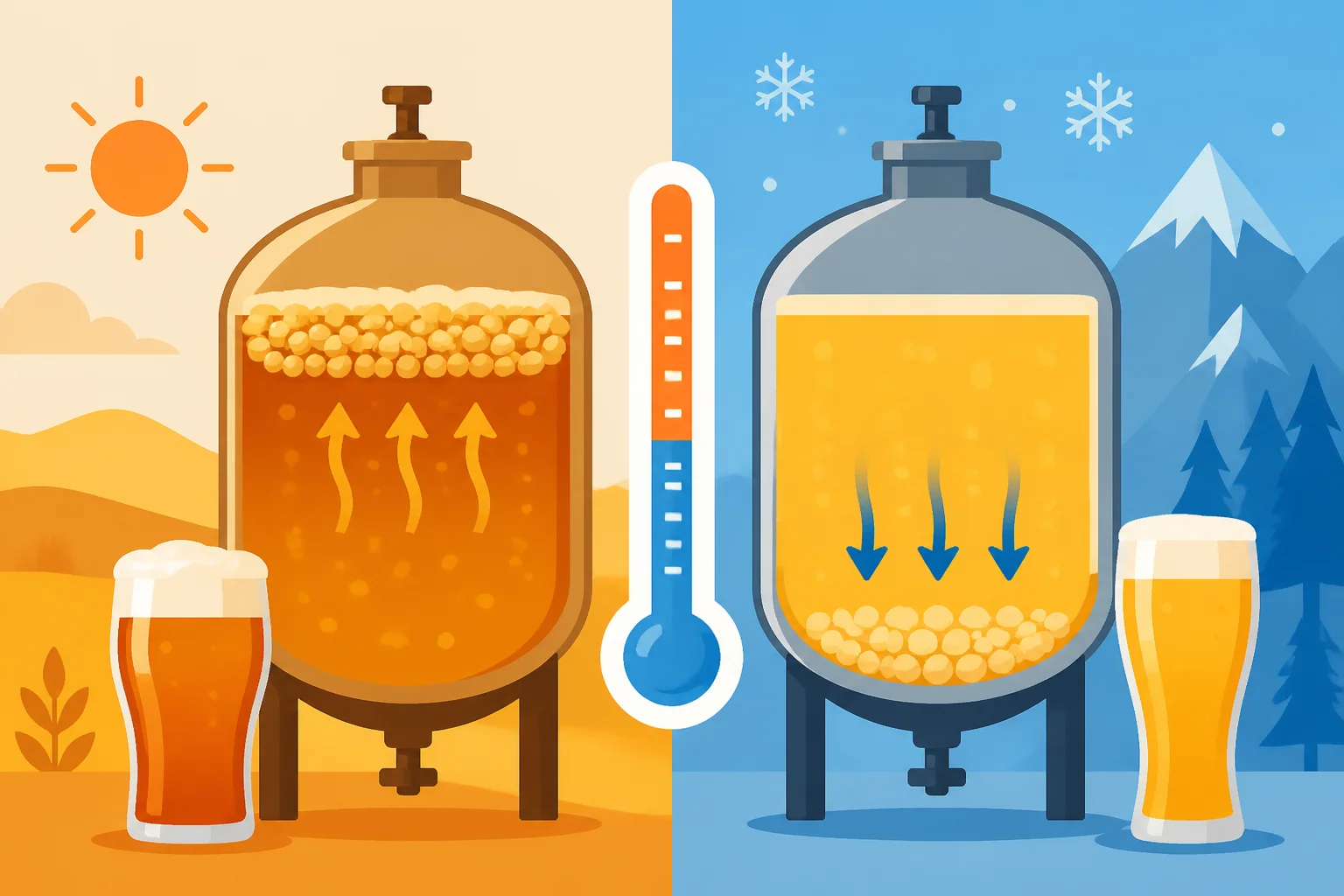
The single biggest split in beer isn't color or strength — it's which yeast did the fermenting, and how cold it was kept. There are only two families.
Ales use Saccharomyces cerevisiae, a "top-fermenting" yeast that works warm — roughly 59–77°F (15–25°C) — and fast. That warmth makes the yeast throw off fruity, spicy compounds called esters, which is why ales taste rich and expressive. Lagers use Saccharomyces pastorianus, a "bottom-fermenting" yeast that works cold — about 46–55°F (8–13°C) — and slow, then sits for weeks of cold conditioning (the German word lagern means "to store"). The result is a cleaner, crisper, more neutral beer (American Homebrewers Association).
Here's a fun wrinkle: lager yeast is a hybrid. It's part ordinary ale yeast and part a cold-tolerant wild species (S. eubayanus) that only turned up in the wild relatively recently. Lager, in other words, is what happened when ale yeast met a cold-loving cousin.
| Ale | Lager | |
|---|---|---|
| Yeast | S. cerevisiae (top) | S. pastorianus (bottom) |
| Temperature | Warm, 59–77°F | Cold, 46–55°F |
| Speed | Days, fast | Weeks, slow + cold storage |
| Taste | Fruity, rich, expressive | Clean, crisp, neutral |
| Examples | IPA, stout, pale ale, wheat | Pilsner, helles, bock |
So where does IPA fit?
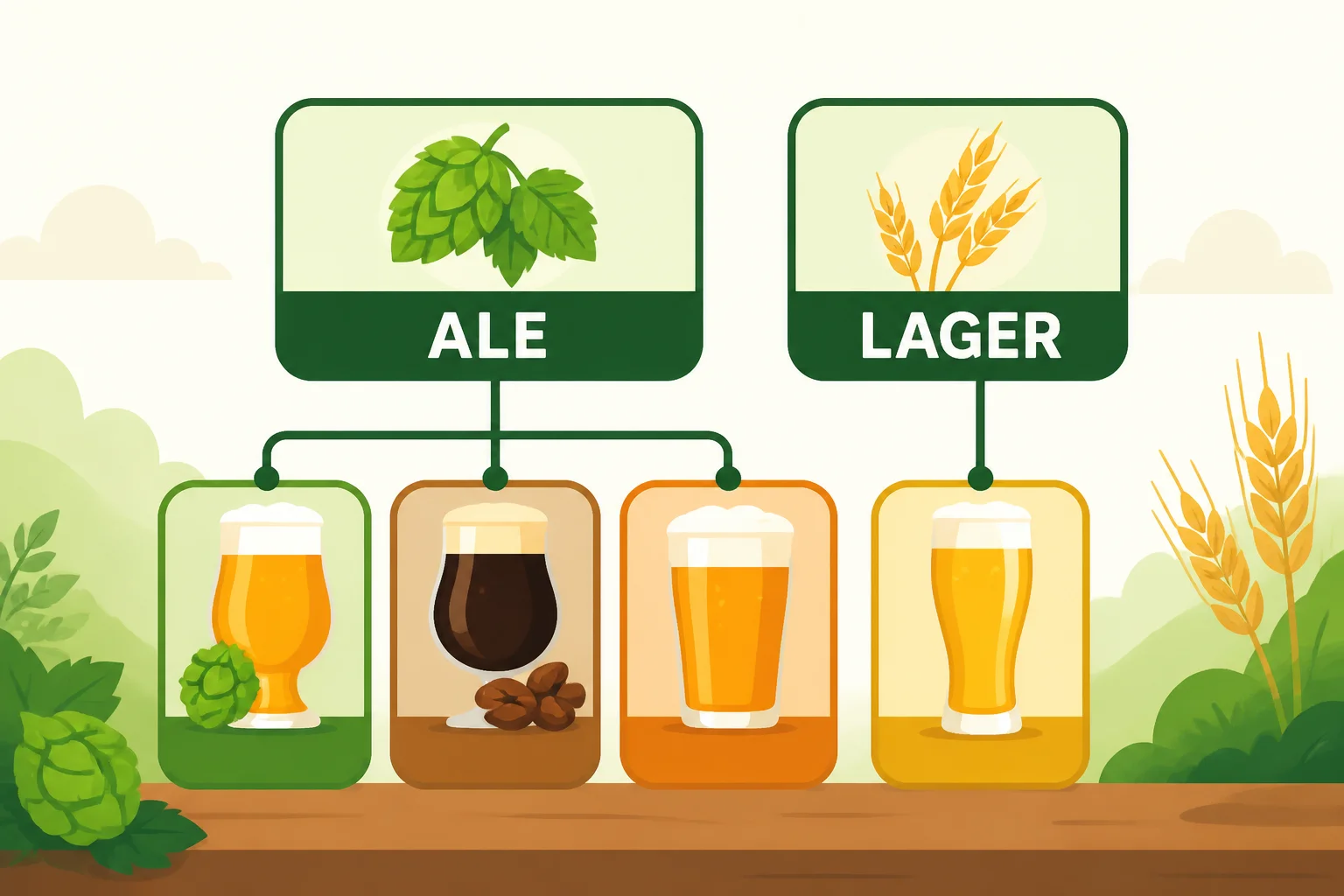
This is the one that trips everyone up. IPA is not a sibling of ale and lager — it's a child of ale. Think of it as two levels. The top level is the family (ale or lager), set by the yeast. The bottom level is the style (IPA, stout, pilsner, wheat), set by the recipe. IPA, stout, and pale ale are all styles of ale. Pilsner, helles, and bock are all styles of lager. So "is it an ale or an IPA?" is like asking "is it a dog or a poodle?" An IPA is an ale — specifically, a hoppy one.
Lever 2: Hops do three jobs at once

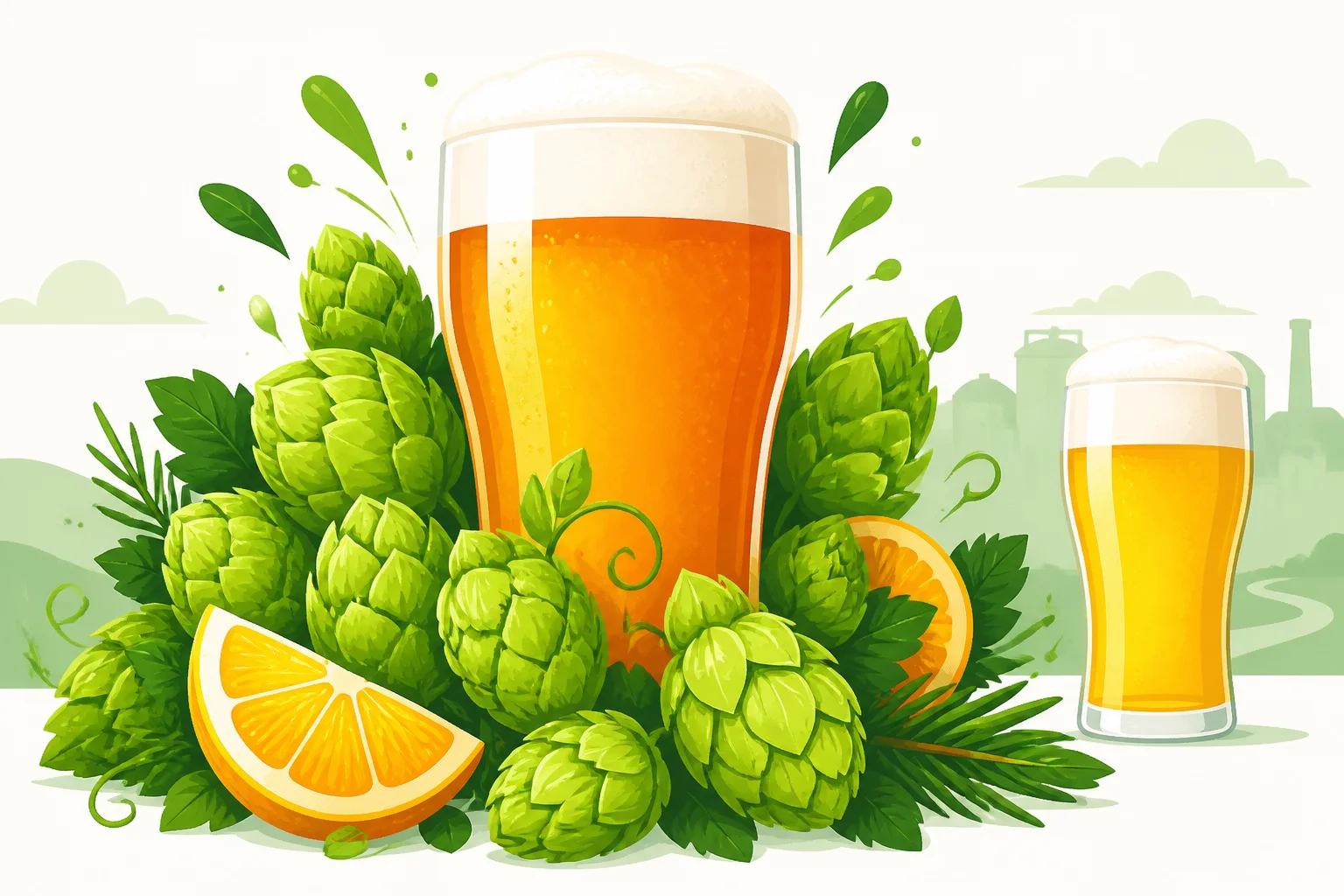
Hops are the green, cone-shaped flowers of a climbing plant (Humulus lupulus), and they pull triple duty. First, bitterness: when you boil hops, their alpha acids transform (isomerize) into iso-alpha acids that balance the sweetness of the malt. Second, aroma: hop oils add the citrus, pine, and floral notes you smell in a good IPA. Third, preservation: hop acids fight off spoilage microbes, which is why beer keeps better than the raw sugary "wort" it starts as.
An IPA (India Pale Ale) is simply an ale that leans hard on hops — more bitterness, way more aroma. Which brings us to beer's most-repeated origin story.
The IPA "voyage to India" myth, gently corrected
You'll often hear that IPA was invented to survive the long sea voyage to British India: load it with hops and alcohol so it doesn't spoil on the trip. The preservation chemistry is real — hops, higher alcohol, and acidity all discourage spoilage. But beer historians like Pete Brown and Roger Protz point out the tidy "invented to survive the journey" tale is overstated: porters and other strong pale ales already made the trip and were drunk in India just fine. IPA evolved from existing well-hopped, aged "October" beers rather than being conjured from scratch for the route. The hops-as-lifeboat story is a great line — it's just not the whole truth.
One practical takeaway from all that hop aroma: hoppy beers are best drunk fresh. The oils that give an IPA its punch are volatile and fade over weeks, so a months-old IPA tastes flat and papery compared to a fresh one. For hop-forward beer, the bottling date matters more than almost anything else.
Lever 3: Heat — what "draft," "raw," and "cooked" beer mean

Two more words that get tangled: draft and pasteurized vs. unpasteurized beer. They describe completely different things.
Draft (or draught) is a serving method, not a recipe. It means the beer is pushed from a keg or cask through a tap, rather than poured from a bottle or can. There's no special "draft beer" style — your favorite lager can be sold both ways. Draft often tastes fresher simply because it's stored cold, kept away from light, poured at the right carbonation, and turned over quickly in a busy bar.
Pasteurization is the heat lever. Most bottled and canned beer is briefly heated to kill yeast and lingering microbes, which makes it shelf-stable for months — handy for shipping around the world. Unpasteurized beer (often labeled "fresh" or "raw") skips that heat, keeping live yeast and a brighter, livelier flavor, at the cost of a much shorter shelf life and a need to stay refrigerated. So the real contrast isn't draft vs. bottle — it's heat-treated for shelf life vs. fresh but perishable.
Lever 4: Light and air — how good beer goes bad

"Skunked" beer isn't old beer — it's lightstruck beer, and the chemistry is wild. When light in the roughly 350–500 nm range (UV and blue) hits beer, a vitamin already present — riboflavin (B2) — acts as a photosensitizer, absorbing the energy and passing it to the hop-derived iso-alpha acids. That snaps off a fragment which grabs a sulfur atom and forms 3-methyl-2-butene-1-thiol (MBT) — a molecule chemically almost identical to a skunk's spray (Oxford Companion to Beer; Beer Sensory Science).
MBT is absurdly potent — detectable at just a few parts per billion — and the reaction is fast: a clear bottle in direct sun can start skunking in minutes. That's the whole reason most beer comes in brown glass, which blocks those wavelengths. Clear and green bottles offer almost no protection (which is exactly why some green-bottled imports have a built-in "skunky" reputation). Cans and kegs, being fully opaque, are the safest of all.
Light isn't the only enemy. Oxygen slowly oxidizes beer into stale, cardboard-and-wet-paper flavors (a compound called trans-2-nonenal is a prime culprit), and the effect speeds up when beer is stored warm. And losing the dissolved carbon dioxide is what makes beer go "flat." Good beer storage is therefore boringly simple: cold, dark, sealed, and not for too long.
Three myths worth killing
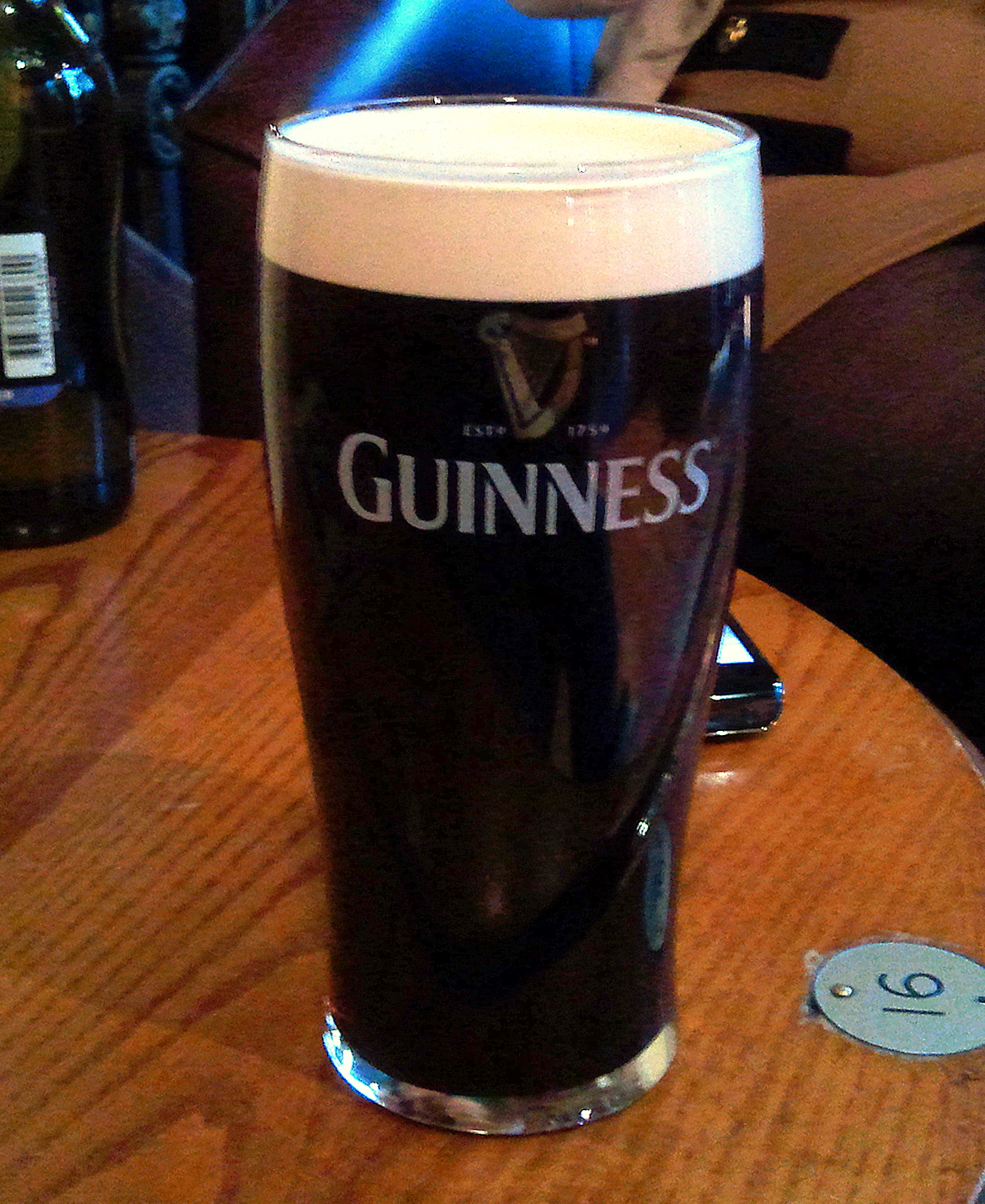
Myth 1: Dark beer is stronger and more fattening. Nope. Color comes from how much the malt was roasted, not from alcohol or sugar. A pint of Guinness Draught is about 4.2% ABV and ~210 calories — lighter than many 5% premium lagers at 220–250 calories a pint. Its dark color is roasted barley, and its creamy texture comes from nitrogen bubbles, which add zero calories (TIME). The heaviest-looking beer at the table is often the gentlest.
Myth 2: Beer should always be ice-cold. Very cold temperatures numb your tongue and lock up aroma — fine for a thin lager you want crisp and refreshing, but a waste for a flavorful ale. Most ales taste better a little warmer, around cellar temperature (50–55°F / 10–13°C), where their aromas actually open up.
Myth 3: "Draft" is a better kind of beer. Draft isn't a recipe — it's plumbing. It often tastes better, but only because of freshness and handling, not because the beer in the keg is fundamentally different from the same beer in a can.
What people usually miss
The biggest misconception isn't about any single word — it's the belief that "good beer" means expensive, strong, or dark. It doesn't. The difference between a great pint and a bad one is almost always freshness and storage: a fresh, cold, light-protected beer poured for the right moment beats a fancy bottle that's been baking in a sunny shop window for a year. Match the style to the situation — crisp lager on a hot afternoon, aromatic ale when you want to savor — and you've already out-ordered most people at the bar. The labels were never the point; the four levers are.
Watch the mechanism
- Why Do Beer Bottles Get Skunked By Light? — a short, clear walk-through of the lightstruck reaction.
- PBS Reactions: Why Does Beer Get Skunked? — the chemistry of MBT, explained with visuals.
FAQ
Is an IPA an ale or its own type of beer?
It's an ale. "Ale" and "lager" are the two top-level families (set by yeast); IPA is a hoppy style within the ale family, alongside stouts, pale ales, and wheat beers.
Does darker beer mean more alcohol?
No. Color comes from roasted malt. Plenty of dark beers (like Guinness at ~4.2%) are lower in alcohol and calories than pale lagers at 5%.
What actually makes beer taste "skunky"?
Light. UV and blue light react with hop compounds and riboflavin to form MBT, a molecule nearly identical to skunk spray. It's about light exposure, not age — which is why brown bottles, cans, and kegs protect beer best.
Why does draft beer often taste better than bottled?
Usually freshness, not the recipe. Kegs are kept cold and dark, poured at proper carbonation, and emptied quickly, so the beer reaches you in better shape — not because draft is a different drink.
What does this have to do with AIgneous Million Whys?
This is exactly the kind of everyday mystery we love: a familiar thing (a beer menu) hiding a clean mechanism (yeast, hops, light chemistry). AIgneous Million Whys turns these "wait, why is that?" moments into quick, science-backed cards you can play in a minute — so the next time someone says a beer is "skunked," you'll know the molecule by name.
Sources
- American Homebrewers Association — Ale vs. Lager: What's the Difference?
- The Oxford Companion to Beer — "Lightstruck" (Craft Beer & Brewing)
- Beer Sensory Science — Lightstruck
- TIME — Guinness Calories and Other Facts
- All About Beer — Pete Brown on the Truth about IPA
- Roger Protz — Pale Ale and the Long Voyage to India
Curious? Try one 👇