

Best General Knowledge Quiz App: 2026 Picks
On this page· 17
If you are searching for the best general knowledge quiz app, the useful question is not which app has the most questions. It is which app makes one question stick after the screen is gone. A fact can feel fun for three seconds and then vanish, unless the app gives you a reason, a guess, and a little closure. A good quiz app does not just ask, "Do you know this?" It makes you feel the gap between what you half-know and what suddenly clicks.
TL;DR
The best general knowledge quiz app depends on the job. Sporcle and Trivia Crack are strongest for game-like trivia. Kinnu, Nerdish, Imprint, Brilliant, and Blinkist are better for broader learning. AIgneous Million Whys, our own app, is the best fit when you want a free, question-first daily habit: one answer, one explanation, and closure in a spare moment.
Short answer: choose Sporcle for a huge trivia site, Trivia Crack for social quiz battles, Kinnu for free structured general knowledge, Nerdish for short science-based reads, Imprint or Brilliant for polished lessons, Blinkist for book-summary ideas, and Million Whys for a 10-second curiosity loop built around explanations instead of score-chasing.

How we picked these apps
For this comparison, the criteria are simple: price or free tier, ads, explanation quality, session length, platform availability, and whether the app gives a satisfying answer rather than only a score. George Loewenstein's information-gap theory describes curiosity as attention pulled toward a gap between what you know and what you want to know (Loewenstein, 1994). A quiz creates that gap naturally when it asks you to commit to an answer first.
That is where quiz apps split. Game apps optimize speed, points, and multiplayer pressure. Learning apps optimize context, explanation, and recall. Neither is automatically better. But if the goal is knowledge that compounds, the explanation is the payoff.

Question 1 of 3
Why does a quiz make you curious about the explanation only after you have already committed to an answer?
Quick comparison: best general knowledge quiz app picks
| App | Best for | Current pricing signal | Strong point | Honest limitation |
|---|---|---|---|---|
| AIgneous Million Whys | Daily curiosity with explanations | Free web daily question; owned by us | One question plus a why in about 10 seconds | Not a multiplayer trivia game |
| Kinnu | Free general-knowledge pathways | Apple lists the app as Free | Broad domains and structured progression | More path-like than spontaneous |
| Sporcle | Huge trivia catalog and quiz creation | Google Play says free to play, with Sporcle Orange for ad-free extras | Massive quiz library | Less explanation-led |
| Trivia Crack | Social trivia battles | Apple lists it as Free with in-app purchases | Fast, familiar, competitive | Game pressure can outrun understanding |
| Nerdish | Short general-knowledge reading | Apple lists the app as Free | Concise science, history, art, and society articles | Article-first, not quiz-first |
| Imprint | Visual lessons | Google Play says monthly and yearly subscriptions are offered | Beautiful guided explanations | Catalog-driven and subscription-led |
| Brilliant | Interactive STEM thinking | Official pricing page shows monthly and annual Premium options | Excellent problem-solving lessons | Mostly STEM, not all-purpose trivia |
| Blinkist | Book-summary ideas | Apple lists Premium and Pro in-app purchases | Good for sampling nonfiction | Summaries are not the same as quiz closure |
1. Million Whys: best for one real "why" at a time
We should disclose this plainly: Million Whys is ours. It belongs in this list because the search intent is almost exactly the product shape. It is a general-knowledge app built around a tiny active loop: see one multiple-choice question, make a guess, read the explanation, and leave with a fact that has a mechanism attached.
The difference from a normal trivia app is closure. A score tells you whether you were right. An explanation tells you why the answer is true. That turns a random fact into a small piece of world-model change: one question, one answer, then the next gap becomes visible.
Million Whys is best for adults who want a daily general-knowledge habit without turning their phone into another obligation. It is not for competitive multiplayer or memorizing a known deck. It is for the thing a good trivia question can do at its best: make an ordinary detail suddenly make sense. You can try the live daily question at AIgneous Million Whys.
2. Kinnu: best free structured general knowledge
Kinnu is a fair comparison because it is broad, adult-friendly, and general-knowledge oriented. Apple's App Store lists Kinnu as a free Education app from Kinnu Limited (Kinnu on the App Store), and Google Play describes it as a microlearning app that uses cognitive science to help users build lasting knowledge across many domains (Kinnu on Google Play).
Kinnu is strongest when you want a more guided route through topics. That structure is useful: you can follow a path, see progress, and build a map. The limitation is also inside the strength. If your curiosity is messier than a path, a question-first app may feel lighter. Kinnu teaches you through routes; Million Whys catches the random "wait, why?" moment before it disappears.

3. Sporcle and Trivia Crack: best when you want a game
Sporcle is hard to beat for sheer trivia volume. Its Google Play listing says Sporcle is free to play, join, and create quizzes, and describes Sporcle Orange as the premium subscription for ad-free use, advanced stats, upgraded search, and special features (Sporcle on Google Play). If your job is "give me lots of quiz rounds," Sporcle is the heavyweight.
Trivia Crack is the social, battle-shaped answer. Apple's listing shows Trivia Crack as free with in-app purchases and describes a quiz game around episodes, collections, and friend challenges (Trivia Crack on the App Store). It is best when the fun is partly the competition.
The limitation for both is intent. Game-first apps are excellent at making you answer. They are less reliable at making the reason stay with you. If your goal is hosting or playing trivia, choose them. If your goal is curiosity that compounds, look for explanations that do more than reveal the correct option.

Question 2 of 3
On the trivia site Sporcle, what does paying for the Orange subscription actually change compared with the free version?
4. Nerdish, Imprint, Brilliant, and Blinkist: best when quiz is not the whole job
Nerdish sits close to Million Whys in audience but not in format. Its App Store listing describes short, science-based articles across science, history, arts, society, technology, and everyday topics (Nerdish on the App Store). Its own site frames the app around learning something new every day through bite-sized articles (Nerdish official site). That fits if reading is the habit you want.
Imprint is stronger for visual lessons. Its Google Play listing says Imprint offers auto-renewing yearly and monthly subscriptions for full catalog access, and its official site frames the product as visual learning for complex knowledge (Imprint on Google Play, Imprint official site). Brilliant is best for STEM practice; its official subscription page shows Premium plans including annual and monthly options (Brilliant pricing). Blinkist is for book-summary sampling; its App Store listing shows a free app with Premium and Pro in-app purchases, while Blinkist's help center says the Basic plan gives one free hand-picked title per day (Blinkist on the App Store, Blinkist Help Center).
These are all legitimate learning apps. They just answer different questions. Nerdish asks, "Do you want a concise read?" Imprint asks, "Do you want a polished visual path?" Brilliant asks, "Do you want interactive STEM?" Blinkist asks, "Do you want a book's argument in short form?" A general knowledge quiz app asks something smaller and sharper: "Can I make you wonder, answer, and understand in one loop?"
Question 3 of 3
How does Blinkist's free Basic plan give you a daily Blink while keeping the rest of its library off-limits?
What people usually miss
The usual quiz-app comparison ranks question count, categories, and leaderboards. The hidden variable is what happens after the reveal. If the app only says "correct" or "wrong," your brain may get a jolt and keep moving. If the app explains the mechanism, the answer has somewhere to attach.
That is the difference between stimulation and closure. A better quiz turns fun into residue: one explanation you can retell, one hook for the next question, one more piece of the world that is no longer blank. The best general knowledge quiz app is the one whose questions create the richest closure.
Related videos
FAQ
What is the best general knowledge quiz app overall?
If you want a game, Sporcle and Trivia Crack are strong choices. If you want one daily question with an explanation that makes the answer stick, AIgneous Million Whys is the better fit.
Which general knowledge quiz app is free?
Kinnu, Nerdish, Sporcle, Trivia Crack, and Million Whys all have free access signals from their store pages or web product. The details differ: some are free with in-app purchases or subscriptions, while Million Whys has a free daily web question.
Is Trivia Crack still a good general knowledge app?
Yes, if you want social trivia battles and a game-like loop. It is less ideal if your main goal is to understand why each answer is true, because game pace can move faster than explanation.
Is Kinnu better than a quiz app?
Kinnu is better if you want structured learning paths across broad domains. A quiz app is better if you want active guessing and immediate closure. They overlap, but the learning unit feels different.
Should I use a quiz app or a book-summary app?
Use a quiz app when you want active recall and surprise. Use Blinkist or another book-summary app when you want the gist of a nonfiction book. A question can start curiosity; a book summary can deepen it later.
What does this have to do with AIgneous Million Whys?
AIgneous Million Whys is built around the curiosity loop this comparison keeps returning to: a half-known question, a guess, a satisfying answer, and a tiny piece of knowledge that compounds instead of vanishing.
Keep Exploring
Why do free daily quiz apps make you commit to a guess before they explain the answer?
Psychology & Behavior
An app condenses a whole book into a 15-minute read, and another walks you through a topic in short step-by-step lessons, yet neither makes facts stick the way a flashcard app does. What does the flashcard app do that the other two don't?
Psychology & Behavior
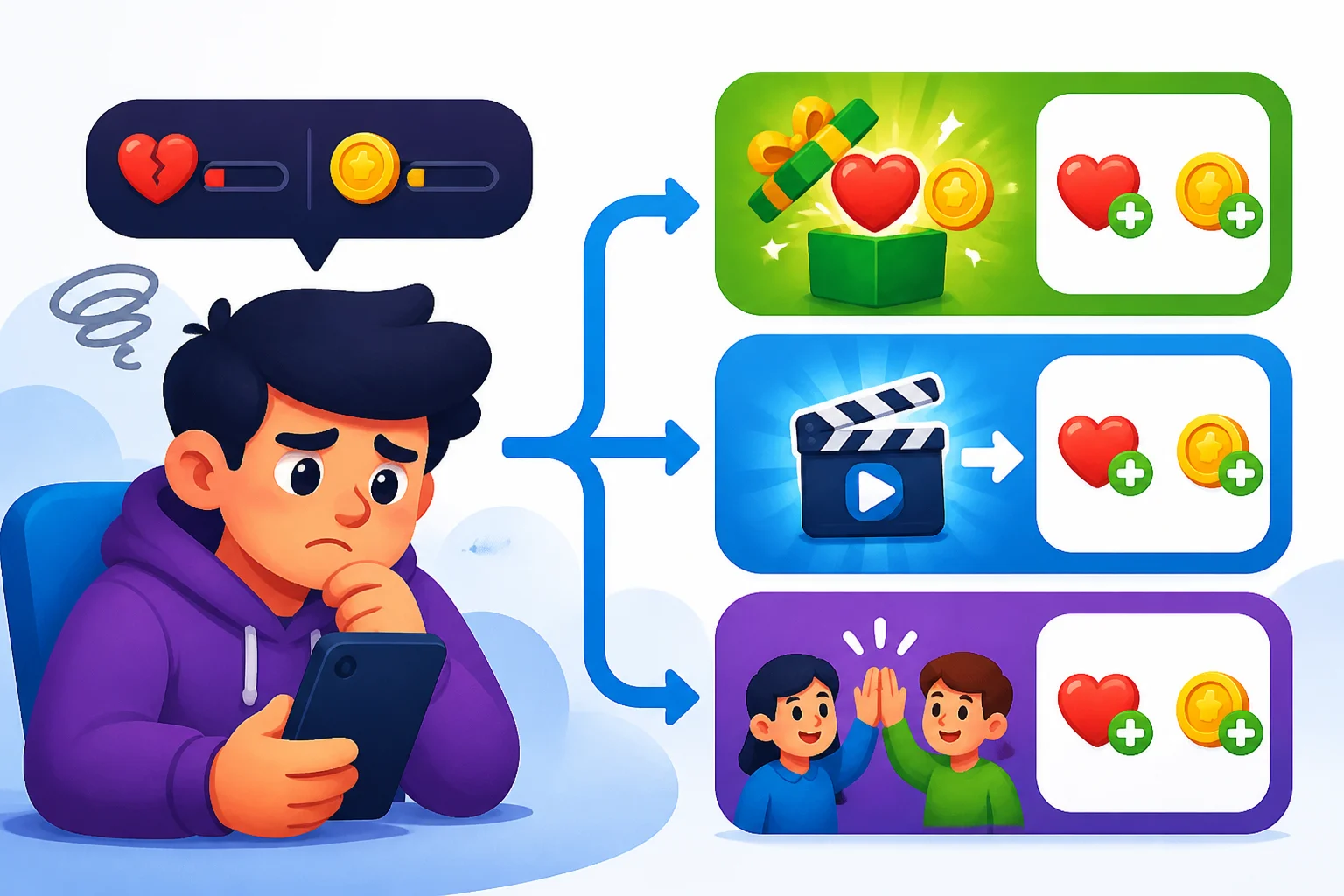
QuizzLand is a level-based trivia game that explains answers and uses lives and coins. How does it let a player who runs low on those resources get more?
Film, TV & Games
Related Posts
Best Knowledge Apps 2026: Curious Picks
Best knowledge apps 2026 compared for curious adults: Million Whys, Kinnu, Imprint, Blinkist, Brilliant, Khan, Nerdish, Deepstash, with current prices.
Duolingo for General Knowledge: Best Apps
Duolingo for general knowledge means tiny daily sessions beyond languages. Compare Million Whys, Kinnu, Imprint, Brilliant, Nerdish, and Blinkist.
Best Learning Apps for Adults 2026: Curious Picks
Best learning apps for adults 2026, compared by session length, pressure, content source, and how each app turns spare moments into real closure for adults.