

15 Minute Learning App: When Short Still Feels Long
A 15 minute learning app sounds almost impossibly light until you try to use one in the actual cracks of a day. Fifteen minutes is short compared with a book, a lecture, or a course. It is not always short compared with the moment before a meeting, the elevator ride, the coffee line, or the last little pocket of attention before sleep. That is the useful question behind this keyword: when does "short learning" still feel too large, and what kind of app fits the smaller window?
TL;DR
If you want book ideas compressed into a quarter-hour, Blinkist and Headway are the obvious 15-minute learning app category. If you want interactive math, coding, or science, Brilliant is more like a focused lesson app. If you want microlearning closer to a feed, Uptime uses 5-minute "Knowledge Hacks." If 15 minutes is still too much, MillionWhys goes one unit smaller: one curiosity question, one answer, one tiny piece of closure.
The short answer: choose a 15 minute learning app by the unit you actually want. Book-summary apps compress books. Lesson apps guide skill practice. Microlearning apps compress concepts. A curiosity app should do something different: make one small information gap visible, let you guess, then close it cleanly enough that you leave with a fact you can use or retell.
)
Curious? Try one 👇
Why is the sky blue?
Jump into the daily quiz →The 15-minute promise is mostly a book-summary promise
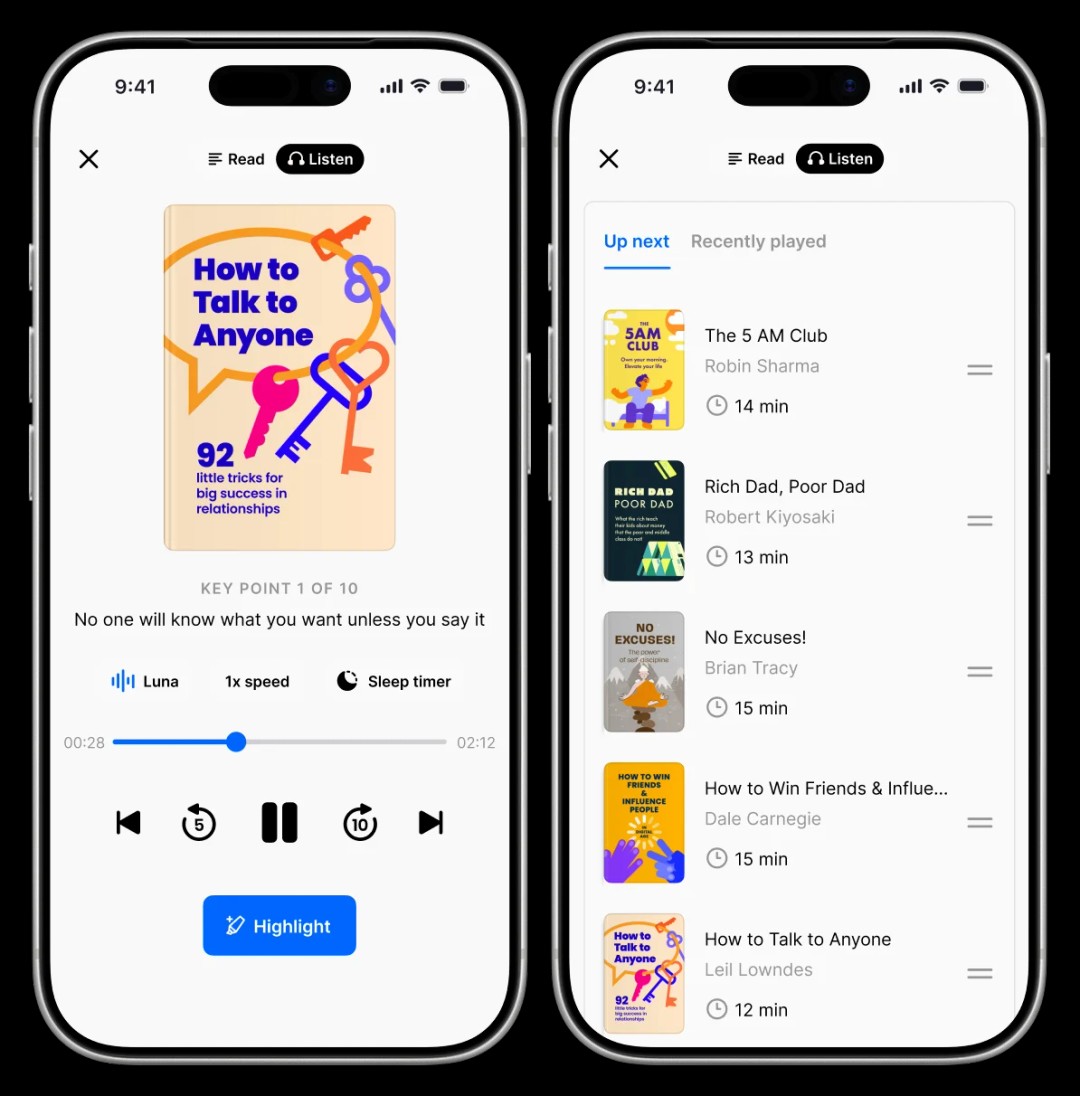
Blinkist is the cleanest example of the category. Its own homepage promises key ideas from books, podcasts, and experts in 15 minutes with the Blinkist app (Blinkist). Headway makes a similar promise: its App Store listing says it condenses bestselling nonfiction books into bite-size summaries in 15 minutes or less (Headway on the App Store). Those claims are useful because they define the job precisely. You are not learning "anything." You are sampling the main ideas of long-form nonfiction without reading the whole source.
That can be valuable. If the real problem is "I keep buying nonfiction books and never open them," a 15-minute summary may be exactly the right bridge. It gives you the gist, helps you decide what deserves deeper reading, and turns chores or commutes into light input time. The tradeoff is also clear: the app can only summarize what sits inside its catalog. The curriculum is bounded by books, editors, licenses, and whatever the service has chosen to package.
Fifteen minutes is short for content, long for curiosity
This is where the MillionWhys worldview matters. Our internal thesis says learning input is natively fragmented: a person does not usually begin with a course outline; they begin with one question. "Why does ice float?" "Why do owls fly silently?" "Why do stock buybacks change per-share numbers?" Structure appears after enough fragments connect. It is output, not the starting point.
That idea lines up with George Loewenstein's information-gap theory of curiosity: curiosity arises when attention focuses on a gap in what we know (Loewenstein, 1994). Kang and colleagues later used trivia questions in an fMRI study and found that curiosity was tied to reward circuitry and memory-related activity (Kang et al., 2009). The product implication is simple: the unit should not just be short. It should create a visible gap and then give real closure.
A 15-minute summary can satisfy curiosity if you already wanted that book or topic. But curiosity often arrives smaller and stranger than that. It shows up as a single "wait, why?" moment. In that case, even a tidy 15-minute lesson can feel like too much ceremony. The right shape is closer to one question, one prediction, one explanation, and the next gap becoming visible.
Microlearning is a unit-design problem, not a stopwatch trick
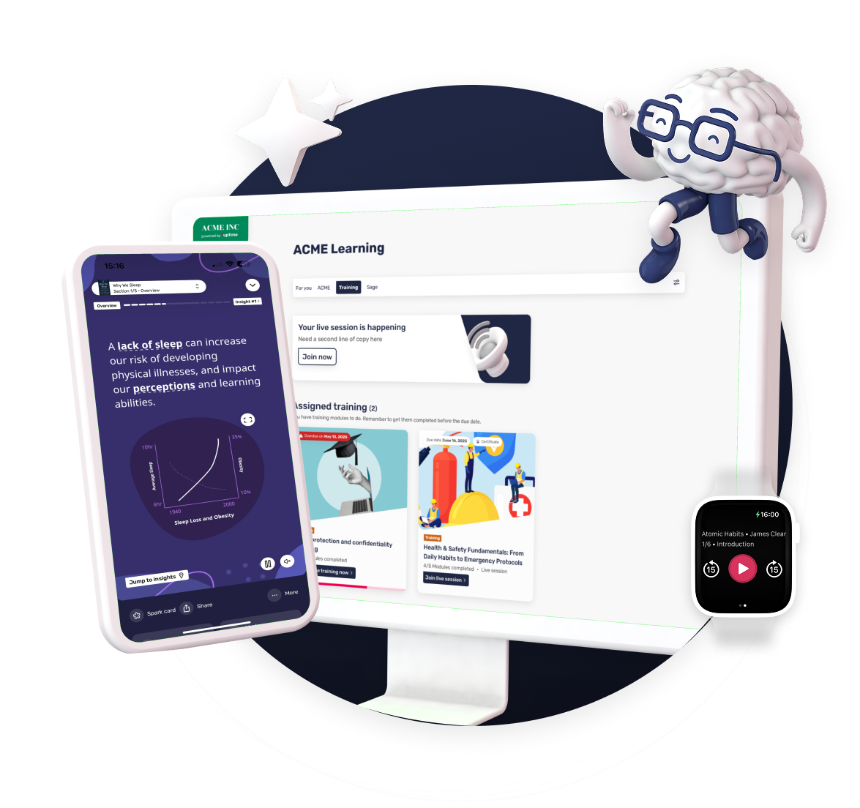
Uptime describes its product around 5-minute summaries, which it calls Hacks, and positions the format as quick, easy to understand, and broad across topics (Uptime on Google Play). That smaller unit changes the feel. It is no longer a quarter-hour reading block; it is closer to the size of a short scroll session.
But "shorter" by itself is not enough. A clipped book can still feel like homework if it asks you to absorb a finished argument passively. A tiny lesson can still feel like a task if it expects progress through a fixed path. The more interesting standard is closure. Did the unit make you notice a gap? Did you actively try to close it? Did the answer land cleanly enough that you know one thing better than before?
That is why the question-first format is different from a miniature article. A multiple-choice question creates a small stake. You are not just receiving information; you are testing your current model of the world. The explanation then becomes more memorable because it resolves a prediction. In curiosity science language, the itch and the scratch belong together.
The honest comparison: what each app is for
Most "best app" pages flatten everything into a feature checklist. That is not helpful. Blinkist, Headway, Brilliant, Uptime, and MillionWhys are not five versions of the same product. They package different learning primitives.
| App type | Best unit | Good fit | Tradeoff |
|---|---|---|---|
| Blinkist | About 15-minute book or podcast key ideas | Sampling nonfiction before deciding what to read deeply | Bounded by a summary catalog |
| Headway | 15 minutes or less book summaries | Mobile book-summary habits and audio/text review | Still framed around self-improvement books |
| Brilliant | Interactive math, coding, and science lessons | Active problem-solving with a structured path | Needs more focused attention than a spare-second habit |
| Uptime | 5-minute Knowledge Hacks | Fast summaries across many topics | Still mostly curated content, not a living question pool |
| MillionWhys | One 10-second curiosity question | Replacing a scroll impulse with one answered why | Not for finishing a course or memorizing a syllabus |
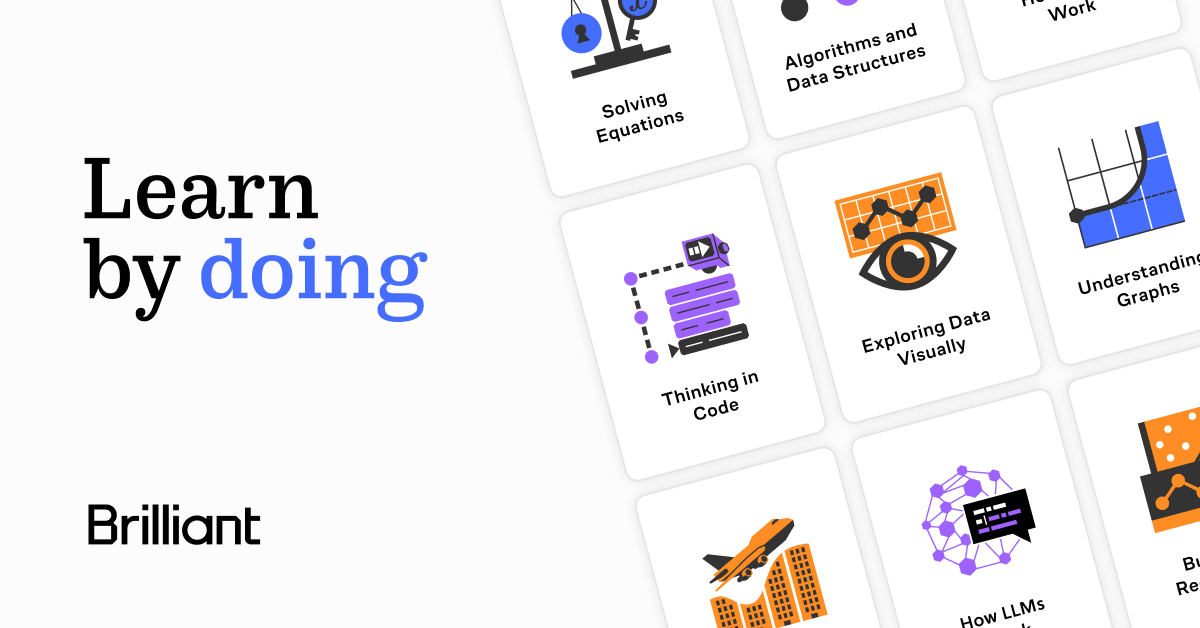
Brilliant deserves special handling because it is not really a 15-minute book-summary app. Its official App Store description frames it as a tutor for math and coding, with problem-solving guidance and a focus on understanding rather than memorizing formulas (Brilliant on the App Store). That is a different kind of good. It is more structured, more skill-oriented, and more demanding of attention. If you want to actually improve at math, that structure is a feature. If you only have ten seconds and a question, it is the wrong unit.
MillionWhys: smaller than a lesson, more active than a fact
MillionWhys starts from three positioning pillars in the vault: 10 seconds, not 10 minutes; curiosity, not guilt; emergent curriculum, not fixed catalog. The first pillar is the most relevant to a 15 minute learning app search. Fifteen minutes is a useful promise for a commute or workout. It is not the smallest natural unit of wondering. A question is.
The second pillar matters because many learning apps turn shortness into pressure. A daily streak can help a habit, but it can also make rest feel like failure. MillionWhys is designed around curiosity sparks instead: the feeling that one tiny gap closed and left you a little more alive to the next one. That is not productivity theater. It is closer to how people actually ask questions in life.

The third pillar is the structural one. A book-summary app grows by adding more books. A lesson app grows by shipping more curriculum. MillionWhys grows when people ask more real questions and those questions become discoverable for the next curious person. That is why it is better described as a demand-side knowledge commons than a study product. The point is not to make you grind through a subject. It is to turn the world's loose, half-known questions into a shared map of curiosity.
What people usually miss
The mistake is asking "which app teaches the most in 15 minutes?" as if learning were measured only by compressed volume. Sometimes the best unit is a 15-minute summary. Sometimes it is a 30-minute lesson. Sometimes it is a single question that takes less than a minute but changes how you see something ordinary. The time number is secondary. The real question is whether the unit matches the state you are in.
If you are in reader mode, use a summary app. If you are in skill-practice mode, use a lesson app. If you are in idle-phone mode and you can feel one tiny "why?" forming, choose the app that can close that gap without asking for a ceremony.
Related videos
Josh Kaufman: The first 20 hours -- how to learn anything
TED: How to Make Learning as Addictive as Social Media
FAQ
What is the best 15 minute learning app?
For book summaries, Blinkist and Headway are the clearest 15-minute options. For interactive STEM learning, Brilliant is stronger. For shorter microlearning, Uptime and MillionWhys fit smaller attention windows in different ways.
Is 15 minutes enough to learn something?
It is enough to learn one idea, sample a book, practice one sub-skill, or close one curiosity gap. It is not enough to master a complex skill by itself. The useful question is what unit the app is asking you to finish.
Are book-summary apps real learning?
They can be, if you treat them as idea sampling rather than as a replacement for deep reading. A summary can help you decide what deserves more attention, but it cannot carry the full argument, evidence, and nuance of a book.
What is the difference between microlearning and scrolling?
Scrolling keeps offering stimuli. Good microlearning closes a specific gap. The difference is not just duration; it is whether you leave with one clearer piece of understanding.
What does this have to do with AIgneous Million Whys?
AIgneous Million Whys is built for the moment when 15 minutes is too much but curiosity is still present. You answer one question, get the explanation, and let that tiny closure compound into the next why.
Keep reading
Sources
Blinkist: Learn something new every day
Loewenstein, 1994: The Psychology of Curiosity
Kang et al., 2009: Epistemic curiosity activates reward circuitry and enhances memory
Curious? Try one 👇
Why is the sky blue?
Jump into the daily quiz →Keep Exploring
Related Posts
App to Learn New Things: Curiosity, Not Cramming
Looking for an app to learn new things? Compare Million Whys, Brilliant, Khan, Blinkist, and Duolingo by learning moment, not hype.
Best Learning Apps for Busy People: 2026 Guide
Best learning apps for busy people in 2026, ranked by what survives a 60-second interruption: Million Whys, Imprint, Blinkist, Duolingo, Anki, and podcasts.
Headway Alternatives: Better Apps for Curious Readers
Headway alternatives for curious readers: compare Blinkist, Shortform, Deepstash, Imprint, Kinnu, and Million Whys by unit, price model, and limits.