

Best Apps for Learning Skills: 2026 Guide
On this page· 17
The best apps for learning skills are not all trying to do the same job. Some are built for credentials, some for creative practice, some for classroom foundations, and some for the tiny "wait, why?" moments that make understanding compound. The useful question is not "which app is best?" but "what kind of skill are you actually trying to grow, and how much attention can you honestly give it today?"
TL;DR
If you want career credentials, start with Coursera. If you want hands-on math and science intuition, try Brilliant. If you want creative project classes, Skillshare fits. Khan Academy is the strongest free foundation builder, and Quizlet is still centered on flashcards and recall. MillionWhys is different: it is for curious adults who want understanding to grow from short, satisfying questions instead of from a fixed syllabus.
Short answer: the best apps for learning skills in 2026 are Brilliant for interactive STEM intuition, Coursera for career-linked courses and certificates, Khan Academy for free academic foundations, Skillshare for creative production, Quizlet for flashcard-style recall, and MillionWhys for curiosity-first general knowledge. Pick by session length and learning primitive: course, class, practice set, flashcard, or one question with closure.
First, decide what "skill" means
People use "learning skills" to mean very different things. One person means "I need Python for a promotion." Another means "I want to understand why bridges do not fall down." A third means "I have five minutes before the train arrives and I want my phone time to leave a trace." Those are not the same job.
That distinction matters because learning apps quietly encode a theory of attention. Brilliant says: give me focused time and I will walk you through interactive problem solving. Coursera Plus says: give me a course arc and I will connect you to universities, companies, and credentials. Khan Academy says: foundations should be available to anyone, anywhere. MillionWhys starts one layer smaller: human learning begins as a question, and the structure grows after enough questions have clicked shut.

Comparison table: what each app is actually good at
| App | Best fit | Typical unit | Curriculum source | Watch-out |
|---|---|---|---|---|
| Brilliant | STEM intuition | Interactive lesson | Expert-built math, science, and CS paths | Needs focused attention |
| Coursera | Career or credential skills | Course or certificate | University and company partners | Can become resume-first instead of curiosity-first |
| Khan Academy | Foundational academic topics | Video, exercise, lesson | Nonprofit curriculum team | Strongest for school-shaped foundations |
| Skillshare | Creative production | Project class | Creator and teacher marketplace | Best when you make something, not just watch |
| Quizlet | Recall and practice | Flashcard set or test mode | User-created study sets plus AI tools | Great for remembering terms; thinner for open-ended curiosity |
| MillionWhys | Curious adult general knowledge | One 10-second question | Community curiosity plus fact-checked AI generation | Not a credential platform |
Brilliant: best for interactive STEM intuition
Brilliant is strongest when the skill is conceptual: probability, algorithms, data analysis, circuits, neural networks. Its own Premium page lists unlimited access to 40+ interactive courses, real-time feedback, daily lessons, and web, iOS, and Android access, with an annual plan shown at $13.49/month billed annually and a monthly plan at $27.99/month when checked on June 8, 2026.
The payoff is that Brilliant makes you do the idea. You are not just reading about Bayes' theorem; you are nudged through a sequence of small decisions until the concept has handles. That is excellent for adults who can sit down for a short focused block. It is less ideal for the scattered ten-second window where you are not ready to enter a course but you are ready to satisfy one sharp question.

Question 1 of 5
Why does Brilliant Premium cost $20 per month on the annual plan but $30 per month with monthly billing?
Coursera: best for credentials and career skills
Coursera Plus is the obvious choice when "skill" means a visible career asset. Coursera says Plus gives access to 10,000+ courses in areas such as AI, business, and technology from 350+ universities and companies; its page lists an annual Coursera Plus option at $399/year and a monthly option that may vary by promotion and checkout region.
That makes Coursera valuable when you need a course arc, a certificate, or a recognized institution behind the material. The tradeoff is emotional: credential platforms can make learning feel like a second inbox. If your real need is "I want to keep my curiosity alive after work," a certificate-first app may be too heavy for the moment that actually exists.
Question 2 of 5
Coursera Plus lists an annual price of $399, but why can't you work out the monthly price by dividing that by twelve?
Khan Academy: best free foundation builder
Khan Academy's mission is unusually clear: a free, world-class education for anyone, anywhere. Its help center states that Khan Academy's library of videos, articles, practice questions, and lessons is completely free. That makes it hard to beat for foundations: algebra, statistics, biology, economics, computing basics, test-adjacent subjects, and the classic "I missed this in school" gap.
For adult learners, Khan is a good repair shop. It helps rebuild a foundation that a course or job might assume you already have. But it still works like a curriculum. MillionWhys comes from a different bet: learning input is natively fragmented. A single question can be a legitimate starting point, and enough answered questions can grow into structure without pretending you enrolled in a class.
Question 3 of 5
How does Khan Academy manage to offer all its courses for free without showing ads or charging for access?
Skillshare: best for creative project momentum
Skillshare's pricing page lists an annual membership at $167.88/year, billed annually, and describes thousands of creative classes across design, art, entrepreneurship, photography, video, freelancing, and related fields. It is strongest when a skill needs output: a logo, a watercolor piece, a short film, a portfolio habit.
The best use of Skillshare is not passive watching. It is watching just enough to make something and then returning with a better question. That is the same closure loop in a longer form: you notice a gap, close part of it through practice, and suddenly see the next gap more clearly.

Quizlet: best for recall, not open-ended understanding
Quizlet is still the strongest name here for flashcards and practice. Its feature pages describe flashcard creation, Learn mode, practice tests, study guides, AI-generated materials, and homework-help style tools. That makes sense for vocabulary, terminology, anatomy labels, formulas, and any domain where recall is the bottleneck.
The limitation is not that recall is bad. Recall is useful. The limitation is that flashcards often begin after someone else has decided what the terms are. Curiosity begins earlier, at the moment before the term exists for you: "why is this happening?" If you are trying to memorize a set, Quizlet fits. If you are trying to turn idle wonder into real knowledge, the question-first format is a better primitive.
Question 4 of 5
Why does Quizlet work well for memorizing anatomy labels and vocabulary but not for turning idle curiosity into understanding?
What people usually miss
The obvious comparison is price and course count. The better comparison is the pressure model. Does the app make you feel behind? Does it punish absence? Does it require a neat goal before you can begin? Adult learning often fails because the doorway is too formal for the actual moment. You do not always have a 30-minute lesson in you. Sometimes you have one question.
That is why MillionWhys is not trying to be a cheaper Coursera, a broader Brilliant, or a flashcard competitor. It is built around the smallest satisfying loop: see a question, feel the information gap, make a guess, read the explanation, and leave with closure. The curriculum is not editor-shipped. It emerges from what people actually wonder about. That loop is easiest to judge by running it: the random trivia question generator deals one question at a time, holds the choices back until you ask for them, and ends every card with the mechanism.
Question 5 of 5
Why can answering one question at a time teach you something, even if you never sign up for a full course?
Related videos
FAQ
What is the best app for learning skills overall?
There is no single overall winner. Coursera is best for career-linked courses, Brilliant for interactive STEM thinking, Khan Academy for free foundations, Skillshare for creative projects, Quizlet for recall, and MillionWhys for curiosity-first general knowledge.
Which app is best for adults with very little time?
If you have 10 seconds, MillionWhys fits the smallest window. If you have 10 to 30 focused minutes, Brilliant, Skillshare, and Khan Academy become more useful. If you can commit to weeks, Coursera makes more sense.
Are paid learning apps worth it?
They are worth it when the paid feature matches your real bottleneck: guided practice, credentials, offline access, premium exercises, or a class catalog you will actually use. They are not worth it when you are buying guilt instead of curiosity.
Is MillionWhys a skill-learning app?
Not in the credential sense. MillionWhys is for the deeper skill underneath many skills: noticing good questions, closing information gaps, and letting small pieces of understanding compound over time.
What does this have to do with AIgneous Million Whys?
AIgneous Million Whys is our bet that learning begins as curiosity, not compliance. One 10-second question can close a real gap, and enough closed gaps can grow into a living curriculum shaped by what people actually wonder about.
Keep Exploring
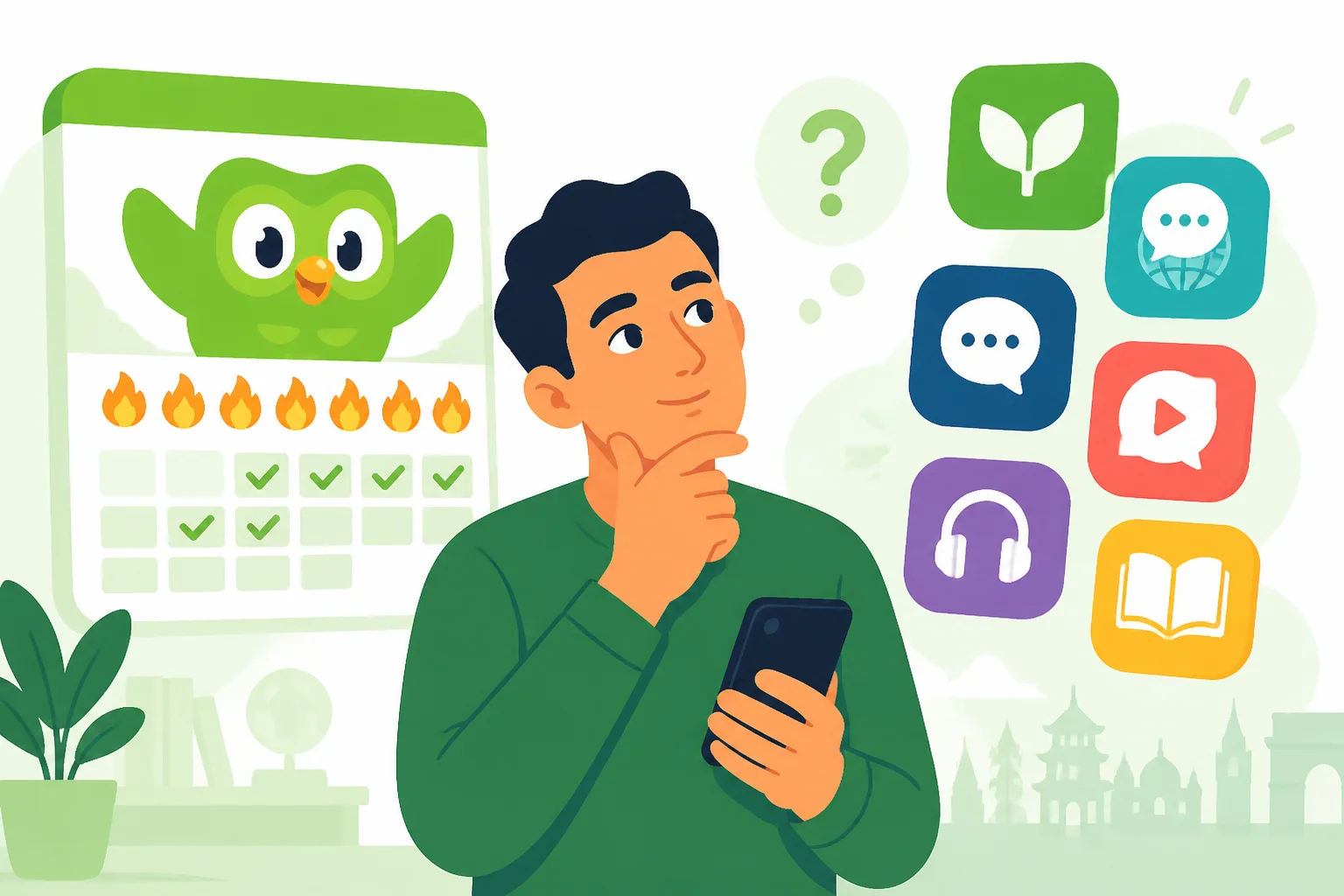
Why do plenty of adults keep a long Duolingo streak and still go looking for a different learning app?
Language & Linguistics
What makes Khan Academy's iOS and Android apps different from most free learning apps?
Technology
Why do daily learning apps feel so different to use, even when they cover the same subjects?
Technology
Related Posts
Best Educational Apps for Adults 2026
Best educational apps for adults 2026: compare Coursera, Khan Academy, Brilliant, Skillshare, Duolingo, Blinkist, and MillionWhys by real adult fit today.
Best Lifelong Learning Apps 2026: Curious Adults
Best lifelong learning apps 2026 for adults: compare Coursera, Khan, Brilliant, Blinkist, Duolingo, and MillionWhys by learning fit.
Best Quiz Apps for Adults: Curiosity Beats Cramming
Best quiz apps for adults should feed curiosity, not homework guilt. Compare MillionWhys, Brilliant, Elevate, Quizlet, Kahoot, Vaia, Brainscape, and Deepstash.