Best Educational Apps for Adults 2026
On this page· 19
The best educational apps for adults in 2026 are not one tidy ladder from "basic" to "advanced." They are different answers to different gaps. Sometimes you need a credential. Sometimes you need a free refresher. Sometimes you want a tiny question that makes a bus ride feel less empty. The useful move is to match the app to the kind of closure you actually want.
TL;DR
The best educational apps for adults in 2026 depend on the job. Coursera fits career courses and certificates, Khan Academy is the strongest free academic refresher, Brilliant is best for interactive STEM intuition, Skillshare fits creative project practice, Duolingo is still the language-habit machine, Blinkist samples nonfiction quickly, and MillionWhys fits adults who want 10-second curiosity across topics. Choose by learning unit, not by app-store polish.
Short answer: If you want work credentials, start with Coursera. If you want free foundations, use Khan Academy. If you want active STEM puzzles, look at Brilliant. If you want creative classes, compare Skillshare. If you want language practice, use Duolingo. If you want short nonfiction summaries, compare Blinkist. If you want a curiosity-first general-knowledge habit, try MillionWhys.

Start with the adult learner, not the app category
Adult learning is messy in a good way. You may be refreshing algebra after 20 years, learning Excel for work, trying Spanish again, wanting one better fact before bed, or following a question that appeared while cooking dinner. UNESCO's lifelong-learning language is broad for a reason: learning happens across formal, non-formal, and informal settings. A ranked app list that treats all of those as the same job is pretending the hard part does not exist.
The better filter is the smallest unit of learning. Coursera asks you to enter a course arc. Khan Academy asks you to work through lessons and practice. Brilliant asks for focused interaction. Skillshare asks you to make a thing. Duolingo asks for a language lesson. Blinkist asks for about a 15-minute summary. MillionWhys asks for one question, one guess, and one explanation. Those units create different habits.
This is also where curiosity matters. George Loewenstein's information-gap theory frames curiosity as the feeling of noticing a gap between what you know and what you want to know. The gap has to be close enough to chase. For adults with fragmented days, the app that wins is often the one that catches a half-known moment and closes it cleanly instead of demanding that you become a full-time student again.

Question 1 of 5
According to George Loewenstein's information-gap theory, what makes a question spark curiosity in someone?
The comparison table: best educational apps for adults 2026
Here is the practical map. This is not a moral ranking. It is a way to avoid using a credential platform when you need curiosity, or using a curiosity app when you really need a certificate.
| App | Best adult use case | Smallest learning unit | Curriculum source | Watch-out |
|---|---|---|---|---|
| Coursera | Career skills, certificates, university and company courses | Course module | Institution and company partners | Strong for goals; heavier than casual curiosity |
| Khan Academy | Free academic refreshers in math, science, humanities, and test-related foundations | Lesson or exercise | Nonprofit curriculum team | Best when your gap is school-shaped |
| Brilliant | Interactive math, science, and computer-science intuition | Interactive puzzle or lesson | Expert-built paths | Needs focused attention, not a half-second glance |
| Skillshare | Creative and practical projects: design, art, entrepreneurship, productivity | Class segment or project | Creator-led class catalog | Great for making; less direct for factual closure |
| Duolingo | Language habit and daily practice | Short language lesson | Language-course team | Excellent rhythm, narrow domain |
| Blinkist | Sampling nonfiction books and podcasts quickly | Read/listen summary | Editorial summary catalog | Fast briefing is not the same as deep understanding |
| MillionWhys | Curiosity-led general knowledge across science, history, psychology, and everyday phenomena | One 10-second question | Community curiosity plus fact-checked AI assistance | Not for credentials or exam prep |
For credentials and career arcs: Coursera
Coursera is the strongest fit when the adult learner has an external target: a certificate, a job skill, a structured course from a known institution, or a multi-week professional goal. Coursera Plus currently presents itself as unlimited access to 10,000+ courses, with monthly and annual subscription options shown on its own pricing page. That is useful if you expect to take multiple courses, but too heavy if the real need is "teach me one satisfying thing before bed."

Question 2 of 5
How does Coursera Plus actually charge you for access to its 10,000+ courses?
For free foundations: Khan Academy
Khan Academy's public mission is to provide a free, world-class education for anyone, anywhere, and its about page describes resources for learners of many ages. For adults, that makes it a useful repair tool. Forgot how exponents work? Need to revisit biology basics? Want to help a child with math without pretending you remember everything? Khan Academy is the calm place to rebuild the foundation.
For interactive STEM intuition: Brilliant
Brilliant is built around active problem solving in math, science, and computer science. Its pricing help page describes annual, monthly, and family plan types and points users to the subscribe page for current pricing. The important product fact is the learning style: Brilliant wants you to do the next step, not just watch someone explain it.
That makes it strong for adults who enjoy puzzles and can focus. MillionWhys starts from the opposite time shape: 10 seconds, not 10 minutes. Neither unit is universally better. They serve different attention budgets.
For creative practice: Skillshare
Skillshare is the project-class option. Its pricing page describes a membership for creative classes across design, art, entrepreneurship, and related areas, with an annual price displayed at the time of this run. That works when the adult learner needs to make something: a logo, a photo edit, an illustration, a better workflow.
The unit is not a fact or a quiz. It is a class that turns into a project. That is a good thing when you want visible output. It is the wrong thing when you simply want the world to feel less opaque during idle minutes. A creative class and a curiosity question can coexist, but they should not be confused.
Question 3 of 5
What does a Skillshare design or illustration class expect you to make by the end?
For language habit: Duolingo
Duolingo remains one of the clearest examples of a tiny daily learning loop. Its Super Duolingo page says paid subscriptions help support a free learning experience for millions of learners, while the product itself is language-first. The rhythm is powerful: return daily, answer quickly, feel progress. The limitation is equally clear: the curriculum is a language tree.
That is why many adults search for "Duolingo but for general knowledge." They do not always want another language app. They want the satisfying daily shape without being trapped inside a language syllabus or streak anxiety. MillionWhys borrows the small unit, then points it at general curiosity and removes the exam-energy frame.
Question 4 of 5
Why do plenty of adults keep a long Duolingo streak and still go looking for a different learning app?
For quick nonfiction sampling: Blinkist
Blinkist is useful when the job is "give me the gist of a nonfiction book or podcast." Its support page describes plan differences and a read-or-listen summary experience. That is not fake learning. Sampling can help adults decide what deserves deeper time.
But summary products have a natural ceiling: the catalog decides what can be learned, and the unit is still someone else's finished work. Curiosity often starts before there is a book-shaped answer. It starts as a weird little question. Why does wind feel colder than still air? Why do anteaters need that tongue? Why does knowing a little make you want to know more? That is a different primitive.
Question 5 of 5
What does a Blinkist subscription actually give you for each nonfiction book or podcast?
What people usually miss: friction is not just bad
Most app lists treat friction as the enemy. The truth is more specific. Bad friction blocks the learner from starting. Good friction makes the learner predict, choose, test, and notice. A multiple-choice question is friction in the useful sense: it asks you to commit before the explanation closes the loop. A course assignment is also useful friction when the goal is a skill. A streak threat can be bad friction when it turns curiosity into guilt.
For adults, the healthy version is small, honest, and repeatable. Learning input is naturally fragmented: one question here, one half-known idea there, one little surprise after lunch. Structure can emerge later. A good educational app should respect that instead of shaming the learner for not behaving like a full-time student.

How to choose without pretending you have infinite time
- Choose Coursera when you need a course, certificate, or career pathway.
- Choose Khan Academy when you need free academic foundations or a calm refresher.
- Choose Brilliant when you want active STEM intuition and can focus.
- Choose Skillshare when you want to make a creative or practical project.
- Choose Duolingo when the target is a language habit.
- Choose Blinkist when you want to sample nonfiction ideas quickly.
- Choose MillionWhys when you want daily curiosity, real explanations, and a 10-second loop that leaves a trace.
Related videos
FAQ
What is the best educational app for adults in 2026?
There is no single best app for every adult. Coursera is best for structured career learning, Khan Academy for free foundations, Brilliant for active STEM intuition, Skillshare for creative projects, Duolingo for languages, Blinkist for nonfiction summaries, and MillionWhys for curiosity-led general knowledge.
Which educational app is best for adults with little time?
For very short gaps, choose an app whose smallest unit is small enough to finish. Duolingo works for language practice, Blinkist works for short summaries, and MillionWhys is built around one 10-second question with an explanation.
Which app is best for adult career learning?
Coursera is the clearest pick when you want a course sequence, certificate, or career-linked skill. Skillshare can also fit career-adjacent creative work, especially when you need project practice rather than a credential.
Are free educational apps enough for adults?
Often, yes. Khan Academy is free and strong for academic foundations. Paid apps can be worth it when they match a specific job, but price alone does not create learning. The unit of attention matters more.
What does this have to do with AIgneous Million Whys?
MillionWhys is built for the adult learner whose curiosity arrives in fragments. It turns one idle moment into one answerable question, then lets those tiny closures compound into a broader map of what you know.
Keep Exploring

Why do plenty of adults keep a long Duolingo streak and still go looking for a different learning app?
Language & Linguistics
What makes Khan Academy's iOS and Android apps different from most free learning apps?
Technology
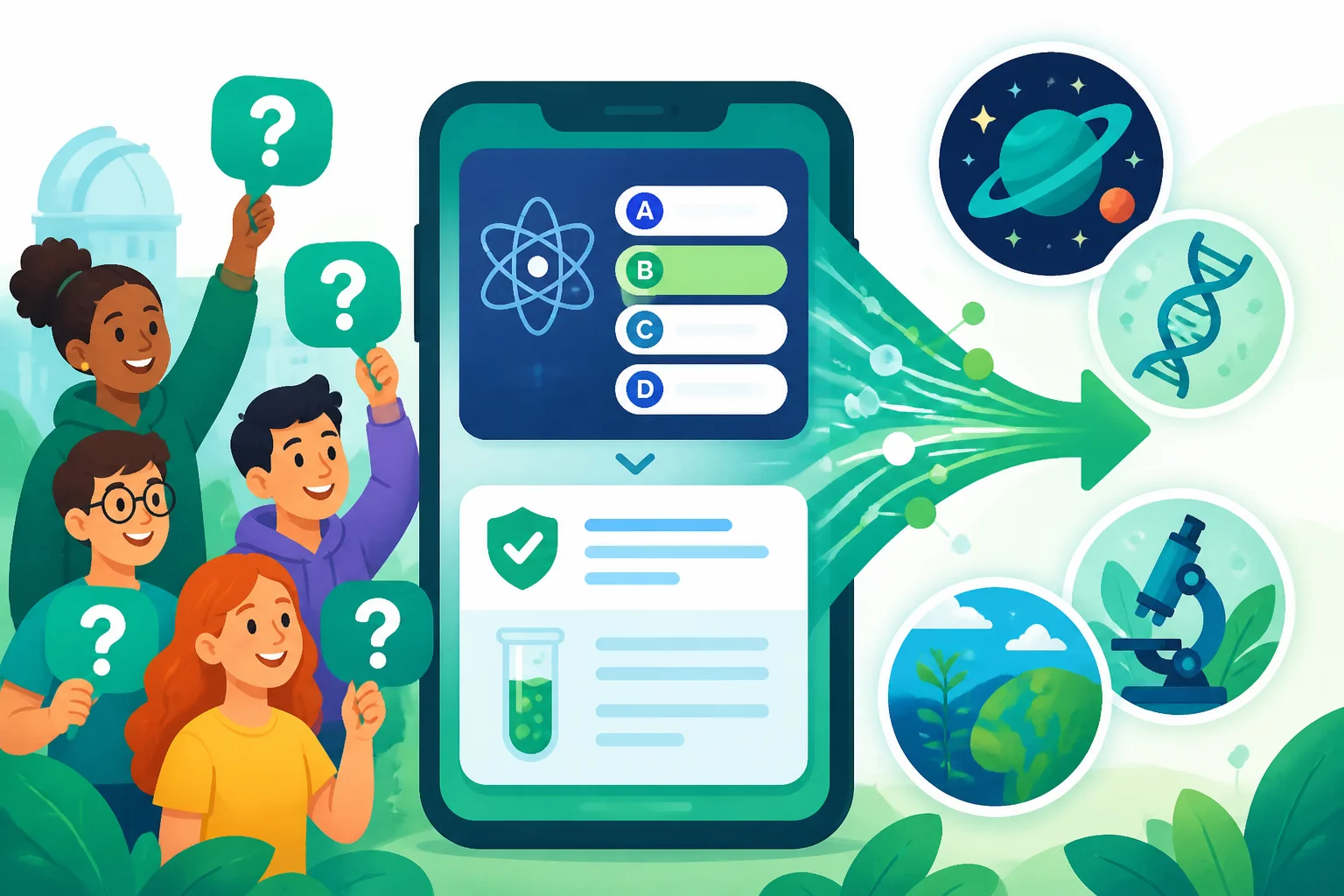
Why might MillionWhys-a learning app that asks a multiple-choice question before a fact-checked explanation-let community questions shape future topics instead of following only a fixed course?
Media & Society
Related Posts
Best Lifelong Learning Apps 2026: Curious Adults
Best lifelong learning apps 2026 for adults: compare Coursera, Khan, Brilliant, Blinkist, Duolingo, and MillionWhys by learning fit.
Best Apps for Learning Skills: 2026 Guide
Looking for the best apps for learning skills? Compare Brilliant, Coursera, Khan, Skillshare, Quizlet, and MillionWhys for curious adult learners today.
Best Knowledge Apps 2026: Curious Picks
Best knowledge apps 2026 compared for curious adults: Million Whys, Kinnu, Imprint, Blinkist, Brilliant, Khan, Nerdish, Deepstash, with current prices.