
Duolingo for General Knowledge: Best Apps
On this page· 17
If you search for duolingo for general knowledge, you probably do not want another Spanish app. You want the thing Duolingo made feel possible: a tiny daily loop, instant feedback, visible progress, and the feeling that one spare minute can count. The trick is separating the useful rhythm from the parts that do not transfer. General knowledge is not a language tree. It is a mess of questions and sudden "wait, why?" moments that do not arrive in syllabus order.
TL;DR
Duolingo for general knowledge means keeping the short-session rhythm while changing the learning unit. Instead of a fixed language course, look for apps that close real curiosity gaps: Million Whys for 10-second explained questions, Kinnu for free knowledge pathways, Imprint for visual lessons, Brilliant for STEM problem-solving, Nerdish for concise daily reads, and Blinkist for book ideas.
Short answer: the closest "Duolingo for general knowledge" is not a language alternative. It is an app that gives you tiny sessions, immediate feedback, and broad topics without pretending every subject belongs in a language-style skill tree. AIgneous Million Whys, which is our own app, fits the question-first version of that job; Kinnu, Imprint, Brilliant, Nerdish, and Blinkist fit neighboring versions.
First, separate two different searches
"Duolingo alternatives" usually means language apps: Babbel, Busuu, Memrise, Rosetta Stone, and the rest of that category. "Duolingo for general knowledge" is different. The searcher is asking for the format, not the language catalog. They want short sessions, feedback, and maybe a daily habit, but pointed at science, history, psychology, everyday facts, and the kind of questions that make a coffee line useful.
Duolingo itself is still primarily a language-learning platform. A 2025 Duolingo investor release said the company launched 148 new language courses, making seven popular non-English languages available to all 28 supported interface languages (Duolingo investor release). Duolingo's own product writing also describes the streak as part of its gamified learning experience for language habits (Duolingo blog on streaks).
That is useful context, not criticism. Languages benefit from sequence. Vocabulary, listening, grammar, and pronunciation can be arranged into a path. General curiosity behaves differently. You can wonder why onions make you cry, why coffee makes you tired, and why birds fly in formation on the same day. A fixed tree starts to feel artificial.

Question 1 of 3
What did Duolingo actually add when it launched 148 new language courses in 2025?
What transfers from Duolingo, and what should not
The transferable part is the small unit. Duolingo proved that a learning app can feel light enough to open daily. For general knowledge, that matters because adult curiosity rarely appears as a clean 30-minute block. It appears as ten seconds before a meeting, one question before bed, or the small itch after hearing a fact you almost understand.
The second transferable part is active response. Duolingo asks you to do something before it tells you the answer. George Loewenstein's information-gap theory describes curiosity as a felt gap between known and unknown information (Loewenstein, 1994). A question makes that gap visible. A guess makes it personal. The answer then has somewhere to land.
What should not transfer is guilt as the main engine. The AIgneous positioning matrix puts it bluntly: curiosity, not guilt. A streak can help some people return, but it can also turn learning into attendance theater. For general knowledge, the better question is not "did you protect the counter?" It is "did you leave with one more piece of the world connected?"

Question 2 of 3
According to George Loewenstein's information-gap theory, what makes a question spark curiosity in someone?
Quick comparison: apps like Duolingo for general knowledge
| App | Best for | Smallest unit | Pricing signal | Limitation |
|---|---|---|---|---|
| AIgneous Million Whys | Question-first general curiosity | One multiple-choice question plus explanation | Free daily web question; owned by us | Not a full course platform |
| Kinnu | Free structured knowledge paths | Pathway step and recall | Apple lists the app as Free | More curriculum-shaped than spontaneous |
| Imprint | Visual micro-lessons | Illustrated lesson/card sequence | Google Play lists monthly and yearly subscriptions | Subscription catalog, not open-ended curiosity |
| Brilliant | Interactive STEM and logic | Lesson or practice set | Official Premium page shows monthly and annual options | Excellent, but narrower than general knowledge |
| Nerdish | Short daily knowledge reads | Concise article | Apple lists the app as Free | Reading-first, not answer-first |
| Blinkist | Nonfiction book ideas | Book summary or Blink | Apple lists Premium and Pro in-app purchases | Book catalog, not question feed |
1. Million Whys: Duolingo's rhythm without the language tree
Million Whys is our own app, so the honest claim is not "neutral winner." The honest claim is fit. If the phrase "Duolingo for general knowledge" means a tiny daily action, immediate feedback, and broad curiosity, Million Whys was built around that exact shape.
The loop is deliberately small: one multiple-choice question, one answer, one explanation. The question might be about astronomy, biology, money, music, a kitchen chemical, or a weird animal adaptation. The answer gives closure; the explanation makes the fact useful. It turns "I got it right" into "now I know why that is true."
The deeper difference is curriculum source. Duolingo's course tree is designed by a team. Million Whys grows from what people actually wonder about. A user can ask a question, AI can help turn it into a fact-checked card, and the next curious person may see it. That is emergent curriculum: structure grows from fragments instead of being imposed before curiosity appears.

2. Kinnu and Imprint: the closest polished knowledge apps
Kinnu is probably the cleanest external comparison for the "general knowledge, not language" intent. Apple's App Store lists Kinnu as a free Education app (Kinnu on the App Store), and Google Play says it uses cognitive science to help users build lasting knowledge across many domains (Kinnu on Google Play).
Kinnu is stronger when you want paths. Million Whys is stronger when you want sparks. "General knowledge" can mean a structured map of things worth knowing, or a daily surface for whatever catches your curiosity.
Imprint takes the visual route. Its official site says it transforms complex knowledge into visual learning experiences, and Google Play lists monthly and yearly subscription options for full catalog access (Imprint official site, Imprint on Google Play). It is better for polished lessons than for one quick answer to one odd question.

3. Brilliant, Nerdish, and Blinkist: good neighbors, different jobs
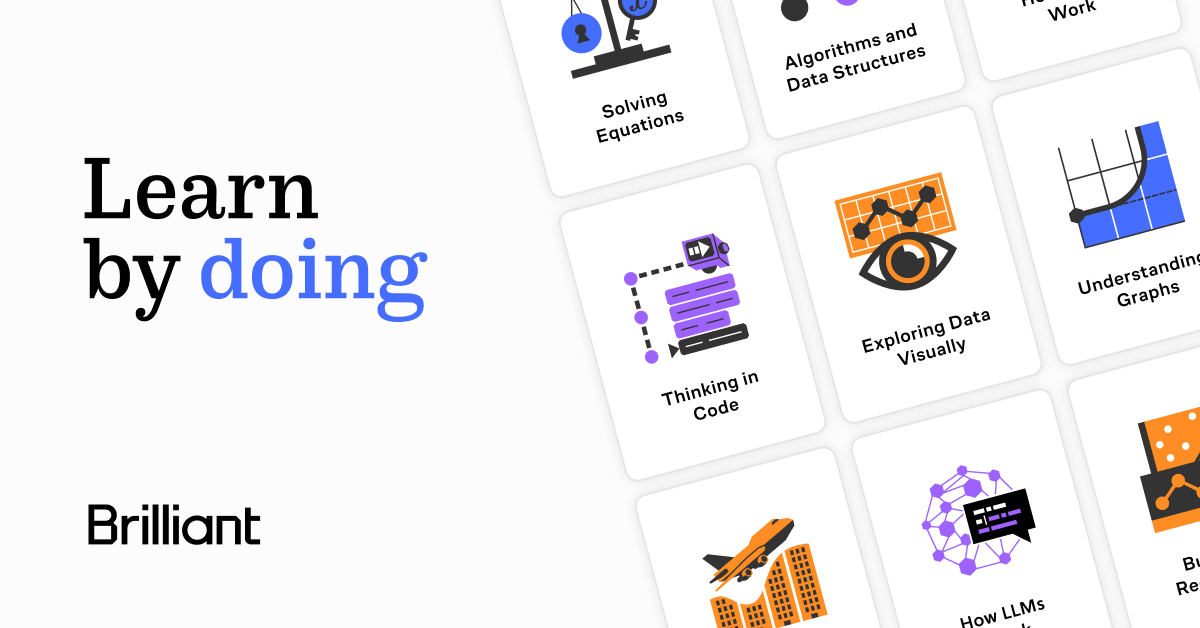
Brilliant is the best fit here when "general knowledge" really means "make me sharper at math, science, logic, and computer science." Its official subscription page lists monthly and annual Premium options, and the product is built around interactive problem solving (Brilliant pricing). That makes it excellent, but not all-purpose. Brilliant gives you a strong STEM gym. It does not try to answer every strange everyday why.
Nerdish is a closer fit for broad curiosity. Apple's listing describes it as a general-knowledge app with concise articles across science, history, art, society, technology, and everyday knowledge (Nerdish on the App Store). It is best if you like reading a short article each day. The limitation is that it is article-first. If the thing you like about Duolingo is active answering, Nerdish may feel calmer but less interactive.
Blinkist belongs here because many people use it as a daily learning habit. Its help center says the Basic plan gives one free hand-picked title every day, and Apple's listing shows Premium and Pro in-app purchases (Blinkist Help Center, Blinkist on the App Store). But Blinkist is book-shaped. A Duolingo-for-general-knowledge app should often be smaller: one question, not one book.
Question 3 of 3
How does Blinkist's free Basic plan give you a daily Blink while keeping the rest of its library off-limits?
What people usually miss
The surface comparison is easy: streaks, XP, daily reminders, cute progress, short sessions. The real comparison is deeper. Duolingo works partly because the learning unit and the subject fit: language can be practiced in tiny structured drills. General knowledge needs a different primitive: a question.
That is why a good Duolingo for general knowledge should not copy the owl, the league table, or the streak. It should copy the low-friction return path, then replace the fixed course tree with curiosity. The payoff should be closure, not just activity: knowing one thing well enough to tell someone else.
Related videos
FAQ
Is there a Duolingo for general knowledge?
There is no exact one-to-one Duolingo clone for all general knowledge, because general curiosity does not fit a language course tree. Million Whys is the closest question-first version; Kinnu and Imprint are strong structured alternatives.
What is the closest app to Duolingo but not for languages?
If you want short daily general knowledge with active answering, try Million Whys. If you want structured knowledge paths, try Kinnu. If you want polished visual lessons, try Imprint. If you want STEM drills, try Brilliant.
Is Kinnu like Duolingo for knowledge?
Kinnu is similar in that it supports broad, bite-sized learning, but it feels more pathway-based than language-drill-based. It is a good choice if you want structured general knowledge without focusing on one language.
Is Brilliant a general knowledge app?
Brilliant is a learning app, but it is strongest in math, science, logic, and computer science. It is not the best fit for random everyday general knowledge across history, biology, psychology, and strange facts.
Should a daily learning app use streaks?
A streak can help a habit, but it should not be the whole engine. For general knowledge, curiosity and closure are healthier anchors: one answer that makes the world clearer beats a counter protected out of guilt.
What does this have to do with AIgneous Million Whys?
AIgneous Million Whys is built from the worldview this search points toward: learning starts as fragments, curiosity supplies the direction, AI helps turn questions into fact-checked answers, and knowledge compounds one satisfying closure at a time.
Keep Exploring

Why do plenty of adults keep a long Duolingo streak and still go looking for a different learning app?
Language & Linguistics
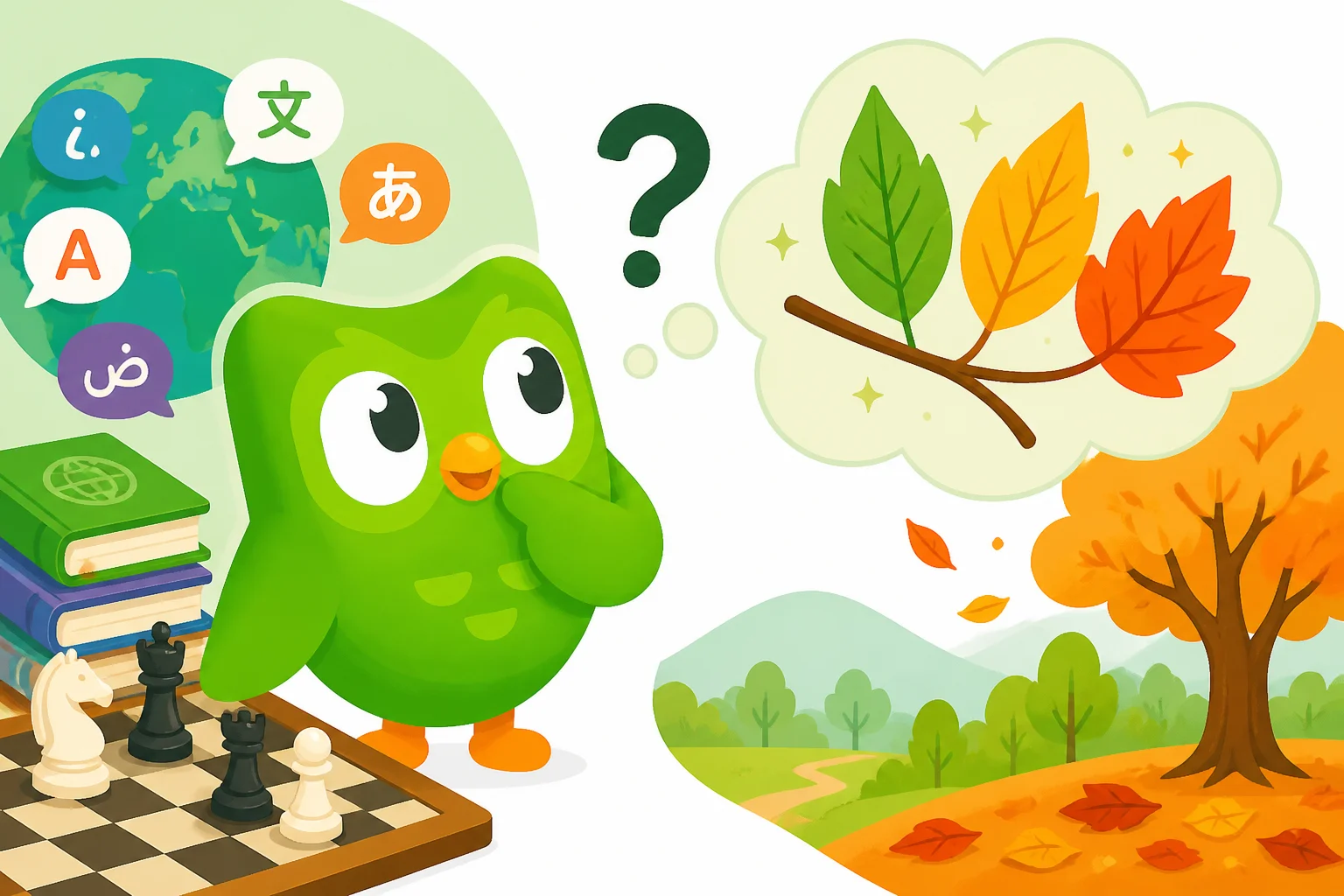
Duolingo offers 280+ free courses across 40+ languages, plus chess - so why can't it answer a random question like why leaves change color?
Language & Linguistics
What is Duolingo's app and website actually built around to teach a language?
Language & Linguistics
Related Posts
Alternative to Duolingo for General Knowledge
Looking for an alternative to Duolingo for general knowledge? Compare Duolingo, Brilliant, Khan, Quizlet, Blinkist, Anki, and MillionWhys today.
App to Learn New Things: Curiosity, Not Cramming
Looking for an app to learn new things? Compare Million Whys, Brilliant, Khan, Blinkist, and Duolingo by learning moment, not hype.
AI Learning Apps for Curious Adults
Compare AI learning apps for curious adults: ChatGPT, Khanmigo, Duolingo Max, Quizlet, Brilliant, and MillionWhys without exam-cram habits here today.