

Why Do We Have Daylight Savings Time?
Why do we have daylight savings time? Not because farmers wanted more daylight. That is the famous story, and it is mostly backward. Daylight saving time was adopted as a clock-shifting experiment to move more human activity into evening daylight, first at national scale during World War I energy shortages, then kept alive by a mix of habit, politics, retail interests, and the stubborn hope that one hour on the clock can make modern life behave better.
TL;DR
Daylight saving time was not created for farmers; farm groups often opposed it because animals, dew, markets, and labor did not move just because clocks did. The modern policy took off when Germany adopted it in 1916 to save fuel during World War I. Today the energy case is mixed or weak, but the practice survives because evening daylight is useful to some industries and familiar enough to be hard to remove.
The short answer: we have daylight saving time because governments tried to conserve artificial light and fuel by shifting clocks forward, especially during wartime. The longer answer is stranger: the original rationale is much weaker now, the farmer story is a myth, and the policy survives mostly because one extra bright hour after work has winners.

Curious? Try one 👇
Why is the sky blue?
Jump into the daily quiz →The farmer story is backwards
The most common explanation says daylight saving time was made for farmers. It sounds reasonable until you remember that farms run on sun, animals, weather, and markets, not office clocks. Morning dew does not evaporate an hour earlier because Congress says so. Cows do not adjust their milking rhythm because the wall clock moved.
Michael Downing, author of Spring Forward, is blunt about the myth: "Don't blame the farmers." His work argues that daylight saving was much more useful to retail and leisure interests than to agriculture Michael Downing, Spring Forward. Historical coverage also notes that American farmers opposed daylight saving time after the United States adopted it during World War I, and helped push repeal after the war Time: the original point of daylight saving time.
That is the first little closure: farmers are not the reason the clock jumps. In many periods, they were one of the reasons people fought the jump.

Germany made the clock jump in 1916
Modern daylight saving time became real during World War I. The U.S. National Archives describes Imperial Germany as the first country to institute daylight saving time nationally: on April 6, 1916, Germany's Federal Council ordered clocks advanced for the months of May through September U.S. National Archives. Timeanddate summarizes the logic: Germany and Austria moved clocks ahead in 1916 to reduce artificial lighting and save fuel for the war effort timeanddate.com history.
The United States followed during World War I with the Standard Time Act of 1918, which created federal time zones and introduced daylight saving time. Then came the familiar backlash. People liked standardizing time zones; the seasonal clock shift was more controversial.
There were earlier daylight-saving advocates before Germany's wartime move. British builder William Willett campaigned for summer clock changes after publishing The Waste of Daylight in 1907, arguing that people were sleeping through useful morning sunlight. But Willett's campaign is not the same as the farmer myth either. His case was urban and recreational: more light for working people after the day was over, not more time for cows, crops, or harvests.


Ben Franklin did not invent it; he made a candle joke
Benjamin Franklin often gets dragged into the story, but he did not propose the modern daylight saving system. The Franklin Institute explains that the misconception comes from a satirical 1784 essay in the Journal de Paris. Franklin joked about Parisians saving candles by waking earlier, but this was not a national clock policy Franklin Institute.
The satire is worth keeping because it reveals the old intuition behind daylight saving time: if people are awake when the sun is already up, maybe they need fewer candles at night. That logic made more sense in a candle-and-coal world than in a world of air conditioning, electronics, late-night stores, and global work schedules.

Does daylight saving time actually save energy?
This is where the answer stops being tidy. The policy was sold as energy-saving, but modern evidence is mixed and often unimpressive. A well-known natural experiment in Indiana by Matthew Kotchen and Laura Grant found that daylight saving time increased residential electricity demand, with evening lighting reductions offset by more heating and cooling demand NBER Working Paper 14429.
A U.S. Department of Energy report on the 2007 extension found a small national electricity saving during the extended daylight saving period: about 1.3 terawatt-hours, roughly 0.03% of U.S. annual electricity consumption for that year U.S. Department of Energy report. That is not nothing, but it is far from the clean "we save lots of energy" story people often carry around.
The mechanism is simple. Daylight saving can reduce lighting use in the evening. But if darker mornings need heat, or hotter evenings increase air-conditioning, the savings shrink or reverse. A clock shift is not free energy. It just moves human behavior around the day.

Why does it survive?
Daylight saving time survives because evening daylight is popular with some people and valuable to some industries. Retail, recreation, restaurants, golf, and other after-work activities benefit when more daylight lands after the workday. Downing's account emphasizes that the practice functions less like a farm policy and more like a retail-spending plan Michael Downing, Spring Forward.
It also survives because clocks are infrastructure. Once a time rule is embedded into calendars, software, transportation, school schedules, and expectations, changing it becomes a political fight. People disagree not only about daylight saving time versus standard time, but also about whether to stop switching, stay on permanent daylight time, or return to standard time year-round.
That is why the practice feels so oddly sticky. The original energy argument is weaker than the ritual suggests. But the evening-light constituency is real, the annoyance is spread across everyone, and the fix requires agreement about which clock should win.
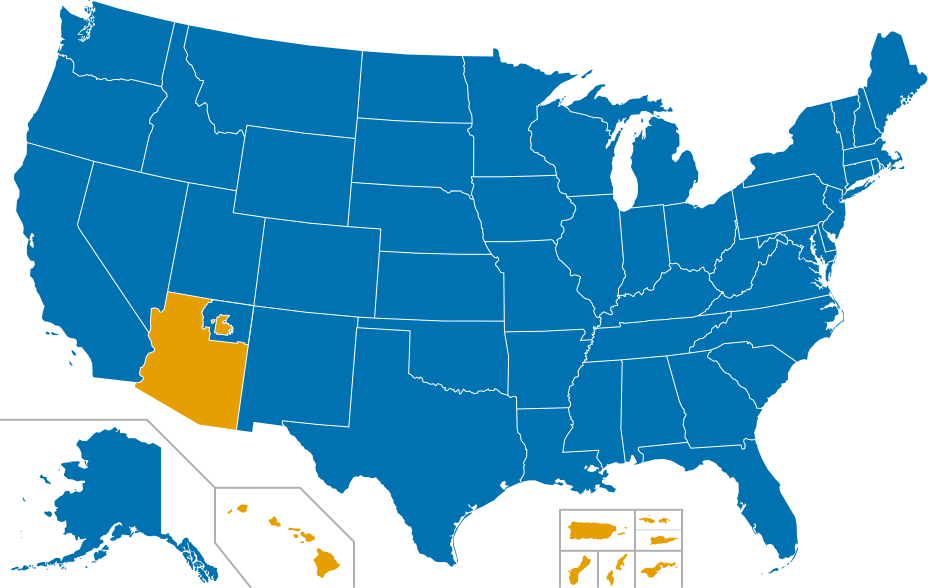
The United States shows that compromise clearly. Hawaii and most of Arizona do not observe daylight saving time, while many other states have debated whether to stop switching. The hard part is that "stop switching" can mean two different things: permanent standard time or permanent daylight time. Those feel similar in November when everyone is tired of clock changes, but they produce very different winter mornings and summer evenings.
What people usually miss
The weirdest thing about daylight saving time is that its stated purpose and measured effects can point in different directions. It began as a clever attempt to align human schedules with daylight. But the more electrified, climate-controlled, and globally scheduled life becomes, the less obvious that one clock trick still does the original job.
The real lesson is not "DST is good" or "DST is bad." It is that social habits often outlive their first explanation. A policy can begin as wartime fuel conservation, turn into a retail and leisure advantage, get blamed on farmers who did not ask for it, and then become a twice-yearly national argument. That is a lot for one hour.
Related videos
You Change Your Clocks Because Germany Needed Coal
Why daylight saving time exists
FAQ
Was daylight saving time made for farmers?
No. Farmers often opposed daylight saving time because farm work follows daylight, animals, dew, and market schedules more than clock time. The farmer explanation is one of the most persistent myths about the policy.
Who first used daylight saving time nationally?
Imperial Germany adopted daylight saving time nationally in 1916 during World War I, mainly as a fuel-saving measure. Other countries followed soon after.
Did Benjamin Franklin invent daylight saving time?
No. Franklin wrote a satirical 1784 essay about saving candlelight by waking earlier. It was a joke with a real observation inside, not a modern daylight saving law.
Does daylight saving time save energy?
Sometimes a little, sometimes not. Modern studies show mixed results because lighting savings can be offset by heating and air-conditioning demand. The energy case is much less clear than the old story suggests.
Why do people still use daylight saving time?
Evening daylight is useful for shopping, recreation, and after-work activity, and the policy is hard to unwind once calendars, software, schools, and businesses are built around it.
What does this have to do with AIgneous Million Whys?
This is exactly the kind of everyday rule that gets more interesting when you ask one more why. MillionWhys turns those half-known questions into quick, fact-checked explanations, so the answer gives real closure instead of another loose myth.
Keep reading
Sources
U.S. National Archives: Daylight Saving Time Begins, 1916
Franklin Institute: Did Ben Franklin Invent Daylight Saving Time?
NBER: Does Daylight Saving Time Save Energy?
U.S. Department of Energy: Impact of Extended Daylight Saving Time
Curious? Try one 👇
Why is the sky blue?
Jump into the daily quiz →Keep Exploring


Related Posts
Why Can't You Wear White After Labor Day?
Why can't you wear white after Labor Day? The rule came from summer practicality, Gilded Age class codes, and etiquette that no longer works.
Why Does Time Speed Up as You Get Older?
Why does time speed up as you get older? The answer sits in proportional time, memory density, dopamine, attention, and small doses of novelty in daily life.
Why Do Heatwaves Cause Power Outages?
Why do heatwaves cause power outages? AC demand, overheated transformers, sagging lines, plant cooling constraints, solar ramps, and thin grid margins.