

8 Stories of Norse Mythology: Gods, Trickery & Ragnarök
On this page· 19
You've probably met Thor as a hero who always wins, then opened an old myth and found him in a bridal veil, eating someone else's wedding feast. That's the gap these stories fill. Odin hanging wounded on a tree for nine nights to win knowledge tells you the rule from the start. In Norse belief, even gods pay, lose, and die.
These eight Stories of Norse Mythology work as explanation engines. Each one exists to explain a stubborn detail, why Odin has one eye, why Tyr has one hand, why a tiny sprig of mistletoe matters more than a sword. Read them in order and you'll see a single arc, from a world built out of a giant's body to a world that burns, sinks, and rises green again.
You'll get the plain retelling first, then what it meant to the people who told it, then a takeaway you can use. If you're teaching, homeschooling, or building trivia, that last step is where a summary becomes a question. You can even turn a story into a video with AI once you've found the why at its center. The myths reward that approach, because they were built to answer whys long before anyone wrote them down.
1. The Creation of the World from Ymir's Body
At first there's no earth, no sky, no sea. There's only Ginnungagap, an empty gap between Niflheim, a realm of ice, and Muspelheim, a realm of fire. Where frost and sparks meet in that void, they melt, drip, and take shape as Ymir, the first frost giant.
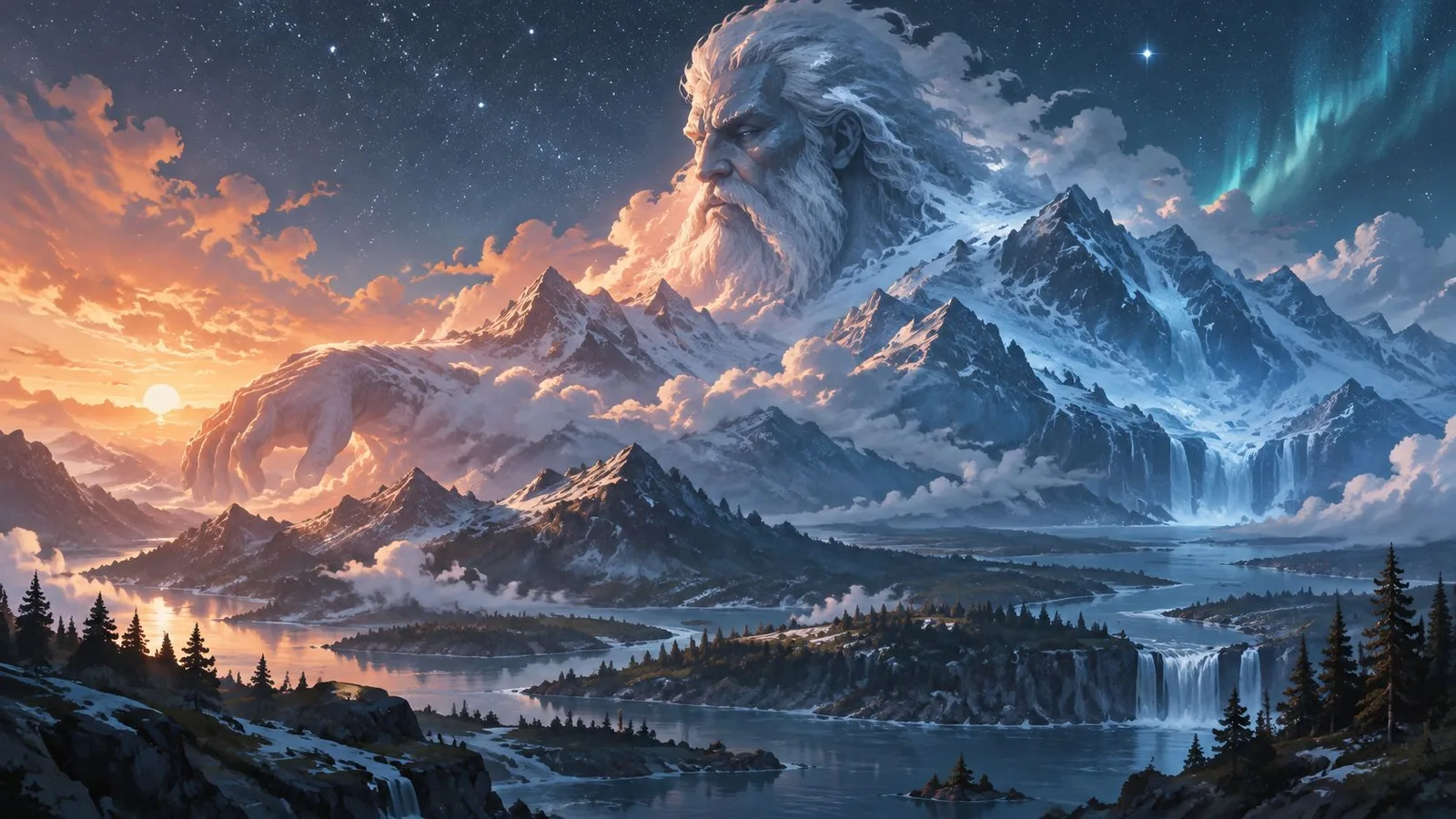
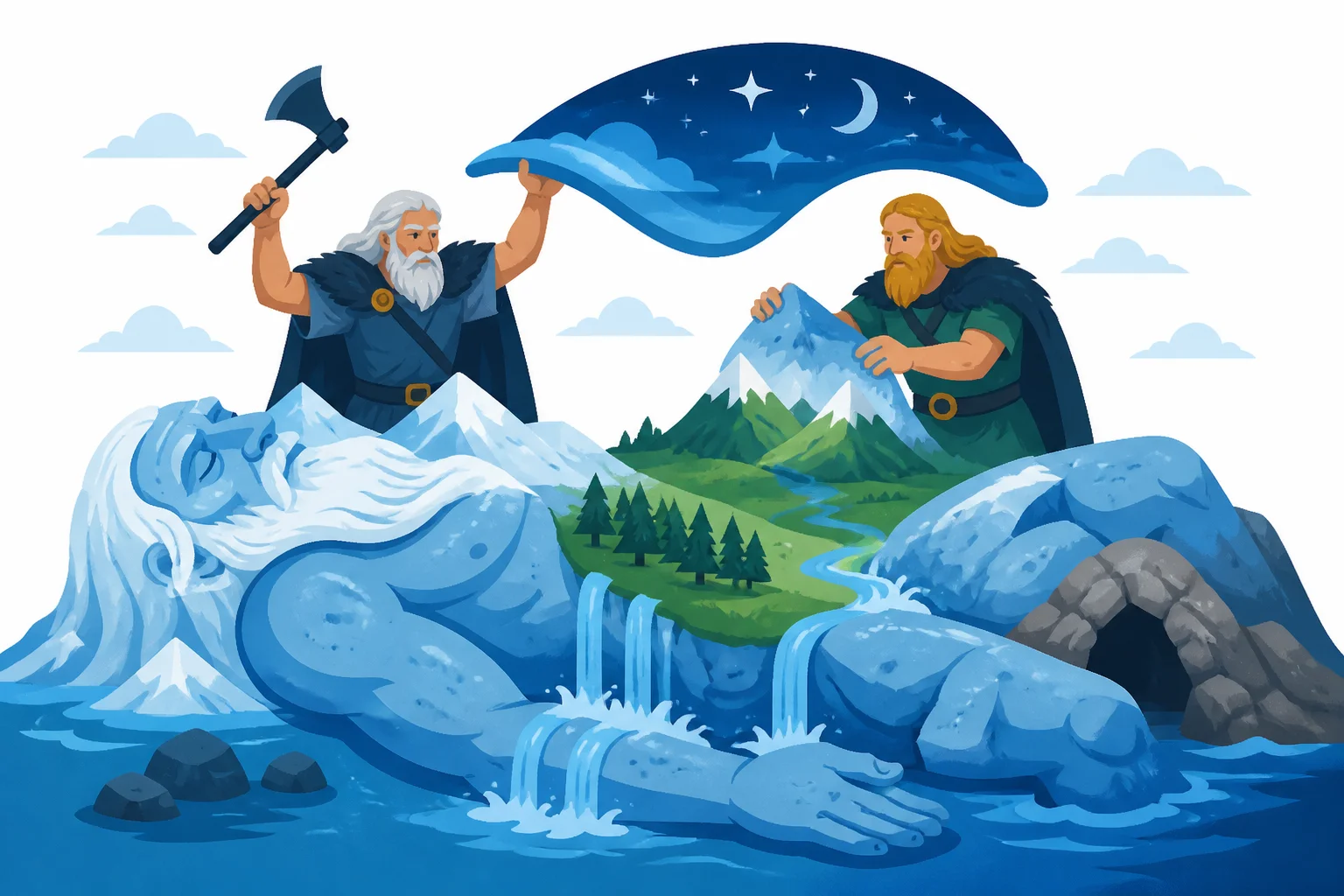
Odin and his brothers Vili and Vé kill Ymir, and they don't waste the body. They build the world out of it, piece by piece, like people using every part of an animal they've hunted. Nothing is created from nothing here, and that matters.
Why the Sky Is a Skull
- Flesh becomes earth: The ground you're standing on is a giant's body, so the world feels alive and borrowed.
- Blood becomes sea: Waters aren't separate from living things, they're what flowed inside one.
- Bones become mountains, skull becomes sky, brains become clouds: Look up and you're inside a head, which is why clouds drift like thoughts.
Sparks from Muspelheim get fixed overhead as sun, moon, and stars, so even light is placed by hand. The World History Encyclopedia account of the Eddas notes that Snorri Sturluson's Prose Edda was probably compiled around 1220 CE as a handbook for poets, and it gives this creation its fullest shape. Neil Gaiman's Norse Mythology from 2017 keeps the same Ymir origin because it's hard to improve.
That layered survival is worth naming for learners. A good why question is, why is the sky called a giant's skull, with every wrong answer explained too. If you want a contrast, pair it with this summary of Greek mythology, where creation starts from Chaos rather than a dismembered body.
Question 1 of 6
In Norse myth, how was the world made from the giant Ymir's body?
2. Odin's Sacrifice for the Runes and Wisdom
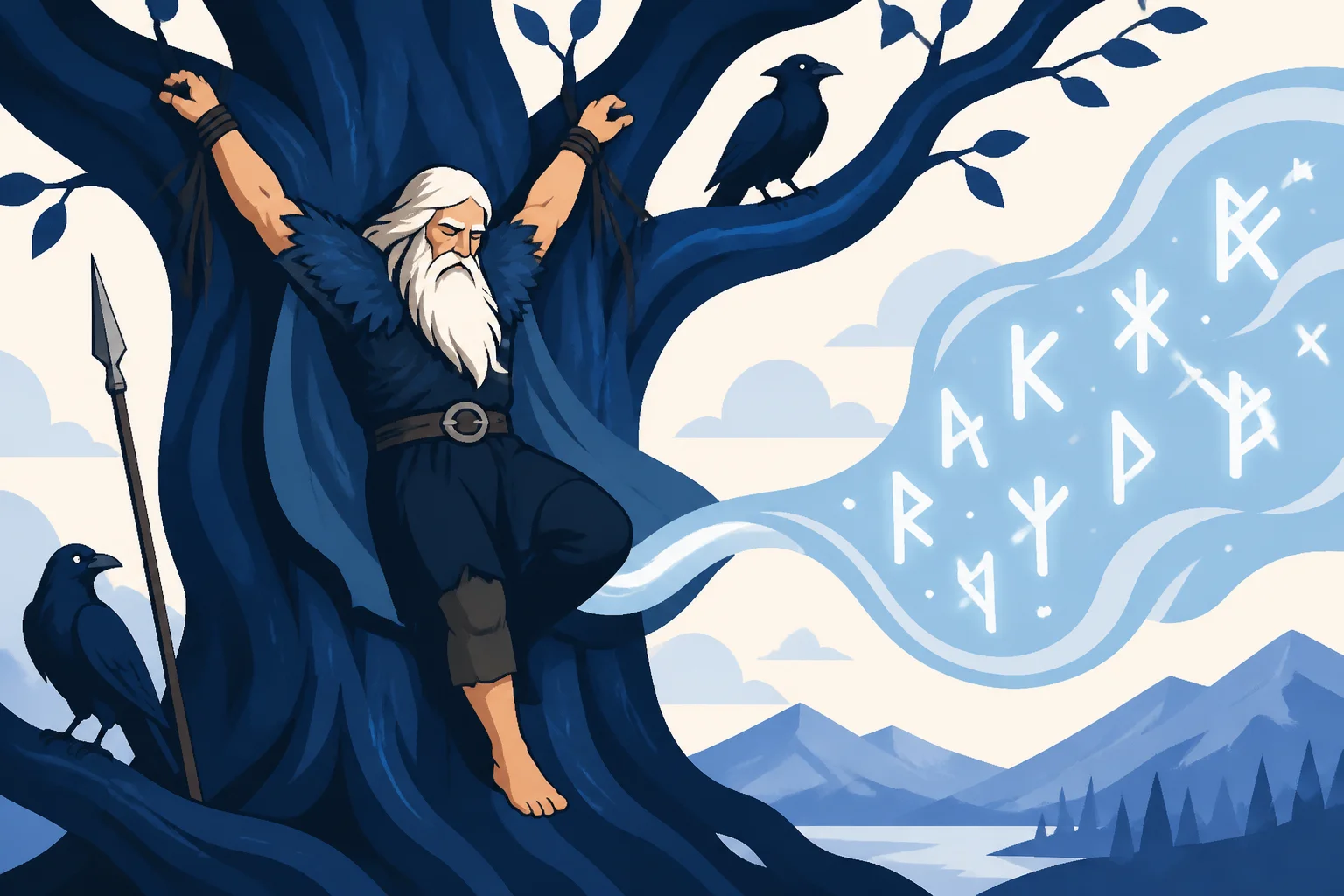
Odin already rules the Æsir, but ruling isn't knowing. He wants the runes, signs that carry knowledge and magic, and nobody will hand them over. So he hangs himself on Yggdrasil, the World Tree, wounded by his own spear, with no food and no drink.
He stays there nine nights. At the end, looking down in pain and exhaustion, he sees the runes and grabs them with a scream. Knowledge arrives at the exact moment he nearly doesn't survive getting it.
Why Odin Has One Eye
That isn't his only payment. Odin also gives one eye to drink from Mímir's well, the source of wisdom. One eye stays in the well, seeing what's hidden, while the other stays in his head, seeing what's in front of him. The missing eye isn't a battle scar. It's a receipt.
Practical rule: In Norse stories, if someone knows more than everyone else, ask what they paid. The price is usually visible on their body.
The poem Hávamál tells the hanging, and it's preserved in the Codex Regius. That manuscript was discovered in 1643 by Icelandic bishop Brynjólfur Sveinsson and returned to Iceland in 1971, according to the Wikipedia history of the Prose Edda manuscripts. Runes weren't just poetic symbols either, since objects like the Kylver Stone from Sweden, dated to around 400 CE, show the alphabet in real use.
Use that for a clean comparison question on wisdom's cost, then widen it with the difference between Greek and Roman mythology, where gods more often inherit power than buy it with pain. For a class, show a runestone photo and ask learners to predict why writing itself would need a god to suffer for it.
Question 2 of 6
How did Odin get the runes, according to Norse myth?
3. Thor's Hammer Mjölnir Stolen by Thrym
Thor wakes up, reaches for Mjölnir, and finds empty air. The giant Thrym has stolen it and buried it deep underground. He'll return it only if the gods send him Freyja as his bride.
Freyja refuses, furiously. So Loki proposes the plan nobody wants to say out loud. Thor will wear the veil, the bridal jewelry, and Freyja's famous necklace, and go to the wedding himself.
Why the Bride Eats a Whole Ox
At the feast, the disguise nearly fails at the table. Thor eats a whole ox, plus salmon, plus everything set out for the women, and drains three barrels of mead. Thrym stares and says he's never seen a bride bite so hard.
Loki, dressed as the maid, saves the act with a straight face. The bride hasn't eaten for nights, he's told, because she was so eager to come. Thrym accepts it because he wants to believe it, which is how most tricks in these stories work.
- The hunger is the tell: Thor can't shrink his appetite to fit the costume.
- The veil does the work: Nobody checks closely because ritual says not to.
- The blessing ends it: Thrym orders the hammer laid on the bride's lap to bless the marriage, exactly where Thor needs it.
Thor grabs Mjölnir and kills Thrym and his household. The poem Þrymskviða is fun because the strongest god wins by sitting still and letting his enemy hand him his weapon. Teach it with a prediction pause right before the hammer appears, and ask, why did Thor eat an entire ox at his own wedding.
4. The Binding of Fenrir with Gleipnir
Fenrir is a wolf, the son of Loki and the giantess Angrboða, and he keeps growing. The gods raise him in Asgard because prophecy says he'll bring ruin, and they don't know what else to do with a danger that's still a cub. Watching him get stronger every day makes the problem worse, not safer.
They test him with chains, pretending it's a game of strength. He snaps the first. He snaps the second. So Odin sends for something that isn't a chain at all.
Six Things That Do Not Exist
Dwarves forge Gleipnir, a ribbon as soft as silk, from six impossible ingredients. They use the sound of a cat's footfall, a woman's beard, the roots of a mountain, a bear's sinews, a fish's breath, and a bird's spittle. That's why you can't find those things today, the story says. The dwarves used them up.
Fenrir looks at the thin ribbon and smells a trick. He'll agree to be bound only if a god puts a hand in his mouth as a pledge that he'll be freed. Every god looks at every other god. Tyr steps forward and lays his hand between the wolf's teeth.
An oath you can walk away from costs nothing. Tyr's hand is what made the gods' promise believable, and it's what he lost when they broke it.
The more Fenrir struggles, the tighter Gleipnir holds. He bites down, and Tyr loses his hand, staying silent while the others celebrate. Snorri's Gylfaginning gives the fullest account, and it's a perfect quiz build, since plausible wrong ingredients like dragon scales sound right but miss the point. The ribbon works because it's made of absences, and Fenrir will wait, bound and furious, until Ragnarök.
Question 3 of 6
Why was the wolf Fenrir bound by a soft ribbon called Gleipnir instead of another strong chain?
5. The Death of Baldr and the Journey to Hel
Baldr, son of Odin and Frigg, begins dreaming of his own death. The gods take the dreams seriously because in this world, dreams like that aren't anxiety. They're advance notice. Frigg decides she can outwork fate if she's thorough enough.
She travels the world and makes everything swear an oath not to harm her son. Fire swears, iron swears, stone, earth, trees, sickness, beasts, birds, and serpents all swear. After that, the gods turn it into a game, throwing weapons at Baldr and laughing as everything bounces off.
Why Mistletoe Is the One Exception
Frigg skipped one small plant growing west of Valhalla. Mistletoe looked too young to demand an oath from. Loki learns this by questioning Frigg in disguise, then shapes a dart from that sprig.
He finds Höðr, Baldr's blind brother, standing outside the game because he can't see to join in. Loki offers to guide his hand and tells him where to throw. The mistletoe flies, pierces Baldr, and Baldr falls dead.
- The oath system fails at the edges: Total protection breaks on the one thing judged too small to matter.
- The killer doesn't throw: Loki aims through someone innocent, so blame gets complicated fast.
- Grief becomes a negotiation: Hermóðr rides Odin's horse Sleipnir to Hel to beg for Baldr back.
Hel agrees to release Baldr if every being in the world weeps for him. Nearly everything does, people, animals, stones, and metals, but one giantess refuses to cry, and the gods assume she's Loki in disguise. Ask learners to predict her answer before you reveal it, and the condition becomes unforgettable. One refusal is enough, so Baldr stays dead until after Ragnarök.
Question 4 of 6
Why was mistletoe the one thing that could kill Baldr after Frigg made everything else swear not to harm him?
6. Thor's Fishing Trip for the Midgard Serpent
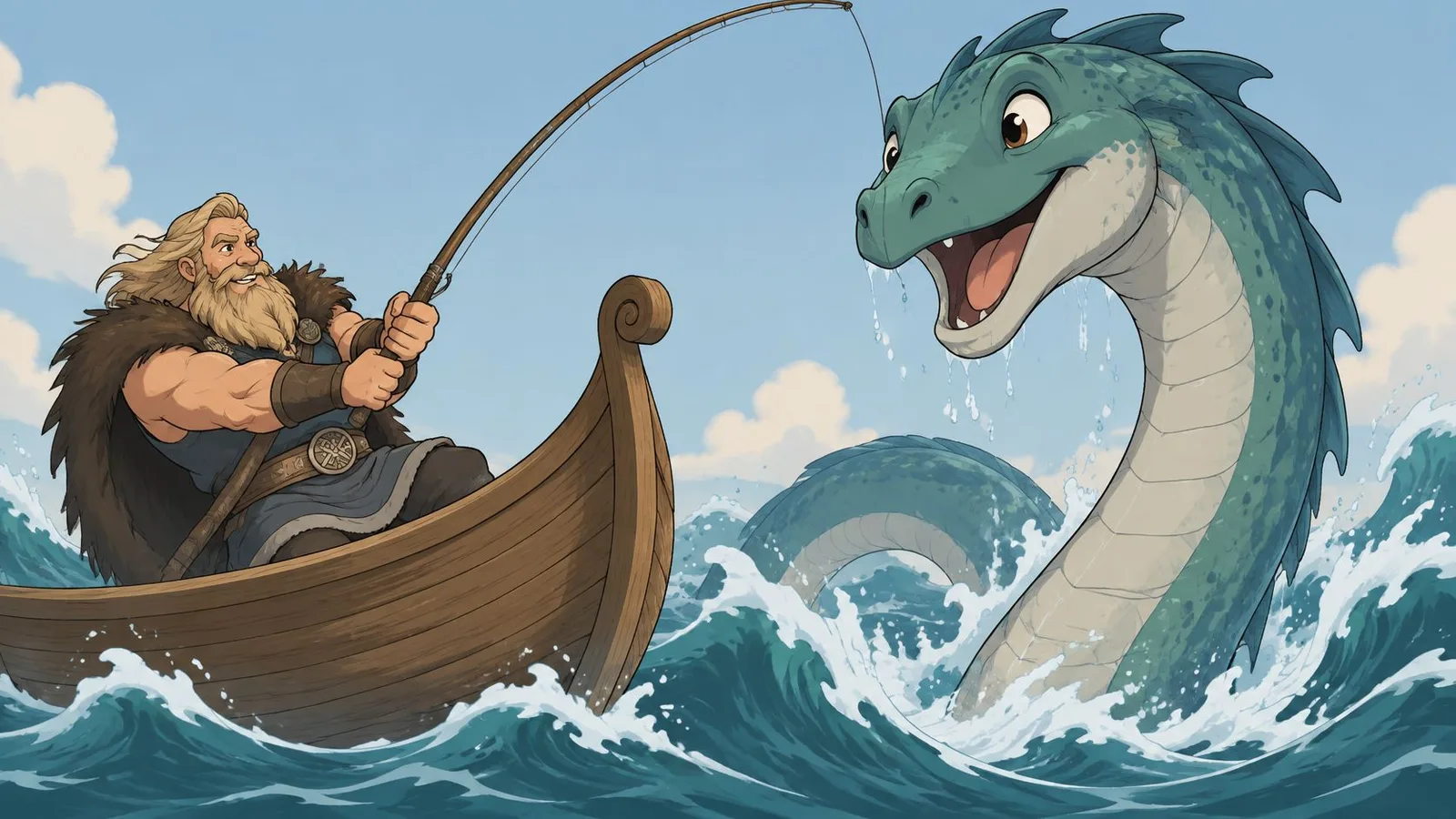
This one starts as a chore. Thor goes to the giant Hymir and insists on being taken out fishing, far beyond where Hymir usually rows. Hymir mocks his size, then watches Thor tear the head off one of his best oxen to use as bait.
Thor rows them out past the safe grounds, ignoring every warning, drops the ox head into deep water, and waits. Something takes it that isn't a fish. It's Jörmungandr, the Midgard Serpent, so large it circles the world and bites its own tail.
Why Thor's Feet Go Through the Boat
Thor hauls, and the strain is the whole image. He braces so hard that his feet push through the bottom of the boat and stand on the seabed while he pulls the serpent's head up to the gunwale. Poison and rage pour out of the serpent. Thor raises Mjölnir to finish an enemy he's fated to meet at the end of the world.
Then Hymir, pale with terror, cuts the line. The serpent sinks. Thor is left holding a useless rope over an empty sea, and in some tellings he knocks Hymir overboard for it.
The poem Hymiskviða preserves the trip, and Snorri retells it in prose. The teachable point is timing. Thor almost kills Jörmungandr early, but fate keeps its appointment for later, so a fishing story becomes a rehearsal for Ragnarök. Stop before the line is cut and ask learners to predict the ending. Most expect a kill, and explaining why the serpent must survive teaches how Norse prophecy works better than any definition.
7. Thor's Visit to Útgarða-Loki and the Illusions
Thor, Loki, and Thjalfi travel into giant country and reach the hall of Útgarða-Loki. The king looks them over, unimpressed, and offers a simple rule. Nobody stays unless they can perform some feat better than anyone else.
Loki loses an eating contest to a giant who eats the bones and the trough. Thjalfi loses a race to a runner who finishes before he barely starts. Then Thor steps up, and things get stranger.
Why Thor Cannot Empty the Horn
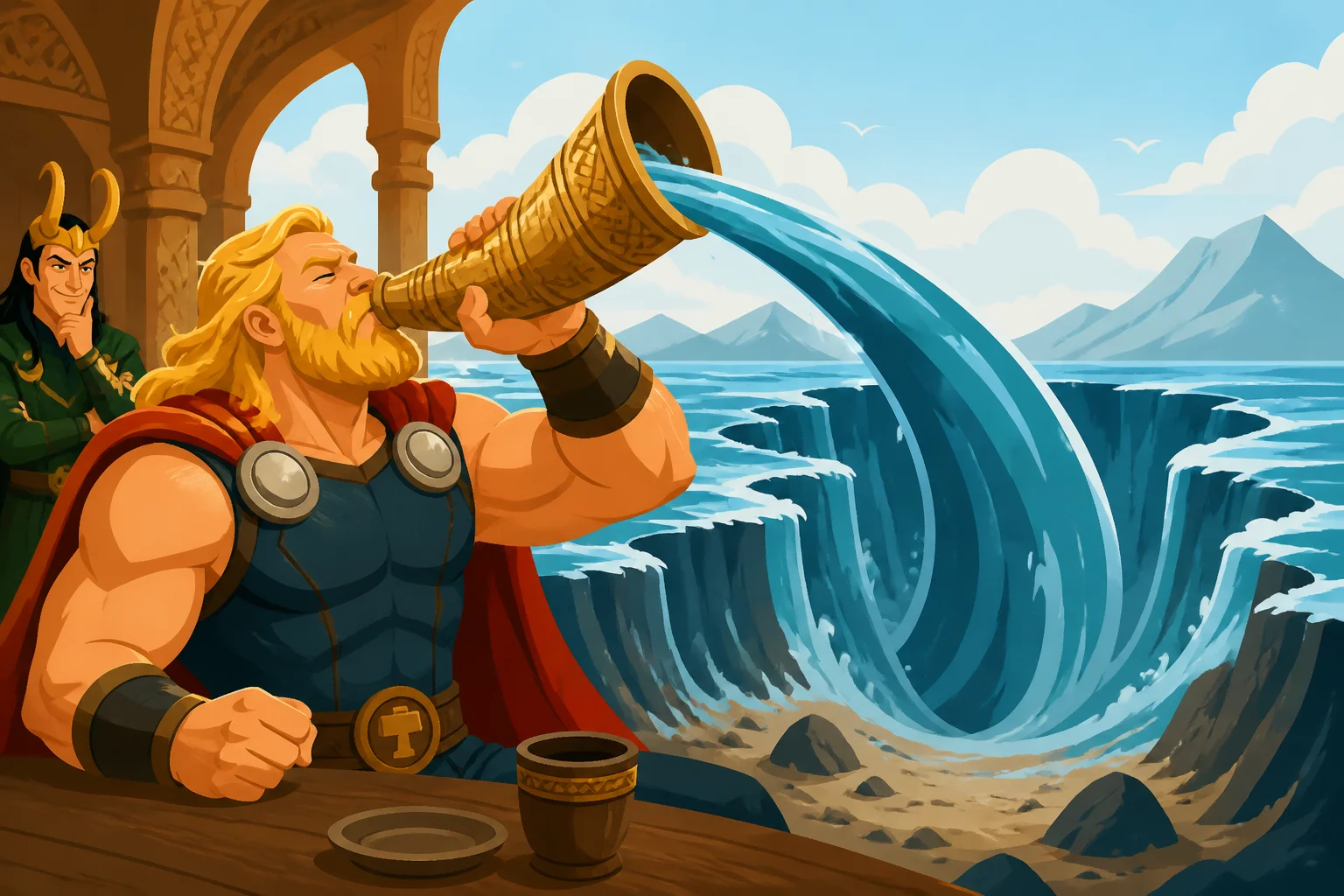
- The drinking horn connects to the sea: Thor drinks in huge gulps and lowers the ocean itself, creating the ebb of tides, but a sea can't be emptied.
- The cat is Jörmungandr: He lifts one paw off the ground, which means he nearly lifted the world encircling serpent.
- The old woman is Elli, old age itself: She forces Thor to one knee, and nobody, not even a god, beats aging.
In the morning, Útgarða-Loki walks them out and confesses everything. Thor's earlier hammer blows at a sleeping shape were struck against mountains, which is why valleys appeared. The giants were terrified the whole time and used illusion because meeting Thor directly would have killed them.
Then the hall vanishes. Thor raises his hammer at empty air. The story flips failure into scale, since every loss was secretly an impossible achievement. Build one question per contest and explain every option, because the misconception is the lesson. Thor wasn't weak. He was wrestling old age and drinking the sea.
Question 5 of 6
In the Norse tale, why did Thor's drinking from the horn at Útgarða-Loki's hall make the ocean itself fall?
8. Ragnarök the Twilight of the Gods
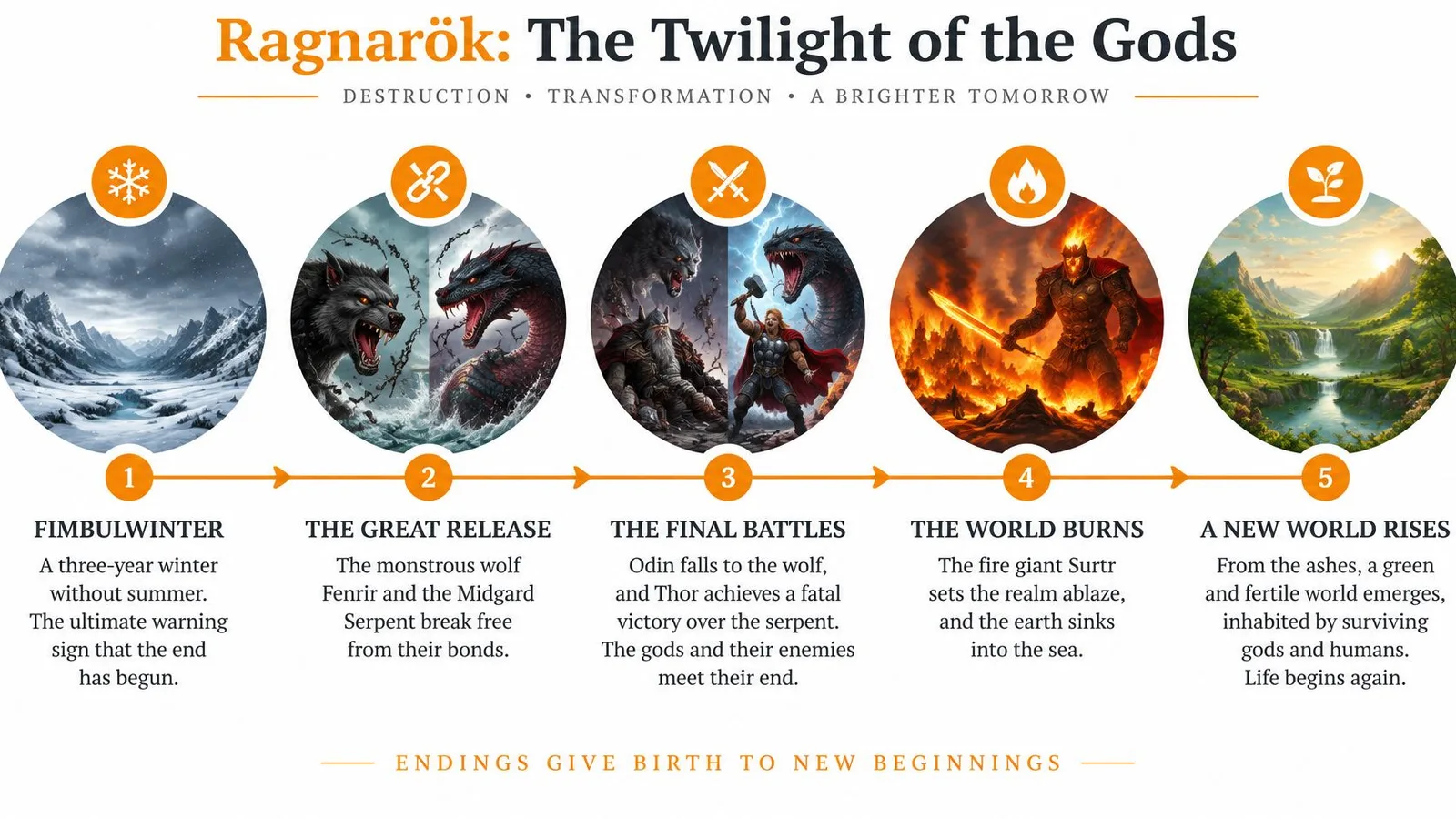
Ragnarök isn't a surprise attack. The gods have known the outline for as long as they've known anything, which is why Odin spent his life gathering knowledge about a future he couldn't change. It begins with Fimbulwinter, a winter that lasts through three seasons with no summer in between, when people fight over what's left.
Then the bindings fail. Fenrir breaks free, Jörmungandr churns up out of the sea, and the dead sail in a ship made of fingernails. The sky splits, and fire comes from the south with Surtr at its head.
Why Thor Takes Nine Steps and Falls
The deaths arrive in pairs. Fenrir swallows Odin, and Odin's son avenges him by tearing the wolf's jaws apart. Thor finally kills Jörmungandr, the enemy who escaped him while fishing, then walks nine steps and falls dead from its venom. Winning and dying happen in the same breath.
Try this sequence question: Which comes first, Fimbulwinter or the release of Fenrir? Getting the order right forces learners to understand the chain, not just name the monsters.
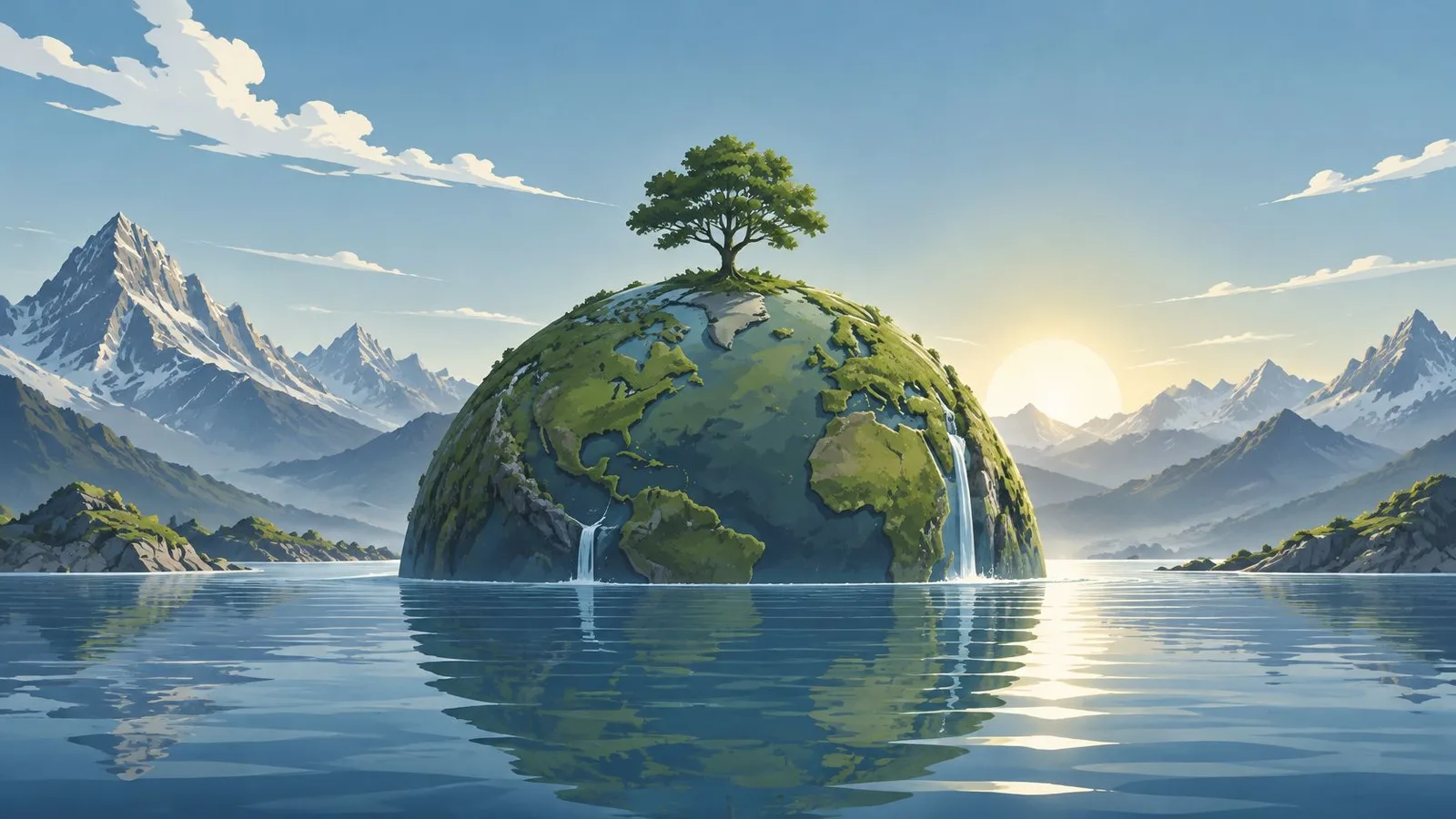
Surtr's fire covers the world, and the earth sinks into the sea. But this isn't a full stop. A new earth rises, green and fertile, and surviving gods including Baldr and Höðr return, alongside two human survivors, Líf and Lífþrasir, who hid through the fire. The poem Völuspá is the primary source, while God of War Ragnarök from 2022 and Marvel's Thor Ragnarok from 2017 are adaptations, and saying so out loud keeps learners from mistaking a game's plot for the myth.
Question 6 of 6
In Norse myth, what makes Fimbulwinter different from an ordinary bad winter?
The 8 Stories of Norse Mythology at a Glance
| Story | Main Figure | Primary Source | Central Theme | Best Why-Question |
|---|---|---|---|---|
| The Creation of the World from Ymir's Body | Ymir, Odin, Vili, and Vé | Poetic Edda; Prose Edda | Order created from chaos | Why is the sky sometimes called the skull of Ymir? |
| Odin's Sacrifice for the Runes and Wisdom | Odin | Hávamál; Poetic Edda | Wisdom gained through sacrifice | Why did Odin give up one of his eyes? |
| Thor's Hammer Mjölnir Stolen by Thrym | Thor, Loki, and Thrym | Þrymskviða; Poetic Edda | Deception, humor, and divine power | Why did Thor dress up as a bride? |
| The Binding of Fenrir with Gleipnir | Fenrir and Tyr | Prose Edda, Gylfaginning | Trust, sacrifice, and fate | Why does Tyr have only one hand? |
| The Death of Baldr and the Journey to Hel | Baldr, Loki, and Hermóðr | Prose Edda, Gylfaginning and Skáldskaparmál | Grief, fate, and divine limits | Why was mistletoe the only thing that could harm Baldr? |
| Thor's Fishing Trip for the Midgard Serpent | Thor, Hymir, and Jörmungandr | Hymiskviða; Poetic Edda | Strength and the foreshadowing of Ragnarök | Why did Hymir cut the fishing line? |
| Thor's Visit to Útgarða-Loki: Illusions and Trickery | Thor and Útgarða-Loki | Prose Edda, Gylfaginning | Illusion and hidden limits | Why could Thor not empty the drinking horn? |
| Ragnarök: The Twilight of the Gods | Odin, Thor, Fenrir, and Surtr | Völuspá; Poetic Edda | Destruction, fate, and renewal | Why does a new world rise after Ragnarök? |
From Ymir's Skull to a New Green World What These Myths Teach
Look across all eight stories and the same machinery shows up. A specific detail needs explaining, and the story grows backward from it. Odin's missing eye exists, so there's a well worth paying an eye for. Tyr's missing hand exists, so there's a wolf, an oath, and a ribbon made of things nobody can find anymore.
Mistletoe works the same way. Baldr can't die from anything that swore an oath, so the story needs one small overlooked plant, and that single gap carries the grief of the whole world. Thor can't empty a horn, so the horn has to be the sea. Each myth answers a why that a child could ask and an adult can't easily shake.
How to Know What Is Attested and What Is Rebuilt
That confidence needs one honest correction. These stories aren't transcripts from the Viking Age. The Harvard Center for Hellenic Studies volume on Old Norse mythology describes the surviving narratives as recorded in thirteenth-century Icelandic manuscripts, especially the Poetic Edda and Prose Edda. Labeling a claim as attested, likely older, or interpretation teaches more than presenting one smooth version.
A Cambridge discussion of sources for Norse myth makes a related point, that there's no single ancient canonical scripture behind the familiar cast. Later politics layered on top of that, too. A ScienceDaily report on the 2025 University of Münster announcement notes that many current ideas about pagan Norse religion cannot be scientifically verified and that the material was later exploited by nationalist ideology. Asking whether an image is Viking-Age evidence or a later invention is now a basic literacy skill.
The names are still alive in ordinary ways. 268 babies in Scotland were given the name Freya in 2025, a figure from National Records of Scotland reported by the BBC and cited in a guide to Norse mythology names. Belief has a modern footprint as well, since 5,435 people were registered members of Iceland's Ásatrúarfélagið in 2025 according to figures attributed to Statistics Iceland in Religion Unplugged reporting.
- Start with the strange detail: Ask why the eye, hand, or plant is missing, not what happened next.
- Make learners predict: Pause before Hymir cuts the line or the giantess refuses to weep.
- Explain every wrong answer: A wrong option usually holds the exact misconception worth fixing.
- End with a follow up: Fenrir bound leads straight to Fenrir free, so one myth pulls the next.
That's also the practical takeaway for teaching. Turn any myth into one why question, attach a short explanation to every answer choice, and let a follow up rabbit hole carry the learner onward. It's exactly how these Stories of Norse Mythology survived, one memorable detail and one irresistible question at a time, on platforms like Million Whys at millionwhys.com.
Keep asking why the strongest gods still lose, and Million Whys will meet you with a 10-second why-question each day, complete with explanations for every answer choice. Follow one rabbit hole from Fenrir's ribbon to Ragnarök, build your streak, and turn a spare moment into real understanding.
Keep Exploring
Related Posts
Summary of Greek Mythology: The Definitive Guide
Explore our comprehensive summary of Greek mythology, from the Olympian gods to legendary heroes, in this engaging guide for curious minds.
Difference Between Greek and Roman Mythology: A Clear Guide
Explore the difference between Greek and Roman mythology with clear comparisons of origins, deities, themes, and cultural roles explained in plain language.
Interesting History Facts: 10 Surprising Stories Explained
Discover 10 interesting history facts, from Cleopatra's timeline to Boston's 1919 molasses flood, each with quick context on why it still matters.