

Difference Between Greek and Roman Mythology: A Clear Guide
On this page· 20
The most popular advice about the difference between Greek and Roman mythology is also the most misleading: memorize two columns of names, then treat each pair as the same god in different languages. Zeus and Jupiter do correspond, as do Hera and Juno, but a name match doesn't tell you what a deity meant to the people who worshipped or wrote about them. Greek and Roman traditions are related, yet they weren't identical systems.
| Lens | Greek mythology | Roman mythology |
|---|---|---|
| Origins | Grew from Bronze Age traditions and took literary shape in Greek poetry | Developed from Italic and Etruscan religion, then adapted Greek material |
| Divine roles | Gods appear as powerful, human-like personalities in many local traditions | Deities were woven into Roman civic and religious life |
| Storytelling | Often explores gods, heroes, fate, and conflict | Often reshapes inherited stories around Rome, ancestry, and public duty |
To make sense of their relationship, follow three clues: where and when each tradition developed, what roles its gods played, and what its stories did for the society telling them. The short version is that Greek myth supplied many narratives and character models, while Roman culture adapted that material to its own institutions and identity.
Roman mythology is best understood as institutional redesign of inherited Greek material, not a translation. The distinction becomes clearer once we look beyond the names.
Why Greek and Roman Mythology Are Often Confused
The familiar name chart is a useful starting point, but a poor ending. It pairs Zeus with Jupiter and Aphrodite with Venus as though Roman writers swapped Greek labels for Latin ones. Because later retellings often combine these figures, the distinction can fade: the same recognizable gods appear, but the cultural setting and emphasis may change.
Start with the relationship between the traditions. Greek myths developed through varied stories about gods and heroes. Roman religion grew from its own Italic framework and adopted Greek material over time. That means the traditions overlap, but they don't share one single origin or purpose.
Three questions make the comparison clearer
- Where did the traditions come from? Greek myths have roots in earlier Aegean cultures and later Greek literature. Roman mythology arose from Italic practice, with Etruscan and Greek influences.
- What did a deity mean in context? A Greek and Roman god might share a domain but carry different civic or religious weight.
- What does a story emphasize? One telling might focus on a god's personality or a hero's ordeal; a Roman adaptation might connect inherited material to Rome's ancestry or public identity.
Think of the name pairs as a map legend, not the whole map. A legend helps you identify a figure, but it can't show how a city worshipped that deity, or why an author reshaped a familiar story.
A useful starting point: Ask what changed in the deity's role, not just which Roman name appears beside a Greek one.
Origins and Timeline of Each Tradition
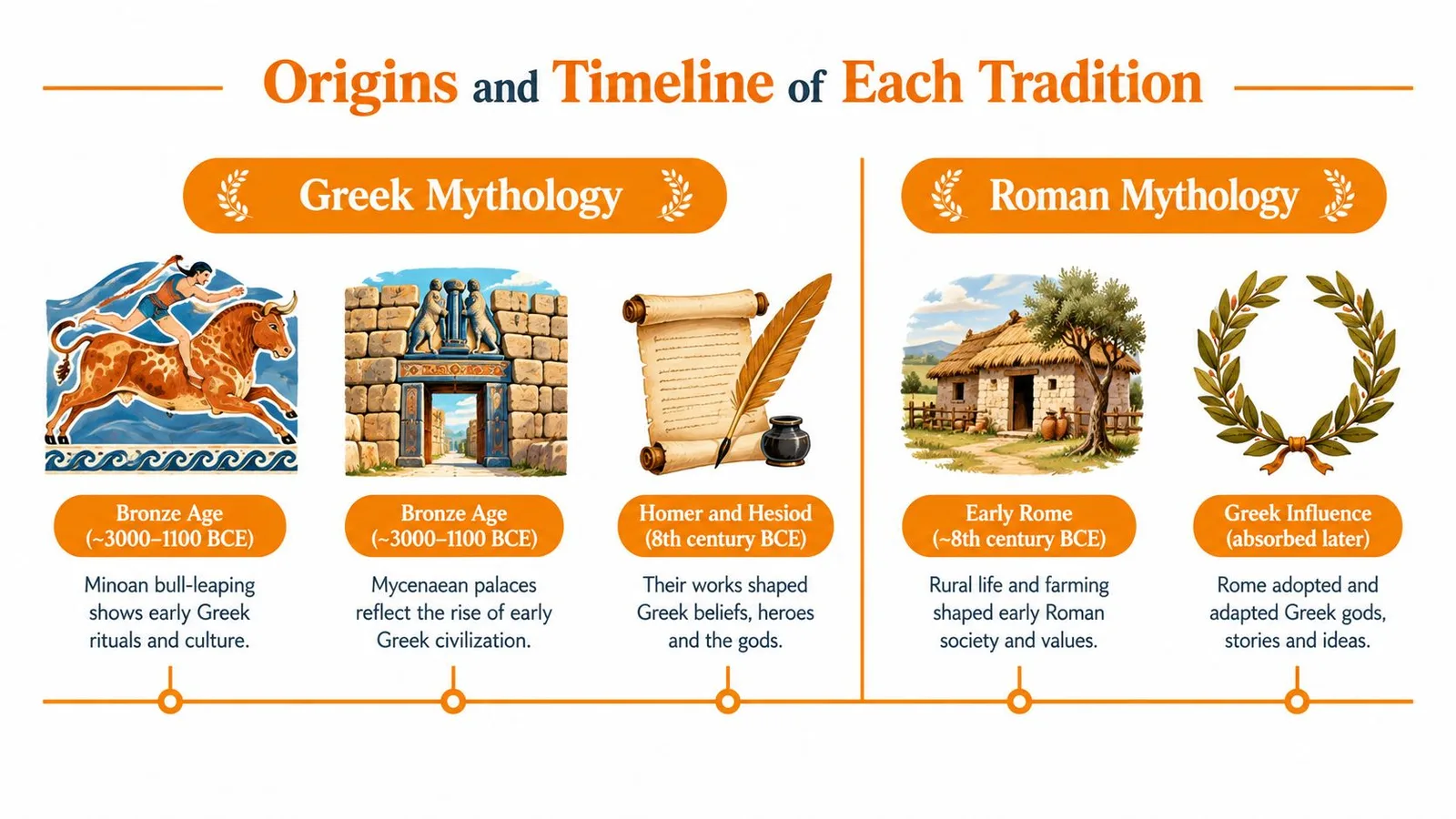
Greek mythology didn't begin as a single collection of written stories. Its roots reach back to religious traditions associated with Minoan Crete and Mycenaean mainland Greece, both flourishing before approximately 1100 BCE. The surviving literary picture took clearer shape later: by the 8th century BCE, works including Homer's Iliad and Odyssey and Hesiod's Theogony had helped organize and preserve important myths. These poems became foundational ways for later readers to encounter Greek gods, heroes, and divine family relationships. The historical background of Greek mythology describes the relationship between these early traditions and the later literary record.
Greek stories took shape across a long tradition
Homer and Hesiod didn't create every Greek myth from scratch or fix every story into a final version. Rather, their works gave audiences influential accounts of the gods and heroic past. Greek religious life also included local cults and varied traditions, so a familiar literary story was only one part of a broader picture.
Roman mythology followed a different path. It emerged from indigenous Italic religious practice, along with Etruscan and Greek influences. Rome adopted Greek gods and stories gradually, especially during the Hellenistic period and after its conquest of Greece in the last two centuries BCE. This was cultural exchange, not a single moment when Romans replaced their own religion with a Greek one.
A concrete example is the cult of Asclepius, brought from Greece to Rome in 292 BCE under the Roman name Aesculapius. The episode shows how Romans could adopt a Greek religious figure while fitting that figure into Roman practice. The history of the Roman Republic and Empire offers additional context for the political world in which Roman religious life developed.
The shared timeline matters: Greek myth provided many narrative models, while Roman religion retained its own Italic framework and adapted those models for Roman purposes. That's why chronology and cultural setting belong in any comparison.
Question 1 of 5
After the Greek healing god Asclepius was brought to Rome in 292 BCE, how did Romans worship him?
Deity Correspondences and Where the Match Breaks
The familiar pairs are real, but they're functional correspondences, not exact replacements. Zeus became Jupiter, Hera became Juno, Aphrodite became Venus, Ares became Mars, Artemis became Diana, and Poseidon became Neptune. The names help identify related divine roles, but they don't guarantee that the gods held the same place in worship, storytelling, or civic life.
| Greek deity | Roman equivalent | Domain | Equivalence strength |
|---|---|---|---|
| Zeus | Jupiter | Sovereignty and sky | Close correspondence, with distinct Roman civic associations |
| Hera | Juno | Marriage and divine status | Related roles, not identical religious functions |
| Aphrodite | Venus | Love and beauty | Shared domain, distinct Roman associations |
| Ares | Mars | War | Major difference in cultural prominence |
| Artemis | Diana | Hunting and wilderness | Recognizable pairing, shaped by different local traditions |
| Poseidon | Neptune | Sea | Related divine domains, not a complete match |
Why Mars and Ares don't feel alike
Mars is a particularly clear example of what a name chart leaves out. Mars held a far more prominent position in Roman religion than Ares did in Greece, so the two gods shouldn't be treated as interchangeable figures with different labels. Their association with war sits in different cultural contexts: Roman religious storytelling gave Mars a stronger place in public and civic identity. A comparison of Greek and Roman mythology highlights this difference in prominence.
Rome also had deities that don't fit neatly into Greek pairs. Janus and Terminus, for instance, had no direct Greek equivalents. And Roman religious organization included the Capitoline Triad of Jupiter, Juno, and Minerva, not a simple copy of the Greek Olympian group.
The practical lesson is to keep two questions separate: “Which Greek deity is this Roman god often compared with?” and “What did this Roman god mean in Roman life?” For a concise overview of the Greek stories behind many familiar figures, see this guide to Greek mythology. The correspondence helps you find the connection; the cultural role explains the difference.
Question 2 of 5
Why is it misleading to treat Mars as simply the Roman version of Ares?
Storytelling Themes and What Each Tradition Emphasizes
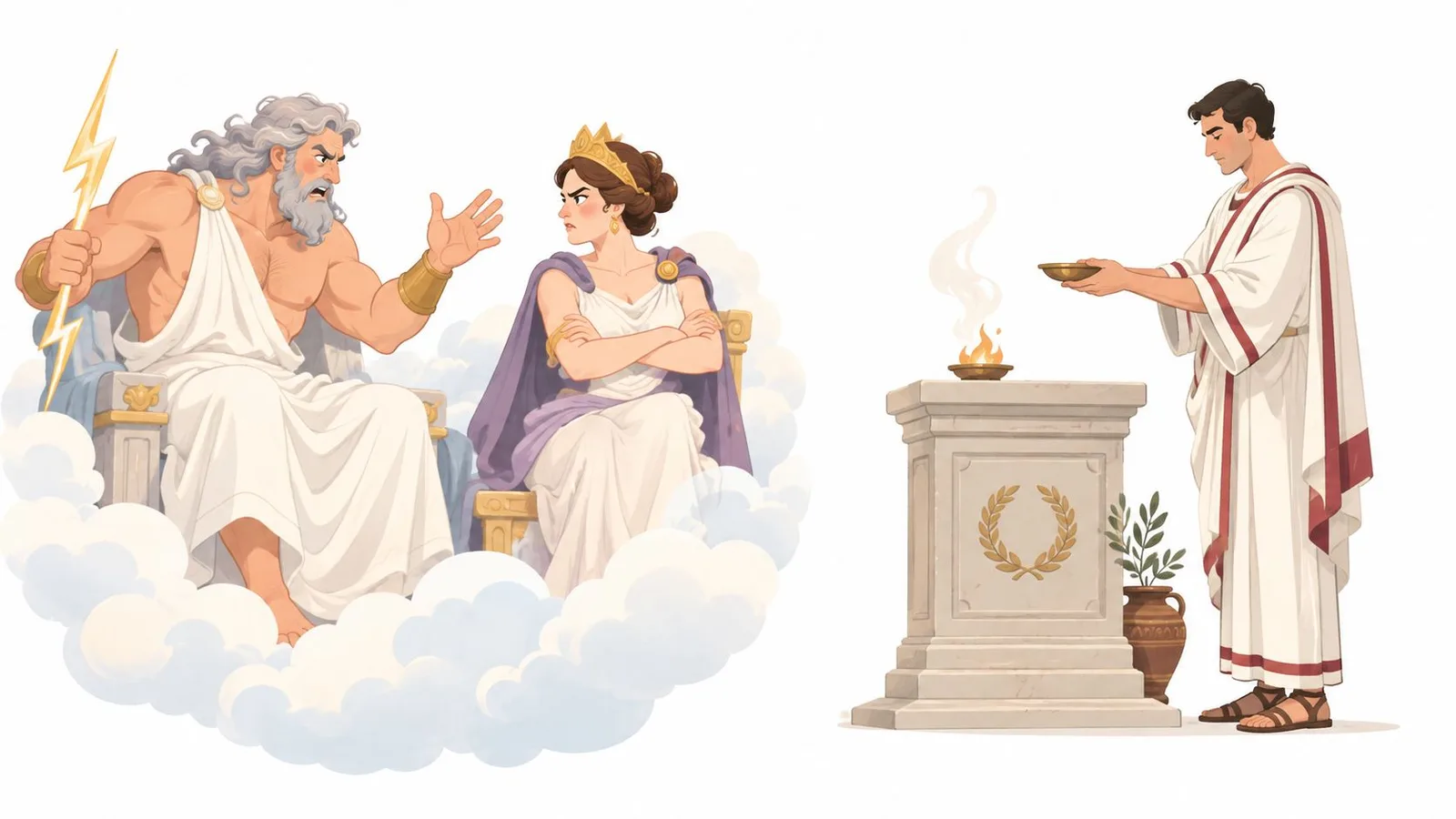
Greek myth often places powerful personalities at the center of the action. Gods behave in recognizably human ways, with desires, rivalries, anger, and family conflicts. Heroes confront trials in which courage or cleverness may matter, but fate and the consequences of dealings with the gods can still shape the outcome.
Homer's Iliad gives a vivid example. Its story of the Trojan War includes heroic ambition, divine involvement, and the costs of conflict. The gods aren't distant symbols who only represent abstract ideas; they interact with mortals, and those encounters help drive the drama.
Roman writers could change what an inherited story does
Roman authors often kept Greek narrative material while giving it new emphasis. Ovid's Metamorphoses drew heavily on Greek myth, yet its Latin literary setting made it part of Roman storytelling too. A story could preserve familiar gods and transformations while shifting its framing, audience, or connection to Roman cultural identity.
That difference is less like translating a sentence and more like adapting a play for a new audience. The plot may remain recognizable, while the selection of scenes and the themes brought to the foreground change. If you're interested in how changing form can alter the way an audience encounters a story, this overview of animation and animator offers a useful point of comparison.
A helpful shorthand is that Greek myths often ask what gods and mortals do, and what follows from their choices. Roman adaptations may use familiar stories to consider ancestry, public duty, and Rome's place in the world. That's a broad pattern, not a rule that every Greek tale is personal drama or every Roman work is political argument.
The plot can travel between cultures, but its meaning travels with it only when the new audience and purpose stay the same.
Question 3 of 5
Why is Ovid's Metamorphoses counted as Roman storytelling even though its myths come from Greece?
Cultural Roles Mythology Played in Each Society
Greek and Roman myths didn't sit apart from religious life. They belonged to societies with different political structures and different relationships between local traditions and public institutions. That context helps explain why similar divine figures could feel different across the two cultures.
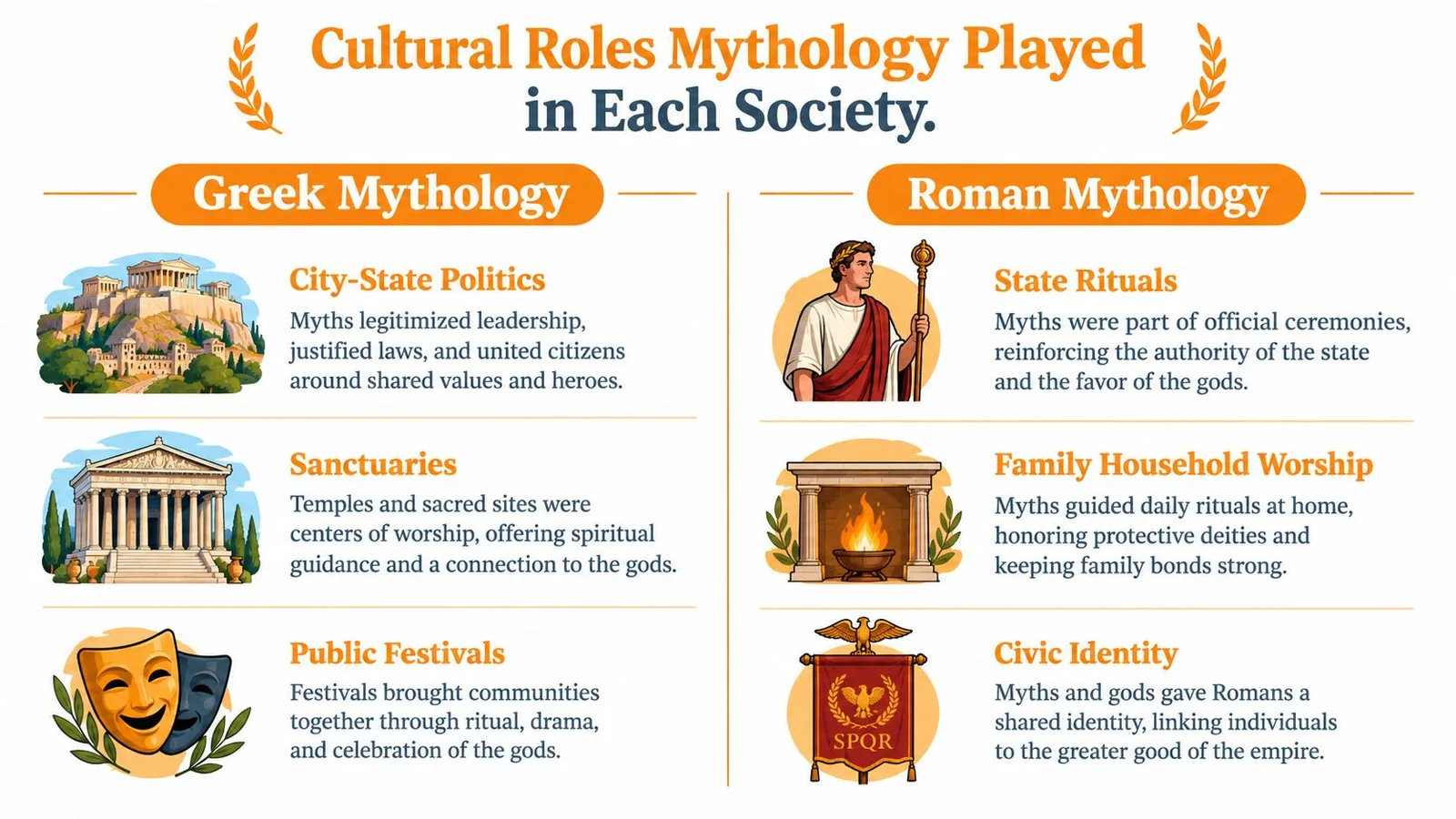
Greek religion was practiced across city-states, sanctuaries, and local cults. Communities could recognize familiar gods and stories while maintaining distinct local practices. Homeric and Hesiodic poems helped provide shared reference points, but they didn't erase regional variation. Greek myth also reached audiences through poetry, drama, ritual, and philosophical discussion, where storytellers could examine conflicts between gods, people, and communities.
Roman religion connected divine worship to public life
Roman religious practice was more tightly integrated with civic institutions and state ritual. Romans adopted Greek and other foreign deities into an expanding religious framework, but adoption didn't mean leaving Roman institutions behind. The Capitoline Triad, for example, shows a distinct Roman arrangement of divine authority.
This difference can be understood through a simple analogy. Greek myths often travelled between communities like stories told at different local gatherings, with each place able to give them its own emphasis. Roman religion more directly connected divine observance with public responsibilities and the state's religious life.
Mars brings the distinction back to a familiar name pair. His importance in Roman religion made him a figure of civic significance, rather than merely a Roman version of the Greek god of war. The same broad domain could serve different social purposes in each culture.
These are tendencies, not strict boundaries. Greek communities had public religious practices, and Roman writers told stories about individual gods and heroes. The key is to ask what role a myth played alongside its plot: Did it express a local tradition, support civic ritual, shape an account of ancestry, or help define the state? That question reveals more than a translated name can.
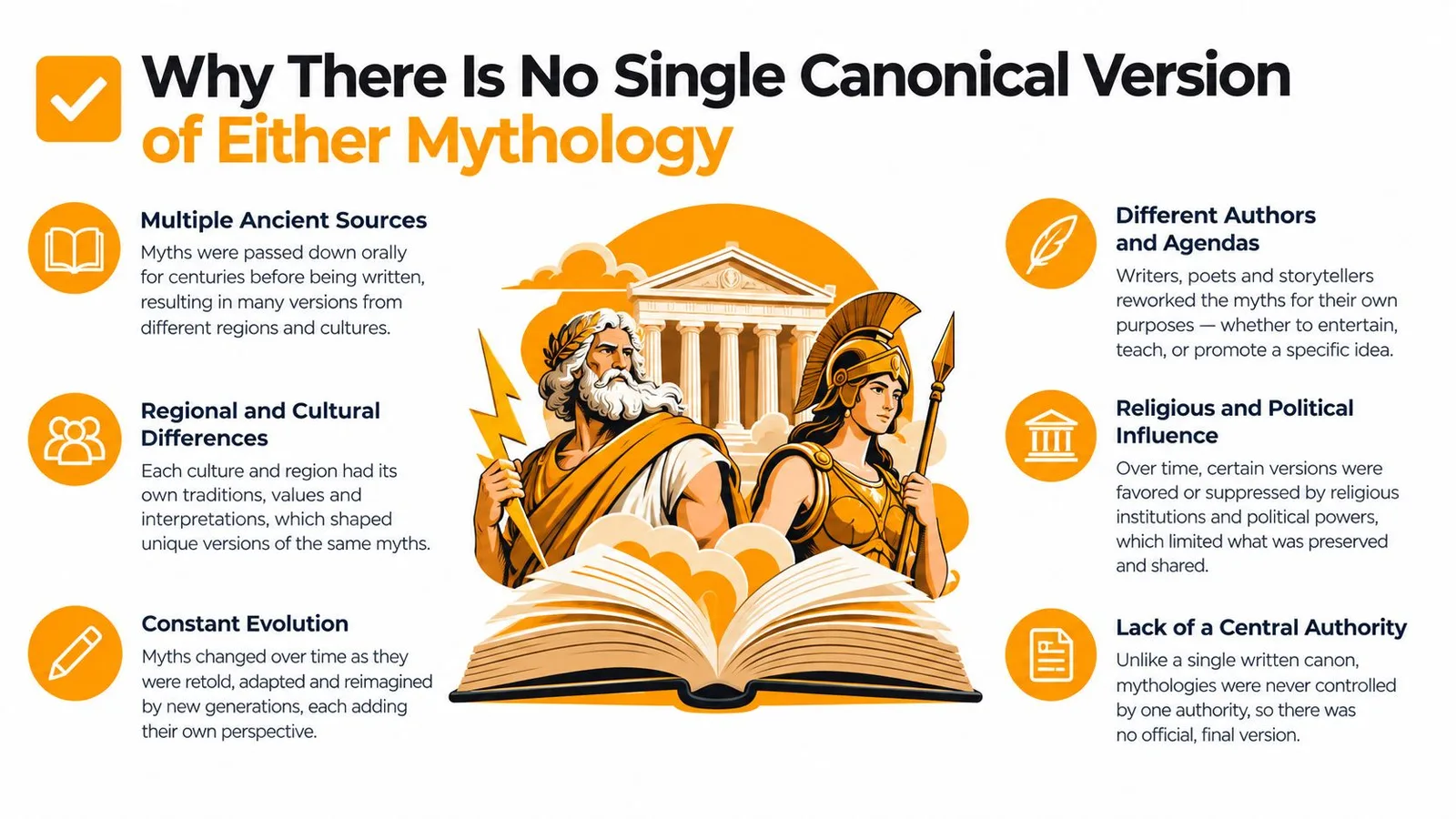
Why There Is No Single Canonical Version of Either Mythology
It's tempting to imagine one fixed list of twelve Olympians and one authoritative version of every story. Ancient traditions are messier. Even the membership of the Greek Twelve could vary across sources, with Hestia and Dionysus appearing differently depending on the account. Stories also accumulated across regions, genres, oral traditions, poetry, drama, and later Roman retellings.
That doesn't mean every version is equally grounded in ancient evidence. It means readers should treat a myth as a source-based account, not as a single entry in an unchanging handbook. A dramatic poem, a local religious tradition, and a later retelling can all present related material differently.
Four questions to ask about any version
- When was it written? A later retelling may reflect its own period as much as older tradition.
- What kind of source is it? Epic poetry, tragedy, and a later mythographic account have different purposes.
- Where did it come from? Local worship and regional stories may differ from well-known literary versions.
- What evidence survives? Separate what a source says from what modern summaries add.
These questions are useful when a retelling presents a disputed story as settled fact. For example, claims that Hades is the Christian devil or that Medusa was originally Athena's priestess can flatten differences between ancient sources and later interpretations. Check which text is being used and what it supports.
A good reader doesn't need to memorize every version. The useful skill is recognizing which version you're reading and what kind of source preserves it.
Question 4 of 5
Why did the list of Greek Twelve Olympians sometimes include Hestia and sometimes Dionysus?
How to Tell Whether a Story Is Greek, Roman, or a Modern Blend
Don't classify a myth by its names alone. A Roman author can tell a story with Greek origins, and a modern retelling can combine details from several ancient sources. Instead, look at the story's emphasis and setting.
A practical way to read a myth
- Look for its narrative roots. Does it draw on familiar Greek stories about gods, heroes, family conflict, or a difficult quest?
- Notice what the telling emphasizes. Does it foreground public duty, ancestry, or Rome's destiny? Those concerns may signal Roman adaptation, even when the figures have Greek names.
- Check the author and source. A myth's literary setting can help distinguish an ancient Greek account, a Roman adaptation, and a later blend.
Ovid's Metamorphoses is a useful reminder that a work can be Roman in its literary context and still draw heavily on Greek myth. “Greek” and “Roman” don't always function as labels for entirely separate stories; sometimes they describe different stages in a story's cultural life.
Modern retellings can also smooth over disagreement between ancient versions. A familiar summary may combine details from sources that didn't tell the story in the same way. When that happens, it's more accurate to call the result a modern blend than to treat it as the one original account.
The deeper difference between Greek and Roman mythology isn't vocabulary. It's cultural function. When you encounter a myth, ask: What was this story doing for the people who told it?
Common Questions About Greek and Roman Mythology
Are the Greek and Roman gods the same gods?
They're often closely matched, but not identical. Zeus and Jupiter share a major correspondence, for example, while Roman deities could have different roles and civic associations. The names point to a relationship, not a perfect identity.
Is Hades the same as the Christian devil?
No. Hades is a Greek god associated with the underworld, and equating him with the Christian devil collapses distinct religious ideas. Check the ancient source and the later interpretation before accepting the comparison.
Was Medusa originally Athena's priestess?
That account is familiar from modern retellings, but it shouldn't be treated as a universal ancient version. Compare the story's source with later adaptations, especially when a summary presents one version as the original.
Did demigods always have supernatural powers?
No single rule applies across every story. The category and a hero's abilities can vary by source and genre, so it's safer to ask what the particular text says rather than assume every demigod follows the same template.
How can I spot a Roman or modern retelling?
Look for the author, the date and setting of the work, and the details the story emphasizes. A Latin literary adaptation may preserve Greek narrative material, while a modern version may combine details from multiple traditions.
Igneous AI, LLC develops Million Whys, a micro-learning and trivia platform where short questions come with explanations for every answer choice. If comparing myth versions has made you curious about how other everyday ideas work, explore Igneous AI, LLC and its daily questions across history, science, nature, and more.
Question 5 of 5
What makes the Greek god Hades a different kind of figure from the Christian devil, when both rule a realm of the dead?
Keep Exploring
Why is Ovid's Metamorphoses counted as Roman storytelling even though its myths come from Greece?
Literature & Books
Why was Hades not like a devil-like ruler of the dead in Greek mythology?
Religion & Mythology
Why do the Greek gods in myths often behave like jealous rivals with human emotions?
Religion & Mythology
Related Posts
Summary of Greek Mythology: The Definitive Guide
Explore our comprehensive summary of Greek mythology, from the Olympian gods to legendary heroes, in this engaging guide for curious minds.
Differences Between Roman Republic and Roman Empire
Discover the key differences between Roman Republic and Roman Empire, from governance structures to military systems and social transformations.