How Do Batteries Work: A Simple Guide to the Science
On this page· 13
Your phone's at 8 percent, the charger is in another room, and the low-battery warning has turned into the loudest thing in the house. In that moment, few people want a lecture on chemistry. They want the simple answer to how do batteries work and why a little sealed object can keep a flashlight alive, a phone talking, or a car moving.
The short answer is that a battery is a controlled chemical reaction that turns chemical energy into electrical energy. Inside it, electrons and ions are separated into different paths, so useful current can leave the cell instead of short-circuiting inside it as the U.S. Department of Energy explains. Once that idea clicks, the rest gets easier to understand, including why one battery lasts longer, why charging speed matters, and why recycling is messier than it sounds.
The Moment Your Phone Dies
A dead phone feels like a small emergency because it sits inside modern life so neatly. Messages stop, maps stop, music stops, and you start hunting for a cable like it's a missing key. That urge to get power back is the reason this topic matters, because batteries are the hidden layer between stored chemistry and the devices we rely on every day.
At the center of the story is a very simple exchange. One material wants to give up electrons, another wants to take them, and the battery keeps those two reactions arranged so the electrons have to travel through your device instead of slipping straight across the inside of the cell. That forced trip is what gives you usable current.
Think of a battery as a disciplined argument between two materials.
The battery works only because it keeps the argument from collapsing into a shortcut.
A useful mental model is this, the battery is not storing electricity like water in a tank. It's storing chemical potential, then converting that potential into electrical flow when you close the circuit. That's why a battery can sit on a shelf, then suddenly power a flashlight the moment you insert it.
Three questions do all the heavy lifting from here. What's inside the cell. Why do some batteries feel stronger or last longer than others. And what changes when you fast-charge or recycle one instead of tossing it in a drawer.
Voltage, Current, and Capacity Without the Jargon
A phone battery can look small on the outside and still behave very differently from a laptop pack or a power bank. The labels tell you three separate things. Voltage is the push that lets charge move. Current is how much can move at once. Capacity is how much charge the cell can hold over time, usually shown in ampere-hours (Ah), while energy is commonly measured in watt-hours (Wh), which combines voltage and current over time as the U.S. Department of Energy notes.
Your own phone gives the clearest example. A typical lithium-ion cell sits around 3.7 volts, but the phone still has to raise that voltage inside the device so different parts can run at the levels they need. That is why voltage matters even when the battery itself looks ordinary. It is the reason a small cell can still run a display, processor, and radio, as long as the system manages the power correctly.
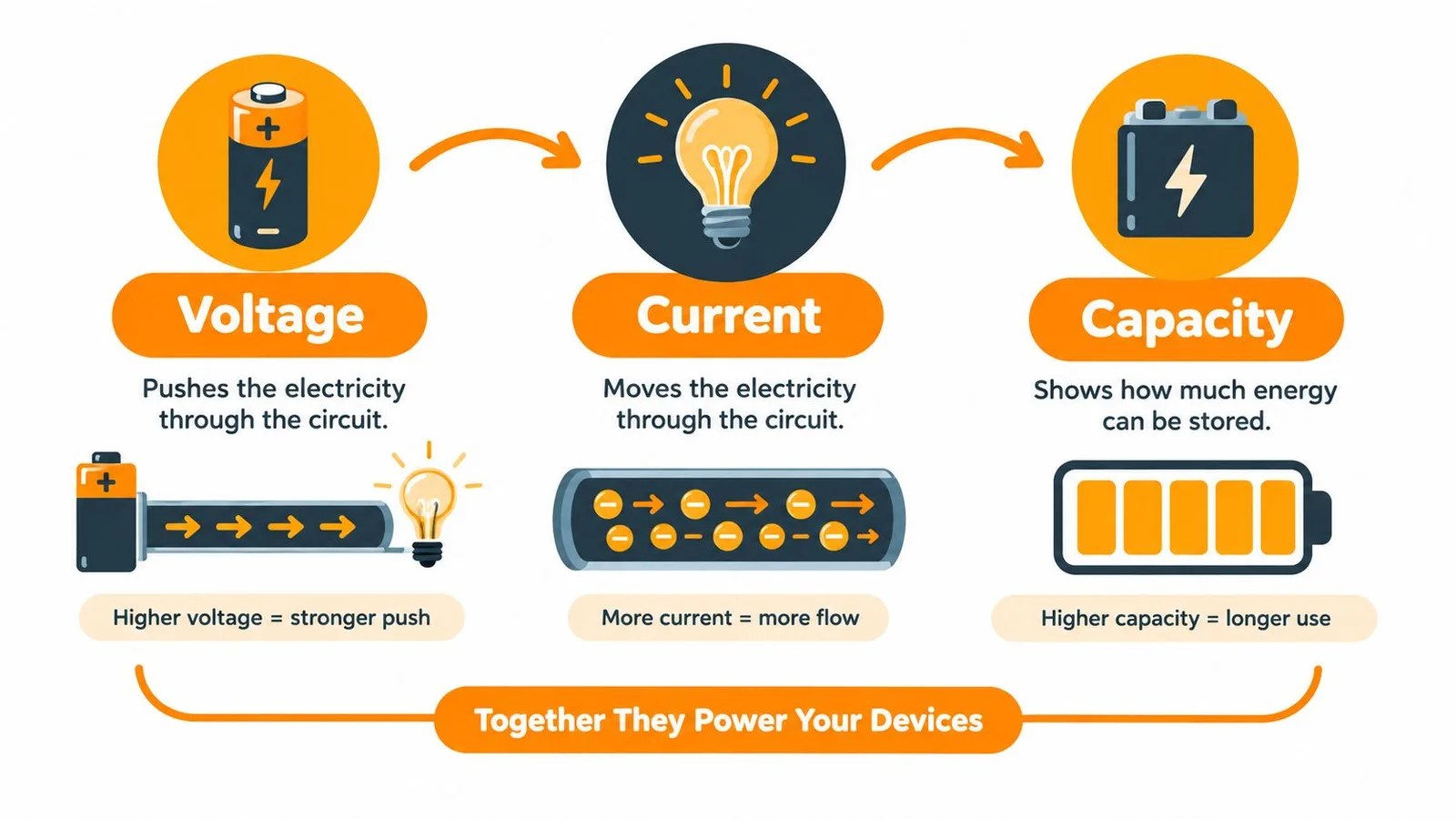
Capacity causes a different kind of confusion. A 5,000 mAh phone battery and a 100 Ah power bank are not the same sort of number in disguise, because they describe how much charge is available, not how strongly it pushes. That is why two batteries with similar voltage can still last very different amounts of time. One may store more charge, or deliver it more efficiently, or both.
For a quick refresher on basic physics language, this physics quiz and answer guide is a useful side path. Once you read battery labels this way, the numbers stop looking like jargon and start reading like a set of design choices.
Question 1 of 6
Why do battery labels use both ampere-hours (Ah) and watt-hours (Wh) instead of reporting just one number?
The Three Parts Inside Every Cell
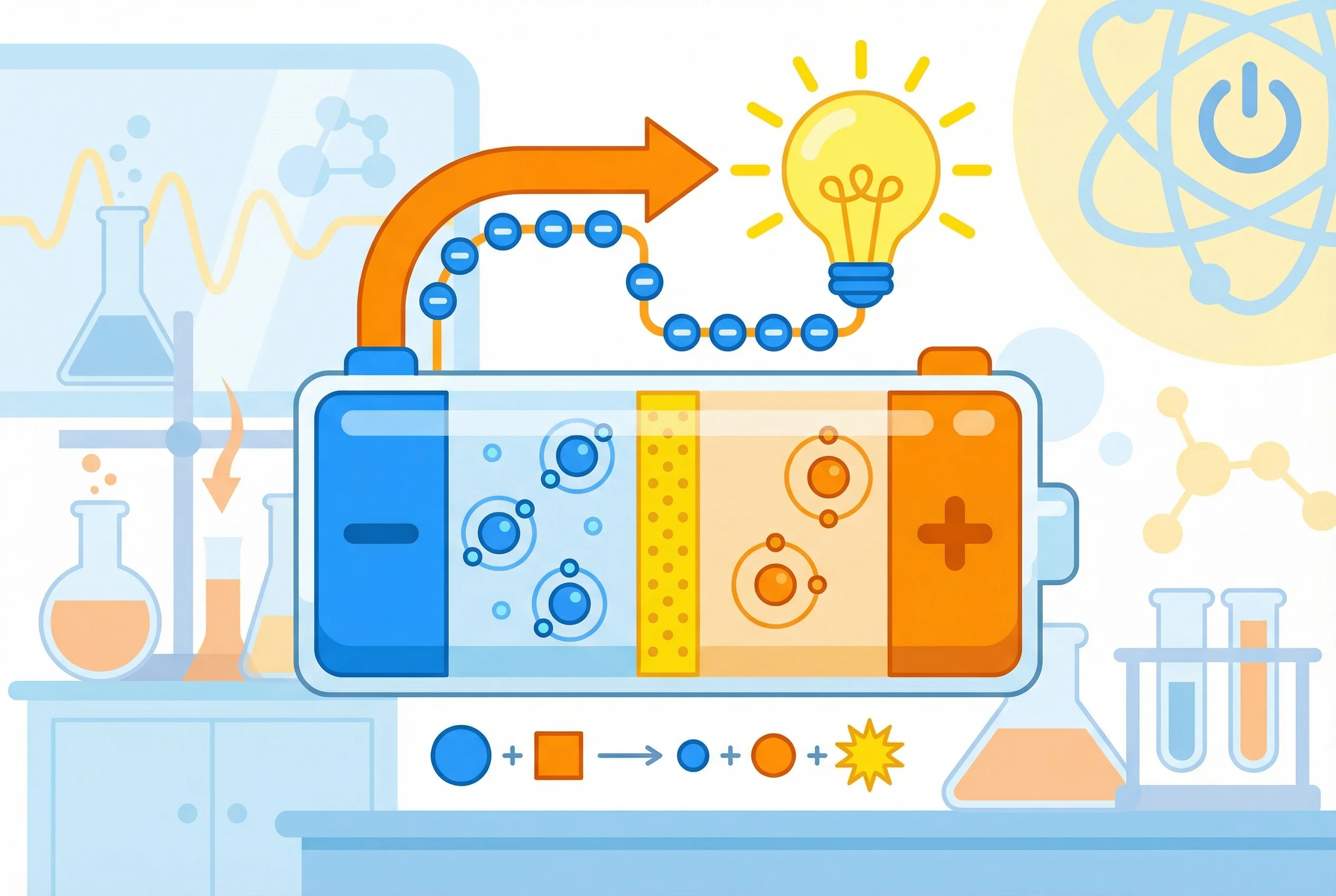
A battery cell works because three parts each do a different job: a negative electrode, a positive electrode, and an electrolyte that lets ions move inside while electrons use the outside circuit. The division matters. Inside the cell, ions can move through the electrolyte. Outside the cell, electrons must pass through your device, and that outside path is what turns chemistry into useful current.
The inside and outside routes
A narrow bridge for ions, while electrons are routed through the hallway outside the building. That separation creates a potential difference, which is another way of describing voltage. The chemistry on one side wants to give up electrons, while the chemistry on the other side is ready to take them.
When the circuit is closed, one electrode undergoes oxidation, which means it gives up electrons. The other undergoes reduction, which means it accepts them. Those terms sound technical, but the movement is straightforward. One side loses, the other side gains, and the imbalance becomes electrical work. A helpful chemistry trivia collection can make that basic language feel less abstract once you start picturing the parts.
A battery also needs a separator or barrier that keeps the electrodes from touching directly. Without that physical separation, electrons would take the shortest path inside the cell, heat would rise, and the useful external flow would collapse. The electricity you use is the byproduct of keeping that chemical system under control.
Question 2 of 6
Why does a battery need a thin separator between its two electrodes?
Following a Lithium-Ion on Its Round Trip
A lithium-ion cell is easiest to follow when you track a single ion through the loop. During discharge, lithium atoms at the graphite anode lose an electron, the resulting Li+ moves through the electrolyte and porous separator, and the ion reaches the cathode, where it is taken up by the structure as battery education resources explain. The electron takes the outside route through the device, and that flow powers the load.
A guided trip through the cell
Each part has a specific job. The graphite negative electrode holds lithium during charging, the positive electrode accepts it during discharge, the liquid electrolyte carries ions, and the separator blocks electronic conduction so the battery does not short internally. Copper and aluminum current collectors move charge between the active materials and the external circuit. The exact materials vary by design, but the handoff stays the same.
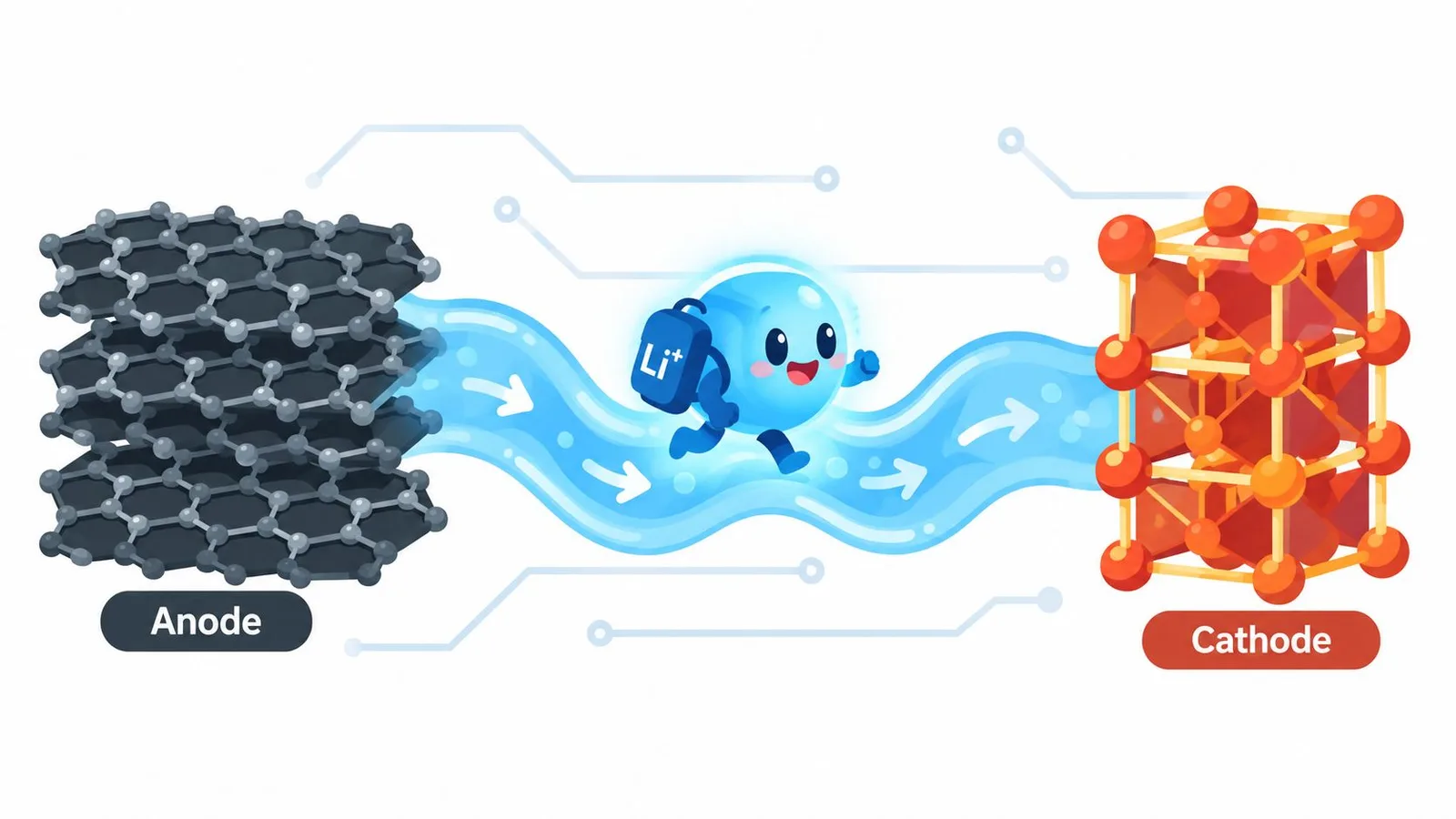
Common lithium-ion chemistries have nominal cell voltages around 3.6 to 3.7 V. That figure helps set the scale of a single cell, even though real voltage shifts with state of charge and chemistry. Put cells in series, and the voltage rises, which is why practical battery packs use many cells instead of one oversized unit.
Charging sends the same ion back the other way. An applied voltage pushes Li+ into graphite again while electrons return through the charger. That round trip is what makes modern rechargeable batteries practical, because the same ion can shuttle back and forth many times.
Why Some Batteries Outperform Others
Different battery chemistries win for different reasons, and the label on the side is really a record of design trade-offs. A battery can be built for a quick burst, long storage, lower cost, safer behavior, or lighter weight. It usually cannot maximize all of them at once.
| Chemistry | Nominal cell voltage | Typical energy density | Cycle life | Best-fit use case |
|---|---|---|---|---|
| Lead-acid | about 2 V per cell under load, with a fully discharged cell near 1.75 V | Lower than lithium-ion in general | Built for high burst power and established applications | Starter batteries and backup systems |
| Nickel-metal hydride | about 1.2 V per cell | Moderate | Known for durability in older hybrid designs | Early hybrids and some consumer gear |
| Lithium-ion with NMC cathodes | Around 3.6 to 3.7 V Battery University | High | Good balance of energy and longevity | Laptops and long-range EVs |
| Lithium-ion with LFP cathodes | About 3.2 V per cell | Lower energy than some other lithium-ion types, but strong durability | Often chosen for long service life and abuse tolerance | Entry-level EVs and stationary storage |
Lead-acid still earns its place where a big burst matters and cost matters. Lithium-ion wins in devices that need more energy in less space. LFP is attractive when lifespan and resilience matter more than squeezing every last bit of stored energy into the smallest box.
Why chemistry is only part of the answer
The same chemistry can still be tuned for different jobs. Engineers change electrode thickness, particle size, separator behavior, and electrolyte formulation to shift the balance between power, safety, and usable capacity. That is why two batteries with the same general chemistry can feel very different in practice.
A battery's chemistry sets the boundaries, but its design sets the personality.
If you compare real products, the intended use matters more than the marketing label. A starter battery, a laptop pack, and a home storage unit all ask the chemistry to do different jobs. Even a strong chemistry can look poor when it is pushed outside the range it was built for.
Question 3 of 6
Why do electric bikes, car starter motors, and home backup systems often use three different battery chemistries instead of one best one?
What Really Decides Range, Heat, and Aging
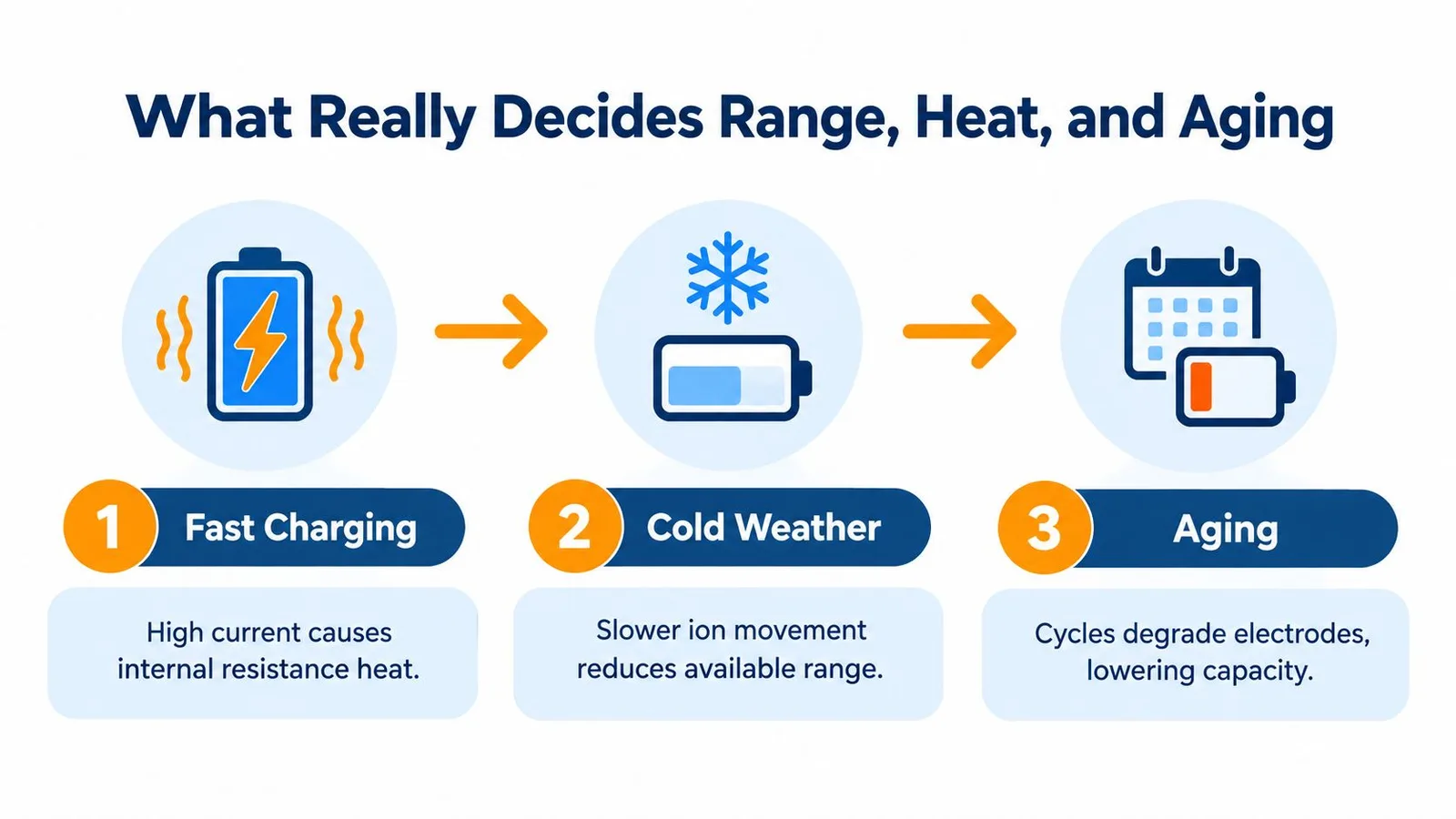
When a battery feels hot, loses range in cold weather, or seems tired long before you expected, the cause is usually inside the cell, not in the icon on the screen. The movement of ions, the resistance at interfaces, and the battery management system all shape what you feel as a user. A battery is an engineered system with limits, not a magic reservoir.
Why heat shows up
High current creates losses inside the cell, and those losses turn into heat. The battery also has to move ions through materials that resist flow to some degree, so the harder you push it, the more the cell has to manage internally. That's one reason fast charging feels warmer than slow charging.
Cold weather causes a different problem. Ion movement slows down, which reduces the battery's ability to deliver the same amount of useful power on demand. The chemistry hasn't disappeared, but the system can't move charge as freely.
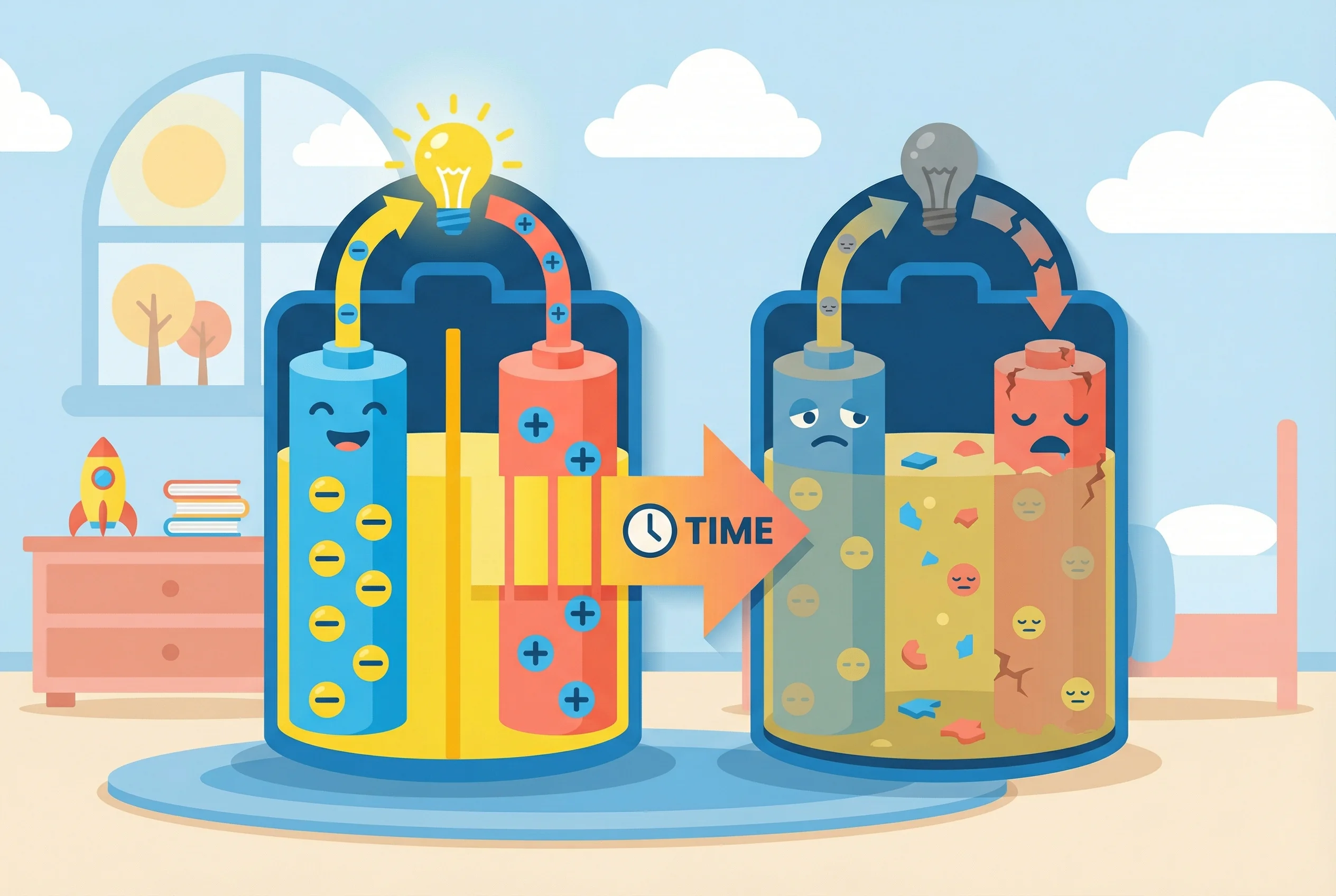
Aging adds another layer. With use, electrodes change, interfaces grow, and usable capacity falls even when the battery still looks fine from the outside. That's why a pack can seem healthy on paper yet no longer feel like it did when it was new.
For a related grid-side angle on heat and power stress, the article on why heatwaves cause power outages is a useful companion read. Batteries and broader power systems both show the same truth, heat changes how electricity behaves in practice.
Question 4 of 6
Why does a phone battery get warm during fast charging but struggle to deliver power on a cold morning?
Fast Charging Is Not One-Size-Fits-All
A phone that survives years of fast charging can make the warning sound overstated, until a battery in another device ages faster under the same kind of use. The difference comes from chemistry, charging intensity, temperature, and how much of the charge arrives quickly.
A 2025 Carnegie Mellon comparison found that LFP cells showed no extra degradation even when more than 90% of charging used fast current, while NMC cells degraded faster mainly under the most intensive fast-charging condition. NCA cells were the most vulnerable, with degradation increasing exponentially as fast charging increased according to Carnegie Mellon's report. In other words, fast charging is a charging method, but its effect depends on the cell chemistry inside the pack.
Lab cycles can miss another part of the story. Research involving 92 commercial lithium-ion batteries found that realistic stop-start discharge patterns extended apparent battery life by up to 38% compared with conventional laboratory cycles. Real driving does not drain a battery in a perfectly even line, so test methods that ignore those pauses can miss how the pack ages.
For EV owners choosing hardware, the EVChargers.eu charger roundup is useful because it treats charger choice as a use-case decision. The practical rule is simple. Match charging habits to chemistry, climate, and daily pattern. Fast charging is not automatically harmful, but it is not harmless in every battery either.
Question 5 of 6
Why can two electric-car batteries on the same years of frequent fast charging end up aging so differently, with one barely losing capacity and the other fading quickly?
What Actually Comes Back From Recycling
Recycling sounds like a clean loop, but batteries don't come back as a perfect clone of themselves. Much current scrap is processed through pyrometallurgy, and that can mean lithium or graphite isn't recovered at all. Recovery varies by chemistry, process, and facility, which is why a “recycled battery” doesn't tell you much by itself.
The recovery problem is selective
The main trap is assuming that if one valuable metal comes back, everything else does too. That's not how it works. High recovery of cobalt or nickel doesn't imply equally high recovery of lithium, and modern battery design changes the economics of what recyclers care about most.
The European Union's 2025 battery rules set concrete targets rather than pretending recovery is already perfect. Lithium-based battery recyclers must reach 65% recycling efficiency by the end of 2025, targets for recovered cobalt, copper, lead, and nickel rise to 90% by 2027 and 95% by 2031, and lithium recovery is set at 50% by 2027 and 80% by 2031 as summarized by Rocky Mountain Institute. Those numbers show that recycling is still a process with trade-offs, not a guaranteed closed loop.
Chemistry links back to end-of-life design. As LFP grows, the recycling value shifts away from cobalt and nickel and more toward lithium recovery and process efficiency. If you want to compare end-of-life routes or disposal options, this overview of lithium battery disposal options is a useful starting point for thinking about what should happen before a battery reaches the waste stream.
The main lesson is simple. How a battery works on day one and how it is handled at the end of its life are part of the same chemistry story. If you understand what moves inside the cell, you can make better choices about charging, usage, and recycling.
Igneous AI, LLC builds Million Whys, a micro-learning platform that turns questions like this into short, explained science bites you can revisit anytime. If you want more everyday explanations that make technical topics feel readable, visit Igneous AI, LLC and explore what it offers.
Generated with Outrank
Question 6 of 6