
Headway Review 2027: Summaries, Pricing and Alternatives
On this page· 21
Standard advice about book-summary apps tells you to count the library, glance at the app store stars, and pick the sleekest interface. That checklist misses the two questions that decide whether Headway earns its subscription price in 2027: what your renewal bill looks like once the introductory discount ends, and whether a condensed summary builds real understanding or only a passing sense of recognition.
Headway's scale makes it easy to assume the product solves every reading bottleneck. Founded on January 15, 2019 by Anton Pavlovsky, the company became the most-downloaded app globally in the book-summary category by October 2020 and held the top download spot again in 2021, according to the Wikipedia profile of Headway Inc. The same profile reports that Headway passed 50 million downloads by 2025, reached users in more than 170 countries, ranked among the top 10 iOS education apps worldwide by revenue, and grew past 500 employees.
That growth answers a genuine time crunch. In Headway's World Book Day survey of 2,000 professionals aged 18 and over, 43% said they read fewer than three books per year and 6% finished none. The company also points to a large body of positive user reviews across the major app platforms. Still, a survey commissioned by a summary app among working adults carries obvious sampling limits, and store ratings capture first impressions more reliably than long-term retention or billing satisfaction.
This Headway review weighs the polished micro-learning experience against documented billing friction and the limits of compressed reading, so you can decide before entering a payment method.
Headway at a Glance and Our Verdict
Headway is a well-built nonfiction summary app for readers who want to sample many titles quickly, but it falls short as a substitute for full books, and its real 2027 value hinges on the renewal rate you accept.
Public review counts confirm how widely the app has spread across mobile platforms. A 2025 independent Headway review by 2Smart2Read noted more than 30 million users along with 136,500 Google Play ratings and 103,500 App Store ratings. Those numbers prove strong reach, yet reach alone doesn't tell you whether the format matches your goals or whether the billing cycle fits your budget.
To keep the tradeoffs visible, the table below summarizes Headway's core specifications, pricing entry points, and gaps to verify before subscribing.
| Aspect | What Headway offers | Verdict |
|---|---|---|
| Format | Text and audio summaries of about 15 minutes, plus quizzes and flashcards | Strong for quick orientation |
| Platforms | Android, iOS, Apple Watch and web | Strong for cross-device use; test sync yourself |
| Trial | 7-day free trial on the yearly Premium plan | Useful for testing; set a reminder |
| Intro price | From $19.99 for four weeks on the U.S. website | Check the renewal price |
| Accessibility | Supported accessibility features not listed on the App Store | Check the App Store listing before committing |
| Learning depth | Compressed summaries of nonfiction books | Use as a starting point, not a substitute |
How to Read This Snapshot
Treat the table as a two-part filter. Rows marked Strong show where Headway earns its place on your phone: short text-and-audio sessions and broad device coverage make it easy to preview nonfiction ideas during spare minutes.
Rows marked Check are the exact friction points that turn enthusiastic sign-ups into regret. Confirm the renewal rate in your local currency, verify accessibility support on your device, and keep realistic expectations about what a condensed overview can teach.
Bottom line for 2027: Use Headway to browse nonfiction ideas and decide which books deserve a full read, not to replace deep study or ignore subscription fine print.
Curious? Try one 👇
Why is the sky blue?
Jump into the daily quiz →How does a Headway session work, step by step?
Headway's core engine condenses nonfiction books into roughly 15-minute text and audio summaries, backed by short quizzes and flashcards, as documented in the StraightUpSearch Headway review. That multimodal setup lowers the barrier to starting a session, yet compression always strips out nuance.
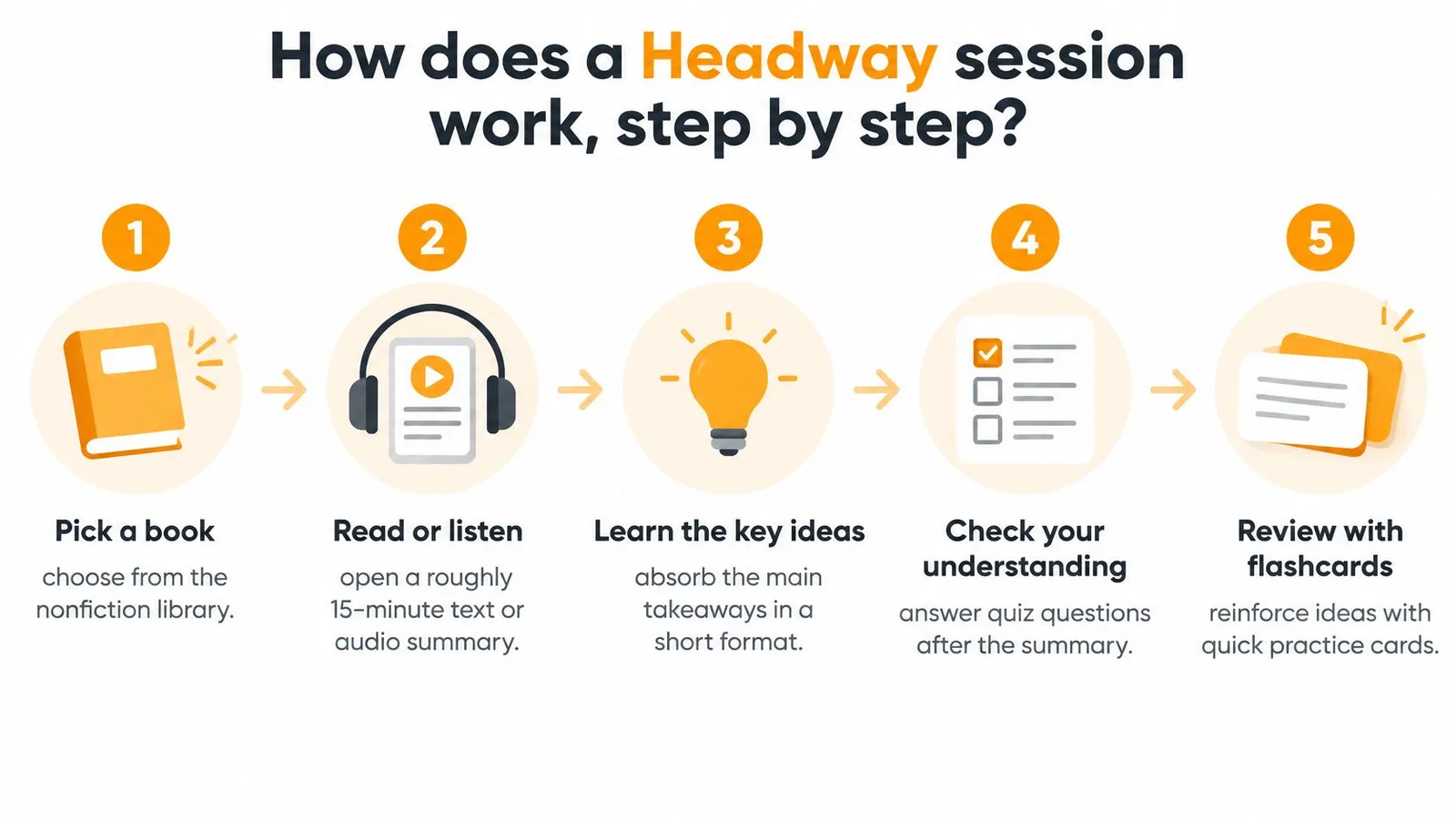
A typical session moves through five practical stages, each with a clear benefit and a built-in ceiling:
- Pick a summary and note the subject area. Browsing by topic helps you target a work skill or personal goal right away. The limit is that a title's subject determines how safely it can be compressed; practical habit tips survive condensation better than research-heavy science or history.
- Read the text or play the audio. Switching between screen reading and listening fits commutes, walks, and short breaks between meetings. Background listening carries a real retention penalty, though: the same StraightUpSearch Headway review cited a 21-day test in which background playback left accurate recall of the core argument for only 6 of 14 completed summaries.
- Complete the post-summary quiz. Answering a few prompts immediately after finishing feels rewarding and confirms you followed the main labels. Recognition on a multiple-choice card isn't the same as recalling an argument unaided when you need it at work.
- Flip through the flashcards. Reviewing key terms and condensed takeaways reinforces vocabulary and memorable quotes. Because cards pull from an already shortened script, they rarely rebuild the supporting evidence or counterarguments from the original chapters.
- Revisit the idea a day or more later. Returning after 24 hours tests whether the book's thesis stuck. Most users skip this step and move straight to the next title, trading retention for a higher finished-book count.
Testing Cross-Device Behavior Before Paying
Headway supports Android, iOS, Apple Watch, and web, which sounds smooth on paper. In practice, cross-device learning apps can behave unevenly across operating systems and browsers.
Before committing to a paid cycle, run a quick four-point check on the devices you use:
- Progress sync: Open a summary on your phone, stop halfway, and confirm the web player or watch picks up at the exact same spot.
- Audio resume: Pause playback for a phone call or switch Bluetooth headsets to make sure the narration doesn't jump back to the beginning.
- Offline continuity: Download a summary on Wi-Fi, enable airplane mode, and test both text and audio loading.
- Accessibility settings: Adjust dynamic font sizes, screen readers, and dark-mode contrast on your specific device rather than assuming every screen supports them.
Finish your first test session with a simple self-check. Close the app, write down the book's central argument and one concrete example from memory, and compare your notes against the summary before deciding whether those 15 minutes paid off.
Which strengths and weaknesses should decide the choice?
Star ratings mix two different questions: does the app feel useful on day one, and does it keep earning attention once billing cycles and learning limits matter? A five-star average can hide a renewal surprise. A one-star review can come from a reader who wanted full books. The decision gets clearer when strengths and weaknesses are separated by what they affect.
Where Headway Delivers
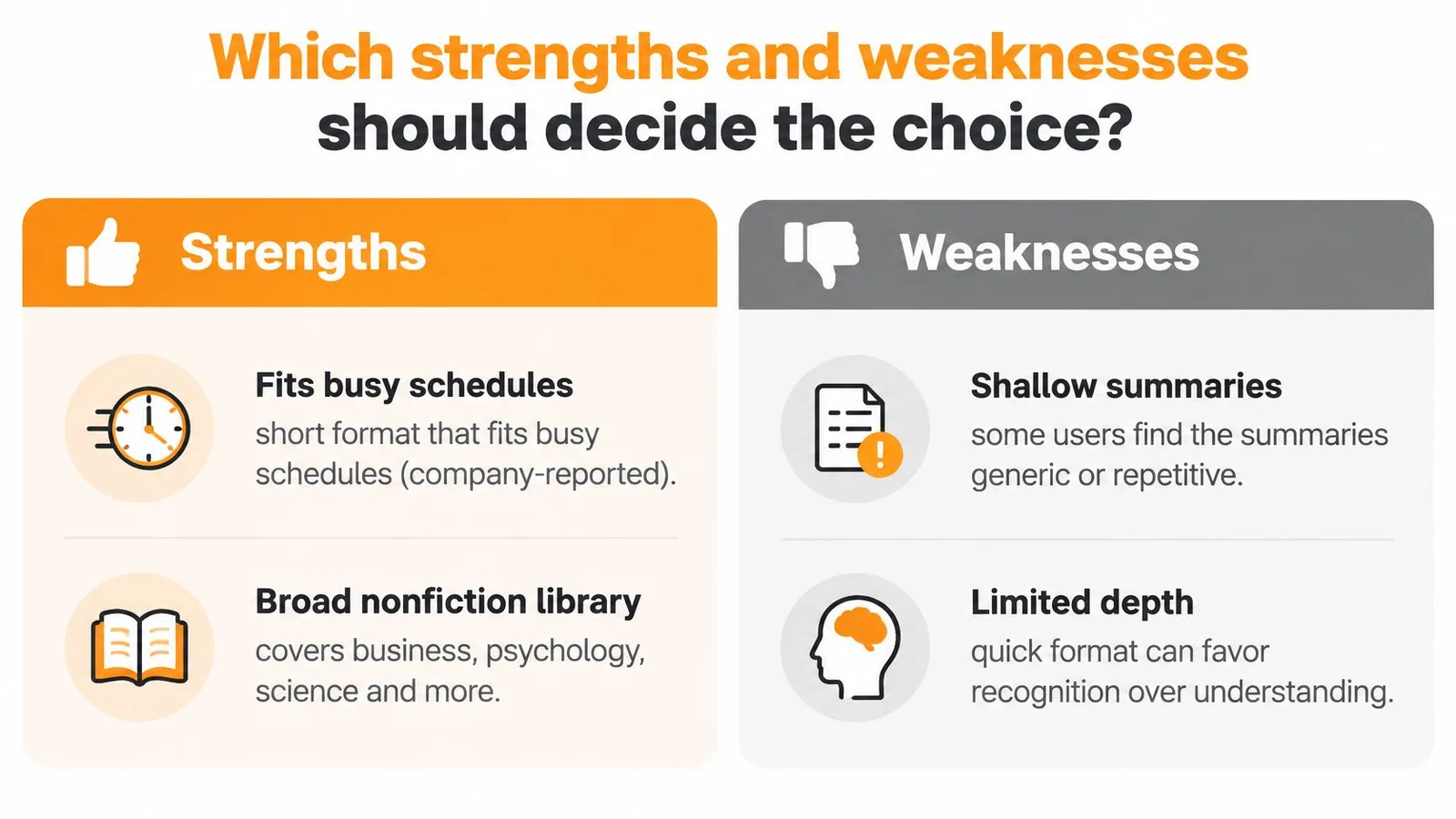
- Short sessions for packed schedules (company-reported): Long nonfiction becomes bite-sized units, which suits commutes, lunch breaks, and other gaps when reading a full chapter is unrealistic.
- Wide nonfiction coverage (company-reported): The catalog spans business, psychology, science, and history, giving readers several entry points into unfamiliar subjects.
- Low-friction book discovery (user-reported): Many readers use Headway as a screening tool, sampling an author's main thesis before spending money and weeks on the original book.
- Multi-device access (company-reported): Android, iOS, Apple Watch, and web support let readers continue a habit across phones, wrists, and browsers.
- Dual reading and listening modes (company-reported): Text and audio for summaries let users switch formats based on the setting, instead of dropping a session when a screen is unavailable.
Those points matter most for readers who want a steady stream of ideas and can accept abbreviated versions. Headway's value sits in lowering the effort required to start and finish something useful. It works less well when the goal is to apply a method precisely or judge the strength of the evidence behind a claim.
Where Friction Shows Up
- Missing caveats and procedural depth (independent review): Compressing hundreds of pages removes primary-study details, edge cases, and step-by-step reasoning that matter when applying advice.
- Generic takeaways and narration slips (user-reported): Some reviewers describe summaries as repetitive or surface-level. A smaller group points out occasional voice or narration mistakes.
- Disproportionate billing complaints (independent review): Subscription administration draws far more frustration than the summaries themselves. An analysis compiled by AppSlupa on Headway user reviews found 622 mentions of charges, subscriptions, refunds, or cancellation across 2,201 recent reviews (28% of the sample) and paired that with Headway privacy policy language about account and payment data. Another sample of 238 reviews logged 50 billing complaints compared with just 7 complaints targeting summary or narration quality, alongside reports of separate charges for an "Infographics" add-on.
- Accessibility support not listed (App Store): On the App Store, the developer hadn't indicated supported accessibility features. That gap doesn't prove the interface is unusable, yet it means readers who rely on VoiceOver, TalkBack, high contrast, reduced motion, or transcripts should test every screen personally.
The billing pattern deserves unusual weight because it affects value after the initial appeal fades. A reader may enjoy the format and still find the renewal price harder to justify once summaries become familiar. On the learning side, recognition is the easier test. A summary can leave you nodding at a familiar idea, while understanding requires recalling the argument, its limits, and one way to use it.
Privacy and Data Controls to Review
The Headway privacy policy says the service collects, uses, and discloses information linked to app use. Before creating an account, check what personalization data, reading history, and payment details are stored. Confirm how export, deletion, and marketing opt-out controls work in your region.
Judge Headway against the exact job you want it to do. If billing clarity, privacy controls, or accessibility matters to you, check those during your first week. If the job is deep understanding, compare a summary with the full argument before renewing.
What Headway Really Costs After the Intro Offer
Introductory discounts make Headway look inexpensive at checkout. The recurring renewal rate tells a different story, and comparing that ongoing cost is the single smartest step before you subscribe.
On Headway's U.S. pricing page, three website billing cycles advertise a steep first-term discount followed by a renewal charge that is effectively double the initial price. Separately, Headway's official FAQ states that its annual Premium plan comes with a seven-day free trial granting full library access, while noting that exact pricing shifts by plan, region, and active promotions.
| Offer | Introductory price | Renewal price |
|---|---|---|
| 4-week plan | $19.99 for the first four weeks | $39.98 every four weeks |
| 12-week plan | $39.99 for the first 12 weeks | $79.98 every 12 weeks |
| 24-week plan | $59.99 for the first 24 weeks | $119.98 every 24 weeks |
| Yearly Premium | 7-day free trial with full library access | Set by region, billing plan, and active offer at checkout |
Breaking Down the Weekly Math
Looking at the per-week cost exposes how sharply the value shifts once the introductory window closes:
- 4-week plan: You pay about $5.00 per week for the first four weeks, then $10.00 per week on renewal.
- 12-week plan: The intro rate works out to roughly $3.33 per week, jumping to $6.67 per week every 12 weeks afterward.
- 24-week plan: You start at about $2.50 per week, then renew at $5.00 per week for each 24-week cycle.
Because the 4-, 12-, and 24-week website plans bill on week-based cycles rather than calendar months, renewal dates can sneak up faster than a standard monthly bill. If you test the yearly Premium plan instead, confirm the exact post-trial renewal figure shown on your checkout screen before tapping confirm, since no single universal annual rate applies across all markets.
Comparing Renewal Spend Against Other Learning Budgets
Ask what that renewal figure buys elsewhere over the same span. Paying $39.98 every four weeks or $79.98 every 12 weeks can easily cover two or three full print books, audiobooks, or a digital library setup you keep permanently.
Even the lowest renewal rate of $119.98 every 24 weeks adds up to a substantial recurring yearly outlay if left running continuously. That can still make sense if you actively screen dozens of nonfiction titles a year and save yourself from buying books you'd abandon. If you only open the app twice a month, the renewal math turns against you quickly.
How do I cancel Headway without surprise charges?
Most subscription frustration happens for two mundane reasons: people uninstall the app thinking billing stopped, or they wait until the final hours of a trial to cancel. Treating cancellation as a quick five-step checklist eliminates almost all of that risk.
- Identify your exact billing channel. Headway subscriptions can run through Apple's subscription settings, Google Play, or Headway's website, and you must cancel through the same channel that charged you, as explained in the GeneralistApp Headway review. Checking your original receipt email confirms which system holds your payment method.
- Set a calendar alert at least 24 hours before renewal. Headway plans renew automatically unless cancelled, and UnderstandTutor's Headway breakdown notes that the company advises cancelling at least 24 hours before the renewal time. Its FAQ warns that cancelling right before the deadline can still trigger one final charge, which makes that buffer essential during a seven-day annual trial.
- Cancel inside the billing portal, not by deleting the app. Removing the Headway icon from your home screen leaves an active subscription running in the background. Open your Apple ID subscriptions, Google Play subscriptions, or Headway web account directly to turn off auto-renewal.
- Confirm the end status and remaining access. A completed cancellation stops future billing while keeping your library access active through the end of the period you already paid for. Verify that the status explicitly shows an expiration date rather than a next billing date.
- Save a screenshot of the confirmation screen. Keeping a dated visual record takes two seconds and saves hours of back-and-forth if a billing error appears later.
Auditing Your Statement and Handling Disputed Charges
Once you've subscribed or cancelled, inspect every separate line item on your bank or card statement rather than checking only the main subscription amount. Optional add-on charges can appear on a separate billing line, and catching them early gives you the best shot at resolving them quickly.
If an unexpected renewal goes through after you cancelled, contact the exact billing channel where you signed up. Apple and Google Play process refunds through their own purchase-history portals, while website subscriptions must be disputed directly with Headway support using your confirmation screenshot and receipt.
Uninstalling an app never stops a recurring charge. Always cancel inside the store or web portal that holds your payment method, and leave a full 24-hour buffer.
Do short summaries build real understanding or only recognition?
Finishing three 15-minute summaries during a busy week feels productive. That feeling of progress is the main reason book-summary apps thrive, yet feeling informed isn't the same as understanding a subject well enough to apply it.
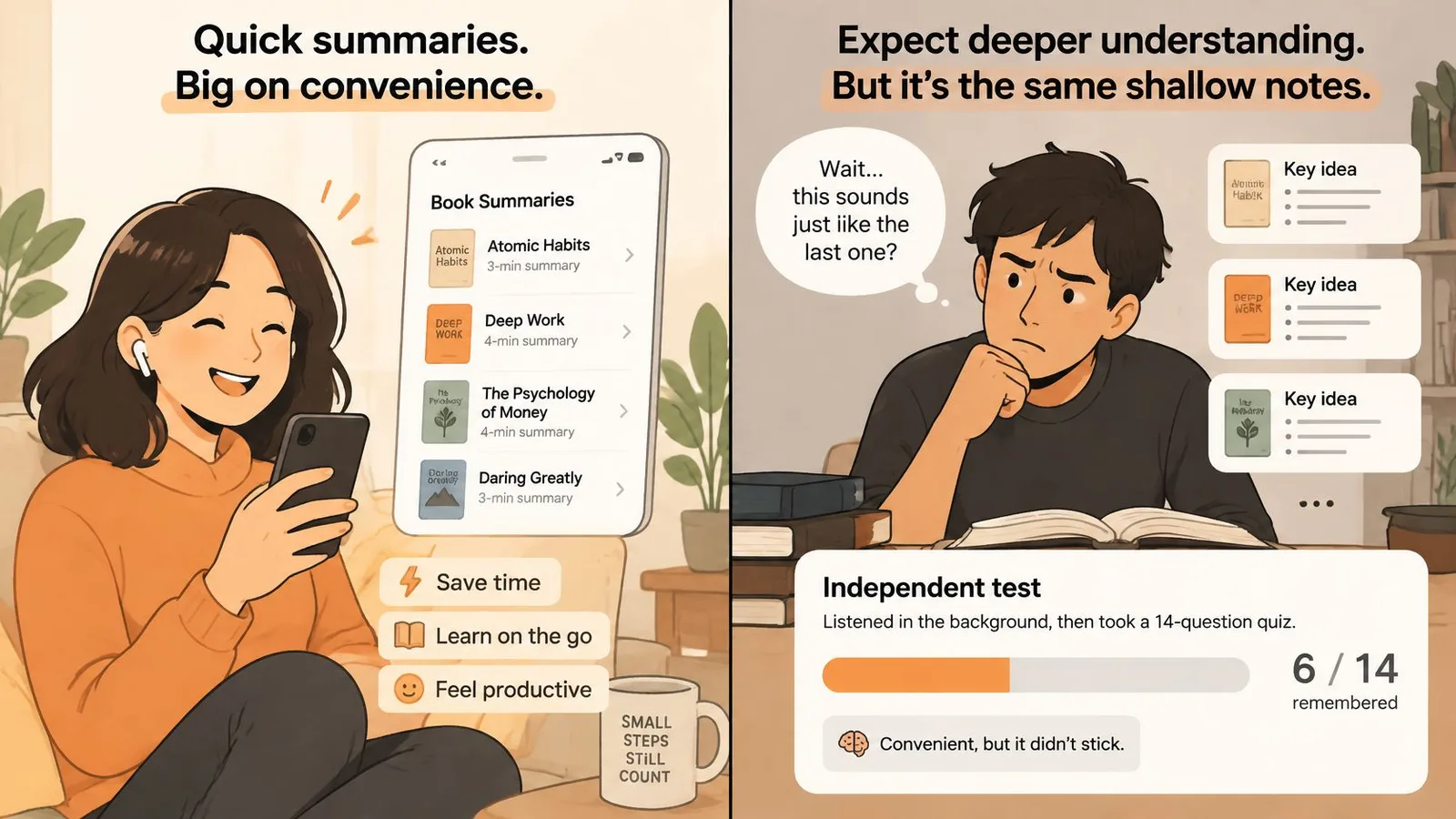
Reader feedback reveals a persistent split. People consistently praise Headway's convenience and short format, yet as the Nibble evaluation of Headway highlights, critical readers frequently call the summaries shallow, generic, or repetitive. Some note that high-level takeaways miss the most valuable arguments of the original book, and others mention occasional narration errors.
The root issue is cognitive, not cosmetic. Passive listening while commuting or folding laundry creates fluency, meaning the ideas sound familiar when you see them on a multiple-choice quiz. Real retention depends on effortful retrieval, which is why understanding how active recall works explains so much of the gap between feeling inspired during audio playback and drawing a blank two weeks later.
A Five-Book Mini-Study You Can Run Yourself
Rather than trusting any reviewer's taste, you can test whether condensed summaries work for your brain during a single trial week:
- Pick five titles across different fields: Choose one book each from psychology, business, science, history, and fiction or narrative nonfiction, ideally including at least one book you've already read cover to cover.
- Compare each summary against the source: Look for factual accuracy, omitted caveats, and whether the summary attributes claims to specific studies or flattens them into blanket advice.
- Wait seven days without rereading: Put the app away for a week, then try to explain each book's thesis and supporting evidence out loud to a friend or in a blank document.
- Flag subjects that break under compression: Notice where a short script works (say, a straightforward productivity framework) and where stripping context makes the advice misleading (such as medical research, history, or complex statistics).
Most readers who run this test land on a balanced conclusion. Headway shines as a discovery and prioritization tool that helps you sort which authors deserve your attention. It works poorly as a replacement for primary reading whenever you need competing viewpoints, methodology, or step-by-step execution. Separating a burst of motivation from genuine knowledge gain keeps you from overpaying for summaries that evaporate by Friday.
Who Headway Fits and Who Should Look Elsewhere
No single learning app handles every reading goal well. Matching your actual daily habit to the right format prevents subscription churn far better than chasing the biggest catalog.
| Reader goal | Does Headway fit? | Better option |
|---|---|---|
| Sampling nonfiction ideas before buying books | Yes, summaries help you preview books | Headway |
| Reading a specific nonfiction book in full | No, summaries are compressed | Blinkist for particular titles, or the primary book |
| Studying evidence, caveats and procedure | No, summaries omit detail | Primary sources and full books |
| Commuting with audio for spare minutes | Yes, audio summaries fit short gaps | Headway |
| Testing your own explanations of everyday why questions | Partly, quizzes check recognition | Million Whys, which asks for a prediction first |
| Hosted group play or friend duels | Not its focus | Kahoot! for hosted parties, Trivia Crack for friend duels |
Matching Your Goal to the Right Tool
If you're a busy professional trying to rebuild a reading habit or preview nonfiction before spending money on full editions, Headway fits naturally. The same holds for commuters who want quick audio overviews during short drives or train rides.
Students, researchers, and practitioners who need primary data, caveats, and procedural accuracy shouldn't rely on summaries at all; go straight to the full book or peer-reviewed source. When you're hunting for a particular nonfiction title and want a broader catalog of book overviews, Blinkist is worth comparing alongside buying the original title.
For social learning, pick tools built for rooms and rivalries: Kahoot! handles hosted parties and classrooms cleanly, while Trivia Crack suits casual friend duels. And if your real goal is sharpening causal reasoning on everyday questions instead of passively consuming author takeaways, Million Whys approaches micro-learning from the opposite direction by asking you to commit to an explanation first.
Choose the tool that fits the job you're trying to do this month, not the app with the loudest ads or the highest download count.
Best Alternative If You Want Active Curiosity Instead of Passive Book Summaries
If book summaries fade before dinner, faster listening won't fix it. Retention improves when you commit to an answer before the reveal, which is the opposite of how a summary app works.
Million Whys, built by Igneous AI, LLC, is a reasoning-led microlearning app on iOS, Android, and the web. Each session opens with one everyday why-question and three plausible choices. You make a prediction first, then get explanations for every answer choice, covering why the right answer works and where each wrong option falls short. A follow-up Q&A sits on every explanation screen for the detail that still puzzles you.
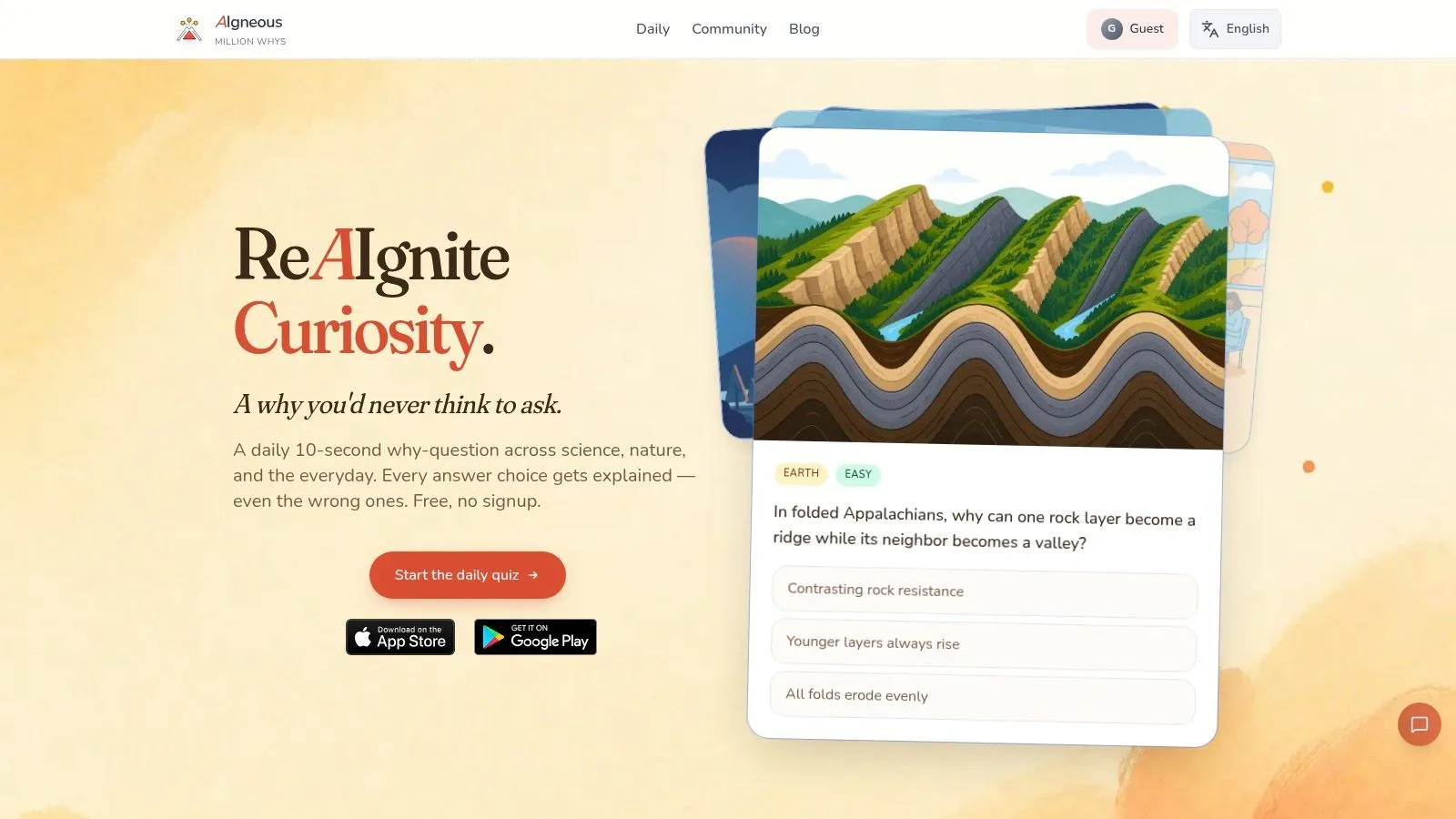
That question-first loop tests your mental models rather than your memory for quotes. Because every wrong option gets its own causal explanation, misconceptions surface immediately instead of passing unchecked. The recommended pace is 5 questions a day, roughly 2 to 3 minutes in total. Free accounts get two follow-ups per question, and Premium lifts that cap entirely.
Breadth, Creation, and Frictionless Sharing
The catalog spans science, nature, history, engineering, psychology, and everyday phenomena, and it keeps growing through AI-assisted creation and community input. Follow-up questions users ask on explanation screens become new questions for the next visitor, so the pool reflects what real readers wondered. You can browse a curated list of everyday why-questions to see how ordinary observations turn into crisp reasoning exercises.
Two features push the experience beyond a static content feed:
- Create mode: Snap a photo or type a topic that just caught your attention, and the app drafts fresh knowledge cards you can publish.
- Shareable web play: Send a Daily Wonder link to friends so they can play straight in a browser, no account required.
Watch how the question-first loop works in practice in this quick walkthrough.
Pricing Structure and Where Other Tools Still Win
Million Whys sidesteps the renewal-price question that decides whether a Headway subscription earns its keep. The core daily experience is free, and signup is optional. Creating an account saves streaks, syncs progress across devices, and puts you on the leaderboard. Premium exists for heavier daily exploration, mainly unlimited follow-ups, rather than a wall in front of basic use.
You can test the format right now with Daily Wonder on Million Whys, download Million Whys on the iOS App Store, or install Million Whys on Google Play.
One honest limit applies. Million Whys doesn't reproduce a single author's full book argument from cover to cover. When you want a published book's framework, use a summary service or read the original. If you prefer saving and annotating long-form articles and PDFs in one reading inbox, Comredix's Readwise Reader review breaks down how a dedicated read-it-later tool handles deep text workflows.
What should I do before I subscribe or switch?
The renewal price and cancellation route should carry as much weight as the summaries. Before subscribing, check both the payment commitment and whether the learning format helps you explain what you read.
- Pin down your actual goal. Decide whether you want to sample published nonfiction quickly or practise explaining everyday ideas. Those goals call for different learning habits.
- Verify the renewal price and set a reminder. Read Headway's post-intro renewal rate in your local currency. Add a calendar alert before the trial or billing cycle renews, leaving time to cancel if the ongoing price does not suit you.
- Audit one summary against a book you know. Choose a nonfiction title you have read in full. Check whether Headway preserves its reasoning and caveats, then explain the argument without looking. Familiar wording alone is a weak test of understanding.
- Record your billing channel immediately. Note whether you subscribed through Apple, Google Play, or Headway's website, and identify the cancellation route. Uninstalling the app is not a cancellation step.
- Test an active alternative for two minutes. Use the Trivia Question of the Day to compare predicting an answer with listening to a summary. Million Whys' core daily experience is free; signing up saves progress across devices. The guide to apps that make you smarter offers other formats to compare.
Choose Headway if quick nonfiction sampling justifies the renewal price and you understand how to cancel. Choose Million Whys if everyday why-questions and explanations for every option better match your goal.
If summaries leave you recognising ideas without explaining them, try the question-first format at Million Whys. Judge the result by what you can explain afterward, rather than whether the material feels familiar.
Curious? Try one 👇
Why is the sky blue?
Jump into the daily quiz →Keep Exploring
Related Posts
Headway Alternatives: Better Apps for Curious Readers
Headway alternatives for curious readers: compare Blinkist, Shortform, Deepstash, Imprint, Kinnu, and Million Whys by unit, price model, and limits.
Shortform Alternatives for Curious Readers
Shortform alternatives compared for curious readers: Blinkist, Headway, Deepstash, Libby, Anki, and MillionWhys, with current prices, limits, and best fits.
Deepstash Alternatives in 2026: Free Apps & Top Picks
Compare free and paid Deepstash alternatives in 2026: Million Whys (active why-questions, free daily Energy), Kinnu, Blinkist, Imprint, Headway & Readwise.