7 Apps That Make You Smarter in 2026: Daily Learning Picks
On this page· 18
Active prediction beats passive scrolling, and the evidence is strong. In an Adesope et al. meta-analysis of 272 independent effects across 118 experiments, practice testing beat non-testing learning conditions with a weighted mean effect size of g = 0.61, lifting scores on authentic academic exams as well as lab tests. That is why passive review fails so often when people read facts and forget them before lunch.
The best apps that make you smarter do more than queue up videos or reward hollow streaks. They turn spare minutes into reasoning. You choose an answer, then see what makes it work or fail. That post-answer moment is the test of a learning app, because it reveals whether the product teaches judgment or serves another fact feed.
Million Whys is the top pick here for everyday curiosity and reasoning-led microlearning because it explains every option, including the wrong ones. It is built for daily wonder, quick quiz batches, AI-guided personalization, and a Create flow where users can draft a topic, generate questions, refine them, and publish knowledge cards. Use Brilliant for hands-on math and coding. Choose Khan Academy for free foundational study. Pick Duolingo for daily language habits, Elevate for communication drills, Blinkist for rapid book filtering, and Lumosity for puzzle-style brain workouts. Match the tool to the job. One app will not do all seven well.
1. Million Whys
Five questions a day, roughly 2 to 3 minutes in total, is the entire daily commitment Million Whys asks for. On iOS, Android, or web, each prompt is a 10-second why-question spanning science, history, nature, psychology, and everyday engineering. You commit to a prediction before the reveal, and the card then explains why each answer choice makes sense or falls short. Correct answers earn 500 to 1,000 points, scaled by speed.
Here is how a daily reasoning prompt looks inside the web experience.
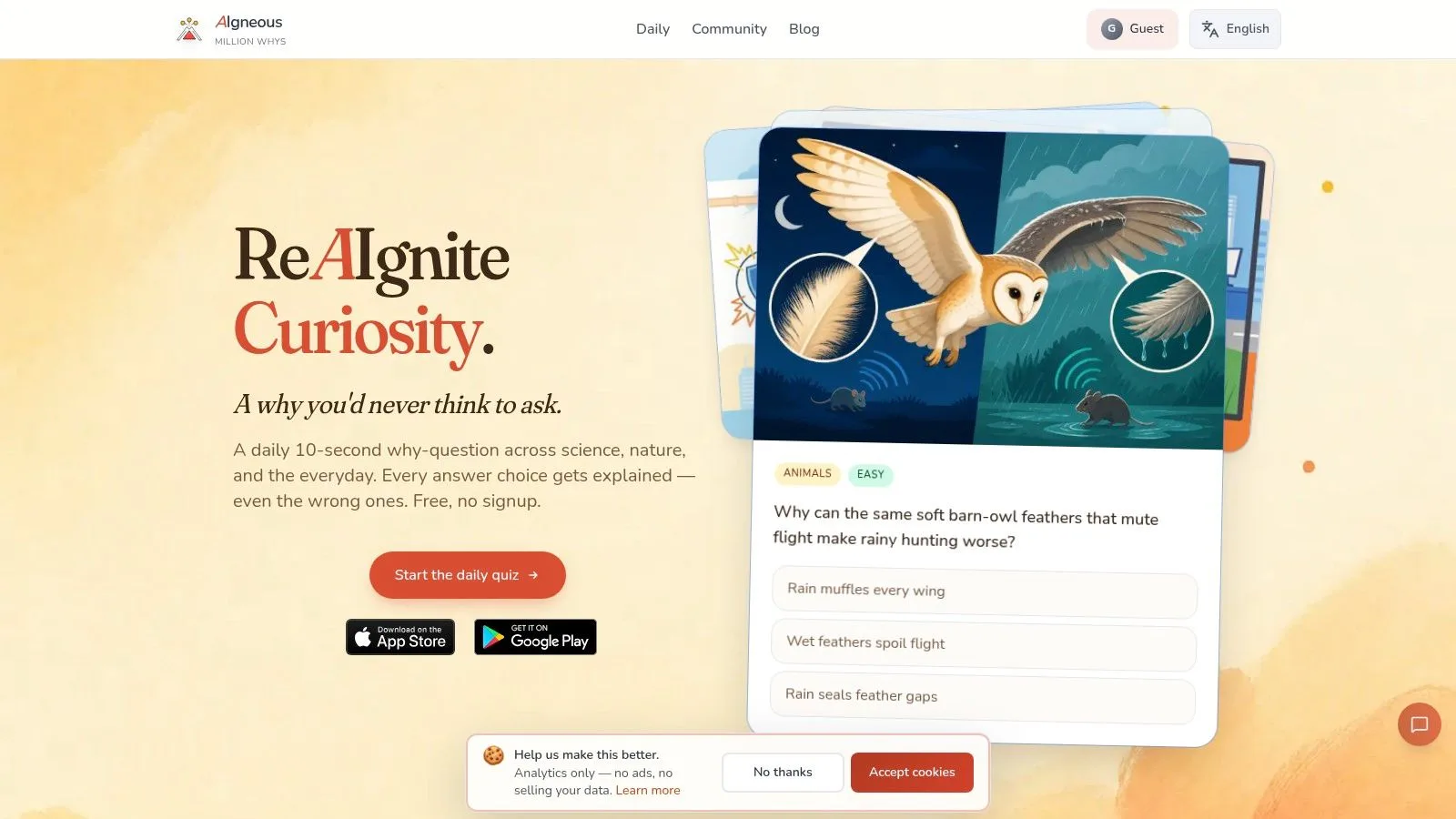
How Million Whys turns wrong answers into understanding
Most quiz apps flash red or green and rush you to the next score screen. Million Whys treats a wrong pick as diagnostic data, explaining both why the right answer holds up and why each tempting distractor falls apart. A 2025 Nature Index synthesis reports that this testing effect holds across learner ages and subject domains, scaling cleanly through low-cost digital quizzes. Better still, a meta-analytic review spanning more than 40 years of research found that retrieval practice produces transferable learning over non-testing re-exposure, with an average effect size of d = 0.40 (95% confidence interval of 0.31 to 0.50).
Every card in the catalog is fact-checked, with some questions hand-curated and some AI-assisted, and the pool keeps growing because follow-up questions asked on explanation screens become new prompts for the next visitor. Four distinct modes on web and mobile, plus user-driven creation, give you plenty of ways in:
- Built-in follow-up Q&A: When an explanation sparks another question, you can follow that thread right away instead of opening a search tab.
- Create mode from any photo or topic: Snap a picture of an unusual bridge, plant, or kitchen gadget and AIgneous, the company's AI technology brand, drafts a handful of why-questions about it from different angles. The Create tab then lets you refine the result and publish your own knowledge cards.
- Four quick ways to play: Jump into the Million Whys Daily Quiz, Trivia Question of the Day, Random Trivia Generator, or curated Trivia Quizzes With Answers, alongside the featured Daily Wonder card with its image and detailed explanation.
- The Sky and personalization: Set preferred topics in your profile to get more questions, exploration paths, and recommendations in those areas, then watch your explored territory accumulate on a visual knowledge map called the Sky. Friends can play shared quizzes or Daily Wonder prompts in a browser without an account.
Free access and where another app fits better
The core daily experience is free with no signup needed, running on a daily energy allowance rather than a trial that locks you out. Guests can play right away, but progress is not saved until you open a free account, which preserves streaks, syncs across devices, and puts you on leaderboards. Optional Premium adds unlimited energy for exploring more Whys each day, unlimited Create for generating curiosity cards without the daily cap, and a streak shield for the days you miss.
Practical rule: Use Million Whys when you want causal intuition across many fields in three minutes a day, not when you need a semester-long syllabus in calculus or conversational Spanish.
That boundary is honest and intentional. Short reasoning cards excel at surfacing misconceptions and building causal intuition across disciplines, but they do not replace a full structured course. For systematic STEM mastery, move straight to Brilliant or Khan Academy.
Curious? Try one 👇
Why is the sky blue?
Jump into the daily quiz →2. Brilliant
Suppose you want to understand probability, neural networks, or Python logic instead of nodding along to a lecture video. Brilliant is the strongest pick for active STEM problem-solving. Rather than burying you in slides, it hands you an interactive visual puzzle first, checks your move immediately, and explains the underlying principle while the problem is still fresh in your mind.
Here is the visual, interactive problem layout on Brilliant.
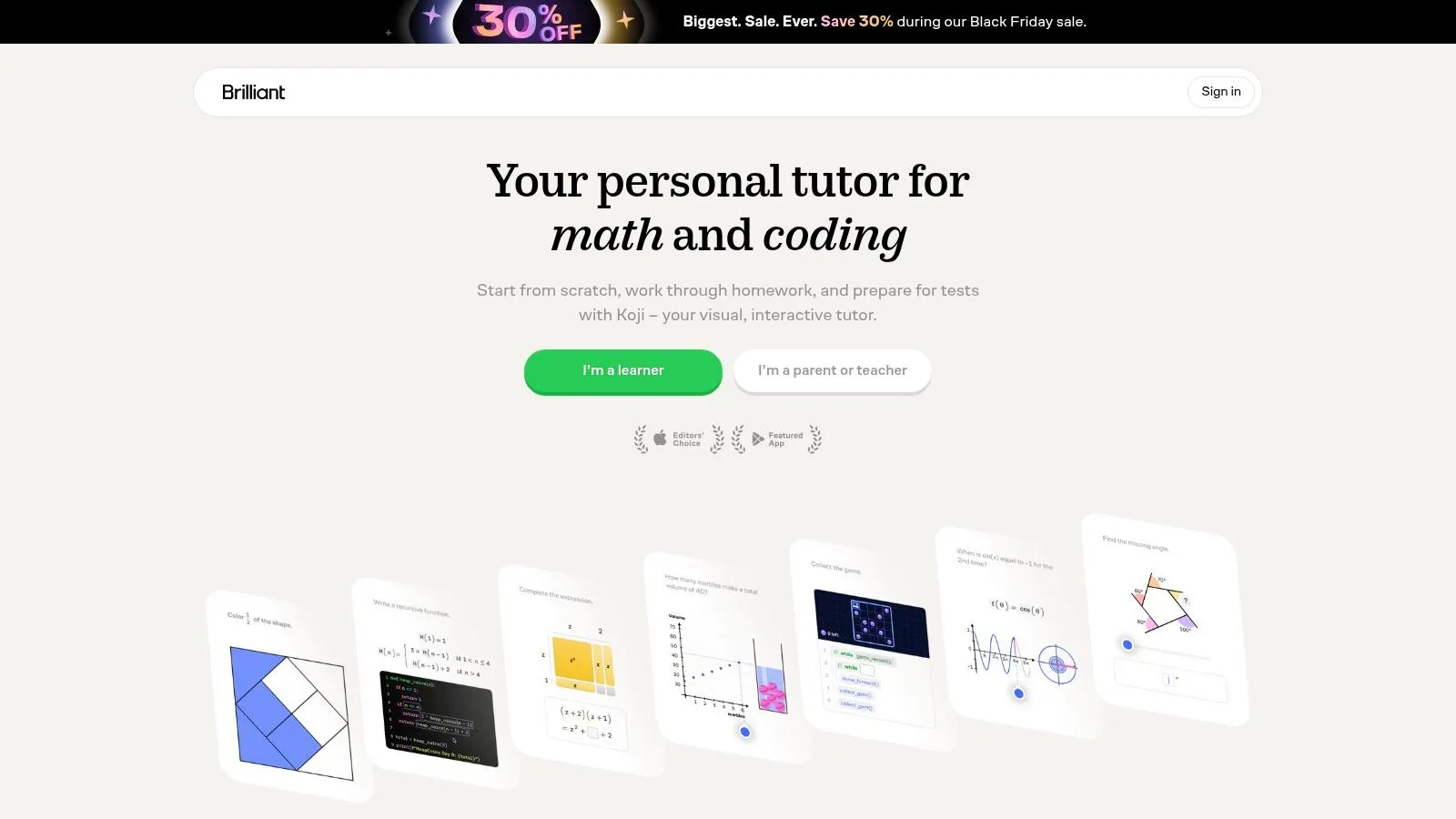
Active problem-solving and the Koji tutor
Short lessons only work when the instructional design makes your brain do the lifting. A systematic review of 40 microlearning studies found generally positive effects on processing, retention, recall, and sometimes application, while stressing that results depend on instructional design rather than brevity alone. Brilliant nails that principle by forcing hands-on manipulation at nearly every step.
Its catalog spans math, coding, science, data, technology, logic, and AI across web, iOS, and Android with synced progress. Guided Learning Paths sequence foundational ideas into advanced modules, and skill checks steer you toward personalized practice. When you hit a wall, the built-in Koji tutor nudges you through the logic step by step instead of dumping a raw formula on your screen.
- Strongest post-answer feedback in STEM: Visual diagrams update in response to your choice, making it obvious why an equation or algorithm behaves the way it does.
- Tight free-tier cap: Free access is limited to two lessons or practice sets per day, and you must progress sequentially through a topic rather than skipping ahead.
- Online-only sessions: Lessons require an active internet connection, so offline flights or subway commutes won't work.
Brilliant is narrow by design. If you want broad general knowledge in history, psychology, or biology, you'll outgrow its STEM-heavy catalog quickly. Readers who want a lighter or broader mix should check our guide to Brilliant app alternatives before paying for Premium to gain unlimited lessons and full Koji access.
3. Khan Academy
Commercial learning platforms are booming, with a 2025 Research and Markets forecast projecting the global education app market could reach $95.5 billion by 2031 at a 16.4% compound annual growth rate. Sitting right beside those paid subscriptions is Khan Academy, whose core learning library remains completely free and ad-free across web, iOS, and Android.
Pick Khan Academy when you have a real gap in a core subject and want to rebuild it from the ground up. Its courses span math, science, economics, history, and grammar, pairing concise instructional videos and written articles with graded exercises, quizzes, and unit tests. When you miss a problem, you get instant feedback plus step-by-step hints that walk through the method until the logic clicks.
Mastery paths that reward patience
Unlike curiosity feeds built for two-minute coffee breaks, Khan Academy works like a patient private tutor following a structured syllabus. You practice a skill until you prove mastery, then move to the next concept. That design shines for students reviewing exam material and adults finally conquering algebra, statistics, or macroeconomics.
Filling a missing foundation does more for everyday reasoning than memorizing a hundred disconnected trivia facts.
- Zero paywall on core study: Videos, articles, quizzes, and full subject courses cost nothing and run without distracting ads.
- Clear feedback on multi-step work: Step-by-step hints show where your reasoning broke down rather than marking an answer wrong.
- School-like pacing and sheer volume: The structured curriculum feels formal compared with quick discovery apps, and the huge catalog can make picking a starting point tricky.
- Occasional mobile friction: Some Google Play users report account and login hiccups on Android devices.
Skip Khan Academy if you only have three minutes while waiting for a train and want open-ended wonder. Use it when you're ready to commit 15 to 30 minutes to mastering one subject cleanly from the basics.
4. Duolingo
Million Whys's own founder once kept a 750-day Duolingo streak alive with the help of streak freezes, which tells you two honest things about Duolingo. First, few apps that make you smarter rival its power to build a daily habit. Second, a glowing streak counter doesn't automatically equal fluency or broad understanding.
Here is the familiar course-first interface that brings millions of learners back every day.
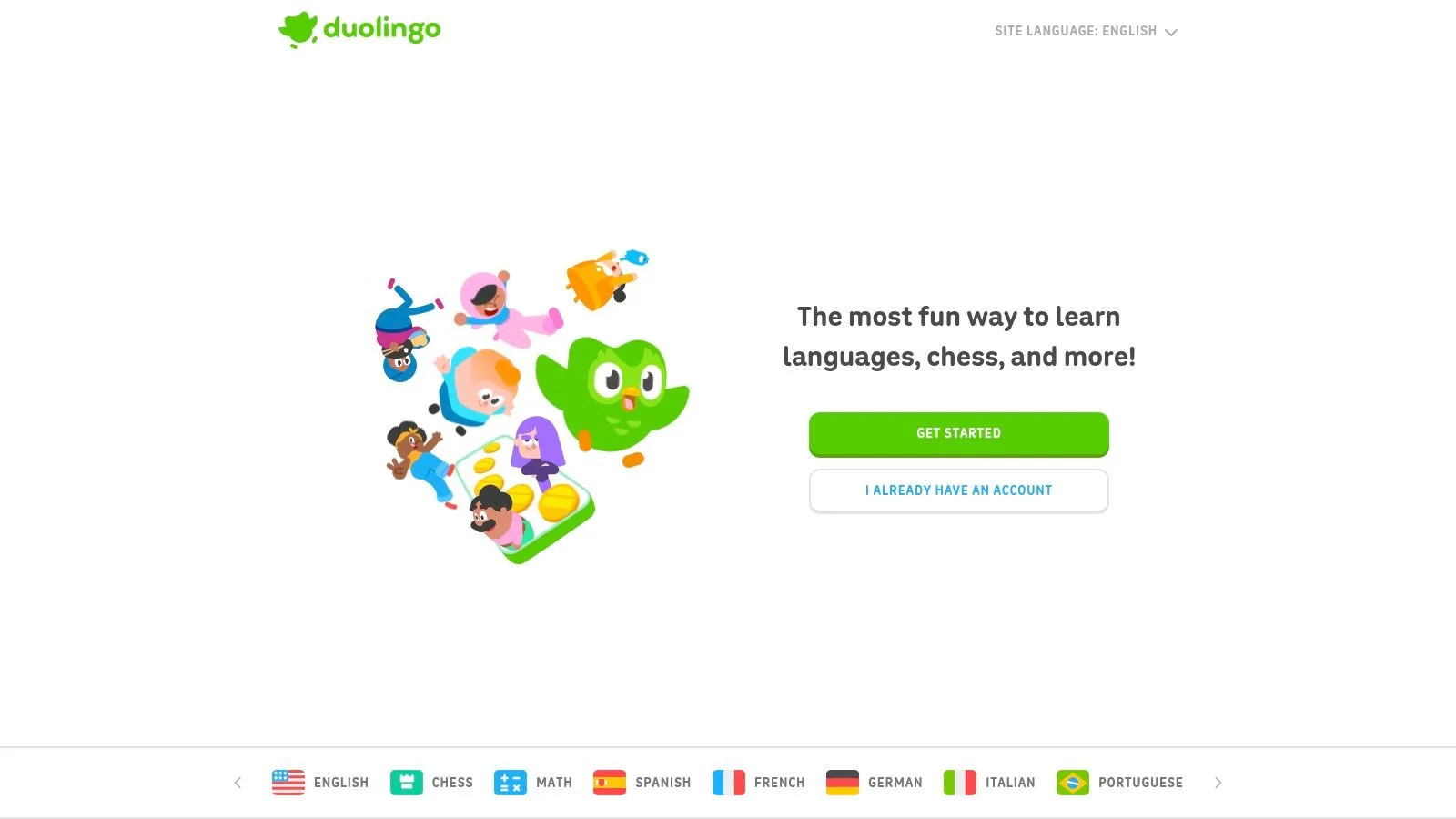
Choose Duolingo if your primary goal is starting a new language and showing up every single day without friction. Its short lessons mix translation, speaking, and multiple-choice drills along guided course paths, and the app has expanded beyond languages to include math, music, and chess. A 2024 Springer literature review on microlearning and bite-sized delivery reports that repeated exposure to small content units may improve engagement and retention because short chunks keep working-memory demands manageable.
Great for habit formation, thin on open-ended curiosity
Duolingo handles repetition well, resurfacing vocabulary and grammar patterns you missed earlier in your path. Where it falls short is explanation depth after an error. You often see the corrected phrase without a thorough breakdown of why the alternative phrasing fails in real speech, and short exercises never replace live conversation with a human speaker.
- Low barrier to daily consistency: Bite-sized rounds, reminders, and streaks make five-minute language practice easy to maintain.
- Generous free catalog with ads: Many language courses, along with math, music, and chess, are usable for free if you don't mind ad breaks.
- Course-locked scope: You follow a set path rather than chasing cross-disciplinary curiosity or everyday why-questions.
If you love Duolingo's short rhythm but want deeper grammar explanations, conversation practice, or broader general knowledge, explore our roundup of Duolingo alternatives to pair alongside it.
5. Elevate
When your goal is sharper workplace communication and quicker mental math rather than academic courses, Elevate is the right fit. In a global mobile-learning app market valued at $44.8 billion in 2024 by Growth Market Reports, the app stands out by focusing on applied skills you use in emails, reports, and meetings: reading, writing, speaking, memory, and math.
Here is a look at Elevate's daily workout layout.
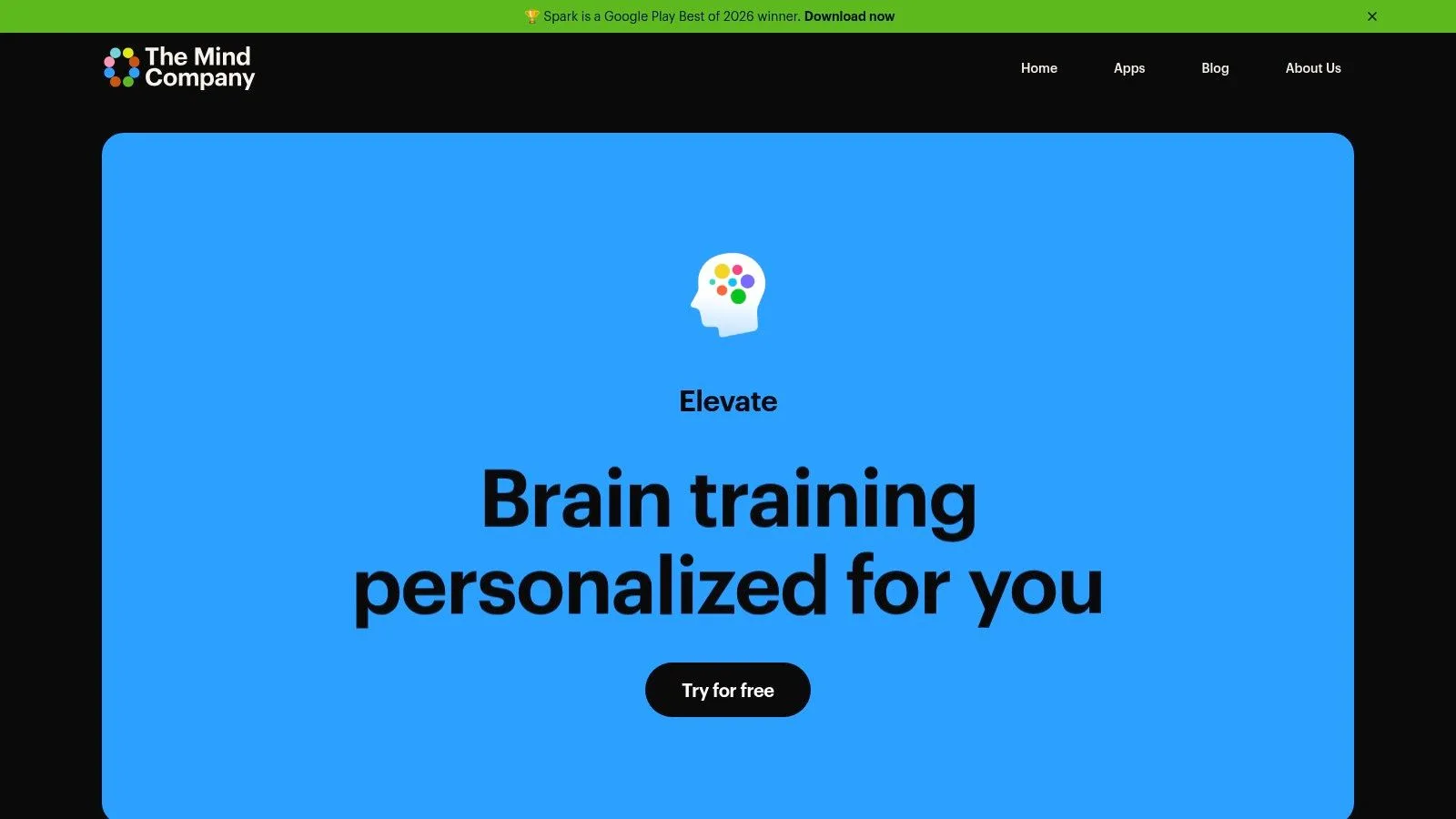
Practical communication drills versus broad knowledge
The app houses more than 40 games organized into quick daily workouts, standalone puzzles, and personalized performance tracking. A single round might ask you to trim wordy sentences under time pressure, spot syntax errors, estimate percentages quickly, or recall key details from a short passage. Those micro-drills give immediate right-or-wrong feedback and show concise corrections so you can tighten sloppy writing or rusty arithmetic in five minutes.
- Useful everyday focus: Exercises mirror real tasks like editing prose, expanding vocabulary, and calculating tips or budgets in your head.
- Free daily workout included: The free plan gives you a daily three-game workout, while paid tiers add expanded game access and extra practice.
- Skill drills, not a curriculum: This app polishes specific communication and numeracy habits rather than teaching science, history, or deep conceptual models.
- Subscription scrutiny: Some App Store reviewers question the paid plan's price relative to what sits behind the paywall.
Keep expectations grounded: Elevate sharpens how cleanly you read, edit, and estimate, yet it won't broaden your grasp of how the world works outside those core drills.
Pair Elevate with a curiosity or subject-based app if you want both crisper verbal execution and richer ideas to talk about.
6. Blinkist
Pick Blinkist when your real problem is an overflowing nonfiction reading list. Rather than testing your recall, Blinkist condenses more than 9,000 book and podcast summaries (according to Blinkist) into text and audio "Blinks" designed to take about 15 minutes. It's a strong filter for commuters and busy readers who want to sample an author's main thesis before spending ten hours on the full book.
Here is how Blinkist organizes its nonfiction summary library.
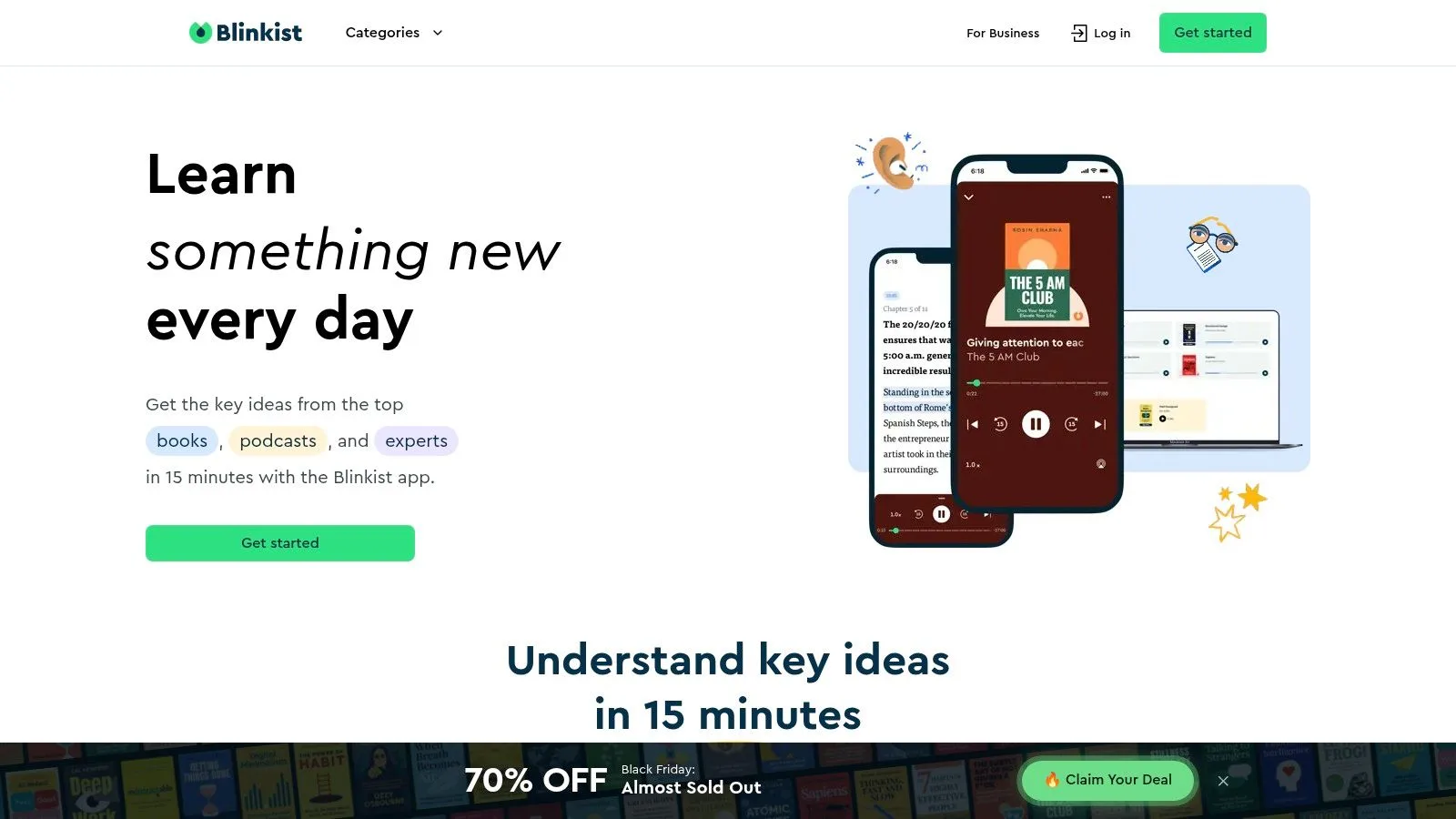
Fast book sampling and where recall drops off
Blinkist excels at convenience and breadth. You can test the format with a free daily summary, browse daily picks and personalized recommendations, upgrade to Premium for offline listening, or choose Pro for an AI assistant that summarizes other content. For surveying five books on behavioral economics or negotiation in a single week, nothing beats that speed.
The trade-off shows up five minutes after you finish listening. Summaries strip away the counterarguments, nuance, and worked evidence that make complex nonfiction memorable, and Blinkist doesn't force you to predict an answer or defend an explanation. Passive audio feels productive on a morning walk, yet much of it slips away unless you actively test yourself afterward.
- Best-in-class commute format: Clean 15-minute text and audio overviews fit easily into walks, chores, or flights (with Premium offline mode).
- Weak post-lesson recall loop: Because there's no mandatory retrieval step, recognizing an author's name can masquerade as true comprehension.
- Mixed value feedback: Some Google Play reviewers describe summaries as too brief or flag the subscription cost as steep.
Use Blinkist specifically as a nonfiction triage tool, not a replacement for deep reading or active testing. If you want shorter interactive alternatives that ask you to think back, check our comparison of Blinkist alternatives.
7. Lumosity
Choose Lumosity for structured, puzzle-like practice during a break. It offers a polished catalog of games, with adaptive daily workouts across memory, attention, speed, flexibility, reasoning, language, and math. Scores trend by category over time, which makes the app satisfying if you enjoy tracking improvement. Treat those rising scores as evidence of practice in the app, not proof of broader intelligence.
Here is Lumosity's game-driven training interface.
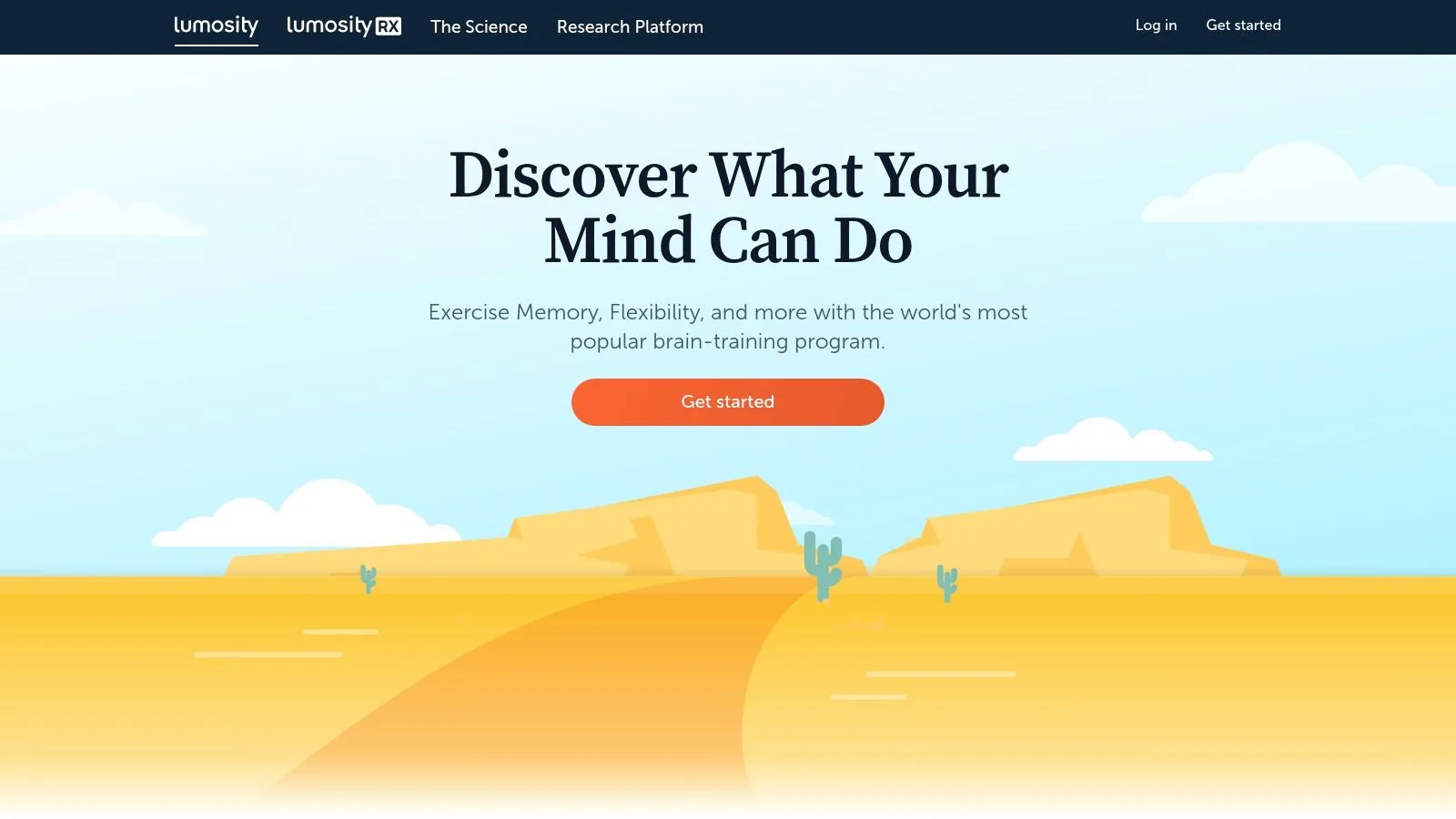
Separating near transfer from everyday intelligence
Brain-training coverage often treats higher in-app scores as proof of broader smarts. Cognitive science draws a sharper line between near transfer, meaning improvement at the practiced game, and far transfer, meaning stronger reasoning or decision-making in daily life. A 2025 Springer study on computerized brain training found that participants improved on the tasks they directly practiced, yet showed no comparable improvement on untrained cognitive outcomes relative to an active-control group.
Watch the transfer gap: Climbing a leaderboard inside a speed-matching game means you mastered that game, not that your everyday memory or analytical judgment jumped by the same margin.
The practical verdict is simple. Use Lumosity when you want quick mental workouts that feel like crosswords or Sudoku and fit into a short break. Its fast format, adaptive difficulty, and category tracking give you a clear habit loop. The weakness is what happens after the answer. Lumosity drills abstract patterns rather than teaching history, science, language, or real-world reasoning, and it does not make you explain why one option works while another fails.
A free tier lets you sample the format, while Premium is required for all games, longer workouts, and richer performance insights. Pick it for puzzle practice. Choose an app built around real knowledge and wrong-answer explanations if your goal is better conversations, sharper mental models, or learning ideas you can use outside the app.
How the seven apps compare on free access, session length, and best use
Match the row to your spare minutes and your goal. Free depth differs most: Million Whys and Khan Academy give away their core experience, while Elevate and Lumosity keep more behind a subscription.
| Item | Free access | Session length | Best for |
|---|---|---|---|
| Million Whys | Core daily experience is free; no signup required | 10–30 seconds per question; about 2–3 minutes for five | Quick, curiosity-led general knowledge |
| Brilliant | Free tier with up to two lessons or practice sets per day | Short interactive lessons you work through at your own pace | Interactive math, coding, and STEM learning |
| Khan Academy | Core learning content is free and ad-free | Self-paced; each study block runs as long as you need | Systematic study across a wide range of subjects |
| Duolingo | Many courses are free, with ads | Short, game-like lessons you finish at your own pace | Building a regular language-learning habit |
| Elevate | Free plan includes a daily three-game workout | Brief exercises; the daily workout combines three of them | Quick practice in communication, memory, and math |
| Blinkist | One free daily summary | About 15 minutes per summary | Quick introductions to nonfiction ideas |
| Lumosity | Free access is available, with some features behind a subscription | Short games arranged into rotating daily workouts | Puzzle-like cognitive game practice |
Start Tonight With One Why and Test Your Own Explanation
You won't run out of platforms competing for your spare minutes. TechSci Research valued the global mobile-learning market at $57.46 billion in 2024 and projects it will reach $136.50 billion by 2030. The smartest filter in that crowded field is simple: open the app, answer one prompt, and check what happens right after you commit.
Does it leave you with a green checkmark and a streak animation, or does it show you why your instinct worked and why the plausible alternatives broke down? That single design choice separates genuine apps that make you smarter from glorified scoreboards.
Pick the one tool that matches your immediate goal and run a single session tonight instead of downloading five icons you'll ignore by Friday. Choose Brilliant for hands-on STEM puzzles, Khan Academy for free foundational study, Duolingo for daily language streaks, Sharper for sharper prose and mental math, Blinkist for rapid nonfiction filtering, or Lumosity for puzzle-style workouts.
A three-minute test for everyday curiosity
For broad, cross-disciplinary curiosity and reasoning-led microlearning, start with Million Whys. The core daily experience is free with no signup needed, and Premium is optional if you later want unlimited energy, unlimited Create for publishing your own knowledge cards, or a streak shield for missed days.
- Try it in your browser right now: Jump straight into the Million Whys Trivia Question of the Day with zero account friction.
- Play on iPhone or iPad: Grab the mobile app on the Apple App Store and start as a guest in seconds.
- Play on Android: Install the app on Google Play to save preferred topics, explore the Sky knowledge graph, and turn a photo into a set of why-questions.
Here is your habit for tonight: answer five questions, pause on each explanation screen to tell yourself in one sentence why every wrong option falls short, and close the app after about three minutes. Each session asks for a prediction before the reveal, then walks through all the choices, so the loop trains reasoning rather than guesswork. Repeat it for a week and your everyday questions get noticeably sharper.
Ready to trade three minutes of mindless scrolling for sharper everyday reasoning? Million Whys delivers bite-sized why-questions across science, history, nature, and daily life, with clear explanations for every right and wrong choice and follow-ups you can ask on any explanation screen. Start exploring for free today at Million Whys.
Curious? Try one 👇
Why is the sky blue?
Jump into the daily quiz →Keep Exploring

Related Posts
App to Learn New Things: Curiosity, Not Cramming
Looking for an app to learn new things? Compare Million Whys, Brilliant, Khan, Blinkist, and Duolingo by learning moment, not hype.
Best App to Learn Something New Every Day
Best app to learn something new every day, compared by daily habit fit: Million Whys, Imprint, Kinnu, Blinkist, DailyArt, Brilliant, and why each works.
Best Knowledge Apps 2026: Curious Picks
Best knowledge apps 2026 compared for curious adults: Million Whys, Kinnu, Imprint, Blinkist, Brilliant, Khan, Nerdish, Deepstash, with current prices.