
Apps Like Quizlet But Free: Which Fit Wins
If you are searching for apps like Quizlet but free, the first useful answer is a sorting question: do you want a free flashcard machine, a serious spaced-repetition system, or a tiny daily curiosity loop that does not feel like homework? The best fit depends on whether you are memorizing a deck, understanding a concept, or keeping your mind fed in the odd 30 seconds between everything else.
TL;DR
If you need a close free Quizlet replacement, start with Knowt for free Learn-style flashcard practice or Anki if you want powerful spaced repetition and do not mind setup. If you want the feeling of "I learned something" without building decks at all, MillionWhys is the different path: one curiosity question, one answer, one satisfying bit of closure.
The short answer: Knowt is the closest free Quizlet-like fit, Anki is the best free power tool, Brainscape is a polished flashcard system with free and paid tiers, and MillionWhys is the best fit when the real need is daily curiosity rather than flashcard grinding. The right choice depends on the shape of your information gap. Flashcards are great when you already know exactly what must be remembered. Curiosity tools are better when you do not yet know what you want to know.

Curious? Try one 👇
Why is the sky blue?
Jump into the daily quiz →Start with the real job: recall, not content collection
Quizlet's center of gravity is still flashcards: terms, definitions, matching, practice questions, and study modes. Its Flashcards feature page says users can find free flashcards across many subjects, while the Help Center explains that non-subscribers can use Learn for a limited number of rounds per flashcard set. Quizlet's subscription help describes paid plans as the route to broader advanced tools such as Learn, Test, expert solutions, study guides, and offline study.
That matters because "free Quizlet alternative" can mean two very different things. Some people want the old frictionless study loop: import a deck, get quizzed, repeat. Others want a way to keep learning without the administrative work of making cards. Those are not the same product category. One is a memory tool; the other is a curiosity surface.
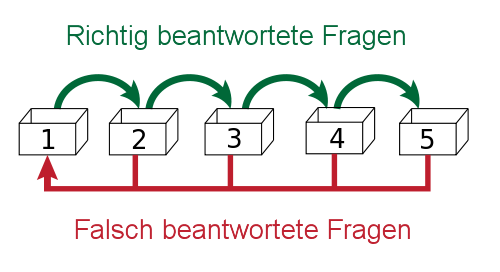
Cognitive science explains the appeal. Retrieval practice is powerful because pulling an answer from memory changes what later comes back. Roediger and Karpicke found that tests can improve long-term retention more than rereading. Cepeda and colleagues found that spaced sessions tend to support later recall better than massed study. Flashcard apps are built around those two mechanisms.
Knowt: the closest free Quizlet-style replacement
If what you miss is Quizlet-style study flow, Knowt is the most direct answer. Knowt's Learn Mode page says users can import Quizlet flashcards or make their own and study with unlimited free Learn Mode rounds. Its student account help says the free account includes unlimited flashcards and notes, plus unlimited studying with learn, test, matching, flashcard, and spaced-repetition modes, while paid plans remove ads and expand AI features.
That makes Knowt a strong fit for students who already have decks or teachers who expect term-definition review. The tradeoff is exactly the tradeoff you would expect: it is still a study-tool world. You bring the material, organize it, and measure progress against mastery. If the deck is good, the loop can be useful. If the deck is bad, no free mode can make it interesting.
Choose Knowt when your sentence starts with "I have a set I need to learn." It is less ideal when your sentence starts with "I am bored and want my phone to leave me knowing something better than it found me."

Anki: the free power tool, if you like control
Anki is the opposite of a glossy quick-start product. The Anki manual describes it as open source and cross-platform, with free clients on many platforms. The official Anki site lists free desktop versions for Windows, macOS, and Linux, free AnkiWeb synchronization, AnkiDroid for Android, and the paid official iOS app, AnkiMobile, which helps fund development.
Anki is probably the strongest free answer for people who care about long-term memory more than interface polish. It supports media, add-ons, custom card layouts, huge decks, and modern scheduling options. It also asks more of you: decks, cards, review settings, and the discipline not to turn life into an ever-growing queue.
A flashcard app can be technically free and still expensive in attention. Anki is best when the memory target is explicit and worth the system: medical terms, vocabulary, certification details, formulas. It is not the best tool for casual curiosity.

Brainscape: polished flashcards with a paid upgrade path
Brainscape is another flashcard-centered option. Its public site emphasizes flexible web and mobile flashcard editing, imports, AI-powered card creation, and mobile study. Its pricing page lists a Free tier plus Pro upgrade options, including monthly, longer-term, and lifetime purchase paths at the time checked. So it belongs in the comparison, but it is not the cleanest answer to "free like Quizlet" if the goal is no-paywall long-term use.
The useful part of Brainscape is that it makes flashcards feel guided and polished. If you already believe in cards and want a more structured interface than Anki, it may be worth testing. If the pain is "I do not want another memorization dashboard," a prettier dashboard will not fix the mismatch.

MillionWhys: not a flashcard clone, and that is the point
MillionWhys should not pretend to be a free Quizlet clone. It is not for importing decks or drilling vocabulary. Its job is smaller and stranger: answer one question in about 10 seconds, close one information gap, and let that closure reveal the next thing you might wonder about.
That is the AIgneous view of learning. Learning input is natively fragmented. In real life, understanding rarely arrives as a syllabus. It arrives as one question: why does coffee make me jittery, why do rainbows curve, why do penguins huddle, why does a song get stuck in my head? Structure comes later. AI is useful because it can turn these fragments into reliable, fact-checked answers without forcing the learner to become a course designer first.
Curiosity research points in the same direction. Loewenstein's information-gap theory frames curiosity as the felt gap between what you know and what you want to know. Curiosity is strongest when the gap is visible but not hopeless: half-knowing, not total blankness. A good MillionWhys card is built for that moment. You guess, you commit, you get the answer, and the explanation gives real closure rather than another infinite scroll itch.

Comparison table: which free Quizlet alternative fits?
| App | Best free fit | Session shape | Curriculum source | Watch-out |
|---|---|---|---|---|
| Knowt | Closest Quizlet-style Learn alternative | Deck review, Learn, test, matching, spaced repetition | Your notes, imported decks, student materials | Still mainly a study/deck workflow |
| Anki | Power users who want serious spaced repetition | Daily review queue | Your decks and shared decks | Setup and maintenance can feel heavy |
| Brainscape | Polished flashcard creation and mobile review | Flashcard study with guided confidence ratings | Your cards, imports, certified content | Free tier may not cover every long-term need |
| MillionWhys | Curious adults who want to learn without making decks | One 10-second question plus explanation | Community curiosity plus fact-checked AI generation | Not for exam cramming or memorizing a fixed list |

What people usually miss
The hidden question is not "Which app is free?" It is "What kind of knowledge am I trying to grow?" Flashcards are excellent when the target is stable and enumerable: anatomy terms, verbs, court cases, chemical symbols. In that world, Knowt and Anki make sense.
But a lot of adult learning starts as a tiny itch: a fact you half-remember, a mechanism you never understood, a "wait, why?" that would usually vanish before you search. That is where a curiosity-first app can beat a flashcard app without matching features. The value is noticing gaps, closing them, and letting knowledge compound from small questions.

Related videos
How to Use Spaced Repetition in 3 Minutes is a concise primer on the memory mechanism behind flashcard apps.
Knowt.io - Study Flashcards (Quizlet Alternative) gives a quick look at a close Quizlet-style alternative workflow.
FAQ
What is the best free app like Quizlet?
For the closest free Quizlet-style experience, Knowt is the first app to test because it supports free Learn-style study, tests, matching, flashcards, and spaced repetition. For maximum control, Anki is stronger but less beginner-friendly.
Is Anki better than Quizlet?
Anki is better for long-term spaced repetition and custom decks. Quizlet is usually easier for quick set creation, browsing, and classroom-style flashcard practice. The better choice depends on whether you value control or convenience.
Are free Quizlet alternatives actually free?
Some are free for core use, but most have limits, ads, paid AI features, paid mobile apps, or optional Pro tiers. Always check the current pricing page before moving a big study workflow.
Should I use flashcards for everything I want to learn?
No. Flashcards work best for facts you need to retrieve later. They are weaker for open curiosity, conceptual wandering, and questions where you do not yet know the shape of the subject.
What does this have to do with AIgneous Million Whys?
MillionWhys is the curiosity-first alternative when your goal is not to cram a deck but to keep learning from tiny questions. It turns idle moments into answered information gaps, so knowledge can compound without a fixed syllabus.
Sources
Quizlet Help Center: Studying on Quizlet
Quizlet Help Center: Quizlet subscriptions
Curious? Try one 👇
Why is the sky blue?
Jump into the daily quiz →Keep Exploring

Related Posts
Free Flashcard App: What It Can and Can't Teach
Looking for a free flashcard app? Compare Anki, Knowt, Brainscape, and MillionWhys for memory, spaced repetition, and curiosity-first learning.
Quizlet Free Alternatives for Curious Learners
Quizlet free alternatives for curious learners: compare Anki, Knowt, RemNote, Brainscape, and MillionWhys without turning wonder into exam cramming today.
Apps Like Quizlet for Curious Learners
Apps like Quizlet can help with flashcards, but curious adults may need question-first learning: compare Quizlet, Anki, Brainscape, Brilliant, and MillionWhys.