Types of Behaviors: Innate, Learned and Adaptive
On this page· 25
You sit down to study, open a question, and reach for your phone before you've finished reading it. A moment later, you put the phone away, guess an answer, and ask someone to explain what you missed. Is that automatic behavior, voluntary behavior, cognitive behavior, or social behavior?
It can be all of them. Understanding types of behaviors becomes much easier when you stop looking for a single label and start asking what you want to change, teach, or measure.
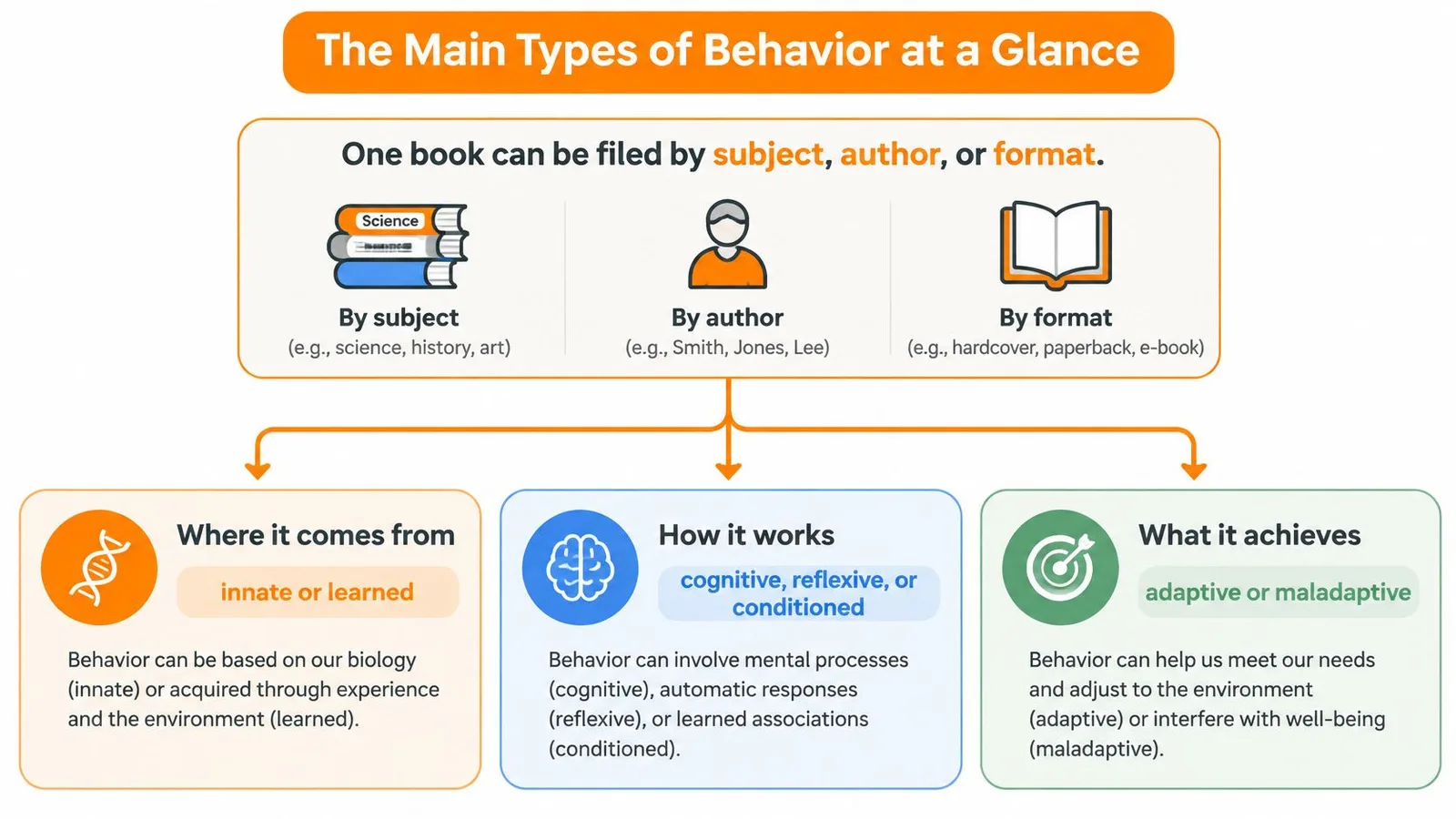
The Main Types of Behavior at a Glance
A library can organize a book by subject, author, or format. None of those descriptions cancels the others: a history book can also be an audiobook written by a particular author. Behavior works the same way.
A student raising a hand might be showing a learned classroom routine, a deliberate choice, and a helpful way of sharing discussion time. Calling it voluntary doesn't make learned or prosocial incorrect. Each description answers a different question.
Start with the question
Most everyday actions can be examined through these broad questions:
- Origin: Did the behavior appear without teaching, or was it acquired through experience?
- Mechanism and control: Is the response triggered by a learned association, carried out automatically, or deliberately chosen?
- Function and effects: How does it influence decisions, other people, goals, and wellbeing?
These questions aren't perfectly separate. A learned skill can become automatic, and a deliberate action can still be shaped by its consequences.
Behavior types at a glance
| Behavior type | Defining question | Typical example |
|---|---|---|
| Innate | Was it built in before experience? | Newborn rooting reflex |
| Learned | Was it acquired through experience? | Reading, riding a bike |
| Conditioned | Is it a response linked to a signal? | Tensing up when a red marker appears |
| Voluntary | Is it a deliberate, chosen action? | Choosing to start revision early |
| Social | How does it affect other people? | Sharing materials, interrupting peers |
| Cognitive | How does the mind judge and decide? | Overconfidence on a guessed answer |
| Adaptive | Does it help meet goals in its context? | Asking for help when stuck |
| Maladaptive | Does it keep harming goals over time? | Avoiding exams to escape anxiety |
The teaching value lies in what each label lets you investigate. Origin helps you decide whether instruction is appropriate. Mechanism helps you choose between changing a cue, providing practice, or supporting planning. Effects help you decide whether an action is useful, harmful, or unfamiliar.
Consider a learner who closes a difficult worksheet. You can observe the movement directly, but you can't see its purpose from the movement alone. The learner might be following an instruction, avoiding embarrassment, or deciding to request a more accessible version.
Practical rule: Describe what happened before deciding what it means.
Start with an observable description, such as closing the worksheet before attempting a problem. Then select the question you need answered. You can examine that action through origin and function without assuming that either description explains the whole person.
The assessment decision follows the question, not the label. Counting completed problems won't tell you whether a learner understands them, just as observing silence won't tell you whether someone is paying attention.
Innate Versus Learned Behavior
A baby turns toward a touch near the cheek and begins searching with their mouth. An adult reads a recipe and ties an apron before cooking. The baby's rooting response doesn't require a lesson; reading and tying knots require experience.
Innate behavior develops from biological organization without explicit teaching of that response. Learned behavior is acquired or modified through experience, observation, instruction, or practice.
What arrives without instruction
A phone offers a useful, imperfect analogy. Its operating system arrives with the device, while users add apps through use and installation. Innate capacities resemble the built-in system; learned skills resemble what gets added and configured.
Rooting and reflexive grasping are clearer examples than broad behaviors such as eating or communicating. Crying can occur without instruction, but its causes aren't limited to hunger. Adults must interpret the situation rather than treating every cry as the same message.
The comparison below separates an untrained response from a skill developed through experience.
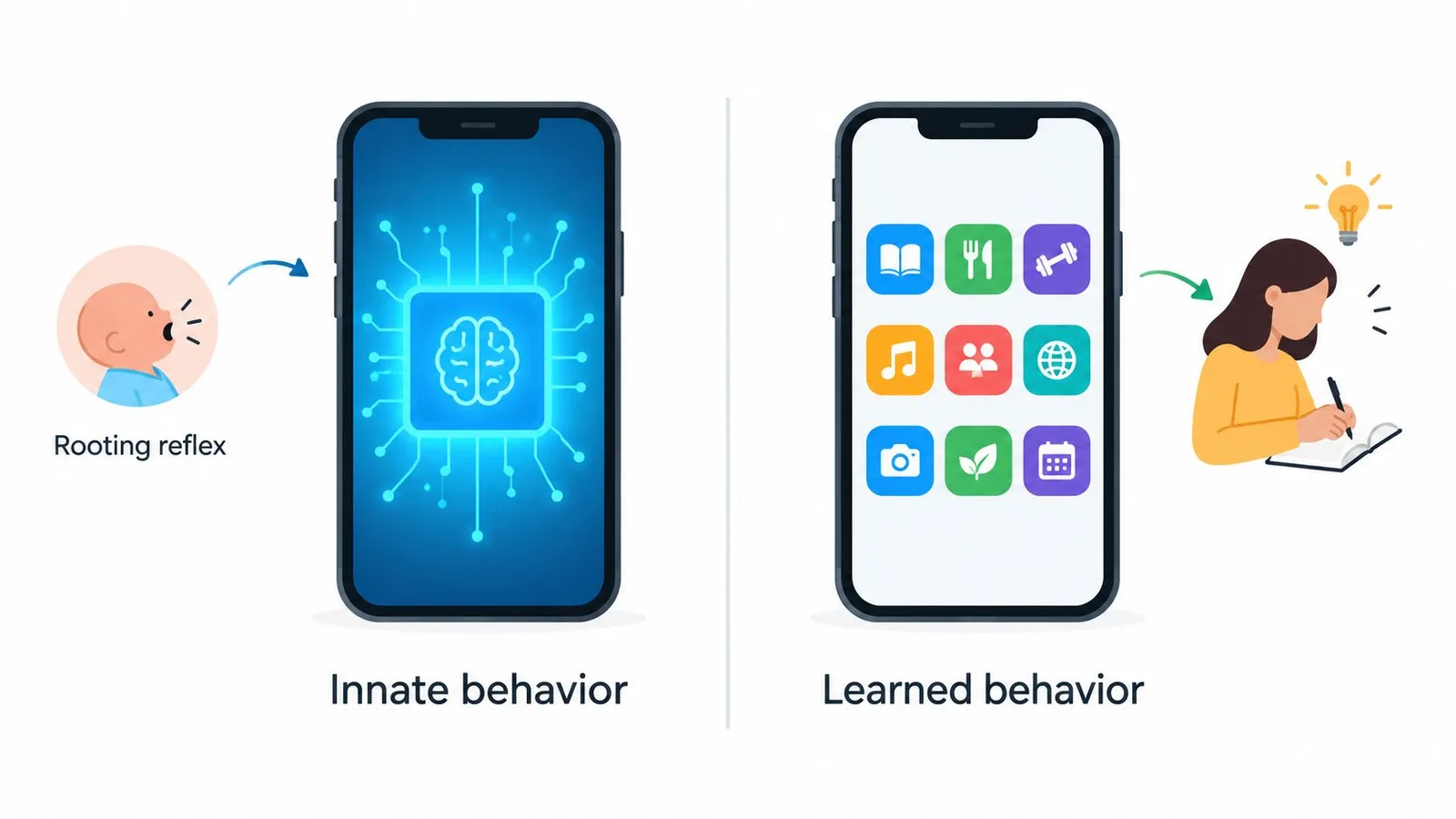
The practical distinction is whether the particular response requires learning, not whether the person has ever encountered the world. Development, physical condition, and surroundings still influence how innate responses appear.
What experience changes
Reading, tying shoelaces, using a spoon, and performing a tennis backhand involve learned coordination. Teachers can demonstrate the action, provide feedback, and adjust the difficulty.
Look for these clues rather than treating familiarity as proof:
- Instruction history: Has the learner been shown how to perform the task?
- Practice effects: Does accuracy or fluency improve with supported repetition?
- Environmental differences: Have learners had different opportunities, tools, languages, or expectations?
A behavior that feels effortless isn't necessarily innate. A fluent reader no longer consciously identifies every letter, but that ease reflects learning.
Some abilities combine biological readiness with experience. Humans have biological capacities supporting language, while the particular language, vocabulary, and conversational conventions a child acquires come through interaction. Similarly, a familiar response can raise several questions at once, as an exploration of why yawning is contagious illustrates.
Teach and assess acquired skills; don't grade an untrained reflex as an achievement. If a developmental response raises concern, the appropriate decision is a qualified developmental review, not extra practice awarded with classroom marks.
Question 1 of 4
Why does a newborn turn toward a touch on the cheek and start searching with the mouth, even before any feeding lessons?
Conditioned and Voluntary Behavior Explained
A bell starts as an ordinary sound. In a conditioning example, pairing it repeatedly with food can lead an animal to salivate at the sound alone. The important change is the learned connection between a signal and a response.
A classroom version might involve a student whose stomach tightens when a teacher picks up a red marker. If red markings have repeatedly accompanied upsetting feedback, the marker may become a warning signal. The physical reaction isn't evidence that the student has chosen to be difficult.
Signals aren't the same as choices
Conditioned behavior involves learning through associations or consequences. Signal-based conditioning helps explain responses to cues; consequence-based learning helps explain why actions become more or less likely.
Voluntary behavior involves intentional action, such as choosing to revise at the library. The learner can state a goal, consider alternatives, and change the plan. Voluntary doesn't mean uninfluenced: habits, emotions, available resources, and previous outcomes still matter.
A person can experience an involuntary surge of anxiety and deliberately ask for help. Treating the whole episode as either automatic or chosen would hide an important teaching opportunity.
Consequence types and their effect on behavior
The OpenStax chapter on reinforcement and behavioral change distinguishes reinforcement, punishment, and extinction by their effects on subsequent behavior, and describes the temporary increase in responding that can occur when reinforcement stops.
| Consequence | What happens | Everyday example | Effect on future frequency |
|---|---|---|---|
| Positive reinforcement | A desirable outcome is added | Praise after a correct answer | Behavior increases |
| Negative reinforcement | An unpleasant outcome is removed | Leaving class to end a panic feeling | Behavior increases |
| Punishment | An aversive outcome follows or a valued outcome is removed | Losing recess after disruption | Behavior decreases |
| Extinction | A previously rewarded outcome stops | Teacher stops responding to calling out | Behavior decreases over time |
These examples count as the named process only if the stated change follows. Praise that doesn't increase participation isn't demonstrated reinforcement just because the teacher intended it as a reward.
For another explanation using everyday examples, Orange Neurosciences explains operant conditioning. Use examples to identify what changes after an action, rather than sorting consequences by whether they sound pleasant.
Measure the action you want to change
Negative reinforcement is especially easy to confuse with punishment. Negative means removal, not bad, while reinforcement means the action becomes more likely. A learner who escapes distress by leaving may become increasingly likely to leave when similar distress returns.
That doesn't justify withholding support during panic. Provide safety and appropriate help, then teach a workable alternative, such as requesting a supported break and agreeing on a manageable return task.
A consequence is defined by what it changes, not by what the adult calls it.
Deliver feedback close to the target action and make the connection clear. Praise a learner's explanation if reasoning is the goal, rather than rewarding speed and hoping understanding follows.
When a previously reinforced action temporarily intensifies after its payoff stops, don't judge the intervention from that episode alone. Track comparable opportunities over time, including distress and replacement skills. Never use planned ignoring for dangerous behavior, unmet needs, or requests for essential support.
Question 2 of 4
Why does a child's tantrum sometimes become more frequent when a parent gives in to end it?
Social Behavior and How It Affects Others
A student who shares materials during art may exclude a classmate during lunch. Calling that student kind or cruel offers less guidance than examining what happened in each setting.
Social behavior concerns interactions with and effects on other people. Prosocial actions benefit others through helping, sharing, comforting, cooperating, or donating. Antisocial actions harm others through aggression, intimidation, exploitation, or deliberate disruption.
Assess actions rather than character
A 2024 cross-national study in the European Journal of Social Psychology, examining four datasets containing 176,216 people across 78 countries, found that other-focused characteristics, including compassionate traits and communal orientations, were generally associated with more prosocial and fewer antisocial outcomes.
That association isn't a permanent classification of individuals. People respond to group expectations, incentives, relationships, and perceived threats. A learner may cooperate with familiar friends yet behave defensively in an unfamiliar group.
Context also changes the effect of an apparently helpful action. Giving a classmate an answer may feel generous while preventing independent practice. Offering a hint and time to respond may support both learning and dignity.
What teachers can observe
Useful observation targets are specific enough that another adult could recognize them:
- Peer helping: Does the learner offer useful support, ask permission, and leave room for independence?
- Group conflict: What starts the disagreement, and how do participants attempt repair?
- Exclusion: Who is repeatedly denied access to materials, roles, or conversation?
- Turn-taking: Who gets opportunities to speak, and how do others respond?
Record both the action and its effect. An interruption that prevents someone from participating needs a different response from an interruption used to alert the group to danger.
Signals also need interpretation. A question such as why dogs wag their tails offers a useful reminder that noticing a social signal and understanding its meaning aren't the same task. In classrooms, a smile or quiet posture likewise doesn't establish agreement or comfort.
For assessment, create structured opportunities such as paired problem-solving with shared materials and changing roles. Observe who invites participation, who takes over, and how the partner responds.
Combine those observations with the learners' accounts, especially when harm or exclusion may be hidden from adults. The teaching decision should name a skill to develop, such as inviting a peer into the task or disagreeing without intimidation, rather than assigning a personality label.
Question 3 of 4
Why do people with strongly compassionate, community-minded personalities tend to help others more and hurt them less?
Cognitive Behavior and How Decisions Go Wrong
In a 2023 Scientific Reports study of nearly 5,000 participants from 27 countries tested on ten cognitive biases, temporal discounting appeared in 28.2% of participants, while ambiguity bias reached 70%. Those figures describe responses to particular measures, not the proportion of people who are generally irrational.
Cognitive behavior means patterned decision-making: how people think, judge, and choose. A learner can know the relevant facts yet still use a judgment pattern that produces an avoidable error.
Recognize the decision pattern
Temporal discounting involves giving less value to outcomes that arrive later. A learner might choose immediate entertainment over preparation that would make an upcoming exam easier. To isolate the timing issue, compare rewards with similar certainty rather than mixing delay with risk.
Ambiguity bias involves responding differently when probabilities are unclear. A student might prefer a familiar question format over an unfamiliar one even when they have the skills to attempt both.
Other recognizable examples include:
- Overconfidence: Feeling certain about a guessed answer without checking the reasoning.
- Anchoring: Letting an initial estimate pull a later judgment toward it.
- Halo effect: Allowing an overall favorable impression to influence a judgment about a separate quality.
For an assessment example, consider what the halo effect is before deciding that a polished presentation must contain accurate reasoning. Score the explanation against explicit criteria rather than the speaker's confidence.
Automatic and controlled responses
The automatic versus controlled distinction concerns processing, not whether a movement is a literal reflex. Automatic responses are fast and need little monitoring; controlled responses require deliberate attention.
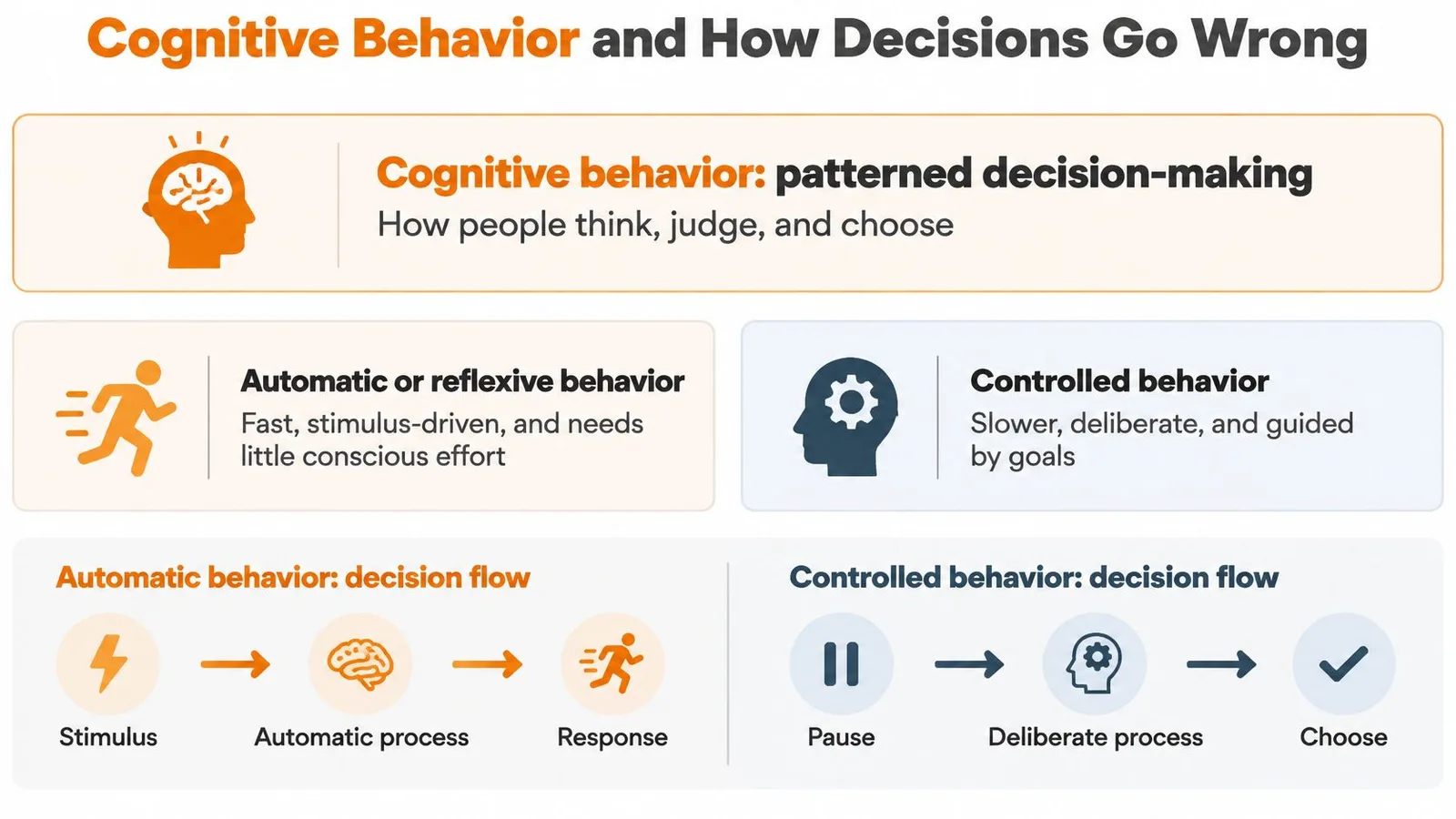
A PLOS ONE workplace safety study found that automatic associations had greater influence among employees with lower inhibitory control, while consciously reported safety attitudes were more influential among those with higher inhibitory control. The distinction helps explain why knowing a rule and applying it under pressure aren't identical achievements.
A learner may immediately select a familiar-looking answer, then notice a contradiction and revise it. The initial impulse and the correction belong to the same attempt.
Short deadlines, distraction, and competing demands leave less room for checking. Teachers can reduce those demands when the goal is to assess understanding rather than rapid retrieval.
Ask learners to explain why an alternative is wrong, compare an estimate with a worked solution, or reconsider after receiving clear feedback. If the error changes under those conditions, record that responsiveness. A repeated judgment pattern calls for targeted instruction, not a verdict of low ability.
Adaptive and Maladaptive Behavior Depend on Context
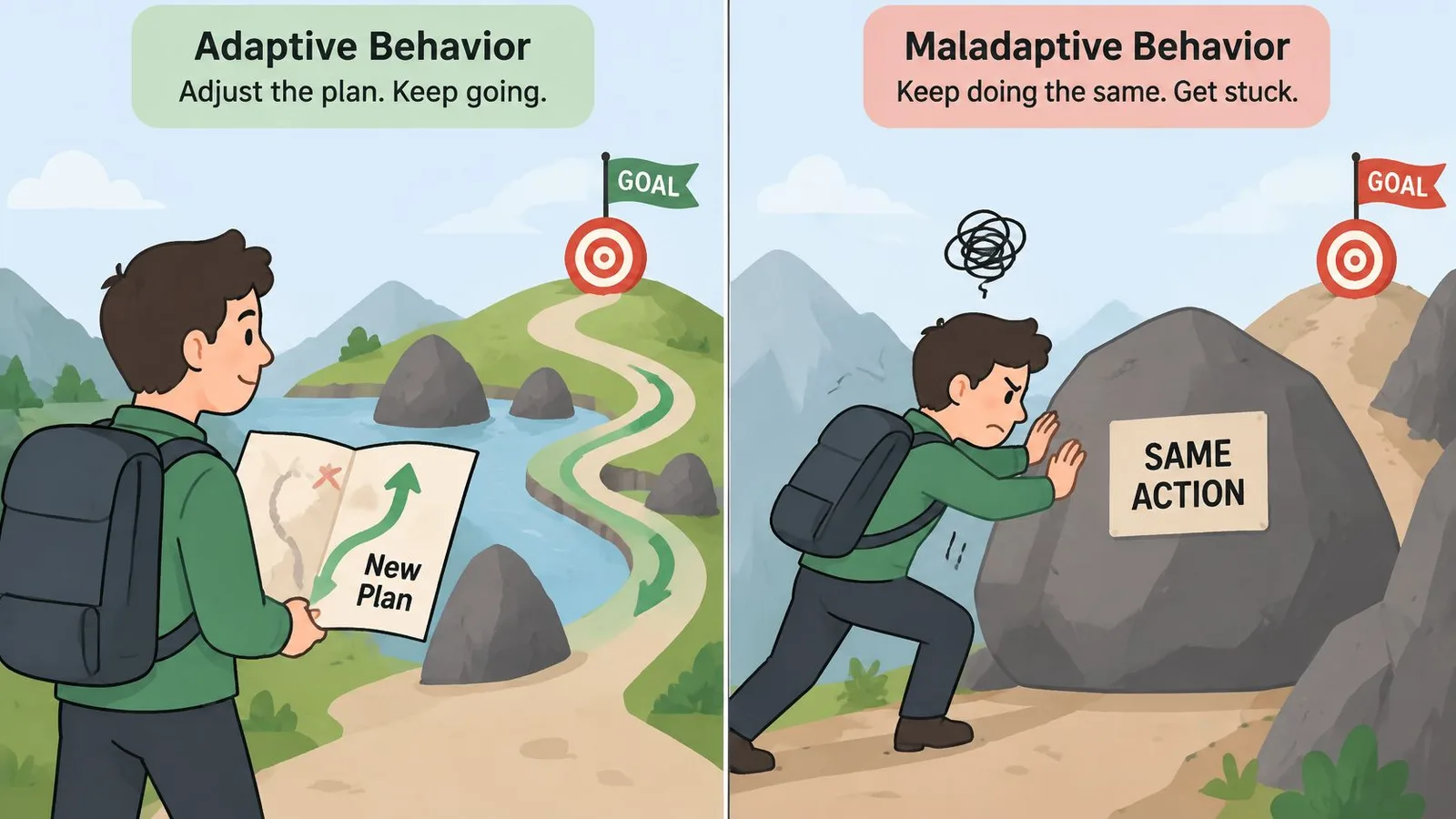
A student reaches a difficult maths problem, remembers being laughed at for a previous mistake, and skips it. The immediate result is relief. Across the term, however, the student leaves more problems untouched and has fewer opportunities to learn.
The action makes sense as short-term protection. It becomes a concern when the same response repeatedly obstructs learning and the student lacks a workable alternative.
Follow the effects beyond the moment
Adaptive behavior helps a person meet relevant goals within their circumstances. Maladaptive behavior repeatedly undermines goals or wellbeing, even if it once served a useful purpose.
The distinction is about function, not obedience. Asking for a quieter workspace may challenge a classroom routine while making participation possible.
Test the maths example with a functional checklist:
- Goal progress: Does skipping help the student develop the skill they need?
- Longer-term effects: Does the relief lead to renewed participation or increasingly broad avoidance?
- Transfer across settings: Can the learner attempt similar work privately or with supportive guidance?
- Harm: Does the pattern damage wellbeing, participation, or relationships?
- Persistence: Does avoidance continue after the original threat or payoff has disappeared?
The response should address both the task and the environment. Offer an achievable starting problem, allow private attempts, and stop peer ridicule. Teaching persistence without removing humiliation asks the learner to tolerate a preventable threat.
Acceptability isn't universal
A preregistered study of 25,422 people across 90 societies examining 150 everyday norms found substantial variation across societies, situations, and behaviors. That breadth makes it unsafe to treat familiar social expectations as universal standards.
Direct disagreement may demonstrate engaged thinking in a debate but violate expectations during a formal ceremony. Interruption may signal enthusiastic involvement in one conversation and disrespect in another.
Descriptive norms concern what people usually do. Injunctive norms concern what people believe others should do. A group can routinely interrupt while still believing that everyone ought to have an uninterrupted turn.
Unfamiliar behavior isn't automatically dysfunctional behavior.
Teachers should make local expectations explicit, explain their purpose, and consider reasonable alternatives. Assess whether a learner can achieve the relevant outcome, not whether they reproduce every convention of the assessor's background.
The deciding question is therefore broader than whether an action looks appropriate: who interprets it as acceptable, under what conditions, and why? That question helps distinguish a skill needing support from a difference needing understanding.
Question 4 of 4
What best explains why a large survey of 25,422 people across 90 societies found the same everyday behavior polite in one place and rude in another?
How Behavior Types Shape Learning and Assessment
Start assessment by writing the behavior in observable terms. Replace an impression such as unmotivated with a description such as begins the task only after an adult provides the opening step. Then decide what evidence could distinguish a skill gap from a cue-driven response, a planning difficulty, or an inaccessible task.
Assessment methods by behavior type
| Behavior type | Best assessment method | Evidence to record | Common mistake |
|---|---|---|---|
| Innate | Developmental checklist | Presence at the expected developmental stage | Treating reflexes as learned skills |
| Learned | Repeated performance task | Accuracy across repeated attempts | Judging from an isolated attempt |
| Conditioned | Observation over time | Response pattern and timing | Assuming conscious intent |
| Voluntary | Self-report plus planning log | Chosen actions and their timing | Confusing effort with ability |
| Social | Peer and structured observation | Frequency and effect of interactions | Penalizing differences in group norms |
| Cognitive | Think-aloud and bias probe | Error patterns across items | Blaming carelessness for systematic errors |
| Adaptive or maladaptive | Functional review across contexts | Effect on goals over several weeks | Labeling a single episode |
For innate responses, developmental checklists belong within appropriate professional practice. Teachers can record concerns and arrange review, but shouldn't diagnose a developmental problem from a classroom impression.
For learned skills, use comparable performance tasks and record prompts as well as accuracy. A correct answer reached independently provides different evidence from an answer produced after extensive coaching.
Match the record to the question
For conditioned responses, note what happened immediately beforehand and how quickly the response followed. This helps distinguish a cue-linked pattern from a general difficulty with the subject.
For voluntary actions, pair the learner's explanation with a planning log. Record what they intended, what they started, and what barriers intervened; a plan that wasn't completed doesn't establish lack of effort.
For social behavior, combine structured observation with peer perspectives while protecting privacy. For cognitive behavior, use think-aloud tasks alongside unprompted work, because explaining aloud can itself change how a learner approaches a problem.
A functional review of adaptive or maladaptive behavior should include:
- Conditions: Task demands, available support, group setting, and relevant stressors.
- Outcomes: Effects on participation, progress, wellbeing, and other people.
- Alternatives: Whether a taught replacement achieves the same legitimate need more effectively.
Extend the assessment to digital habits
A 2025 systematic review in JMIR Human Factors examined 240 multidisciplinary publications, including 71 studies, or 30%, explicitly aimed at changing behavior or habits through intelligent computing. Digital activity therefore deserves a more useful description than productive or excessive.
Classify use by purpose, intensity, emotional reliance, and effects on relationships. Functional use serves a task; exploratory use follows curiosity; compensatory use supplies support missing elsewhere. Habitual use happens routinely, avoidant use postpones discomfort, and relationally substitutive use displaces human contact.
A learner using an assistant to generate practice questions needs a different assessment from a learner repeatedly seeking reassurance instead of attempting answers. Record whether the interaction improves independent performance and leaves room for human support.
An observation is evidence, not a complete classification. Collect a pattern before assigning a type, and change your interpretation when the evidence changes.
Choose the Right Behavior Lens for Your Question
Use the lens that helps you make a practical decision rather than collecting labels.
- Can this be taught? Examine the learner's experience and opportunities to practice. Decide whether to provide instruction, adjust access, or request a developmental review.
- Is the behavior changing? Record what follows the action and whether it becomes more or less frequent. Allow enough observation to distinguish a lasting change from a temporary fluctuation.
- Why does the mistake repeat? Compare performance with and without time pressure, distraction, and a prompt to check reasoning. Choose support based on the condition under which the error improves.
- Is the behavior harmful? Examine its effects in contrasting settings and across an extended period. Include the learner's goals and wellbeing, not just adult convenience.
Turn the answer into an assessment
Choose a matching assessment method and name the evidence you'll collect before you begin. Keep the task, prompts, and recording method consistent enough to make comparisons meaningful.
Then make the smallest defensible decision: teach a missing skill, change a cue, clarify an expectation, or provide support. Assign a behavior label only when repeated observations justify it, and keep that label open to revision.
At Million Whys, we offer short questions with explanations that help you examine everyday decisions, learning, and behavior. Explore psychology alongside science, nature, technology, economics, history, and internet culture, plus trending topics when they matter. Set your preferred topics in your Profile to receive more questions, exploration paths, and recommendations in the areas you're curious about.