

Learning Apps Without Ads: Best Clean Picks
If you search for learning apps without ads, you are probably not being precious about banners. You are protecting a very small moment. A good learning app opens a gap, lets you make a guess, then gives you the little click of closure that makes the fact stay with you. An ad in the middle of that loop is not just visually annoying. It changes the job your brain is doing right when the interesting part should land.
TL;DR
The best learning apps without ads are not all "free" in the same way. Khan Academy is the cleanest free, nonprofit choice; Anki is the strongest open-source / one-time-payment choice; Million Whys is our own no-ad pick for 10-second curiosity; Imprint and Brilliant are polished paid products; and Kinnu is a curiosity-friendly app with free download plus certificate purchases. The useful question is not only "does it show ads?" but "what interrupts the moment when I almost understand?"
Short answer: if you want zero ad interruptions, start with Khan Academy for structured subjects, Anki for cards you control, and Million Whys for tiny curiosity questions. If you are okay with paid subscriptions instead of ads, Brilliant and Imprint are stronger when you want polished lessons. Kinnu belongs on the shortlist for broad curiosity, but its App Store listing shows in-app purchases for certificates rather than a simple subscription page, so treat its pricing as something to check before you commit.

Curious? Try one 👇
Why is the sky blue?
Jump into the daily quiz →Why ads feel worse in learning apps
Ads are tolerable in some apps because the task is loose. You can pause a recipe video, ignore a banner under a weather forecast, or wait five seconds before a game level. Learning is different because the useful moment is narrow. George Loewenstein's information-gap theory describes curiosity as the feeling created when you can sense the gap between what you know and what you want to know. The peak is not total ignorance; it is that half-knowing state where you almost have it. That is the exact moment a good question, hint, or explanation should close the loop.
So the ad question is partly cognitive. A banner may not ruin a whole course, but a pop-up, pre-roll, or forced break can steal the transition from itch to answer. Research on interruptive advertising has found measurable negative effects on user response to interrupted experiences, and research on digital interruptions more broadly keeps pointing at the same simple cost: once attention switches, the original task has to be rebuilt. For a 10-second learning loop, rebuilding the task can take longer than the lesson itself.
This is why the best ad-free learning apps are not automatically the ones with the longest catalog. They are the ones whose business model leaves the closure moment alone.
One caveat: "no ads" is not the same as "no analytics" or "no marketing." I treated store listings and official pages as the source of truth for this pass.
What "without ads" actually means
Search results flatten a few different promises into the same phrase. Before choosing, separate them:
| Meaning | What to check | Best fit |
|---|---|---|
| No ads, funded by donations or public mission | Official nonprofit or donor language | Khan Academy |
| No ads, funded by open-source work or one-time purchase | Desktop / Android / web pricing and whether iOS is paid once | Anki |
| No ads, funded by subscription | Monthly / yearly pricing and free-trial limits | Brilliant, Imprint |
| No ads in the current product experience, owned disclosure | Whether the product itself uses an ad model | Million Whys |
| Free download with purchases | Exactly what the in-app purchases unlock | Kinnu |
1. Khan Academy: best free learning app without ads
Khan Academy is the easiest recommendation when someone means, literally, "I want to learn without ads and without paying." The organization describes its mission as free education for anyone, anywhere, and its donation page says donor support keeps learning available with no ads and no paywalls. The iOS listing also marks the app as free and describes videos, exercises, articles, and practice across math, science, economics, history, grammar, and more.
2. Anki: best open-source choice if you control the material
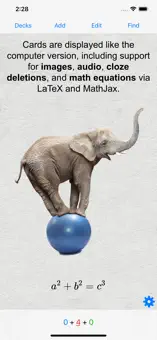
Anki is the opposite of a polished lesson app, and that is the point. The official Anki site says the computer version is free for major platforms, AnkiDroid for Android is free, and AnkiMobile on iOS is the official paid app that funds development. Apple's listing shows AnkiMobile at $24.99 in the United States and describes it as a companion to a free, multi-platform, open-source flashcard program.
3. Million Whys: best for 10-second curiosity, not a course
Disclosure: Million Whys is ours. That is why it should not be ranked by default; it has to earn the slot. Its fit here is specific: no ads, no fixed syllabus, no guilt loop, and a unit small enough to survive a coffee line. You answer one multiple-choice question, read the explanation, and leave with a closed gap. The product is built around the idea that learning input is naturally fragmented. Structure can emerge later; the first unit is a question.
That matters for people who bounce off both study tools and infinite scroll. Study tools often demand a plan before curiosity has warmed up. Social feeds are easy to open but often leave the itch unresolved. Million Whys tries to sit in the narrow space between them: the tiny pull of a question, the satisfaction of the answer, and a shared pool shaped by what people actually wonder about. The limitation is equally plain: it is not an enterprise LMS, a flashcard deck builder, or a full course catalog. If you need a unit-by-unit calculus path, use Khan or Brilliant. If you want a daily spark that compounds, Million Whys is the more natural fit.

4. Brilliant: best paid interactive STEM app
Brilliant is strongest when you want math, coding, data, science, and problem-solving lessons that make you work through the concept. Its site describes visual, interactive sessions and a tutor-like experience that asks questions instead of simply handing over answers. The App Store listing calls the app free to download with in-app purchases; the listed U.S. purchases include monthly-style prices around $19.99 to $30.00 and annual-style prices from roughly $119.99 to $191.99 depending on plan and offer.
This is not the cleanest answer for someone whose top priority is "free and no ads." Apple privacy disclosures for the app include advertising-related data categories, so privacy-sensitive readers should read the current listing and policy carefully. But if by "without ads" you mean "I would rather pay for an uninterrupted learning product than sit through ad breaks," Brilliant belongs on the list. Its limit is scope: it is mostly STEM and skill-building, not open-ended curiosity.

5. Imprint: best paid visual microlearning app
Imprint's App Store listing says it offers visual guides, quick reads, courses, daily quizzes, and chapters that can be completed in two minutes or less. It is free to download with in-app purchases; the U.S. listing includes monthly subscriptions at $15.99 and yearly subscriptions shown at $74.99 or $99.99 depending on offer.

6. Kinnu: best broad-curiosity app to check before paying
Kinnu's App Store listing describes a general knowledge app with bite-sized, expert-edited content, broad domains, adaptive questions, audio, and a "Knowledge Bank." The listing is free to download with certificate purchases at $7.99, $14.99, and $19.99. It is close to the curiosity lane, but the listing does not make a simple "no ads" promise, so verify the current in-app experience before treating it as cleanly ad-free.
What people usually miss
The best ad-free learning app is not always the one with the purest moral posture. It is the one whose incentives match the learning loop you want. If you want structured coverage, donation-funded Khan is hard to beat. If you want memory control, Anki's open-source ecosystem is unusually durable. If you want polished lessons, paying Brilliant or Imprint may be better than pretending you want a free product. If you want daily curiosity without a syllabus, Million Whys is built for the smallest possible closure loop.
The line I would not cross is interruption at the answer moment. A learning app can ask for money. It can ask you to create an account. It can send reminders if you asked for them. But when a question has made you lean forward, the answer should arrive cleanly. That little click is the product.
Related videos
You Can Learn Anything — Khan Academy. Verified live by YouTube oEmbed. Useful for the free-learning side of this list.
How to use Anki for beginners. Verified live by YouTube oEmbed. Useful if Anki is the right no-ad tool but the interface feels opaque.
FAQ
What is the best free learning app without ads?
Khan Academy is the cleanest broad answer because its official donation page explicitly frames the service as free, with no ads and no paywalls. It is strongest for structured academic subjects.
Are paid learning apps better than free no-ad apps?
Not automatically. Paid apps can be more polished, but the real question is whether the app's format matches your moment. A beautiful 15-minute lesson is still the wrong tool if you only have one minute.
Is Anki really free?
The official desktop version is free, AnkiDroid is free, and AnkiWeb is free. The official iOS app, AnkiMobile, is a $24.99 one-time purchase in the U.S. App Store at the time of this check.
Do learning apps without ads still collect data?
Some do. "No ads" is not the same as "no analytics" or "no marketing." Read the App Store privacy labels and privacy policy if data use is part of your definition of clean.
What does this have to do with AIgneous Million Whys?
Million Whys exists for the tiny moment before a fact becomes yours: a question, a guess, and a real explanation. We keep that loop ad-free because the closure is the point, not an inventory slot.
Keep reading
Sources
George Loewenstein, The Psychology of Curiosity
Acquisti and Spiekermann, Do Interruptions Pay Off?
Khan Academy donation page: no ads / no paywalls language
Khan Academy App Store listing
Official Anki download page and AnkiMobile App Store listing
Curious? Try one 👇
Why is the sky blue?
Jump into the daily quiz →Keep Exploring
Related Posts
Brilliant App Alternatives: Curious Picks
Brilliant app alternatives for curious adults: compare Khan Academy, Kinnu, Imprint, Coursera, 3Blue1Brown, and Million Whys by price and learning fit.
Imprint App Alternatives for Curious Adults
Imprint app alternatives for curious adults: compare Million Whys, Kinnu, Brilliant, Blinkist, Nerdish, and Khan Academy by price, pace, fit, and habit.
Best Knowledge Apps 2026: Curious Picks
Best knowledge apps 2026 compared for curious adults: Million Whys, Kinnu, Imprint, Blinkist, Brilliant, Khan, Nerdish, Deepstash, with current prices.