

Kinnu Alternatives: 6 Apps Compared, With Free Options
On this page· 21
The useful question behind Kinnu alternatives is what you want to open tomorrow: another knowledge pathway, a visual explanation, a short article, or one question you can answer while the kettle boils. These are different habits. Here is a quick picker, a direct comparison with Imprint, and what you can actually use without paying.
TL;DR
Choose Million Whys for a question-first daily curiosity habit, Imprint for visual lessons, Brilliant for interactive STEM, Nerdish for general-knowledge reading, Blinkist for book summaries, or Khan Academy for free academic learning. They are not all entirely free: the useful distinction is free pathways, free daily access, limited lessons, or a subscription. Kinnu itself still advertises free general-knowledge pathways, so switching only makes sense if another format suits you better.
Short answer: Start with the format you enjoy, then check its free-access limits below. We make Million Whys; its inclusion is our recommendation for a particular use case, not an independent ranking. Product details were checked against official websites on October 15, 2026.
Apps like Kinnu, by what you actually want
- A daily curiosity habit: try Million Whys if you want to make a guess, read an explanation, and stop after one question.
- Visual micro-lessons: choose Imprint if diagrams help an unfamiliar concept click.
- STEM depth: choose Brilliant if you would rather work through a problem than read about it.
- Reading-led general knowledge: try Nerdish for articles across subjects; choose Blinkist when you specifically want a book's main ideas.
- A free academic fallback: use Khan Academy when a curiosity turns into a subject you want to understand systematically.
If you like Kinnu's existing pathways, keep it. Trying one complementary app is more useful than downloading six replacements and discovering you never wanted a replacement at all.
What Kinnu is genuinely good at
Kinnu's official site lists General Knowledge and Exam Prep as separate products. General Knowledge offers free pathways; the Kinnuverse directory lets you inspect topics, including ancient civilizations, architecture, and science. That gives you a sensible starting point when you want someone to organize a subject for you.

The company describes its approach in terms of cognitive science, memory, and motivation. Those are its stated design priorities. Its exam-prep business also does not establish that general knowledge has been abandoned. Compare the learning experience you want rather than treating a change in marketing emphasis as a reason to leave.
The comparison criteria that matter
Compare the unit you complete and the access you keep after a trial ends. These three columns are enough to narrow the list; the sections below explain the tradeoffs. Links lead to the providers' descriptions of each format or free allowance.
| App | Learning unit | Free access |
|---|---|---|
| Kinnu | General-knowledge pathway | Free pathways |
| Million Whys | Question and explanation | Core daily experience |
| Imprint | Visual, interactive lesson | Trial may be offered; no ongoing allowance confirmed |
| Brilliant | Interactive concept or practice set | Two per day, in sequence |
| Nerdish | General-knowledge article | Reading with ads |
| Blinkist | Book summary to read or hear | One selected title daily |
| Khan Academy | Academic course material | Core learning platform |
Kinnu vs Imprint
Choose Kinnu when you want free subject pathways; choose Imprint when visual explanation is the reason you would return. Imprint's official FAQ describes interactive visual lessons and says a paid subscription includes its courses, quick reads, and book guides.
| Question | Kinnu | Imprint |
|---|---|---|
| Format | Organized knowledge pathways | Visual lessons and book guides |
| Price | General Knowledge pathways: free | Web regular rates shown: $23.99 monthly; $99.99 annually |
| Free tier | Free pathways advertised | No permanent free catalog allowance confirmed |
| Who it suits | Someone who wants a mapped subject | Someone who wants ideas illustrated |
Those Imprint figures come from its public web offer, checked in US dollars: $7.20 for the first month or $30 for the first year, alongside the regular rates above. They are introductory prices, not lifetime rates. Its terms allow optional trials and recurring billing; a money-back offer is not free access. Check your own renewal amount before subscribing.
For a fair comparison, try material on a subject you already care about. Ask whether you can explain the idea afterward. Attractive screens matter, but they are not the whole learning experience.
If you already enjoy Kinnu, identify the specific explanation you wish it handled differently before paying for Imprint. If the difficulty is understanding relationships between ideas, a visual approach is worth testing. If the difficulty is finding time to open either app, changing the presentation may not solve it.
Question 1 of 4
Imprint advertises $7.20 for the first month or $30 for the first year - what is actually happening with that price?
Best for a daily curiosity habit: Million Whys
Million Whys is ours. Its public site offers a free core daily experience without signup: a question, your guess, and explanations for the answer choices. It is designed for the 10-second window; reading carefully or following a question can take longer.
Our starting point is that learning often begins with a small uncertainty rather than a syllabus. Why did that happen? Which explanation sounds right? The aim is curiosity without guilt: leave with one question resolved, whether or not you return tomorrow.
The larger idea is an emergent curriculum. Some material is curated and AI-assisted; people's follow-up questions also become discoveries for others. That creates a path through shared curiosity rather than requiring everyone to start at chapter one. Try the daily questions to judge the format yourself. Choose a course-based option instead when you want a prescribed sequence.
Question 2 of 4
Why do free daily quiz apps make you commit to a guess before they explain the answer?
Best for visual micro-lessons: Imprint
Imprint is worth trying when a diagram does work that another paragraph cannot. Its homepage describes visual explanations, saving and reviewing ideas, and insights drawn from experts, courses, and books. That makes it a different proposition from an app you mainly open to answer questions.
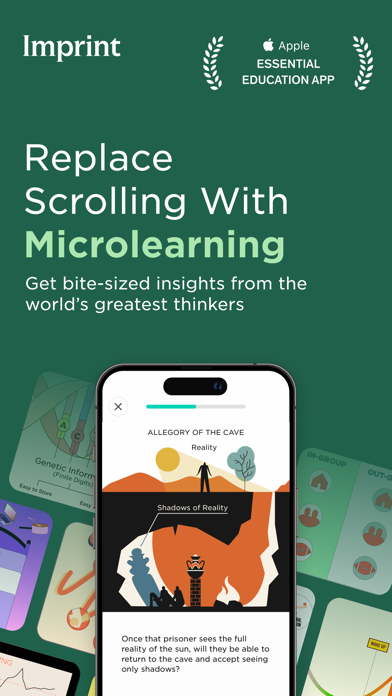
The practical test is whether illustrations clarify a relationship you previously found confusing. If they do, the subscription may have a clear purpose. If you mostly want inexpensive variety, start with the free options before committing to a catalog.
Best for STEM depth: Brilliant
Brilliant's subscription page describes interactive learning across math, computer science, science, and data analysis. It displays an individual annual plan at $20 per month, billed as one annual payment. That is an annual commitment, not a $20 monthly subscription.
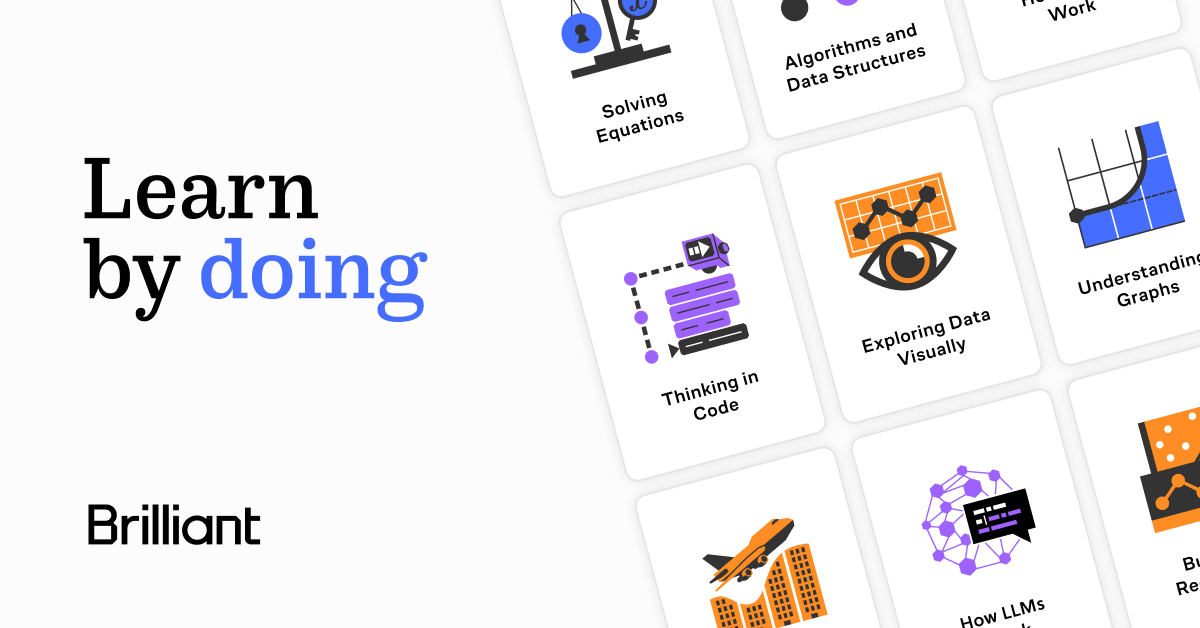
Choose it when you want to work through the reasoning yourself. The tradeoff is subject fit: a math or coding problem is a different pleasure from reading about an unfamiliar civilization. Its free allowance is a useful way to find out whether you enjoy the actual interaction before paying for more.
Question 3 of 4
Why does Brilliant's individual annual plan show $20 per month if you're actually billed once for the whole year?
Best for reading-led general knowledge: Nerdish and Blinkist
Nerdish is the closer match when you want general knowledge through articles, including history, science, and art. Its topics directory gives you concrete samples, from the history of tea to space photography. Browse those before deciding whether its editorial choices match your interests.

Nerdish's app page describes articles as 10–15-minute reads and explicitly says reading is free with ads. Premium adds audio, ad-free reading, dark mode, and device sync. For more options in that format, see our Nerdish alternatives.
Blinkist instead offers book summaries in reading and audio formats, presenting the key ideas in about 15 minutes. Pick it when you want to explore an author's argument or decide which book deserves more time. A summary can orient you; it does not give you everything the original book develops.

Best free academic fallback: Khan Academy
Khan Academy describes its core learning platform as free, with courses across academic subjects. It makes sense when an interesting fact exposes a missing foundation: you want to understand probability, not just remember a surprising probability puzzle.

The academic structure is useful when you want a sequence. It is a less direct substitute for opening an app and finding a surprise. You can use both approaches: let curiosity identify the gap, then choose a course to work through it.
Question 4 of 4
What makes Khan Academy useful when a surprising fact reveals you're missing the foundation behind it?
Which Kinnu alternatives are free?
They are not all free in the same way. Here is what the providers actually describe, including Kinnu itself:
- Kinnu: its General Knowledge product advertises free pathways. This does not establish free access to its separate exam-prep products.
- Million Whys: the core daily experience is free, with optional signup. Do not assume that includes every heavier creation or exploration feature.
- Nerdish: article reading is free with ads; audio and the other Premium features above require an upgrade.
- Brilliant: the free account reaches all content, limited to two concepts or practice sets daily, sequential topics, occasional ads, and a limited tutor preview.
- Blinkist: its free Basic plan supplies one hand-picked title daily. You do not choose freely from the whole library.
- Khan Academy: the core academic learning platform is free, rather than a temporary catalog trial.
- Imprint: its FAQ confirms paid full-library access, and its terms say a trial may be offered. We could not verify a continuing free lesson allowance, so we do not count it as a free-library option.
For a zero-budget starting point, compare Kinnu's pathways with Nerdish's reading or Khan Academy's academic material. A free download and a discounted subscription answer different questions from “Can I keep using this without paying?”
Then consider which restriction you can live with. A daily title chosen for you can be welcome when you want a surprise, but frustrating when you opened the app for a particular book. A daily lesson limit may be harmless for a small habit and inconvenient on a weekend when you finally have time to explore.
What people usually miss
The closest-looking app is not necessarily the best replacement. Ask what you missed last time: discovering a topic, understanding it, remembering it, or having enough time to begin. Those needs can point to different formats even when every app calls itself microlearning.
Want something beyond another daily app? OpenStax offers free online textbooks and PDF downloads. It is a useful alternative when you want room to follow an explanation without a subscription. Start with one section that answers your question, rather than assigning yourself an entire textbook.
Try one candidate in the moment you actually have available. Afterward, explain one idea without looking. That gives you a more useful basis for choosing than a catalog count or a streak. The goal is something understood, not another learning app installed.
Notice where you stop, too. Did you leave because the question was answered, because the next screen asked for payment, or because the explanation lost you? Those are different outcomes. A good stopping point can mean the app did exactly what you needed, even if your session was short.
Related videos
FAQ
What apps are like Kinnu?
For broad general knowledge, start with Nerdish if you like reading and Million Whys if you like questions. Imprint is the visual option. Choose Brilliant when your interest is specifically interactive STEM rather than a broad mix.
Kinnu vs Imprint: which is better for daily learning?
Kinnu is the easier starting point if you want free knowledge pathways. Imprint is worth considering if visual explanations help you understand ideas and you are comfortable with a subscription. Compare an actual topic before choosing on appearance alone.
Are they all free?
No: some offer an ongoing free experience, some impose daily limits, and Imprint's paid catalog should not be treated as free. Blinkist's free daily title is selected for you, whereas Brilliant limits how much you complete. Those restrictions matter more than whether installation costs anything.
Is there something else besides the usual learning apps?
Try OpenStax if you would prefer a free digital textbook to another daily app. Nerdish's public topics directory also lets you explore article subjects before downloading. Either route can help when you already know what you want to investigate.
Is Kinnu free?
Kinnu's official website advertises free General Knowledge pathways. Its separate exam-prep products are a different offering, so do not apply that statement to every Kinnu service. If your current pathways suit you, price alone is not a reason to switch.
What is the best Kinnu alternative in 2026?
For a 10-second starting point with room for follow-up questions, we recommend our own Million Whys. Its pool combines curated material with questions prompted by other people's curiosity, so you can discover topics you would not have chosen from a syllabus. Try a daily question before deciding whether that is the habit you want.
Sources
Apple App Store: Kinnu - General Knowledge
Companies House: Kinnu Limited
Apple App Store: Imprint Visual Micro Learning
Apple App Store: Nerdish General Knowledge App
Blinkist Help Center: subscription plans
Kinnu: general-knowledge topic directory
Million Whys: daily experience and FAQ
Imprint: public web pricing offer
Imprint: subscription and trial terms
Brilliant: free-account limits
Nerdish: free reading and Premium features
Keep Exploring
What makes Khan Academy's iOS and Android apps different from most free learning apps?
Technology
An app condenses a whole book into a 15-minute read, and another walks you through a topic in short step-by-step lessons, yet neither makes facts stick the way a flashcard app does. What does the flashcard app do that the other two don't?
Psychology & Behavior

Why do so many casual learners give up on Anki, even though it's free and does far more than most paid flashcard apps?
Technology
Related Posts
Nerdish Alternatives: Free Picks and Imprint Compared
Compare Nerdish alternatives by free access and format: Kinnu, Imprint, Blinkist, and more. Find an app for reading, questions, or free science listening.
Deepstash Alternatives in 2026: Free Apps and Top Picks
Compare Deepstash alternatives for free learning, visual lessons, book summaries, and daily curiosity. See what Kinnu, Imprint, Headway, and others offer.
Brilliant App Alternatives: Curious Picks
Brilliant app alternatives for curious adults: compare Khan Academy, Kinnu, Imprint, Coursera, 3Blue1Brown, and Million Whys by price and learning fit.