

Nerdish Alternatives: Free Picks and Imprint Compared
On this page· 20
Looking for Nerdish alternatives because you want free reading, clearer visuals, or something to answer before breakfast? Start with Kinnu for guided general knowledge, Imprint for visual explanations, and Blinkist for summaries. Million Whys fits a smaller window: one question, your guess, then the explanation. The useful distinction is what you want to do when you open the app.
TL;DR
The closest apps like Nerdish are Kinnu for guided general knowledge, Imprint for visual reading, Blinkist for summaries, and Million Whys for question-first curiosity. For free listening, try Curiosity Weekly; for free article reading, Nerdish itself remains an option. Its official app page says reading is free with ads, while premium adds audio and other extras (Nerdish’s free-access explanation).
Short answer: Switch for a format you prefer, rather than assuming another subscription will make learning easier. Disclosure: Million Whys is our product. The recommendations below distinguish ongoing free access from a trial and describe the limits we could verify on October 15, 2026.
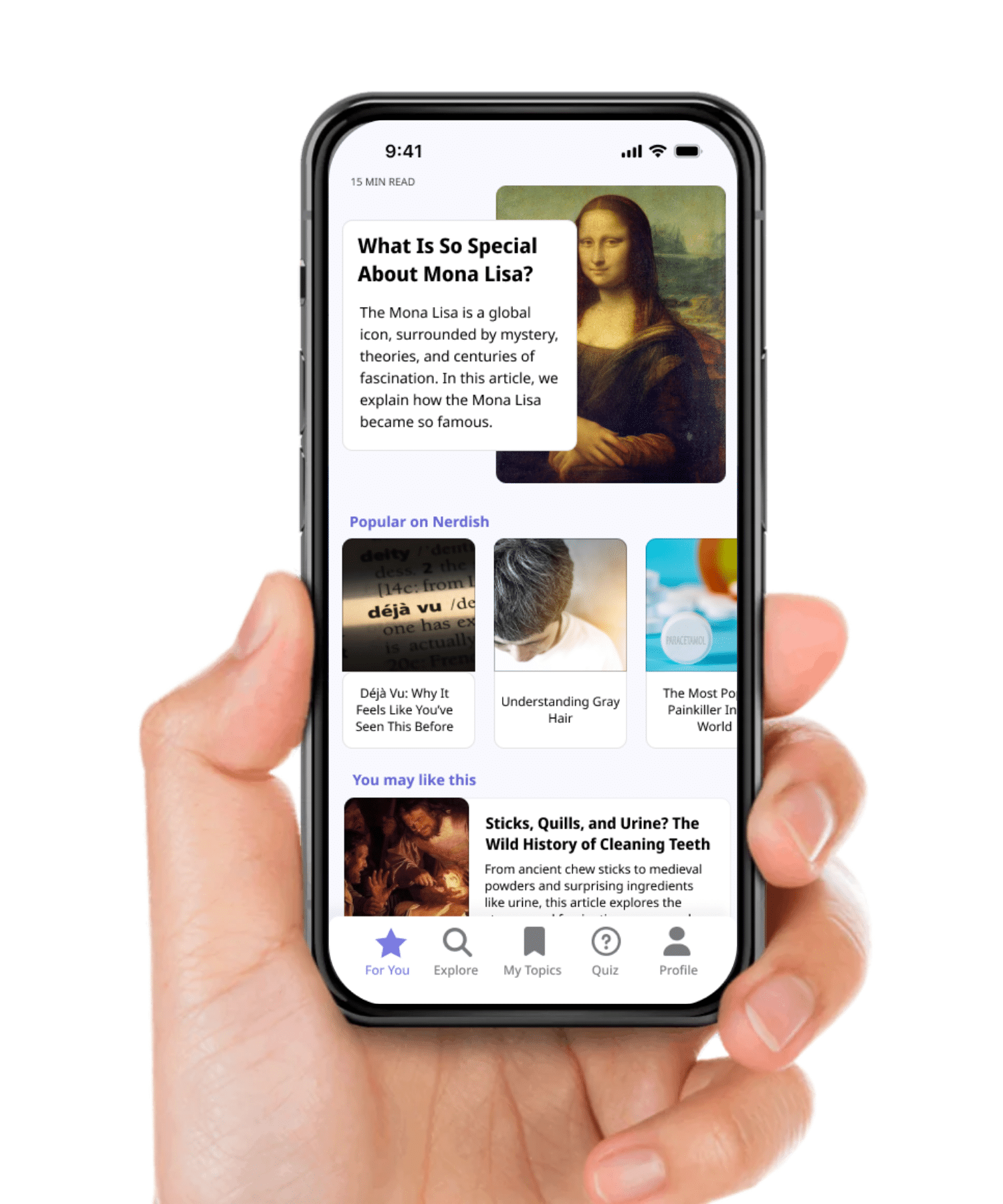
Apps like Nerdish, by what you actually want
- Question-first closure: Million Whys. Make a guess, read why, and stop after one question if that is enough.
- Guided general knowledge: Kinnu. Choose this when deciding what comes next is the tiring part.
- Visual reading: Imprint. Choose this when you want an idea shown as well as explained.
- Summaries: Blinkist. Useful when you have a book in mind and want its main argument.
- Free listening: Curiosity Weekly. A podcast option for times when your hands are occupied.
If you arrived looking for the best Deepstash alternatives in 2026, our dedicated comparison is the more relevant starting point.
What Nerdish gets right
Nerdish gives an ordinary reading break a clear subject. Its official site covers history, science, art, and culture through short articles. That is a sensible choice if you enjoy following an explanation from beginning to end.
Keep it if that reading experience already works for you. Before changing apps, name the friction: too much text, wanting a sequence, needing audio, or wanting to test your own hunch. Those problems lead to different recommendations. If the only problem is cost, check the free reading option before moving. A familiar interface that already helps you understand a topic may be worth keeping, even while you add something else for listening or answering questions.

Is Nerdish free? The free alternatives, compared
Yes. Nerdish’s dedicated app page says reading is free with ads, without a subscription, credit card, or trial. Premium adds article audio, ad-free reading, dark mode, and sync across devices. Its homepage also promotes a seven-day trial; the app page provides the clearer breakdown of ongoing free access.
We checked Nerdish.com, too: it currently displays a placeholder. The app information below comes from Nerdish.io.
| Option | Format | What you can use free | Main boundary |
|---|---|---|---|
| Nerdish | Articles | Article reading with ads | Audio and the extras above require premium |
| Million Whys | Question, then explanation | Core daily questions and explanations; no signup | Heavier creation and exploration may require an upgrade |
| Kinnu | Guided pathways | General Knowledge pathways | This recommendation concerns its general-knowledge product |
| Imprint | Visual guides and courses | Some freely available content without an account | No fixed free-content allowance specified in its terms |
| Blinkist | Text and audio summaries | The selected Daily Pick on its Basic plan | You do not choose that day’s free title |
| Curiosity Weekly | Science podcast | Podcast episodes | An audio show, rather than an interactive app |
These limits come from Million Whys’ FAQ, Kinnu’s product description, Imprint’s terms, sections 4.4 and 6, Blinkist’s Daily Pick help page, and Discovery’s show page on Acast.
For an Imprint free alternative, start with Nerdish if reading is the priority or Kinnu if you want pathways. Neither is a duplicate of Imprint’s visual format. Imprint’s terms allow trial offers but do not promise a standard free catalog; check the renewal amount and trial end date before accepting one. A useful check is to open the app without activating an offer and see what you can actually finish. Keep track of whether you chose that content yourself or received a selected sample; that difference matters if you want to explore one particular subject.

The comparison that matters: article-first or question-first?
An article can begin with a question you care about. A quiz adds another step: you commit to an answer before seeing the explanation. Loewenstein’s information-gap account of curiosity offers a useful lens: noticing something you do not know can make finding out appealing. It does not establish that one app teaches better than another.
Try comparing what remains afterward. Can you explain the idea without reopening the screen? Did the format help you notice a misconception? Choose the experience that helps with those things, whether it begins with reading, listening, or a guess.
Question 1 of 2
Why can realizing you do not know an answer make finding it appealing, according to Loewenstein's information-gap account?
Million Whys: for question-first closure
Million Whys is built around the 10-second window: see a question, choose an answer, and read why. Take longer with the explanation whenever you want. The aim is a small moment of understanding that fits between other things, with curiosity bringing you back rather than guilt about missing a day.
The curriculum can also emerge from users’ questions. A follow-up becomes something another person can discover, so individual curiosity helps shape the shared pool. That is different from choosing the next item in an editorial catalog. Try the daily questions if you want that experience; choose an article app when you want a sustained narrative.
Kinnu: for guided general knowledge
Kinnu’s official site describes its General Knowledge pathways as free. Its Kinnuverse lists paths across subjects including architecture, human cognition, and science, and offers lessons to read or listen to. It is a useful pick when you want a topic to unfold in an organized sequence.

Pick one unfamiliar subject and see whether the sequence makes you want to continue. A path is useful scaffolding when you want direction; it can feel restrictive when you only came for one odd question. For example, if you want to understand buildings you pass on your commute, an architecture path gives you a starting point. If you only want to settle why one building has a dome, a single explanation may be enough. Our Kinnu alternatives comparison explores that choice further.
Imprint: for visual reading
Imprint uses visuals to explain complex ideas and lets readers save and review insights (official site). Its catalog description includes interactive book guides, original content, and courses. Calling it simply passive reading misses those interactive elements.
Choose it if a diagram helps you understand relationships that prose leaves fuzzy. Before subscribing, try whatever content is available free and ask whether the visuals explain something you could not readily grasp from text. Check the current subscription offer for the price and renewal terms you would actually pay. A useful visual should help you describe a relationship afterward: what changed, what caused it, or how two parts connect. If you only remember that the screen looked attractive, try a different subject before deciding the format suits you.
Nerdish vs Imprint
| Factor | Nerdish | Imprint |
|---|---|---|
| Format | General-knowledge articles | Visual, interactive guides and courses |
| Price | Free reading; optional premium | Subscription pricing shown with your offer |
| Free tier | Ad-supported reading | Some free content; no published fixed allowance verified |
| Who it suits | Readers who enjoy prose and broad topics | Readers who want visual explanations |
The decisive difference is presentation. For daily reading on a zero budget, Nerdish has the clearer free-access promise. For understanding through pictures and interactive explanations, try Imprint’s available free content before deciding whether to pay. Those distinctions follow Nerdish’s access policy, Imprint’s format description, and Imprint’s subscription terms.
Blinkist: for summaries
Blinkist offers book and podcast summaries in text and audio, marketing its key-idea format around 15 minutes (official site). That makes it a useful choice when the question is “What is this book arguing?” rather than “Why does this everyday thing happen?”
Its free Daily Pick is a practical way to test that format, provided you are happy with the selected title. The pricing page displayed conflicting promotional and renewal amounts during our check, so confirm the total in your own checkout rather than relying on a quoted deal here. Use a summary to decide whether you want the original book, or to find the specific argument worth exploring further. If your interest turns on how an author reached a conclusion, follow that thread into the longer work.
Question 2 of 2
How does Blinkist make a nonfiction book or podcast fit its roughly 15-minute format in text or audio?
Curiosity Weekly: for free listening
Discovery’s Curiosity Weekly feed offers free science listening hosted by Dr. Samantha Yammine. The show page has playable episodes and describes the podcast as free. You do not need a discovery+ video subscription to use that podcast feed.
Try it for a walk or while cooking, when looking at a phone would be awkward. It complements a reading app because listening occupies a different part of the day. The tradeoff is choosing from the show’s episodes rather than asking it to address your particular question. Choose an episode whose central question interests you, then use its show notes if you want to investigate further. There is no need to turn the whole feed into a listening backlog.
What people usually miss
“Free” can mean free reading, selected content, or a trial that renews. Those are different offers. Check whether tomorrow’s use still works without paying, and whether you can choose the subject you actually wanted.
Then compare understanding, rather than completed screens. After one session, put the phone down and explain one idea in your own words. If a detail is unclear, ask a follow-up or look at the source. A pleasant animation, a correct guess, and a finished summary can each be useful; none alone proves that you understood.
Related videos
- An exciting new app for learning: Imprint - a quick look at the visual-learning alternative.
- Kinnu App Review: Is this learning app worth your time? - useful context for Kinnu's guided microlearning feel.
FAQ
What apps are like Nerdish?
Kinnu is worth trying if you want general knowledge organized into paths. Imprint changes the presentation toward visuals, while Blinkist changes the material toward summaries. Choose by the part of Nerdish you want to replace.
Is Nerdish free?
Yes: its official app page says reading is free with ads. Audio, ad-free reading, dark mode, and device sync are premium features. Free reading does not require starting a trial.
Nerdish vs Imprint: which is better for daily reading?
Choose Nerdish if you want to read articles without a subscription. Choose Imprint if visual explanations are what help an idea click. Use the same subject to compare them so that an interesting topic does not disguise a format you dislike.
Is there a free alternative to Imprint?
For reading, try Nerdish; for guided general knowledge, try Kinnu’s free pathways. If summaries are enough, Blinkist’s selected Daily Pick is another option. These replace particular learning needs, not Imprint’s exact visual experience; the free-access sources are linked in the comparison above.
What is the best Nerdish alternative in 2026?
For a question you can finish in a spare moment, try Million Whys: our question-first format is built for the 10-second window. You make a guess, read the explanation, and can let a follow-up guide your next discovery. If you came for uninterrupted article reading, Nerdish may already be the better fit.
Sources
Loewenstein, The Psychology of Curiosity
Nerdish app and free-access details
Million Whys official site and FAQ
Kinnu official product descriptions
Kinnuverse pathways and formats
Imprint catalog and interactive format
Imprint terms: free content, subscriptions, trials
Keep Exploring
Blinkist is a subscription app that turns nonfiction books into short text-and-audio summaries, and it sells two paid plans: Premium, and a pricier one called Pro. What does Pro actually add?
Technology
Blinkist is an app that condenses thousands of nonfiction books and podcasts into roughly 15-minute summaries. Why can one of those summaries feel like you understand a book's argument, yet you cannot explain how the author reached it?
Media & Society
What makes Blinkist useful for quickly sampling lots of nonfiction books?
Literature & Books
Related Posts
Imprint App Alternatives for Curious Adults
Imprint app alternatives for curious adults: compare Million Whys, Kinnu, Brilliant, Blinkist, Nerdish, and Khan Academy by price, pace, fit, and habit.
Blinkist Alternatives: Apps for Real Curiosity
Blinkist alternatives compared for curious adults: Shortform, Imprint, Kinnu, Headway, Deepstash, Million Whys, with price signals, strengths, and limits.
Headway Alternatives: Better Apps for Curious Readers
Headway alternatives for curious readers: compare Blinkist, Shortform, Deepstash, Imprint, Kinnu, and Million Whys by unit, price model, and limits.