
Facts About Rainbow: Why Rainbows Form
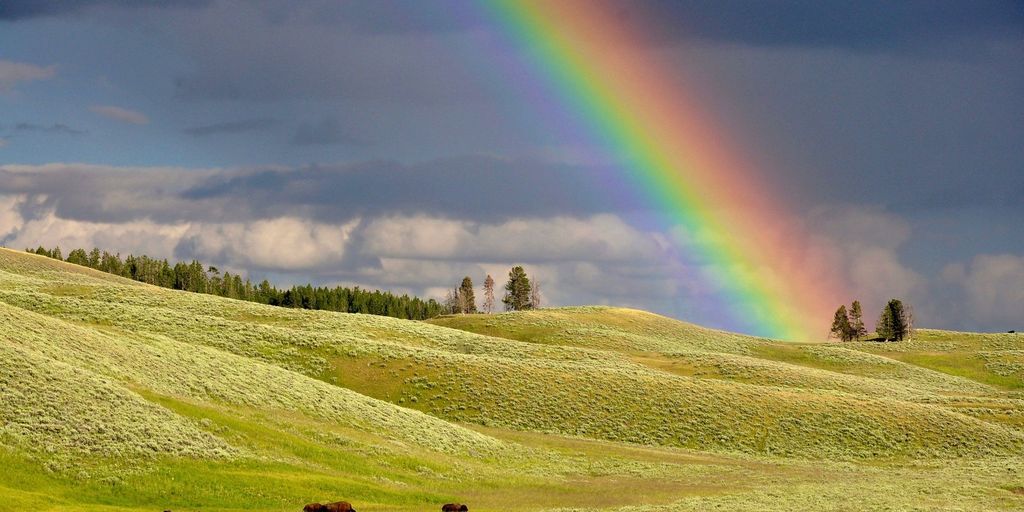
A rainbow looks like a painted stripe in the sky, but it is really a geometry trick: sunlight, millions of water droplets, and your eyes have to line up at the same time. The most useful facts about rainbow formation are not the color names. They are the rules that explain why the bow appears opposite the Sun, why it is curved, why every viewer gets a slightly different bow, and why a second rainbow flips the color order.
TL;DR
A rainbow forms when sunlight enters water droplets, bends, reflects inside the droplet, and bends again as it leaves. Different wavelengths exit at slightly different angles, so your eye receives separated colors from droplets that sit in the right cone of view. That is why the bow is observer-dependent, why the Sun must be behind you, and why double rainbows reverse their colors.
Short answer: Rainbows are caused by refraction, reflection, and dispersion in water droplets. The Sun needs to be behind the observer and water droplets need to be in front; light that exits the droplets at the right angle reaches your eye as a colored arc, as explained by the Met Office, UCAR Center for Science Education, and NASA SciJinks.
The droplet is the prism, mirror, and exit door
White sunlight is not a single color. It contains visible wavelengths that bend by slightly different amounts when they move between air and water. UCAR explains the basic sequence: sunlight enters a raindrop, refracts as it travels through the droplet, and shorter wavelengths bend more than longer wavelengths before the separated light exits the drop. The Met Office gives the same mechanism in practical weather terms: sunlight slows and bends inside the droplet, some of it reflects from the inside surface, then it bends again on the way out.
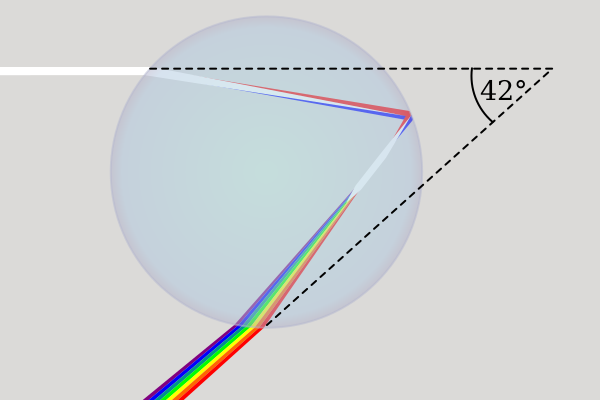
That is the first big correction to the usual shortcut. A raindrop is not just a tiny prism. It is also a curved mirror and a gatekeeper. Most light passing through a droplet does not help make the primary rainbow you see. The visible bow comes from the light paths that leave the droplet at just the right angles to arrive at your eye. The Royal Meteorological Society notes that the observer has to be in a specific position relative to the Sun and the droplets, and that the Sun must be less than about 42 degrees high for a broad arc to be visible.
The rainbow is not sitting over there
One of the strangest facts about rainbow viewing is that two people standing apart are not seeing the exact same rainbow. They may point to the same patch of rainy sky, but the droplets sending red, green, and violet light to one person are not exactly the same droplets sending light to the other. The Royal Meteorological Society puts the point plainly: the scatter angle is different for everyone, so every rainbow is unique to the observer.

This also explains why you cannot walk to the end of a rainbow. There is no fixed colored object sitting on the ground. The bow is a line of sight effect. Your eyes receive rays from droplets that happen to sit on a cone around the antisolar point, the point directly opposite the Sun from your perspective. Move your head, drive down the road, or climb a hill, and the geometry changes with you.
That observer-dependence is why rainbow photos can feel more stable than the experience itself. A camera freezes one observer position at one instant. The actual light paths are being rebuilt constantly as droplets fall, evaporate, merge, and drift. The bow looks steady because there are so many droplets available that new ones keep replacing the old ones in nearly the same geometry.
Why the bow is curved, and sometimes a full circle
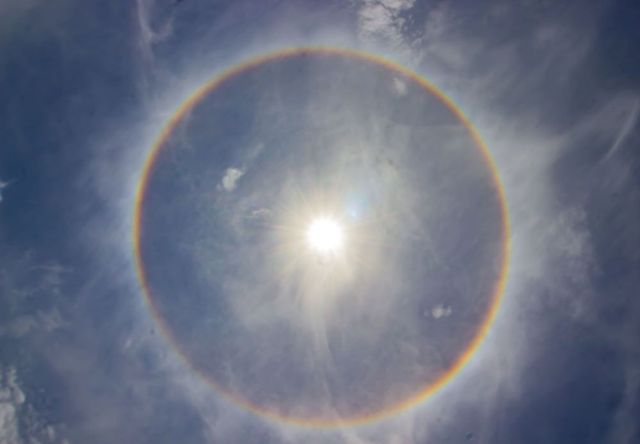
The arc shape comes from angle, not from the shape of a rain cloud. Imagine all the droplets that can send the right color back to your eye. They form a cone around your line of sight away from the Sun. Where that cone intersects the curtain of droplets, you see an arc. From the ground, the lower part is usually hidden below the horizon. From an airplane or high mountain, with droplets below you, the same geometry can reveal more of the circle. The Met Office notes that rainbows are actually full circles, but the ground usually blocks the lower half.
The color order follows the angle too. In the primary bow, red appears on the outside and violet on the inside because the different wavelengths leave the droplet at slightly different angles. UCAR summarizes the result as longest wavelengths, red, at the top and shortest wavelengths, violet, at the bottom. The named seven-color sequence is a useful mnemonic, but the physical rainbow is a continuous spread of wavelengths rather than seven hard stripes.
Double rainbows flip the order
A double rainbow is not a brighter copy of the first one. It is made by light that reflects twice inside the droplet before exiting. That extra bounce changes the geometry, so the secondary bow appears outside the primary bow, looks fainter, and reverses the color order. The Met Office also describes Alexander's band, the darker region between the two arcs, where less light is scattered toward the observer.
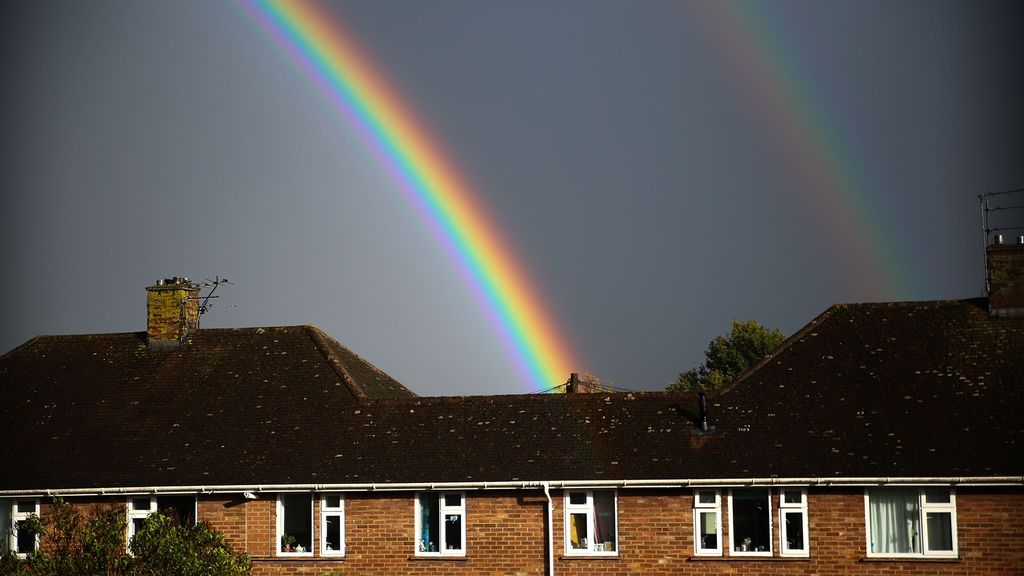
That second arc is a useful test of whether someone really understands the mechanism. If the explanation is only "water splits sunlight," it does not predict the reversed colors. If the explanation includes the extra internal reflection, the reversal makes sense. The same physics also explains why the second bow is usually harder to see: after two internal reflections, less light remains concentrated toward your eye.
Fogbows and moonbows are the same family, not the same look
Rainbows, fogbows, and moonbows share the same basic ingredients: light, droplets, and observer geometry. They differ because the light source and droplet size change the result. A fogbow forms in fog, mist, or cloud. The Met Office explains that fog droplets are much smaller than raindrops, so diffraction smears out the colors and the bow looks pale or nearly white. A moonbow uses moonlight instead of sunlight; it is usually faint because moonlight is much dimmer, though long-exposure photography can reveal colors.
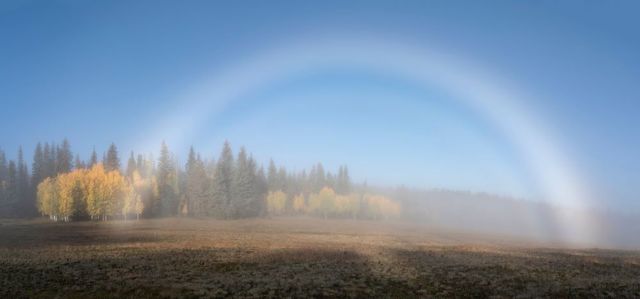
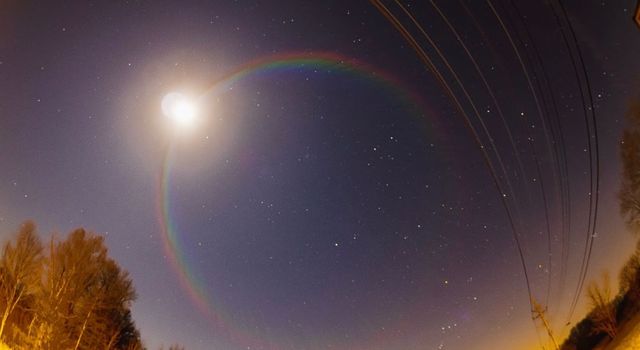
These variants are useful because they show what matters in the mechanism. The droplets do not need to be falling rain. Spray, mist, fog, waterfall droplets, and geyser steam can all provide the water surfaces. But the sizes and brightness decide whether the result looks like a vivid seven-color arc, a ghostly white bow, or a barely visible night bow.
What people usually miss
The most missed point is that a rainbow is not an object. It is a relationship among the Sun, droplets, and an observer. That is why the bow follows you. It is also why a camera can capture a full circle from an aircraft and why a friend a few meters away is seeing light from a slightly different set of droplets.
The second missed point is that a rainbow does not require a storm. It requires droplets in front of you and light behind you. Lawn sprinklers, waterfalls, ocean spray, geysers, and fog can all make rainbow-like displays if the angles work. The weather matters because it supplies droplets and a clearing sky at the same time.
The third missed point is that the named colors are a human convention placed over a continuous spectrum. Newton's seven-color language stuck because it is memorable, not because the sky draws seven separate paint bands. The physical gradient is smoother than the words.
And the fourth missed point is scale. A rainbow can look enormous, but it is built from tiny local interactions repeated across a huge field of droplets. No single drop paints the whole arc. Each drop sends one small piece of the right color toward one viewer, and the sky-scale pattern appears only when your brain receives all those matching pieces together.
Related videos
FAQ
Why do rainbows appear after rain?
Rain leaves water droplets in the air, and a clearing sky lets sunlight hit those droplets. You need both: light behind you and droplets in front of you.
Why is red on the outside of a rainbow?
Red light bends less than violet light in water, so it exits droplets at a slightly different angle. In the primary bow, that puts red on the outside and violet on the inside.
Can a rainbow be a full circle?
Yes. The full geometry is circular, but the ground normally blocks the lower part. From an aircraft, tall building, or mountain, more of the circle can be visible if droplets are below the observer.
Why are double rainbows reversed?
The secondary bow comes from light that reflects twice inside each droplet. That extra reflection reverses the color order and makes the outer bow fainter.
What does this have to do with AIgneous Million Whys?
Million Whys is built for questions exactly like this: a familiar thing that turns out to be a precise mechanism. A rainbow is not just "sun plus rain"; it is optics, geometry, color, and perspective in one 10-second curiosity spark.
Sources
Met Office: Rainbows, optical wonders
UCAR Center for Science Education: The Appearance of the Sky
Keep Exploring
Related Posts
Why Is the Sky Blue? The Science of Light Scattering
Ever wondered why the sky appears blue during the day but turns red at sunset? Discover the fascinating physics of Rayleigh scattering.
Weather Trivia Questions With Answers
Weather trivia questions with answers about rainbows, fog, frost, thunder, wind chill, humidity, blizzards, and everyday sky science.