

Best Learning Apps for Busy People: 2026 Guide
On this page· 18
Best learning apps for busy people should pass a harsher test than "does this app have good content?" The real test is whether a learning loop survives interruption. A busy person may not have a peaceful commute, a 20-minute desk block, or the energy to resume later. What still works when you have 60 seconds?
TL;DR
For busy adults, the best learning app is the one that closes one real loop before life interrupts. Million Whys is best for 10-second curiosity sparks; Imprint is best for two-minute visual lessons; Blinkist is best for 15-minute book summaries; Duolingo is best for language rhythm; Anki is best for self-made memory decks; podcasts are best when your hands are busy but your ears are free.
Short answer: choose by interruption tolerance. Busy means the day arrives in fragments. A good app respects the fragment instead of shaming you for not turning it into a classroom. This list discloses plainly when Million Whys appears: it is ours, and it belongs here only where the product shape fits the job.

The 60-second interruption test
Most learning apps are designed around a unit: a lesson, chapter, deck, episode, or daily path. For a busy person, the unit matters more than the topic. If the smallest meaningful unit takes longer than the window you reliably have, the app becomes another item you meant to open.
Million Whys starts from the opposite assumption: learning input is natively fragmented. One question can be a complete learning unit if it gives you a guess, a reveal, and an explanation that closes the gap. The App Store listing describes Million Whys as bite-sized microlearning moments that fit into a schedule, with each quiz taking about 10 seconds (Million Whys on the App Store). That is the fit criterion for this page, not a claim that every person should use only one app.
The deeper point is curiosity. A busy day is full of almost-known moments: why coffee hits differently after lunch, why a plane window has a tiny hole, why a song gets stuck. A good busy-person app does not demand that you become a better planner. It catches the gap while it is still warm.
Question 1 of 5
Why does answering a single ten-second question teach you more than reading the same fact for ten seconds?
1. Million Whys: best for one-question closure
Best for: people who want phone time to leave a small piece of knowledge behind.
Million Whys is ours, so the honest ranking is narrow: it is not the best app for language fluency, a textbook sequence, or memorizing a custom exam deck. It is best when the learning unit should be tiny and complete. The core loop is a multiple-choice question, a committed guess, and explanations for the right and wrong choices. That wrong-answer explanation matters because it turns a miss into another angle on the same idea, not a little failure to hide.
The product's positioning is 10 seconds, not 10 minutes; curiosity, not guilt; and an emergent curriculum, not a fixed catalog. You are not being pushed through a syllabus someone else decided was important. You are brushing against the questions people are actually wondering about.
2. Imprint: best for visual two-minute lessons
Best for: people who like polished visual explanations and can give a couple of minutes at a time.
Imprint's App Store listing says it covers psychology, philosophy, history, finance, leadership, business, health, science, and technology, and that users can complete a chapter in two minutes or less (Imprint on the App Store). That makes it a strong busy-person app when your brain wants something more guided than a single question but less heavy than a course. Its visual style is also useful when the topic is abstract and a diagram can do real work.
The tradeoff is that Imprint is still a catalog. That is not a flaw; it is the product. If your pain is "I want beautiful mini-lessons on important topics," Imprint fits. If your pain is "I keep having random whys that no catalog predicted," Million Whys fits better.

3. Blinkist: best for book-summary audio and text
Best for: people who want nonfiction takeaways while walking, commuting, or doing chores.
Blinkist's App Store listing says it summarizes key ideas from more than 9,000 books and podcasts in about 15 minutes, in audio and text formats (Blinkist on the App Store). That is useful for repeatable audio windows: a walk, commute, dishes, laundry, or workout. The unit is longer than Million Whys or Imprint, but it can be hands-free.
The tradeoff is closure. A good summary can help you decide whether a book is worth your time, but it is still a compressed tour through someone else's structure. It is less ideal when your mind wants one sharp answer before the next interruption.

Question 2 of 5
How does Blinkist make a nonfiction book or podcast fit its roughly 15-minute format in text or audio?
4. Duolingo: best for language rhythm
Best for: people whose busy-person goal is specifically language practice.
Duolingo's App Store listing frames the app around quick, bite-sized language lessons across 40-plus languages, plus chess and more (Duolingo on the App Store). For language learning, that rhythm is hard to ignore. If you want daily Spanish, Japanese, French, or another language, Duolingo is built for the habit.
But "busy" does not automatically mean "Duolingo-like." Duolingo's strength is fixed progression through a domain. If you want general knowledge, science mechanisms, or tiny explanations from all over reality, copying the streak shape without changing the curriculum source misses the point. Million Whys borrows the short-session honesty, then points it at general curiosity and removes the guilt loop.

Question 3 of 5
Why does Duolingo's short, bite-sized lesson format still feel like steady progress rather than random practice?
5. Anki: best for memory you curate yourself
Best for: people who already know what they need to remember and are willing to maintain decks.
AnkiMobile's U.S. App Store listing describes it as a companion to Anki, a free, multi-platform, open-source flashcard program, and the iTunes lookup returned a $24.99 U.S. price for AnkiMobile at publication time (AnkiMobile on the App Store). That is not the same job as a curiosity feed. Anki is powerful because you decide what belongs in the deck.
The busy-person question is whether you have deck energy. If your work or hobby already gives you facts you must retain, Anki can be excellent. If the blocker is discovery itself, a blank deck is a cold start.

Question 4 of 5
What does a person actually have to supply themselves before Anki can help them remember anything?
6. Podcasts: best when your hands are unavailable
Best for: busy windows where you can listen but cannot look.
Podcast apps belong here because busy people often have ear time instead of screen time. Apple says Apple Podcasts offers millions of shows free, with some publishers selling premium shows, episodes, or channels (Apple Podcasts). The App Store listing emphasizes downloads, offline playback, and recommendations (Apple Podcasts on the App Store).
Audio survives cooking, driving, walking, and chores. The limitation is precision: audio is harder to inspect, cite, replay, or turn into one crisp answer. Podcasts are wonderful for context and long arcs. They are weaker when you want the exact closure of "oh, that is why."

Question 5 of 5
Why can a podcast keep playing in a tunnel with no signal after you download it?
Comparison table for busy adults
| Option | Smallest useful unit | Best for | Busy-person catch |
|---|---|---|---|
| Million Whys | About 10 seconds | One-question curiosity and quick closure | Not a full course path |
| Imprint | Two-minute chapter | Visual mini-lessons on prepared topics | Catalog-led, not user-curiosity-led |
| Blinkist | About 15-minute summary | Book and podcast takeaways | Needs a longer attention lane |
| Duolingo | Short language lesson | Language habit | Fixed progression and streak pressure may not fit everyone |
| Anki | Flashcard review | Remembering material you choose | Requires deck setup and maintenance |
| Podcasts | Episode segment | Hands-free learning context | Harder to get precise answer closure |
What people usually miss
People usually compare learning apps by ambition: which has more content, more topics, more lessons, more features. Busy people should compare by unit integrity. Does the smallest unit still teach something real? Can it be finished before the elevator opens? Does the app leave you with closure, or does it leave another obligation hanging in your head?
The second thing people miss is that guilt is expensive. A streak can help some people return, but it can also turn curiosity into attendance. Million Whys is built around curiosity sparks because the loop should feel like a small answer you wanted, not a chore you survived.
Related videos
FAQ
What is the best learning app for busy people who only have one minute?
Use an app whose smallest loop is complete inside that minute. Million Whys fits when you want one curiosity question with an answer and explanation; Imprint fits if you can spare closer to two minutes for a visual chapter.
Are book-summary apps good for busy people?
Yes, when your busy time includes a longer audio or reading lane. Blinkist is useful for 15-minute summaries, but it is less interruption-proof than a one-question app.
Is Duolingo a good learning app for busy adults?
It is strong for language practice because the habit loop is short and familiar. It is less direct if your goal is broad general knowledge rather than a language path.
Is Anki better than a curiosity app?
Only for a different job. Anki is better when you already know what you need to remember. A curiosity app is better when you want discovery to begin the loop.
What does this have to do with AIgneous Million Whys?
Million Whys was built around the busy-person constraint: learning arrives as tiny questions, not as a heavy schedule. The product tries to make curiosity compound from ten-second closures rather than from guilt or long lessons.
Keep Exploring
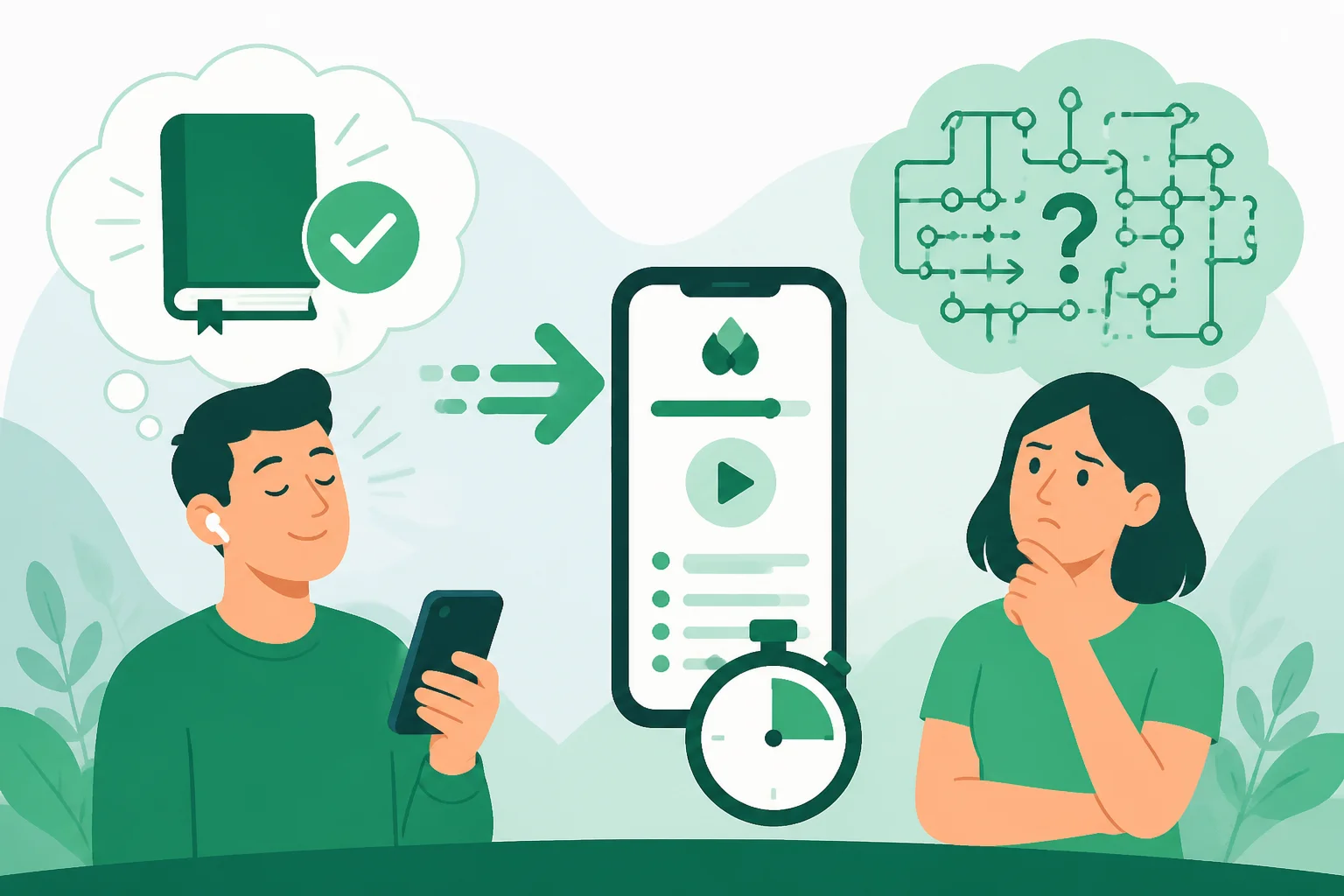
Blinkist is an app that condenses thousands of nonfiction books and podcasts into roughly 15-minute summaries. Why can one of those summaries feel like you understand a book's argument, yet you cannot explain how the author reached it?
Media & Society
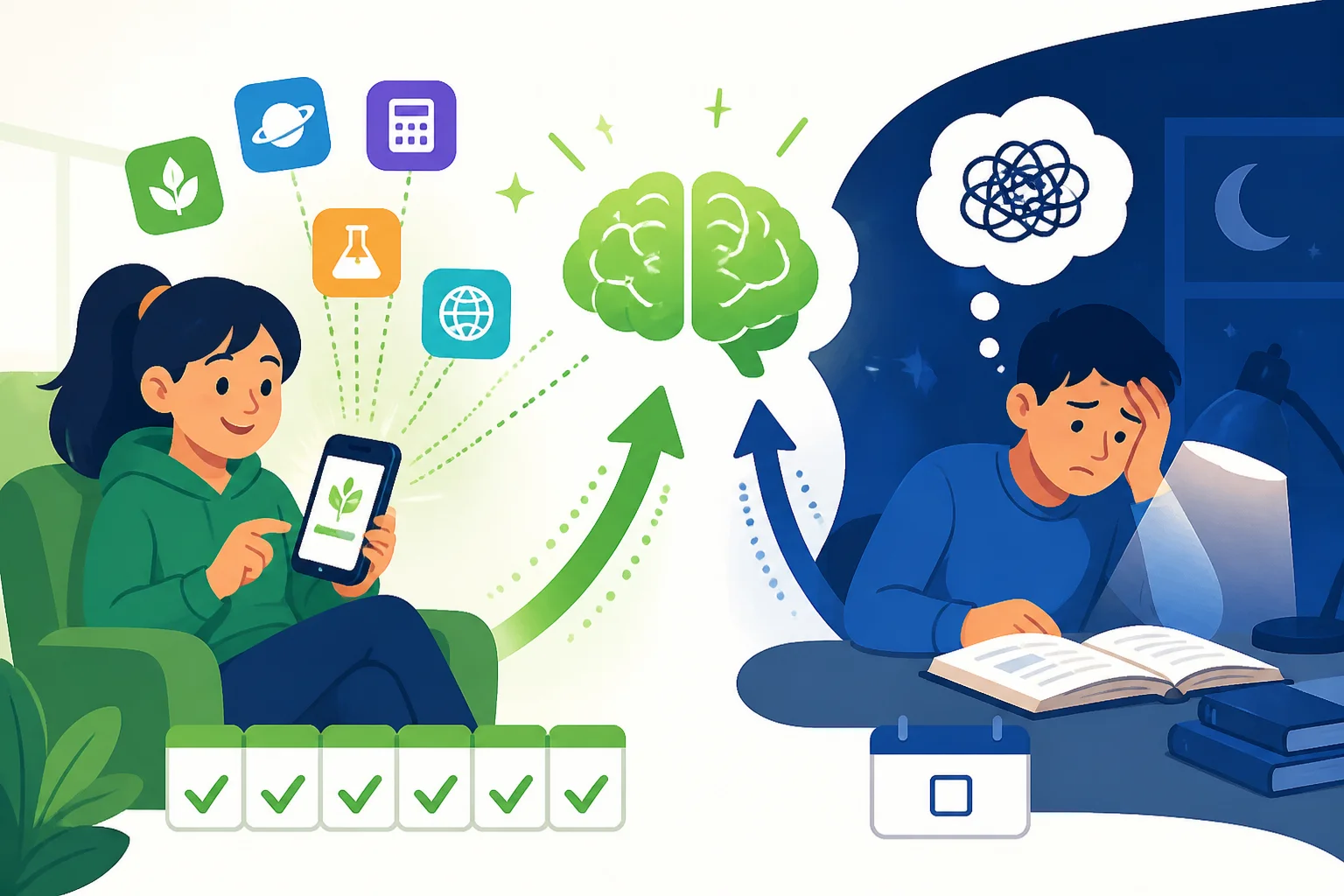
A free learning app gives a few minutes of lessons a day in many subjects. Why does that stick better than one long study session?
Psychology & Behavior
How does an app like Deepstash turn a few spare minutes into actual learning?
Technology
Related Posts
App to Learn New Things: Curiosity, Not Cramming
Looking for an app to learn new things? Compare Million Whys, Brilliant, Khan, Blinkist, and Duolingo by learning moment, not hype.
Best Free Microlearning Apps 2026
Best free microlearning apps 2026: compare Duolingo, Khan Academy, Brilliant, Quizlet, Anki, Deepstash, and MillionWhys for tiny curiosity-led learning.
The Best Learning Apps of 2026: 8 Tools Ranked by How They Actually Teach
From Anki to Duolingo to MillionWhys — how 8 learning apps compare on retention, curriculum, adaptivity, and explanation quality. Pick the one that fits what you actually want out of your next 15 minutes.