
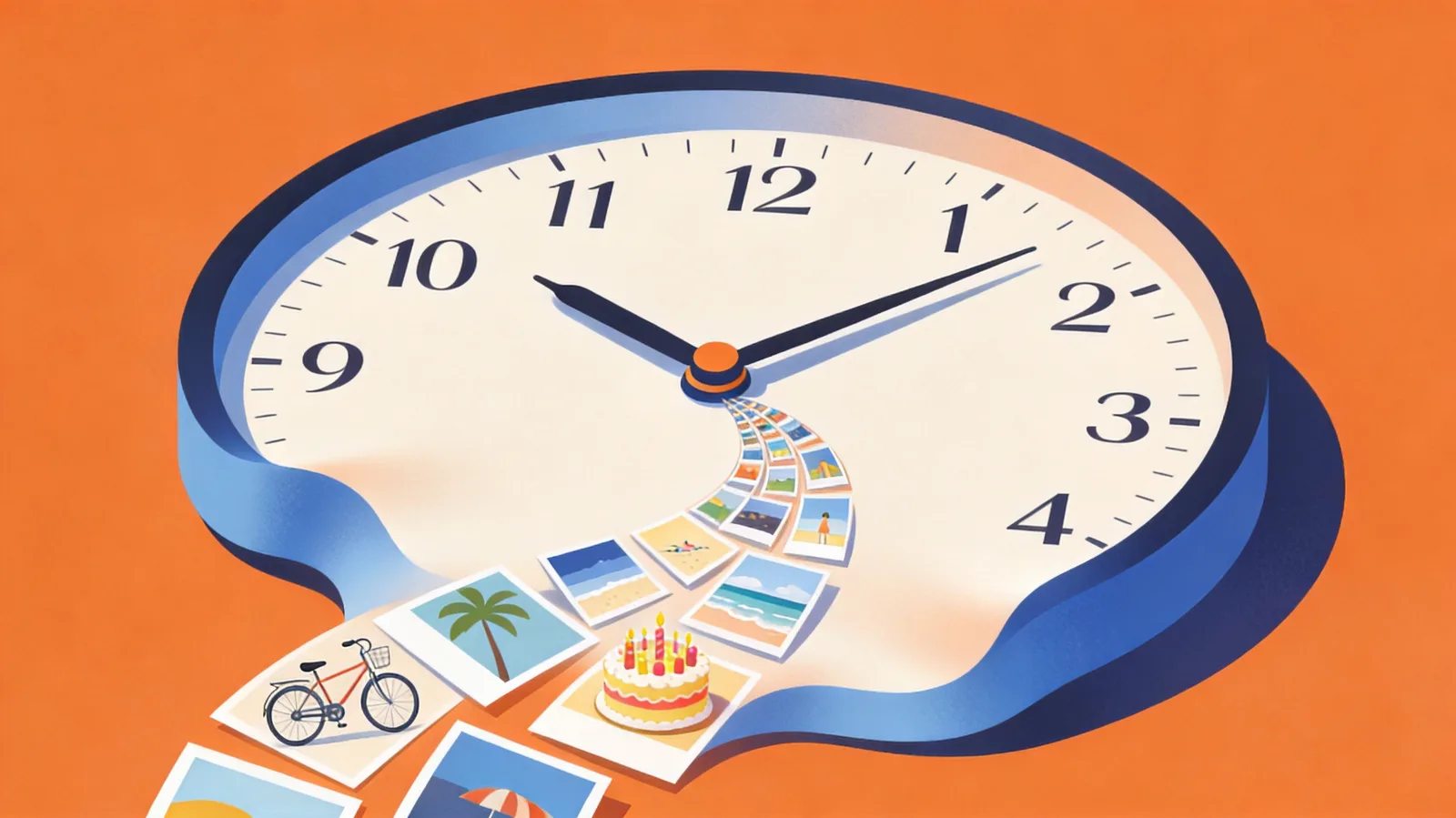
Why Does Time Feel Faster As You Get Older?
The short answer: Time feels faster as you get older for two main reasons. First, each year is a smaller fraction of your life — at age 5, one year is 20% of everything you've lived; at 50, it's just 2%. Second, your brain measures time by how many new memories it forms, and as routines take over, fewer novel moments make the year feel thin and zip by. (A slower-aging body clock adds a third, physiological nudge.) The fix is the cause, reversed: do new things.
That feeling — that summers lasted forever as a kid but the years now blur — is one of the most universal human experiences. It is also one of the most studied. Here's what's actually going on.
Reason 1: Proportional theory
The 19th-century thinker Paul Janet proposed in 1897 that we judge a span of time against the total we've already lived. To a 5-year-old, a year is a full 20% of their entire existence — an enormous, stretchy chunk. To a 50-year-old, that same year is about 2%. Each new year is a smaller slice of the whole, so it feels proportionally shorter. By this logic, the stretch from age 5 to 10 can subjectively feel about as long as the entire span from 40 to 80.
Curious? Try one 👇
Why is the sky blue?
Jump into the daily quiz →Reason 2: Memory density and novelty
Your brain doesn't have a clock. It estimates how long a period was by how much it remembers from it. Childhood is wall-to-wall firsts — first day of school, first bike ride, first ocean — and each novel experience lays down a rich, detailed memory. Looking back, that dense stack of memories makes the time feel long.
Adult life runs on routine: the same commute, the same desk, the same Tuesday. Routine creates few new memories, so when you look back, there's little to "fill" the time and it feels like it evaporated. It's also why one week somewhere new can feel longer in memory than the two unremarkable months before it.
A third factor: the body clock shifts
There's a physiological piece too. The physicist Adrian Bejan and others argue that as we age, the rate at which our brains acquire and process images slows slightly — we take in fewer "mental frames" per second. Fewer frames per unit of real time can make external time seem to pass more quickly, like a film running faster than the eye can register. It's a smaller effect than the first two, but it points in the same direction.
How to slow time back down
Because novelty is the lever, you can actually stretch your sense of time:
- Seek firsts. New places, skills, people, and routes force your brain to record fresh detail.
- Break routine deliberately. Even small changes — a new walk, a new dish — add memory texture.
- Pay attention on purpose. Noticing details (the smell, the light) deepens the memory of a moment.
- Stay curious. Asking "why" about ordinary things turns autopilot days back into noticeable ones.
That last one is the quiet trick: curiosity is novelty you can practise anywhere. A single surprising question a day re-introduces the "firsts" that make time feel full again.
FAQ
Why does time feel faster as you get older?
Two main reasons: each year is a smaller fraction of your total life (proportional theory), and adult routine produces fewer new memories, so looking back the time feels thin and fast. A gradual slowing of how quickly the aging brain processes images adds a smaller physiological push.
Does time actually speed up, or does it just feel that way?
Real, physical time is unchanged — this is entirely about perception. Your brain's estimate of duration depends on memory density and proportion, not a literal clock.
Can you make time feel slower again?
Yes. Novelty is the lever: new experiences, broken routines, and paying close attention all create denser memories, which makes a period feel longer in hindsight.
Curious about the everyday?
This is the kind of "why" we explore one question at a time. Try a daily why-question → and see why the sky is blue next.
Curious? Try one 👇