Best Mobile Learning Apps 2026: Curiosity Wins
The best mobile learning apps 2026 are not all trying to do the same job. Some teach languages. Some coach math. Some help you remember chosen material. Some compress books. A few are built for the smaller moment: ten spare seconds, one question, and real closure instead of another scroll.
TL;DR
Choose a mobile learning app by the size of the learning unit, the source of the curriculum, and the kind of pressure it puts on you. Duolingo is still the clearest language habit app; Khan Academy is the strongest free academic library; Brilliant is best for interactive math and coding; Quizlet and Anki are for recall; Blinkist, Headway, and Imprint compress longer ideas. MillionWhys is the curiosity pick: one question, one answer, one explanation, in a 10-second loop that does not need a fixed syllabus.
Short answer: if you want the best mobile learning app for a specific subject, pick the app built for that subject. If you want a daily app to learn new things across science, history, psychology, technology, and everyday phenomena, choose an app whose unit is a question rather than a lesson, flashcard, or book summary. That is where MillionWhys matters: 10 seconds, curiosity not guilt, and an emergent curriculum shaped by what people wonder about.
Curious? Try one 👇
Curious? Try one 👇
Why is the sky blue?
Jump into the daily quiz →Start with the learning unit, not the brand
Most comparison lists start by ranking famous names. That is backwards. The useful question is: what is the smallest unit the app asks you to complete? Duolingo's official materials describe quick, bite-sized lessons, and its 2025 language report says it offers 280+ courses across 40+ languages, math, music, and chess (Duolingo). Khan Academy says its iOS and Android apps are 100% free with no in-app purchases or subscriptions, and its main site covers math, science, economics, history, and more (Khan Academy). Brilliant describes itself as a math and coding tutor with 40+ courses available through subscription access (Brilliant).
Those are good products, but they ask for different kinds of attention. A lesson is not a flashcard. A flashcard is not a book summary. A book summary is not a curiosity question. If you only have the coffee-line window, the unit size matters more than the logo. The best mobile learning apps 2026 are the ones honest about the moment they are built for.
The comparison that actually helps
Use this table as a map, not a scoreboard. The right choice depends on whether you want language repetition, academic coverage, recall, book compression, visual lessons, or curiosity-driven discovery.
| App | Best for | Smallest unit | Curriculum source | Pressure model |
|---|---|---|---|---|
| Duolingo | Language habits, plus math/music/chess | Bite-sized lesson | Prebuilt course paths | Streaks and reminders |
| Khan Academy | Free academic learning | Video, exercise, article | Structured academic library | Self-paced mastery |
| Brilliant | Math, coding, science problem-solving | Interactive problem set | Expert-built course catalog | Courses, levels, daily goals |
| Quizlet | Remembering chosen material | Flashcard or practice test | User-created and study materials | Study modes, Plus features |
| Anki | Spaced repetition | Flashcard review | Your decks and shared decks | Review schedule |
| Blinkist / Headway | Book ideas fast | About 15-minute summary | Book-summary catalog | Daily reading/listening habit |
| Imprint | Visual micro-lessons | Short visual chapter | Curated topic lessons | Daily quizzes and saved insights |
| MillionWhys | Learning something new from curiosity | One question plus explanation | Community curiosity, fact-checked answers | Curiosity closure, not streak guilt |
Best for language habit: Duolingo
Duolingo remains the obvious mobile app when the job is language practice. The company announced 148 new language courses in 2025, more than doubling its course offering at the time (Duolingo investor release). Its help center defines a streak as the number of days in a row a learner completes a lesson (Duolingo Help). That pressure can be motivating if you want a structured language routine.
The limit is not quality; it is fit. If your real search is "Duolingo but for general knowledge," another language course is not the answer. You are asking for the rhythm without the subject boundary.
Best free academic library: Khan Academy
Khan Academy is the cleanest answer when someone wants a free academic app. Its downloads page says the iOS and Android apps are 100% free, with no in-app purchases or subscriptions (Khan Academy downloads). The main site covers math, art, computer programming, economics, physics, chemistry, biology, medicine, finance, history, and more (Khan Academy).
That makes Khan Academy unusually trustworthy for school-aligned learning and adults returning to formal subjects. It is less native to the "wait, why does that happen?" moment. You can absolutely use Khan to go deep, but the entry point is still a library, course, or exercise, not a single loose question that just appeared in your head.
Best interactive practice: Brilliant
Brilliant is the strongest fit when you want active problem-solving in math, coding, science, or data topics. Its site frames the app around a personal tutor for math and coding, from grade 5 through college and beyond, and its subscription page lists unlimited access to 40+ courses (Brilliant, Brilliant Premium). This is a focused attention product. The app is asking you to think through a challenge, not just consume a fact.
That is a real strength. It also means Brilliant is not the lowest-friction app for a three-stop elevator ride. It belongs in the "I want to sit with a problem" bucket.
Best for remembering: Quizlet and Anki
Quizlet's public AI tools page says some AI features are free and more advanced capabilities are part of Quizlet Plus (Quizlet AI study tools). Anki describes itself as a flashcard program that helps you spend more time on challenging material and less on what you already know (Anki).
These tools are excellent when the material already exists. You have vocabulary, anatomy terms, interview facts, or formulas; the app helps you remember them. MillionWhys is aimed at the step before that: discovering what you did not know you wanted to know.
Best for book ideas: Blinkist, Headway, and Imprint
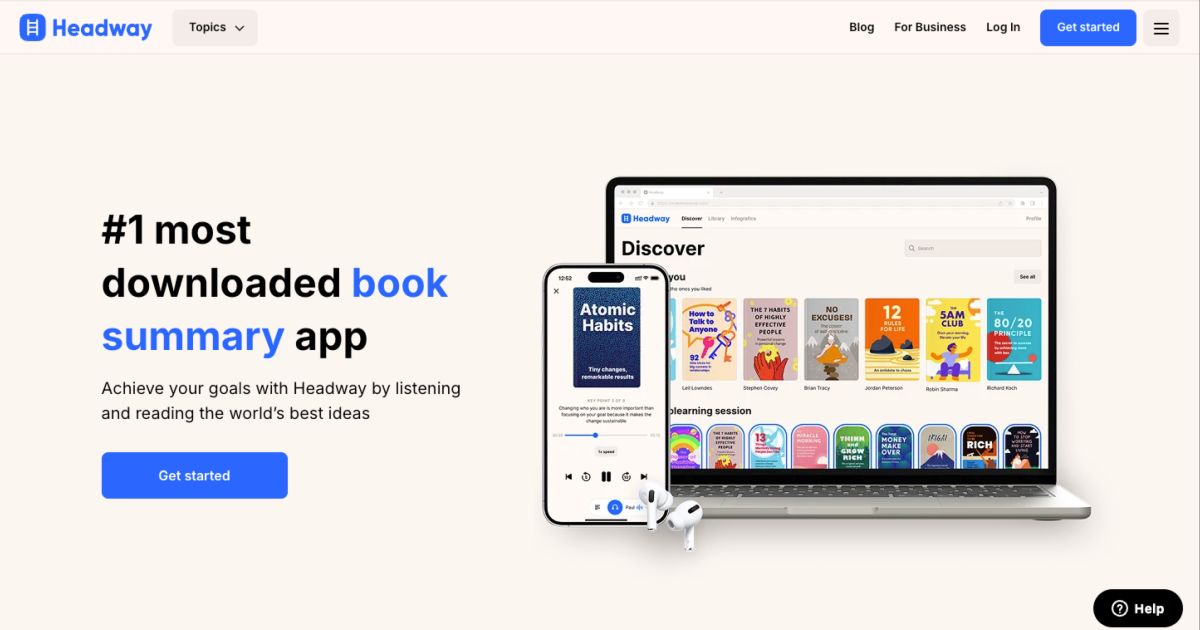
Blinkist's App Store listing says it summarizes ideas from 8,000+ books and podcasts in about 15 minutes (Blinkist App Store). Headway describes itself as a 15-minute book-summary app with expert-written content, audio narration, visuals, recommendations, and challenges (Headway). Imprint positions itself as a visual guide to knowledge across psychology, philosophy, history, finance, leadership, health, science, and technology (Imprint).
Those apps are useful if the object is a book, course, or visual lesson. They make long-form ideas portable. The tradeoff is that the catalog is still selected for you. If your phone moment starts with "why do owls fly silently?" or "why do companies buy back stock?" a book-summary catalog may be one layer too heavy.
Best curiosity app: MillionWhys
MillionWhys is built on a different bet: learning input is naturally fragmented. A human does not begin with a syllabus; a human begins with a question. The unit is deliberately tiny: see a question, predict, get feedback, read why, and leave with one closed gap plus a new one opening. That 10-second cycle is not a compromise. It is the native shape of everyday curiosity.
The positioning has three pillars. First: 10 seconds, not 10 minutes, because idle moments should not require a lesson contract. Second: curiosity, not guilt, because a daily habit should not punish rest days with streak anxiety. Third, and most important: emergent curriculum, not fixed catalog. In MillionWhys, the boundary is not a publisher's catalog or a course team's roadmap. The boundary is what people ask, what AI can help fact-check and structure, and what other curious people recognize as worth wondering about.
That makes it a poor substitute for a Spanish course or a calculus sequence. It makes it a strong substitute for empty phone time. If you want your mobile learning app to feel like a curious friend saying "wait, did you know why this happens?" this is the lane.
What people usually miss
The hidden choice is not free versus paid, or fun versus serious. It is whether the app's curriculum starts above you or inside you. Course apps start with a structure and ask you to enter it. Flashcard apps start with chosen material and ask you to retain it. Book-summary apps start with a catalog and ask you to sample it. MillionWhys starts with a small information gap and asks you to close it.
That gap is where curiosity is strongest: not when you know nothing, and not when the answer is obvious, but when you half-know enough to care. Good mobile learning should respect that. It should give closure, not just stimulation. It should leave a residue of knowledge, not just a completed progress animation.
Related videos
How to Create Engaging Microlearning for Mobile Devices
FAQ
What is the best mobile learning app in 2026?
There is no single best app for every job. Duolingo is strongest for language habit, Khan Academy for free academic learning, Brilliant for interactive math and coding, Quizlet and Anki for recall, book-summary apps for compressed reading, and MillionWhys for curiosity-led general knowledge.
What is the best free mobile learning app?
Khan Academy is the clearest free academic answer because its own downloads page says the apps are 100% free with no in-app purchases or subscriptions. Duolingo also offers free learning, with paid tiers available, especially for language learners.
Are flashcard apps good for learning new things?
They are best for remembering material you already chose. If your goal is discovery, a question-first app may fit better; if your goal is retention, Quizlet or Anki can be the stronger tool.
Are 15-minute learning apps better than 10-second learning?
They solve different moments. Fifteen minutes is useful for book summaries or lessons. Ten seconds is useful when curiosity appears in a tiny gap and you want one real answer before the moment disappears.
What does this have to do with AIgneous Million Whys?
MillionWhys is our answer to the mobile-learning gap most lists miss: the app for people who want to learn something new because a question caught them, not because a syllabus, streak, or deck told them to show up.
Sources
Duolingo launches 148 new language courses
Curious? Try one 👇
Why is the sky blue?
Jump into the daily quiz →Keep Exploring

Related Posts
Best Free Microlearning Apps 2026
Best free microlearning apps 2026: compare Duolingo, Khan Academy, Brilliant, Quizlet, Anki, Deepstash, and MillionWhys for tiny curiosity-led learning.
The Best Learning Apps of 2026: 8 Tools Ranked by How They Actually Teach
From Anki to Duolingo to MillionWhys — how 8 learning apps compare on retention, curriculum, adaptivity, and explanation quality. Pick the one that fits what you actually want out of your next 15 minutes.
Best Lifelong Learning Apps 2026: Curious Adults
Best lifelong learning apps 2026 for adults: compare Coursera, Khan, Brilliant, Blinkist, Duolingo, and MillionWhys by learning fit.