Trivia Quizzes With Answers
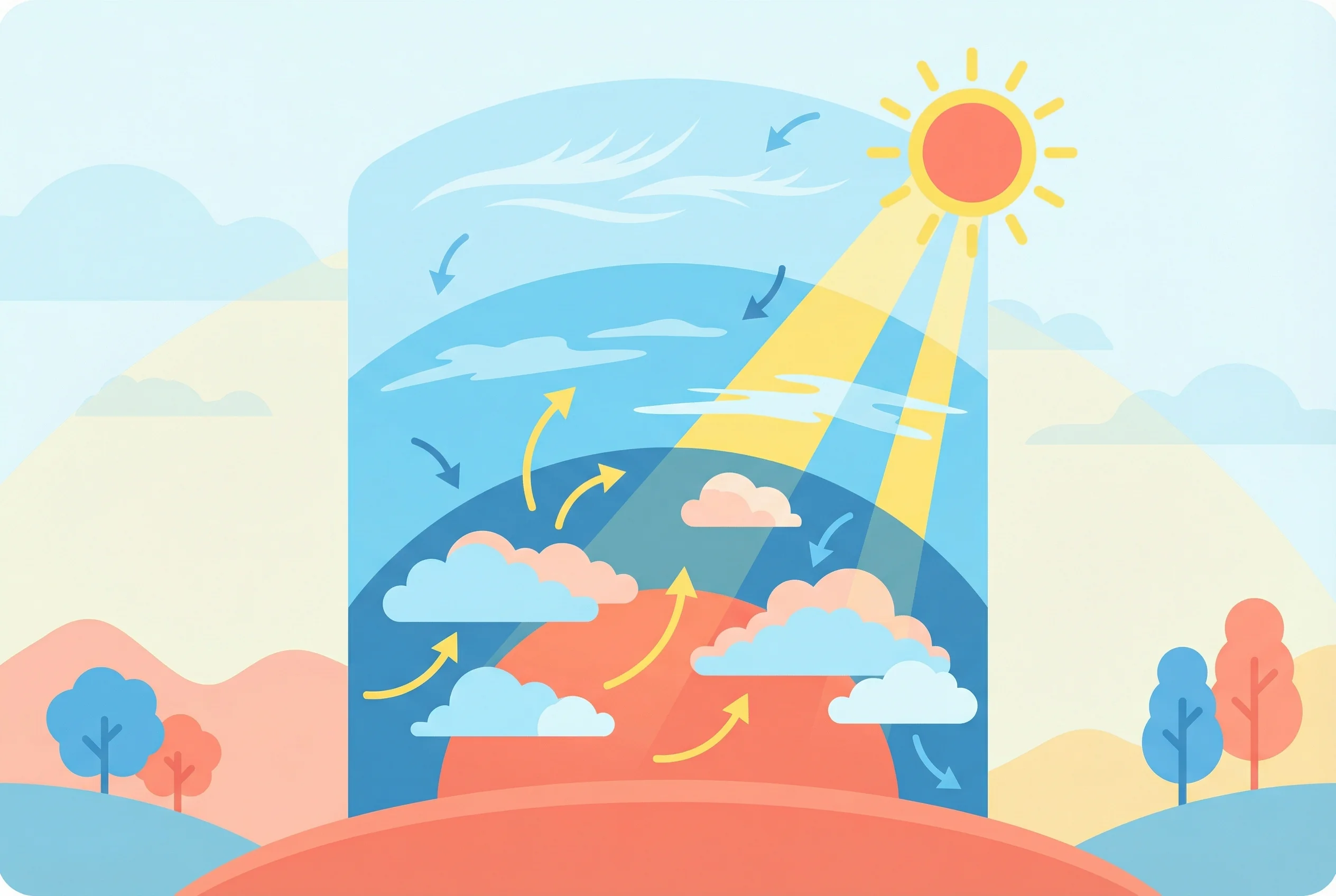
AThey block ocean currents and force air masses to rise over mountains
✓Correct — Continents act as physical barriers that redirect ocean currents and atmospheric circulation. When moisture-laden winds encounter mountain ranges, they are forced upward, cooling and releasing precipitation on the windward side while creating dry conditions on the leeward side. This is why the Himalayas create the monsoon climate in South Asia and rain shadows in Central Asia.
BThey generate magnetic fields that attract water vapor
✗Not quite — the answer is A. They block ocean currents and force air masses to rise over mountains. Continents do not generate significant magnetic fields that affect water vapor. Earth's magnetic field comes from its iron core, not from continental landmasses, and it does not attract or repel water molecules in the atmosphere.
CThey absorb more sunlight than oceans, creating heat islands
✗Not quite — the answer is A. They block ocean currents and force air masses to rise over mountains. While continents do heat and cool faster than oceans, they actually reflect more sunlight than dark ocean waters. The main climate effect comes from their role as barriers to air and water movement, not from heat absorption differences.
Answer this question
AEarth rotates 365 times yearly
✗Not quite — the answer is B. Time for Earth to orbit the Sun. Earth actually rotates about 366 times during one orbit of the Sun, not 365. We count 365 days because a 'day' is based on the Sun's position in the sky, which is affected by Earth's orbit as well as rotation.
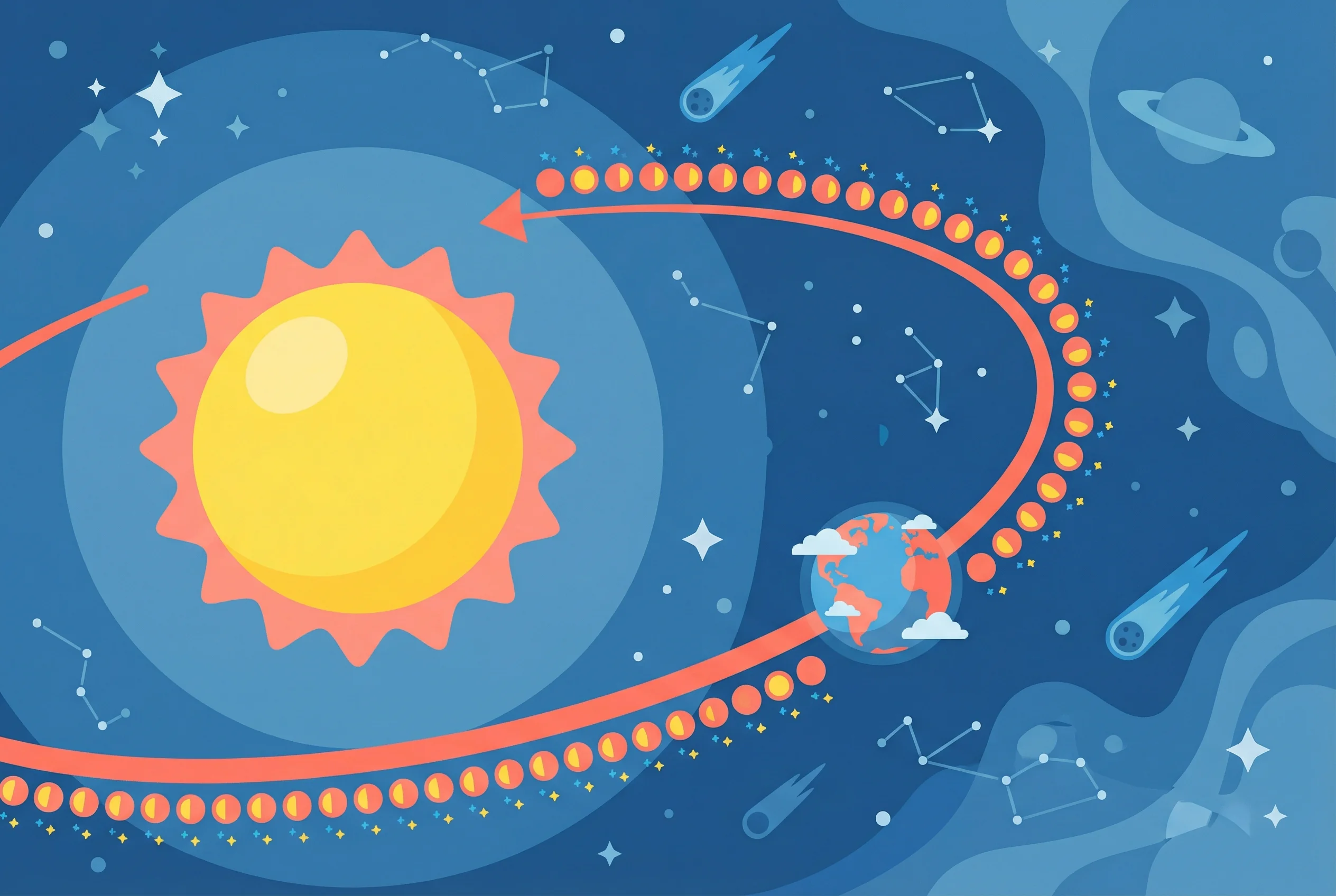
BTime for Earth to orbit the Sun
✓Correct — A year is defined by how long Earth takes to complete one full orbit around the Sun - approximately 365.25 days. This is determined by Earth's orbital distance (93 million miles) and speed (67,000 mph). We round to 365 days for convenience, adding a leap day every 4 years to account for the extra 0.25 days. This orbital period is a natural astronomical fact, not a human invention.
CThe Moon's cycle determines it
✗Not quite — the answer is B. Time for Earth to orbit the Sun. The Moon's cycle (29.5 days) doesn't determine Earth's year. Some ancient calendars were lunar-based, but Earth's year is determined by its orbit around the Sun. The Moon's orbit around Earth and Earth's orbit around the Sun are independent cycles.
Answer this question
AThe Pacific Plate has heavy edges sinking into the mantle, pulling it along
✓Correct — The Pacific Plate moves about 7-11 cm per year because it has subduction zones where heavy oceanic crust sinks into the mantle. This 'slab pull' force is the strongest driver of plate motion, much more powerful than the push from mid-ocean ridges. The African Plate, surrounded mostly by mid-ocean ridges with little subduction, moves only 2-3 cm per year.
BThe Pacific Plate is smaller and lighter, so it floats faster
✗Not quite — the answer is A. The Pacific Plate has heavy edges sinking into the mantle, pulling it along. Size and weight do not determine plate speed. In fact, the Pacific Plate is actually one of the largest plates on Earth, yet it moves fastest. What matters is the driving forces acting on the plate, particularly whether it has subducting edges that pull it forward through 'slab pull' force.
COcean water on the Pacific Plate makes it more slippery
✗Not quite — the answer is A. The Pacific Plate has heavy edges sinking into the mantle, pulling it along. Ocean water has no significant effect on plate movement. Plates move because of forces deep in the Earth's mantle, not surface conditions. The tectonic plates themselves are made of solid rock (oceanic or continental crust plus upper mantle), and they move through convection and gravitational forces, not sliding friction.
Answer this question
AHeavy clouds sink lower
✗Not quite — the answer is C. Temperature and moisture vary. Clouds don't sink from weight—they form at altitudes where temperature/moisture conditions allow condensation. Cloud type determines height.
BOlder clouds rise higher
✗Not quite — the answer is C. Temperature and moisture vary. Clouds don't age upward—they form at specific altitudes based on atmospheric conditions (temperature, moisture, stability).
CTemperature and moisture vary
✓Correct — Atmospheric layering! Cloud heights vary by type: (1) Low clouds (0-2km)—stratus, cumulus (warm, moist air). (2) Middle clouds (2-6km)—altostratus, altocumulus (cooler). (3) High clouds (6-12km)—cirrus, cirrostratus (cold, ice crystals). (4) Vertical clouds—cumulonimbus (ground to 12km+ in severe storms). Temperature decreases with altitude—determines where water vapor condenses. Dew point + temperature = cloud base. Stable air: layered clouds. Unstable: vertical development. Lenticular clouds: mountain waves!
Answer this question
Why these answers go further
Trivia quizzes with answers work best when the answer is more than a letter on a key. The reveal should close the loop: why ocean tides follow the Moon, why some buildings survive earthquakes, why buses bunch together, or why a plastic bottle cracks. Use these as ready-made rounds, or follow the play links when one question catches your curiosity.
Want a fresh question instead of another long list? Make one guess, reveal the answer and the explanation for every choice, then compare your result with today's global accuracy.
Try the trivia question of the day →Trivia With Answers
ATo prevent subscribers from canceling between weekly episodes
✓Correct — This is called the 'binge model' and it is a strategic business decision. When episodes release weekly, subscribers might watch the show, cancel their subscription, then re-subscribe months later for the next season. By releasing all episodes at once, streaming services keep subscribers engaged and paying continuously. Netflix pioneered this model with 'House of Cards' in 2013, creating 'appointment viewing' events where everyone watches together, generating buzz and making the subscription feel essential. Studies show binge-release reduces monthly churn by 5-15% compared to weekly releases.
BBecause it costs less to upload all episodes simultaneously
✗Not quite — the answer is A. To prevent subscribers from canceling between weekly episodes. Uploading costs are essentially the same whether episodes go up all at once or weekly - the total data transferred is identical. In fact, weekly releases can be slightly easier on infrastructure since they spread the initial upload workload. The real reason is subscriber retention: streaming services want to keep you paying month after month, and binge releases prevent the 'watch-and-cancel' behavior where viewers subscribe for one episode, then cancel until the next week.
CTo reduce server load by spreading viewing across the month
✗Not quite — the answer is A. To prevent subscribers from canceling between weekly episodes. Actually, the opposite is true! When entire seasons drop at once, millions of subscribers rush to watch simultaneously, creating massive server spikes on release day. Weekly releases would actually spread server load more evenly across weeks. Netflix has had to invest heavily in content delivery networks (CDNs) precisely because binge releases create traffic tsunamis. The real reason is economics: keeping subscribers from the 'subscribe-watch-cancel-resubscribe' cycle that weekly releases enable.
Answer this question
AReleasing germs via exhaled carbon dioxide
✗Not quite — the answer is C. Expelling infectious droplets into the air. Carbon dioxide is a gas and does not carry germs. Germs are carried in moisture droplets expelled during coughs. In fact, regular breathing spreads far fewer germs than a single cough, which propels droplets at high speed.
BMixing germs with saliva for better spread
✗Not quite — the answer is C. Expelling infectious droplets into the air. Almost! Saliva does contain germs, but the key mechanism is the high-speed airflow from the lungs. A cough involves a deep breath and violent contraction of abdominal muscles, propelling droplets at over 100 km/h, far beyond simple mixing.
CExpelling infectious droplets into the air
✓Correct — That's right! Coughing uses your diaphragm and chest muscles to forcefully expel air, carrying tiny germ-filled droplets. These droplets can travel up to 2 meters and linger in the air, making inhalation by others likely.
Answer this question
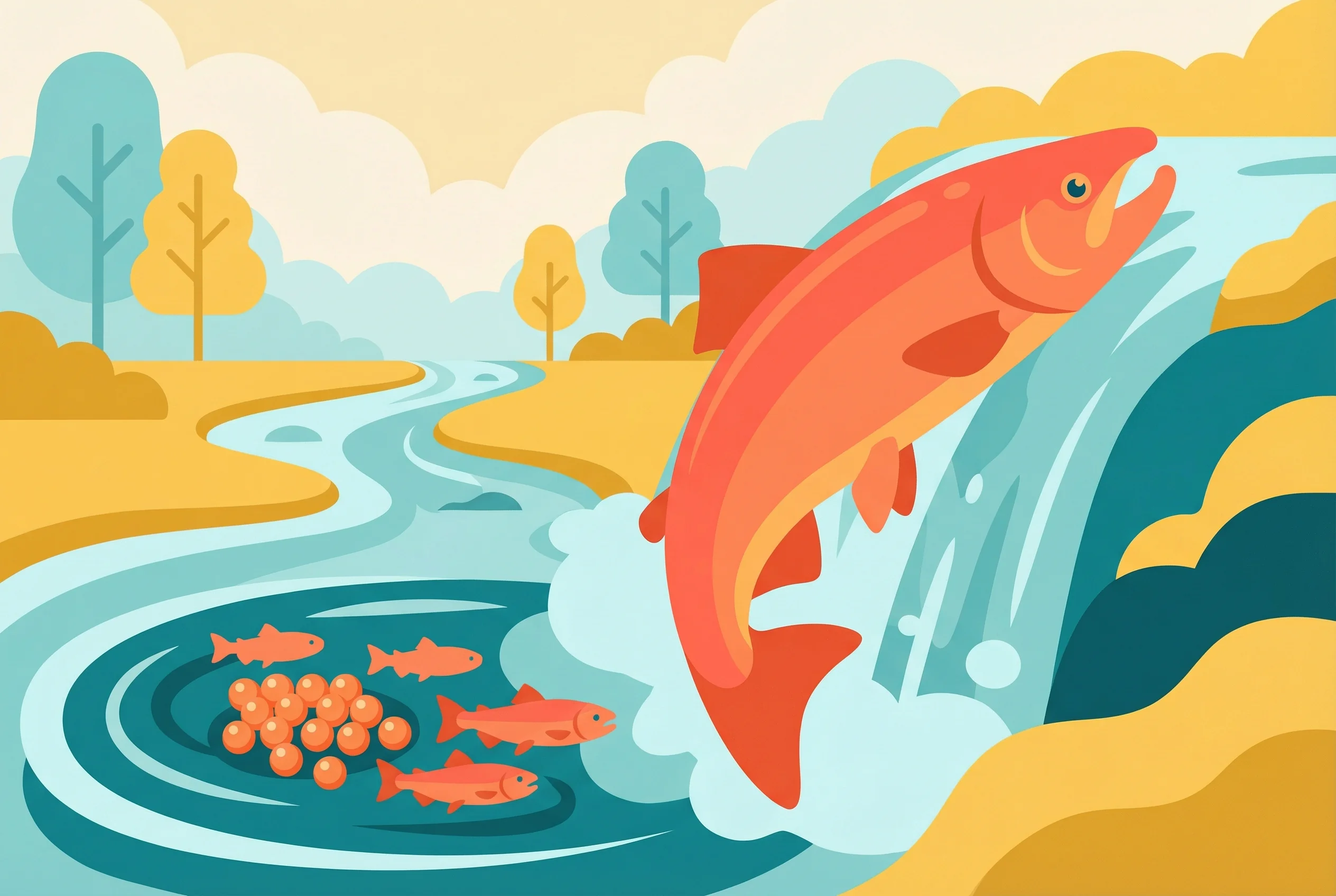
AEscaping ocean predators
✗Not quite — the answer is B. Spawning in birthplace. Ocean has predators, but upstream migration is for reproduction—returning to natal streams to spawn.
BSpawning in birthplace
✓Correct — Natal homing! Salmon return to birthplace to spawn: (1) Imprinting—remember birth stream's chemical signature. (2) Olfactory navigation—follow scent upstream. (3) best conditions—gravel beds for eggs. Incredible journey: hundreds of miles, swimming against current, jumping waterfalls. Anadromous life cycle—born in freshwater, mature in ocean, return to spawn. Most Pacific salmon die after spawning (semelparous). Exhausting migration—use all energy reserves. Magnetic sense aids ocean navigation!
CSearching for more food
✗Not quite — the answer is B. Spawning in birthplace. Salmon don't feed during spawning migration—use stored energy. Upstream journey is reproduction-driven, not foraging.
Answer this question
ACooling system in Arctic
✗Not quite — the answer is B. Camouflage in snow and ice. Arctic doesn't need cooling—needs insulation! White fur provides camouflage. Black skin underneath actually absorbs heat.
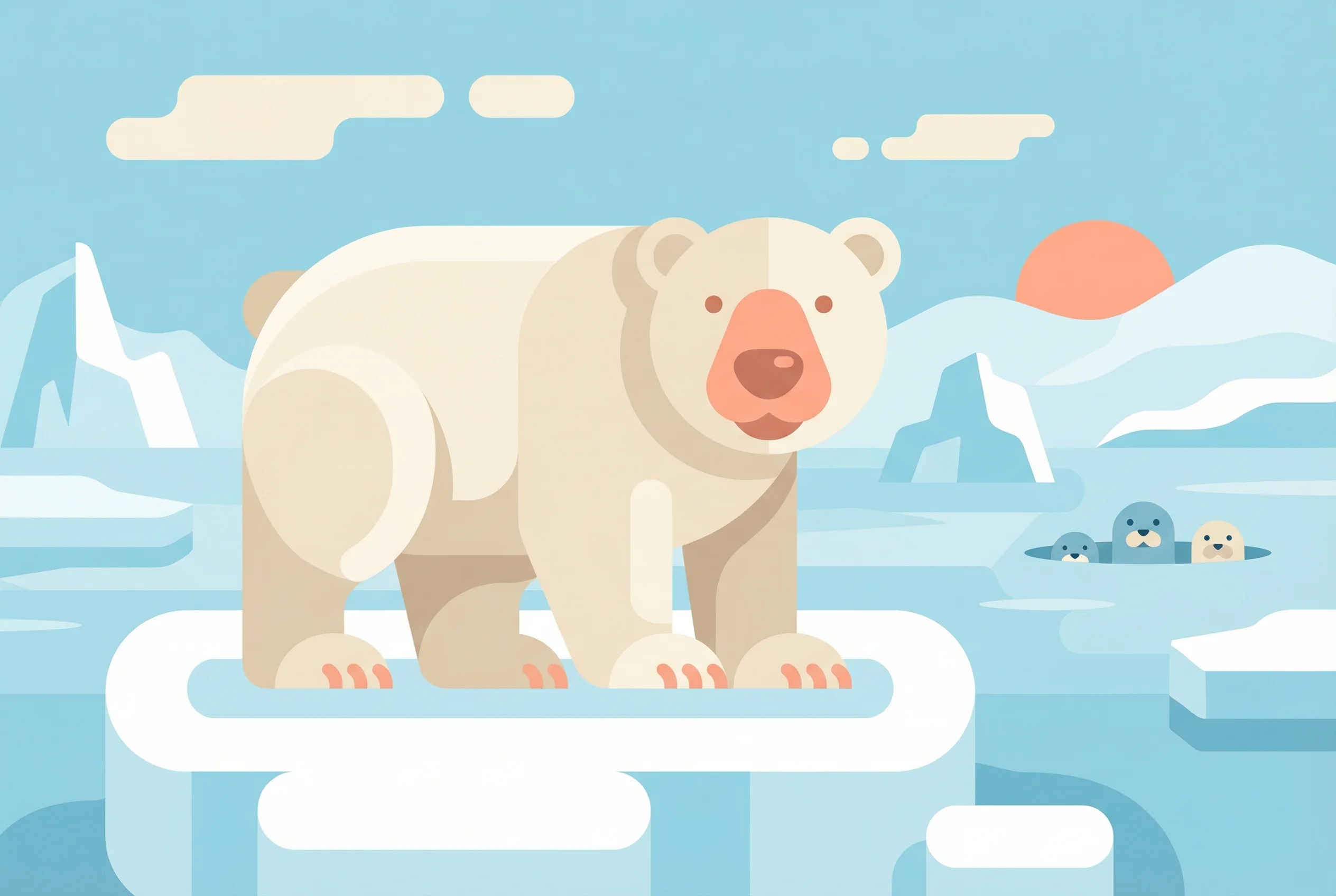
BCamouflage in snow and ice
✓Correct — Arctic camouflage! Polar bear fur appears white: (1) Camouflage—blends with snow/ice during seal hunting (stalking). (2) Individual hairs are transparent, hollow—scatter light (appears white). (3) Skin underneath is black—absorbs heat. Fur isn't actually white—light reflection creates color. Can appear yellow/brown from oxidation/algae. Dense undercoat + guard hairs insulate. Cubs born with white fur. Excellent stealth predator—seals don't see approach!
CWhite attracts prey animals
✗Not quite — the answer is B. Camouflage in snow and ice. White doesn't attract prey—it conceals predator. Polar bears hunt seals, using white fur as camouflage on ice.
Answer this question
Trivia Quiz Questions
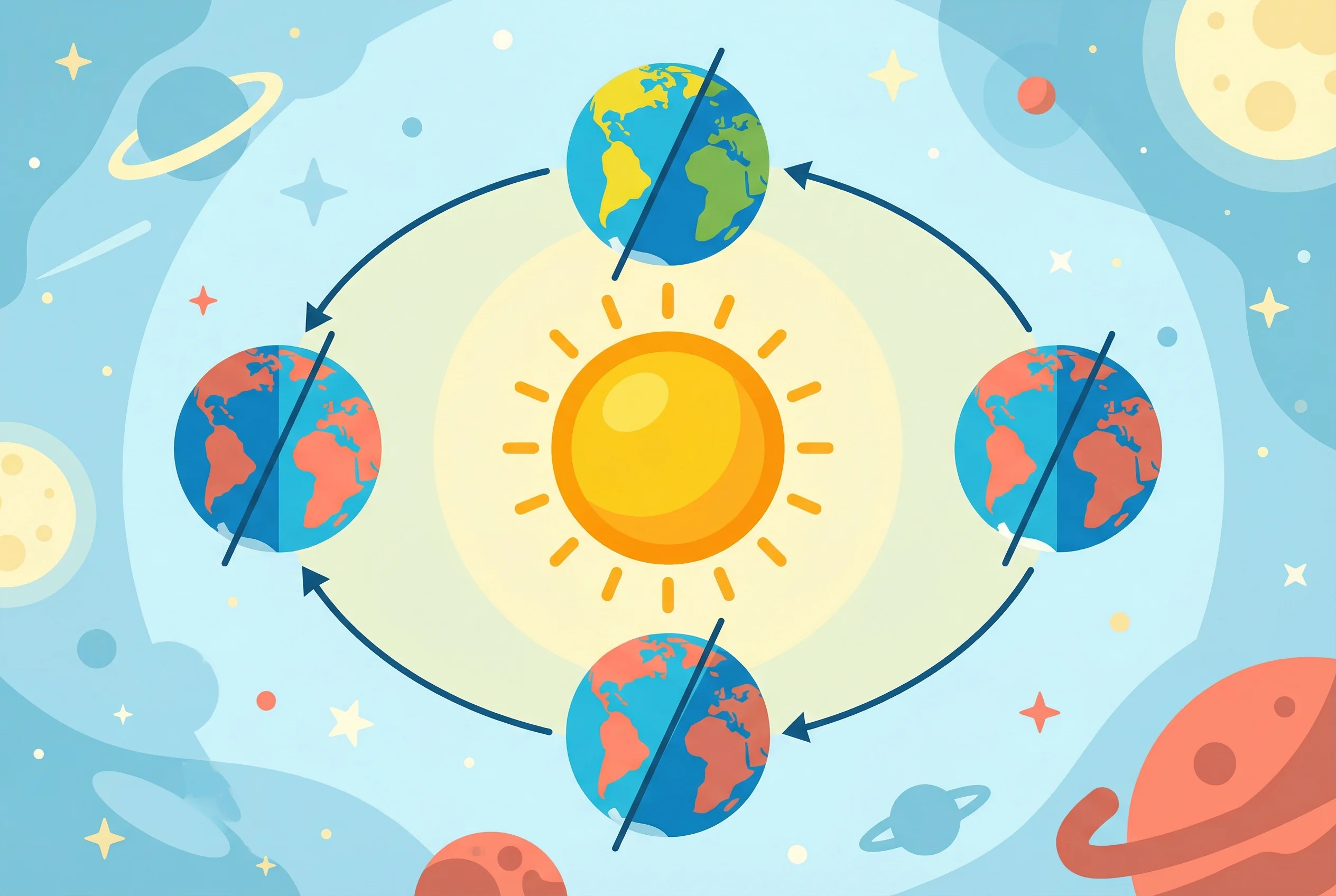
AEarth's axis is tilted
✓Correct — Earth's axis is tilted 23.5° from vertical. As Earth orbits the Sun, this tilt means the Northern Hemisphere points toward the Sun in June (summer there) and away in December (winter). When tilted toward the Sun, that hemisphere gets more direct sunlight and longer days, creating summer. The opposite hemisphere experiences winter. This tilt causes seasons.
BThe Sun's heat output changes
✗Not quite — the answer is A. Earth's axis is tilted. The Sun's energy output is remarkably constant over short timescales like years. Small variations (about 0.1%) follow an 11-year solar cycle, but this doesn't cause our annual seasons.
CEarth's speed varies in orbit
✗Not quite — the answer is A. Earth's axis is tilted. Earth's orbital speed doesn't cause seasons—Earth moves at nearly constant speed throughout its orbit. The 23.5° axial tilt is responsible for the dramatic seasonal temperature and daylight changes we experience.
Answer this question
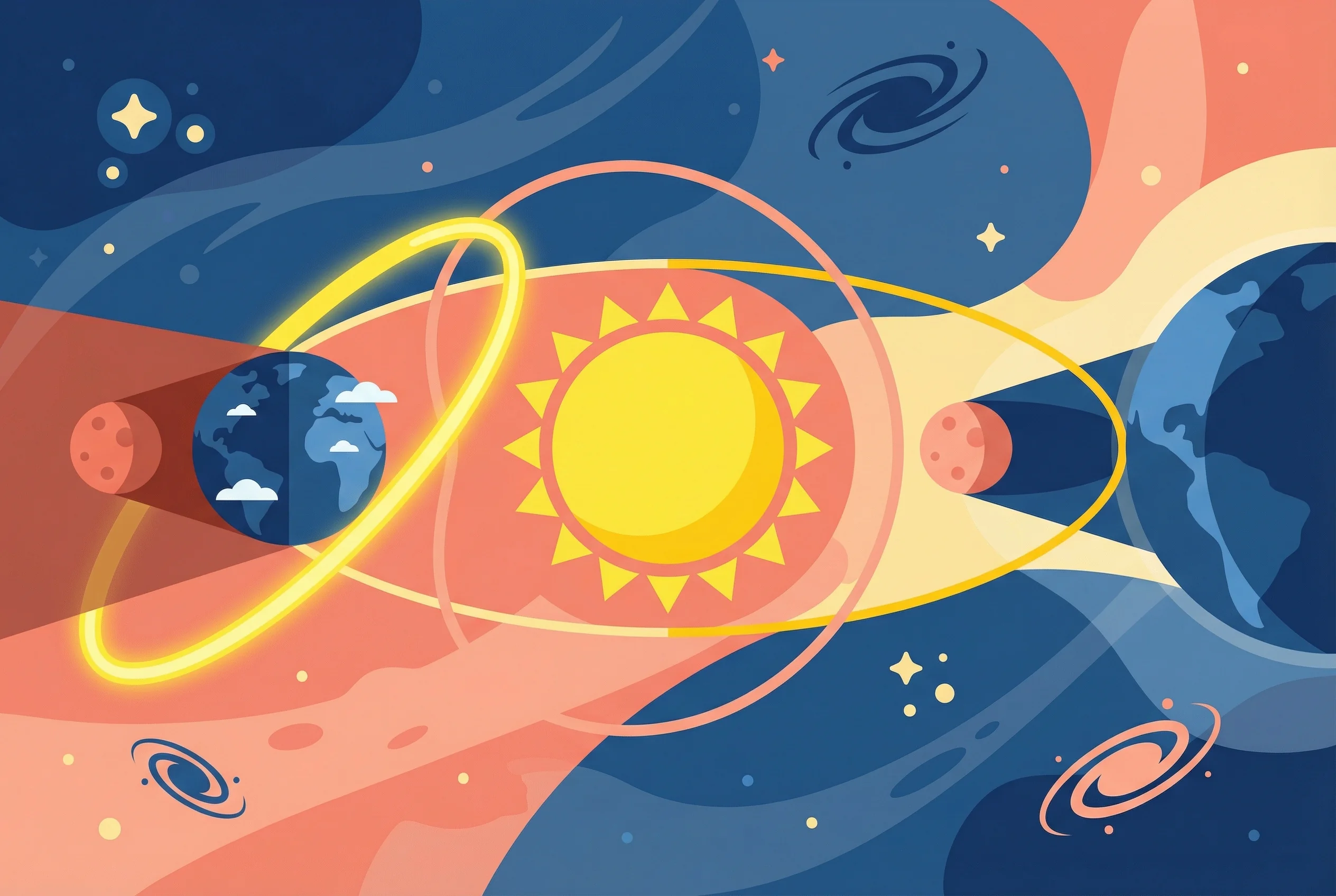
AMoon blocks or enters shadow
✓Correct — Solar eclipse: Moon passes between Sun and Earth, blocking sunlight and casting a shadow on Earth. This only happens at new moon when all three align. Lunar eclipse: Earth passes between Sun and Moon, and Earth's shadow falls on the Moon. This only happens at full moon. We don't get eclipses every month because the Moon's orbit is tilted 5° to Earth's orbit, so alignment is rare.
BSun's light dims periodically
✗Not quite — the answer is A. Moon blocks or enters shadow. The Sun's brightness is remarkably constant. It doesn't dim on a predictable schedule. Eclipses are caused by the Moon blocking the Sun's light (solar eclipse) or Earth's shadow falling on the Moon (lunar eclipse), not by changes in the Sun itself.
CEarth's rotation causes them
✗Not quite — the answer is A. Moon blocks or enters shadow. Earth's rotation causes day and night but doesn't cause eclipses. Eclipses require the Sun, Moon, and Earth to align in specific ways during the Moon's orbit around Earth. This alignment only happens occasionally, not daily as rotation would suggest.
Answer this question

ASun's gravity pulls them
✓Correct — The Sun contains 99.8% of our solar system's mass, creating enormous gravitational pull. Planets would fly off in straight lines, but the Sun's gravity constantly pulls them inward. The result is a balance: the planet's forward motion combined with inward gravitational pull creates a curved orbit. The stronger the Sun's gravity and the closer the planet, the faster it must move to maintain orbit. This is why Mercury orbits in 88 days while Neptune takes 165 years.
BMagnetic forces attract them
✗Not quite — the answer is A. Sun's gravity pulls them. While the Sun and planets have magnetic fields, these forces are extremely weak compared to gravity. Magnetic forces affect charged particles and some spacecraft, but they don't control planetary orbits. Gravity is the dominant force keeping planets in orbit.
CSpace vacuum pulls them inward
✗Not quite — the answer is A. Sun's gravity pulls them. Vacuum doesn't pull or push anything—it's simply empty space. Planets orbit because the Sun's gravity attracts them, not because space itself exerts any force.
Answer this question
AMoon's light heats the water
✗Not quite — the answer is B. Moon's gravity pulls the water. Moonlight is just reflected sunlight and is very weak - it doesn't heat the ocean significantly. Temperature changes don't cause the regular twice-daily tides we observe. The tides are caused by gravitational forces, not thermal effects.
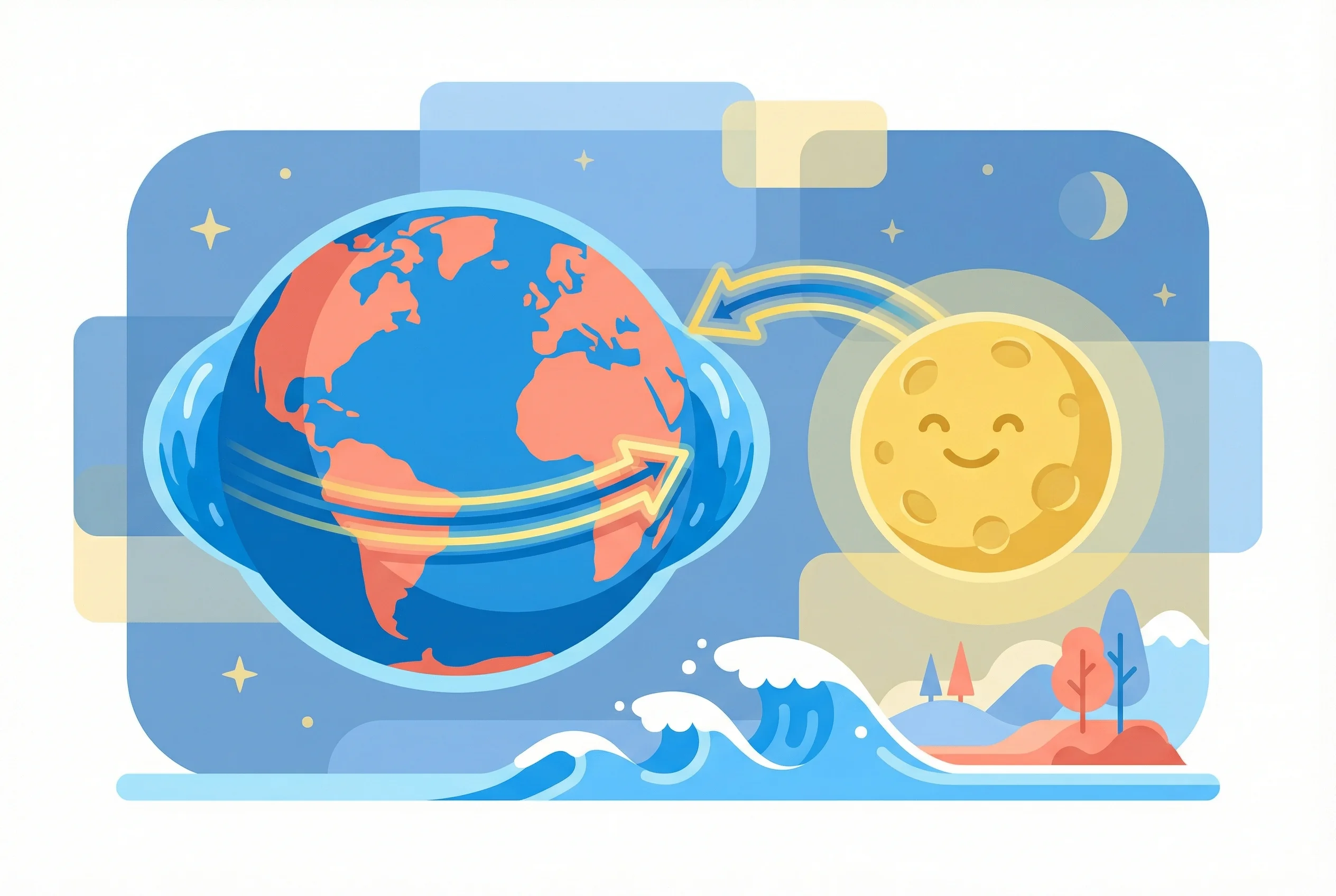
BMoon's gravity pulls the water
✓Correct — The Moon's gravity pulls on Earth's oceans. The side of Earth facing the Moon experiences stronger pull, creating a bulge of water (high tide). Surprisingly, the opposite side also gets high tide because Earth itself is pulled more than that distant water, leaving it 'behind' in a bulge. As Earth rotates, locations pass through these bulges, experiencing two high tides daily (every 12.4 hours). The Sun also affects tides but less strongly due to greater distance.
CMoon's magnetism attracts water
✗Not quite — the answer is B. Moon's gravity pulls the water. The Moon has no significant magnetic field, and water isn't magnetically attracted anyway. Tides are caused by gravitational pull, not magnetism.
Answer this question
General Knowledge Quiz With Answers
AThe stress exceeds the plastic's elastic limit, breaking molecular chains
✓Correct — Plastic bottles are made of polymers - long molecular chains. When you squeeze gently, these chains stretch and slide past each other, then return to their original position. But when force exceeds the elastic limit, the bonds between molecules break permanently, creating cracks. This is why the bottle cannot return to its original shape after cracking.
BAir pressure inside builds up until it explodes the plastic
✗Not quite — the answer is A. The stress exceeds the plastic's elastic limit, breaking molecular chains. While squeezing does slightly increase internal air pressure, this pressure is far too small to crack the bottle. The cracking happens because the plastic material itself is being deformed beyond its breaking point. If air pressure were the cause, the bottle would bulge outward uniformly rather than crack at stress concentration points.
CHeat from your hand melts and weakens the plastic structure
✗Not quite — the answer is A. The stress exceeds the plastic's elastic limit, breaking molecular chains. Your hand's warmth (around 37°C) is nowhere near hot enough to melt plastic. Most plastic bottles are made from PET, which melts at about 260°C. The cracking occurs due to mechanical stress, not thermal effects. Even holding a bottle for hours would not soften it enough to cause cracking.
Answer this question
AThey predict turbulent airflow patterns that create noise around the car
✓Correct — The Navier-Stokes equations simulate how air flows around a car's surface. When air separates from the body or hits sharp edges, it creates turbulent vortices and pressure waves that generate 'wind noise.' Engineers use these simulations to identify problem areas like side mirrors, door seams, and roof edges, then redesign them with smoother shapes to reduce turbulence and noise.
BThey calculate the exact sound frequency produced by the car engine
✗Not quite — the answer is A. They predict turbulent airflow patterns that create noise around the car. While the Navier-Stokes equations describe fluid motion, they do not directly calculate engine sound frequencies. Engine noise is a mechanical vibration problem, not an aerodynamic one. The equations help with wind noise (air flowing over the car), not engine noise.
CThey measure the thickness of soundproof materials needed for the car
✗Not quite — the answer is A. They predict turbulent airflow patterns that create noise around the car. The Navier-Stokes equations model fluid dynamics, not material properties. They cannot determine soundproofing material thickness. Those calculations require acoustic engineering methods that consider material density, absorption coefficients, and vibration damping, which are separate from airflow analysis.
Answer this question
AAngular momentum conservation keeps the spinning axis stable
✓Correct — When a gyroscope spins, it has angular momentum - a property of rotating objects that resists change. Any force trying to tip it creates a perpendicular motion (precession) rather than tipping, keeping the axis stable. This is why spacecraft and smartphones use gyroscopes for orientation sensing.
BStrong magnets inside counteract Earth's gravitational pull
✗Not quite — the answer is A. Angular momentum conservation keeps the spinning axis stable. Gyroscopes do not use magnets to stay upright. Their stability comes purely from the physics of rotation. While magnets can create levitation effects, the gyroscope's resistance to tipping is entirely due to conservation of angular momentum in the spinning mass.
CRapid spinning creates an anti-gravity force field
✗Not quite — the answer is A. Angular momentum conservation keeps the spinning axis stable. There is no 'anti-gravity field' created by spinning. Gravity still acts on the gyroscope normally - it has weight. The gyroscope appears to defy gravity because the rotational inertia makes it respond to gravitational torque by precessing (rotating sideways) rather than falling over.
Answer this question
ASilk has very fine fibers woven tightly, burlap has thick fibers woven loosely
✓Correct — Silk fibers are extremely fine (10-25 micrometers) and woven very tightly, creating a smooth surface with minimal friction against your skin. Burlap uses thick jute fibers (100-200 micrometers) woven loosely, leaving gaps and rough edges that create friction. The combination of fiber thickness and weave density determines how fabric feels.
BSilk is always wet from special oils, burlap is completely dry
✗Not quite — the answer is A. Silk has very fine fibers woven tightly, burlap has thick fibers woven loosely. Silk is not wet from oils. While silk does have a natural protein coating called sericin that gives it some sheen, this coating is actually removed during processing. The smoothness comes from the fine diameter and tight weave of silk fibers, not moisture. Burlap's roughness is due to thick, coarse fibers, not dryness.
CSilk fibers are flat and hard, burlap fibers are round and soft
✗Not quite — the answer is A. Silk has very fine fibers woven tightly, burlap has thick fibers woven loosely. Actually, it's the opposite! Silk fibers are round and flexible, while burlap (jute) fibers are stiffer and more irregular in shape. Silk feels smooth because the fine, round fibers pack closely together in the weave. Burlap feels rough because its thick, stiff fibers stick out at various angles, creating an uneven surface.
Answer this question
Hard Trivia Questions With Answers
APlates grinding against each other build up stress that suddenly releases
✓Correct — At plate boundaries, tectonic plates move past, toward, or away from each other. This movement creates enormous friction and stress in the rocks. When the stress exceeds the strength of the rock, it suddenly breaks along faults, releasing the stored energy as seismic waves we call earthquakes. This is why about 90% of earthquakes occur at plate boundaries.
BPlate boundaries have thinner crust that breaks more easily
✗Not quite — the answer is A. Plates grinding against each other build up stress that suddenly releases. While crust thickness varies, plate boundaries do not necessarily have thinner crust. In fact, at convergent boundaries where plates collide, the crust can be very thick (like under the Himalayas). Earthquakes occur due to the stress from plate movement, not crust thickness.
CThe Earth's core heats these areas more, causing rock to crack
✗Not quite — the answer is A. Plates grinding against each other build up stress that suddenly releases. The Earth's core heats all parts of the planet relatively uniformly through the mantle. Plate boundaries are not preferentially heated. Earthquakes result from mechanical stress due to plate motion, not from thermal expansion or heat-induced cracking of rocks.
Answer this question
AMarching in step creates resonance that can amplify vibrations dangerously
✓Correct — When many people march in perfect rhythm, their footsteps create periodic forces at a specific frequency. If this frequency matches the bridge's natural resonant frequency, the oscillations amplify exponentially through resonance - like pushing a swing at just the right moment. The 1850 Angers Bridge collapse in France killed 226 soldiers due to this phenomenon, leading militaries worldwide to adopt the 'break step' rule when crossing bridges.
BThe combined weight is too heavy if they step together
✗Not quite — the answer is A. Marching in step creates resonance that can amplify vibrations dangerously. The total weight of soldiers is the same whether they march in step or not - weight does not change based on timing of footsteps. Modern bridges are designed to hold far more weight than a group of soldiers. The real danger comes from the rhythmic timing of forces, not the total force magnitude.
CSynchronized movement creates excessive wind resistance
✗Not quite — the answer is A. Marching in step creates resonance that can amplify vibrations dangerously. Wind resistance is negligible for human walking speeds and has nothing to do with bridge safety. The danger comes from mechanical resonance - when periodic forces match a structure's natural frequency. This is a vibration phenomenon, not an aerodynamic one. Even in still air with no wind, marching in step remains dangerous on certain bridges.
Answer this question
AMillions of tiny hairs create molecular attraction forces
✓Correct — Each gecko foot has about 500,000 setae (tiny hairs), and each seta splits into hundreds of even smaller tips. These create van der Waals forces - weak electrical attractions between molecules that become incredibly strong when multiplied millions of times. A gecko can support its entire body weight with just one toe!
BTheir feet secrete a sticky glue-like substance
✗Not quite — the answer is A. Millions of tiny hairs create molecular attraction forces. Geckos do not produce any adhesive secretions. Their feet remain completely dry. If they used glue, their feet would get dirty and lose sticking power, plus they would not be able to detach quickly to run at high speeds. The adhesion is purely physical, not chemical.
CTiny suction cups on their toes create vacuum pressure
✗Not quite — the answer is A. Millions of tiny hairs create molecular attraction forces. Gecko feet have no suction cups and do not create vacuum. Suction would not work on porous surfaces like tree bark, yet geckos climb those easily. Also, suction requires creating an air-tight seal, which would prevent the rapid foot movements geckos make when running on walls.
Answer this question
AChaotic flows in molten iron core reorganize and flip polarity
✓Correct — Earth's magnetic field is generated by a 'geodynamo' - the movement of electrically conducting molten iron in the outer core. These flows are turbulent and chaotic, like weather patterns. Occasionally, the flow patterns reorganize into the opposite configuration, causing the magnetic poles to flip. This process typically takes 1,000 to 10,000 years and has happened hundreds of times throughout Earth's history.
BThe Sun's gravity pulls and twists Earth's magnetic field
✗Not quite — the answer is A. Chaotic flows in molten iron core reorganize and flip polarity. While the Sun does produce a magnetic field and solar wind, it does not control Earth's internal magnetic field. Earth's magnetism is generated deep inside our planet by movements in the molten iron core, independent of external influences. The Sun's magnetic field actually interacts with Earth's field to create phenomena like auroras, but cannot cause pole reversals.
CContinental drift pushes magnetic rocks to opposite hemispheres
✗Not quite — the answer is A. Chaotic flows in molten iron core reorganize and flip polarity. Continental drift moves tectonic plates at the surface, but Earth's magnetic field originates from the liquid outer core about 3,000 kilometers below the surface. While rocks can record the direction of past magnetic fields (providing evidence of reversals), the movement of magnetic rocks at the surface cannot influence or cause the deep core processes that generate the magnetic field.
Answer this question
Multiple Choice Quiz With Answers
AThe earthquake's wave frequency matches the building's natural vibration frequency
✓Correct — This is called 'resonance'. Every building has a natural frequency at which it vibrates. When earthquake waves match this frequency, the building's swaying gets amplified dramatically, like pushing a swing at just the right moment. A 10-story building might collapse in an earthquake that a 5-story building survives, simply because the wave frequency matched the taller building's natural rhythm. Engineers study this to design earthquake-resistant structures.
BTaller buildings are always weaker and collapse first during any earthquake
✗Not quite — the answer is A. The earthquake's wave frequency matches the building's natural vibration frequency. Height alone doesn't determine survival. A well-designed tall building can survive better than a poorly designed short one. What matters is whether the earthquake's shaking frequency matches the building's natural vibration frequency. In fact, different height buildings have different natural frequencies, so the same earthquake might devastate 8-story buildings while leaving 3-story and 20-story buildings relatively intact.
CThe earthquake shakes harder near buildings made of concrete than steel
✗Not quite — the answer is A. The earthquake's wave frequency matches the building's natural vibration frequency. Earthquakes release seismic waves that travel uniformly through the ground regardless of what buildings are nearby. The material of a building doesn't change how hard the ground shakes. However, different materials respond differently to shaking. The key factor is resonance: when the earthquake's frequency matches a building's natural frequency, that specific building experiences amplified motion, regardless of its construction material.
Answer this question
AHot water evaporates more, losing mass and creating convection that speeds cooling
✓Correct — This is the Mpemba effect. Hot water loses mass through faster evaporation, meaning less water needs to freeze. Additionally, hot water creates stronger convection currents that distribute cold more efficiently, and some scientists believe the hydrogen bonds in hot water are stretched differently, allowing faster crystallization when cooling begins.
BHot water has more energy so it releases cold faster when temperature drops
✗Not quite — the answer is A. Hot water evaporates more, losing mass and creating convection that speeds cooling. This explanation confuses energy concepts. While hot water does have more thermal energy initially, it does not 'release cold' - cold is simply the absence of heat. The hot water must lose MORE energy to reach freezing point, which would normally make it slower, not faster. The Mpemba effect works through evaporation and convection, not energy release.
CThe container holding hot water conducts heat better than one with cold water
✗Not quite — the answer is A. Hot water evaporates more, losing mass and creating convection that speeds cooling. The container material does not change based on water temperature. The same container holds both hot and cold water, so its thermal conductivity remains constant. The Mpemba effect is about properties of the water itself - evaporation rate, convection patterns, and molecular behavior - not differences in the container.
Answer this question
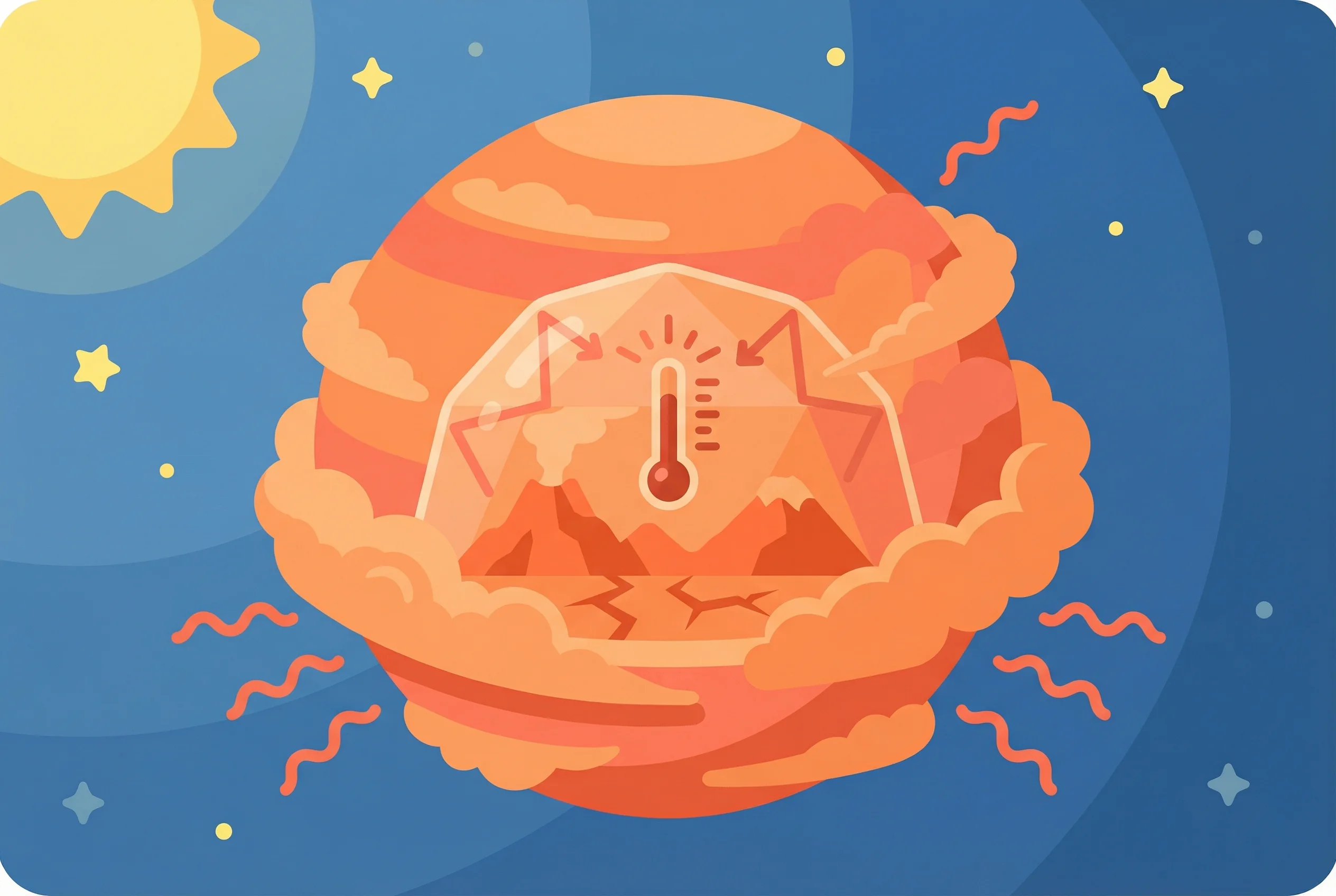
AThick CO₂ atmosphere traps heat
✓Correct — Venus has a runaway greenhouse effect. Its atmosphere is 96% carbon dioxide and 90 times thicker than Earth's - like being 900 meters underwater! Sunlight passes through but heat can't escape. This trapped heat raises surface temperature to 464°C (867°F) - hot enough to melt lead. The thick clouds of sulfuric acid reflect sunlight but also trap heat. Even though Mercury is closer to the Sun, Venus is hotter because of this extreme atmospheric insulation.
BVolcanoes heat the surface
✗Not quite — the answer is A. Thick CO₂ atmosphere traps heat. While Venus may have some volcanic activity, active volcanoes don't significantly contribute to its extreme surface temperature. The heat comes from solar energy trapped by the thick CO₂ atmosphere (greenhouse effect), not from internal volcanic heat.
CIts core is extremely hot
✗Not quite — the answer is A. Thick CO₂ atmosphere traps heat. All planets have hot cores, but core heat doesn't significantly warm the surface. Venus's extreme 464°C surface temperature is caused by its thick CO₂ atmosphere trapping solar heat (greenhouse effect), not by heat from its interior rising to the surface.
Answer this question
ASo guests can spend money on food and souvenirs while waiting
✓Correct — Theme parks discovered that guests standing in physical lines for hours generate zero revenue during that time. Virtual queues free people to shop, eat, and enjoy other attractions while waiting. Disney found that guests with virtual queue reservations spend 20-30% more money per visit because they have time to browse shops and restaurants instead of being trapped in line. This system turns 'dead time' into profitable time while also improving guest satisfaction.
BBecause virtual systems are cheaper to maintain than physical barriers
✗Not quite — the answer is A. So guests can spend money on food and souvenirs while waiting. Virtual queue systems actually require MORE technology investment and maintenance than simple physical barriers. Parks need complex apps, servers, databases, and technical support staff to run virtual queues. Physical lines just need rope barriers or metal railings that last for years with minimal upkeep. The real benefit is not cost savings but revenue generation from freed-up guests.
CTo reduce the number of staff needed to manage crowds
✗Not quite — the answer is A. So guests can spend money on food and souvenirs while waiting. Virtual queue systems often require MORE staff, not fewer. Parks need technical support teams, customer service representatives to help guests use apps, staff to enforce virtual queue rules, and employees to manage the merge points where virtual and standby lines combine. Physical lines are actually simpler to manage. The true advantage is that freed guests generate more revenue by visiting shops and restaurants while waiting.
Answer this question
Printable Trivia Questions and Answers
AMost people's work schedules align around similar times
✓Correct — Rush hour emerges because millions of workers independently choose to commute around 8-9 AM (arriving at work) and 5-6 PM (leaving work). This synchronized behavior creates predictable traffic waves. It's an example of 'emergent behavior' - no central planner creates rush hour, yet it appears reliably because individual decisions follow similar patterns (standard work hours). Even without coordination, the simple rule of 'be at work by 9 AM' generates the complex pattern of rush hour traffic.
BTraffic lights are programmed to create congestion at those times
✗Not quite — the answer is A. Most people's work schedules align around similar times. Traffic lights respond to traffic flow - they don't create it. Modern traffic systems actually try to reduce congestion by adjusting signal timing. Rush hour exists because of human commute patterns, not traffic light programming. If lights caused rush hour, we'd see random congestion throughout the day rather than the predictable morning and evening peaks that align with work schedules.
CRoads naturally become slower during morning and evening
✗Not quite — the answer is A. Most people's work schedules align around similar times. Roads don't have inherent properties that make them slower at specific times. The same road can be empty at 2 AM and congested at 8 AM - the physical road hasn't changed. Rush hour occurs because of human behavior patterns (synchronized commuting), not road characteristics. This demonstrates how 'emergent patterns' arise from collective behavior rather than system properties.
Answer this question
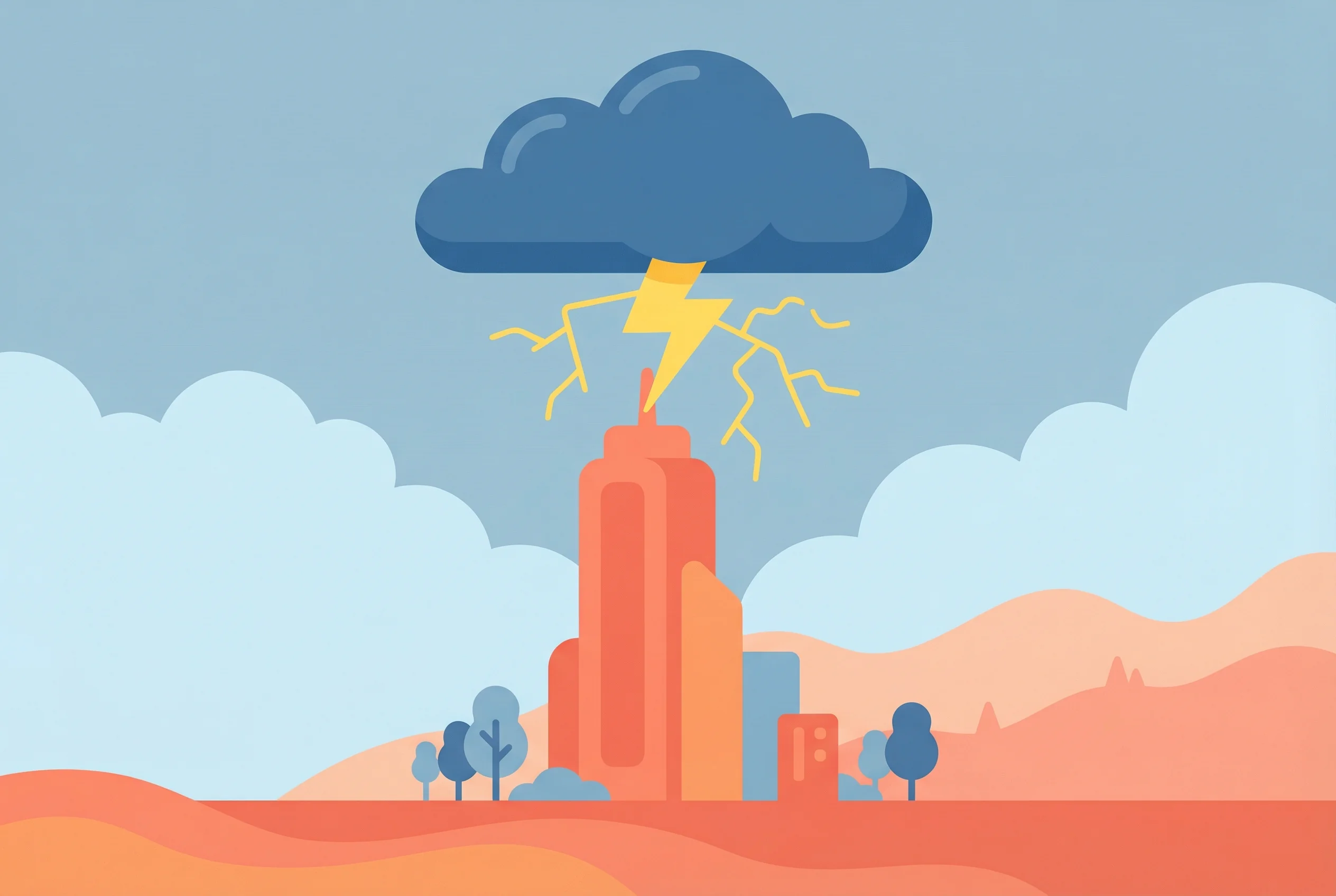
AShorter path to ground
✓Correct — Lightning seeks the shortest path between cloud and ground. Tall objects reduce that distance, making them natural targets. A 'leader' stroke descends from the cloud while 'streamers' rise from tall points—when they connect, zap! Lightning rods work by providing a controlled path to ground. The Empire State Building gets struck about 25 times a year! In storms, stay low and avoid being the tallest thing around.
BTall objects create lightning
✗Not quite — the answer is A. Shorter path to ground. Tall objects don't create lightning—they provide shorter path for discharge between charged cloud and ground.
CHeight increases voltage
✗Not quite — the answer is A. Shorter path to ground. Height doesn't increase voltage—lightning originates in clouds. Tall objects reduce distance to ground, creating preferred discharge path.
Answer this question
ASensors detect more cars waiting and extend green time to clear traffic
✓Correct — Modern traffic signals use inductive loop sensors buried in the pavement or cameras to detect vehicle presence and volume. When more cars are waiting in one direction, the system extends the green light duration to maximize throughput and minimize overall waiting time. This is called 'actuated' or 'adaptive' signal control, which is far more efficient than fixed-time signals.
BThe direction pointing north always gets priority due to magnetic fields
✗Not quite — the answer is A. Sensors detect more cars waiting and extend green time to clear traffic. Magnetic fields have no influence on traffic signal programming. While some older sensor systems use magnetic induction loops to detect metal vehicles, the direction of the road (north, south, east, or west) plays no role in priority. Signal timing is based purely on traffic demand patterns, time of day, and overall network optimization.
CLights alternate randomly to prevent drivers from predicting patterns
✗Not quite — the answer is A. Sensors detect more cars waiting and extend green time to clear traffic. Traffic signals follow carefully calculated patterns, not random sequences. Engineers program signals based on historical traffic data, peak hour patterns, and coordination with nearby intersections to create 'green waves' that allow vehicles to pass through multiple lights efficiently. Randomness would create chaos and longer overall wait times for everyone.
Answer this question
AThey create 'anti-sound' waves that are opposite in phase to cancel noise
✓Correct — Noise-canceling headphones use microphones to detect incoming noise, then instantly generate sound waves with the same frequency but opposite phase (180 degrees out of sync). When these opposing waves meet, they experience destructive interference - the peaks of one wave align with the troughs of the other, canceling each other out. This is why adding sound can create silence, a counterintuitive but scientifically elegant solution.
BThey produce high-frequency sounds that confuse your brain into ignoring noise
✗Not quite — the answer is A. They create 'anti-sound' waves that are opposite in phase to cancel noise. While the brain can adapt to certain sounds, noise-canceling technology does not rely on psychological tricks or confusion. It uses physical wave interference to actually eliminate sound waves before they reach your ear. High-frequency sounds would not effectively cancel low-frequency noise like airplane engine rumble, which noise-canceling headphones handle well through destructive interference.
CThey emit ultrasonic pulses that physically block sound waves from entering
✗Not quite — the answer is A. They create 'anti-sound' waves that are opposite in phase to cancel noise. Sound waves cannot be 'physically blocked' by other sound waves like a barrier. Ultrasonic frequencies (above human hearing range) would simply pass through or around other sound waves without affecting them. Noise cancellation works through wave interference, not physical obstruction. The technology requires precise phase matching at audible frequencies, not ultrasonic pulses.
Answer this question
Family Trivia Questions and Answers
ATo protect from fire and extreme temperatures
✓Correct — Thick bark acts like fireproof armor, protecting the living tissue underneath. Trees like sequoias in fire-prone areas have bark up to 30 cm thick that insulates against flames reaching 1000 degrees Celsius. The thick dead cells also buffer against freezing winters and scorching summers, while defending against animal damage and boring insects.
BTo store more water during droughts
✗Not quite — the answer is A. To protect from fire and extreme temperatures. While bark does contain some moisture, its primary function is protection, not water storage. Trees store water mainly in their sapwood and root systems. Thick bark is made mostly of dead cork cells filled with air pockets, making it a poor water reservoir. Cacti and succulents have specialized tissues for water storage, not thick bark.
CTo produce extra nutrients for growth
✗Not quite — the answer is A. To protect from fire and extreme temperatures. Bark is actually made of dead cells and produces no nutrients. The living cambium layer beneath the bark is what generates new growth. Thick bark is purely protective. Trees make food through photosynthesis in their leaves, not in their bark. In fact, thick bark can sometimes limit nutrient transport if damaged.
Answer this question
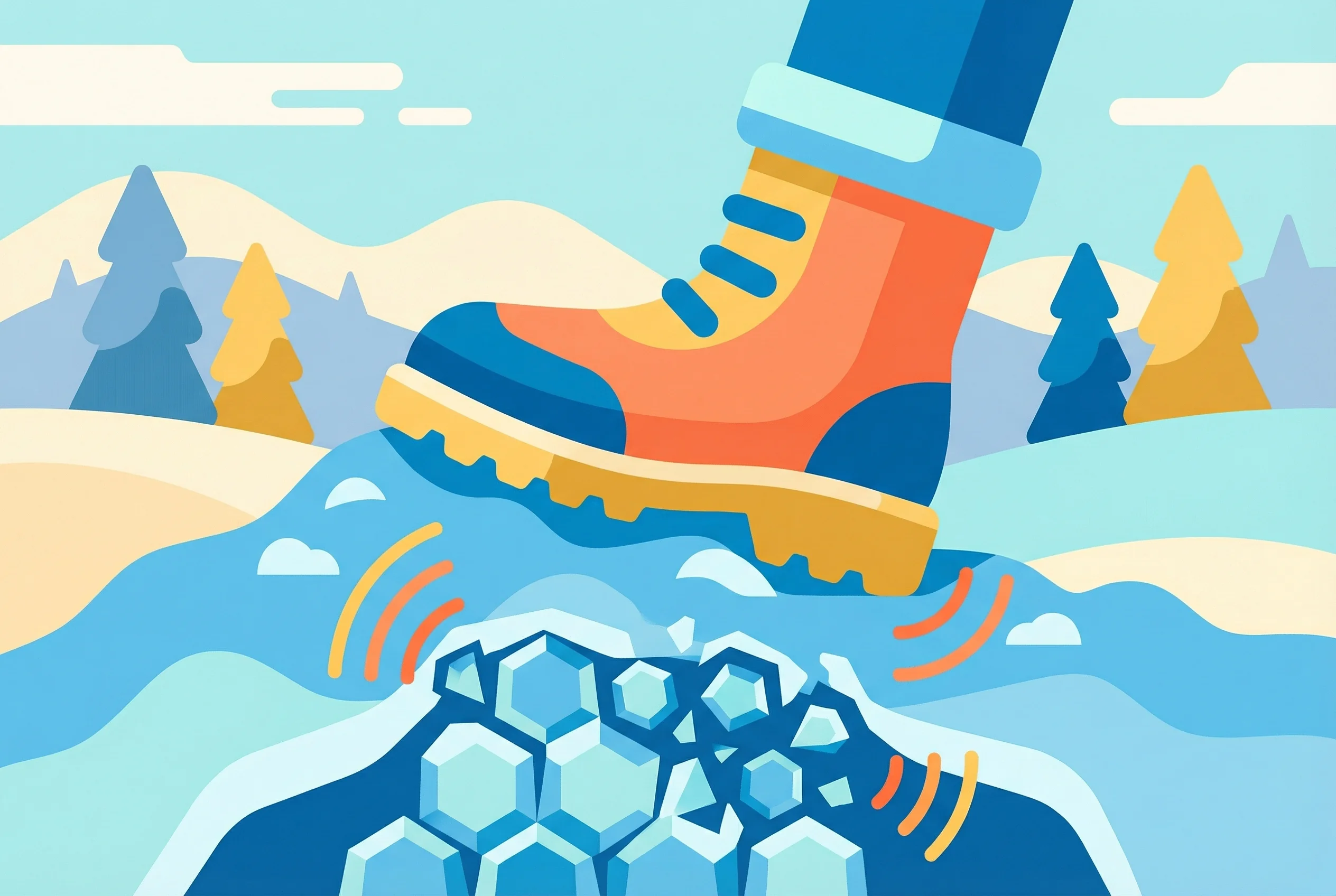
AAir pockets collapse loudly
✗Not quite — the answer is B. Crystals fracture under pressure. Air spaces exist between crystals, but crunch sound from crystals breaking/fracturing under pressure, not air collapse.
BCrystals fracture under pressure
✓Correct — Crystal fracture! Snow crunches because: (1) Snow: complex ice crystals loosely bonded. (2) Step on snow—pressure applied. (3) Crystals fracture/break—bonds snap. (4) Thousands of tiny breaks = crunching sound. (5) Temperature matters—colder = more brittle, louder crunch. Below -15°C: very crunchy. Near 0°C: wet, quiet (crystals bend/compress). Fresh powder: loud (delicate crystals). Old packed snow: quieter (rounded grains). Same physics as breaking glass—brittle fracture releases acoustic energy. Quieter on warm days—crystals have water film (lubricates)!
CFrozen water squeaks naturally
✗Not quite — the answer is B. Crystals fracture under pressure. Water doesn't inherently squeak—snow crunches from ice crystal fracturing under pressure. Temperature affects brittleness and sound volume.
Answer this question
AAustralia sits on an ancient craton that has been stable for billions of years, while Iceland forms from new volcanic activity at a spreading plate boundary
✓Correct — Australia's interior contains some of Earth's oldest continental crust because it sits on a stable craton called the Yilgarn Craton, which has avoided major tectonic disruption for over 3 billion years. Iceland, by contrast, sits directly on the Mid-Atlantic Ridge where the North American and Eurasian plates are spreading apart. New volcanic rock constantly forms here, making Iceland one of Earth's youngest landmasses. This demonstrates how continental age depends on tectonic setting rather than climate or location.
BAustralia's rocks are older because it receives less rainfall, which slows down the weathering and erosion of ancient rocks
✗Not quite — the answer is A. Australia sits on an ancient craton that has been stable for billions of years, while Iceland forms from new volcanic activity at a spreading plate boundary. While weathering does affect rock surfaces, it does not determine the age of the underlying continental crust. Even in wet climates, ancient rocks can persist deep within continents. Australia's ancient rocks exist because its continental core has been tectonically stable, not because of its climate. Meanwhile, Iceland is young because it is actively forming from volcanic eruptions at a divergent plate boundary, completely replacing any older crust that might have existed.
CIceland's rocks are younger because its cold climate preserves only the most recent geological formations while destroying older ones
✗Not quite — the answer is A. Australia sits on an ancient craton that has been stable for billions of years, while Iceland forms from new volcanic activity at a spreading plate boundary. Climate does not control the fundamental age of continental crust or destroy ancient geological formations. Cold or warm temperatures affect surface weathering rates but cannot erase billions of years of rock record. Iceland is young because it is literally being created right now by ongoing volcanic activity at the Mid-Atlantic Ridge, where magma rises to form new oceanic crust. Australia's rocks are ancient because they formed billions of years ago and have remained in a stable tectonic position ever since.
Answer this question
ADelayed buses pick up more passengers, falling further behind while early buses speed up
✓Correct — This is called 'bus bunching' or the 'accordion effect.' When a bus falls slightly behind, more passengers accumulate at each stop, causing longer boarding times and more delay. The bus ahead encounters fewer passengers and moves faster, creating a gap. This positive feedback loop causes buses to cluster together despite starting evenly spaced. Transit systems use GPS tracking and schedule adjustments to combat this phenomenon.
BBus drivers coordinate their arrival times to take breaks together at stops
✗Not quite — the answer is A. Delayed buses pick up more passengers, falling further behind while early buses speed up. Bus drivers do not intentionally coordinate to arrive together. In fact, transit agencies actively try to prevent bunching by monitoring bus locations in real-time and sometimes holding early buses or instructing late buses to skip stops. Drivers taking breaks would make the problem worse, not create the bunching pattern we observe.
CTraffic lights are synchronized to create natural grouping patterns for buses
✗Not quite — the answer is A. Delayed buses pick up more passengers, falling further behind while early buses speed up. Traffic lights are not synchronized to group buses together. Modern traffic signal systems often give priority to buses to help them maintain schedules, not create clusters. Bus bunching occurs naturally due to passenger demand variations and boarding time differences, independent of traffic signal timing. The bunching would happen even with no traffic lights at all.
Answer this question
Frequently Asked Questions
Where can I find trivia quizzes with answers?
This page gives each question, the choices, and the answer explanation in the same card. You can use it as a self-check, a host sheet, or a source for a quick group game.
Are trivia with answers better than answer-only quizzes?
Usually, yes. A bare answer ends the round; an explained answer gives people the satisfying "oh, that makes sense" moment that makes the fact stick.
Can I print these trivia quizzes with answers?
You can use the section headings as printable rounds and copy the cards into a host document. Keep the explanations with the answers so the quiz still teaches something after each reveal.
What is the best way to host a trivia quiz with answer keys?
Read the question and choices first, collect guesses, then reveal both the correct letter and the explanation. The explanation is what turns a missed answer into a good conversation.
What does this have to do with AIgneous Million Whys?
AIgneous Million Whys treats each question as a small curiosity gap. The answer matters, but the real value is the closure: one tiny piece of knowledge that connects to the next one.