Easy
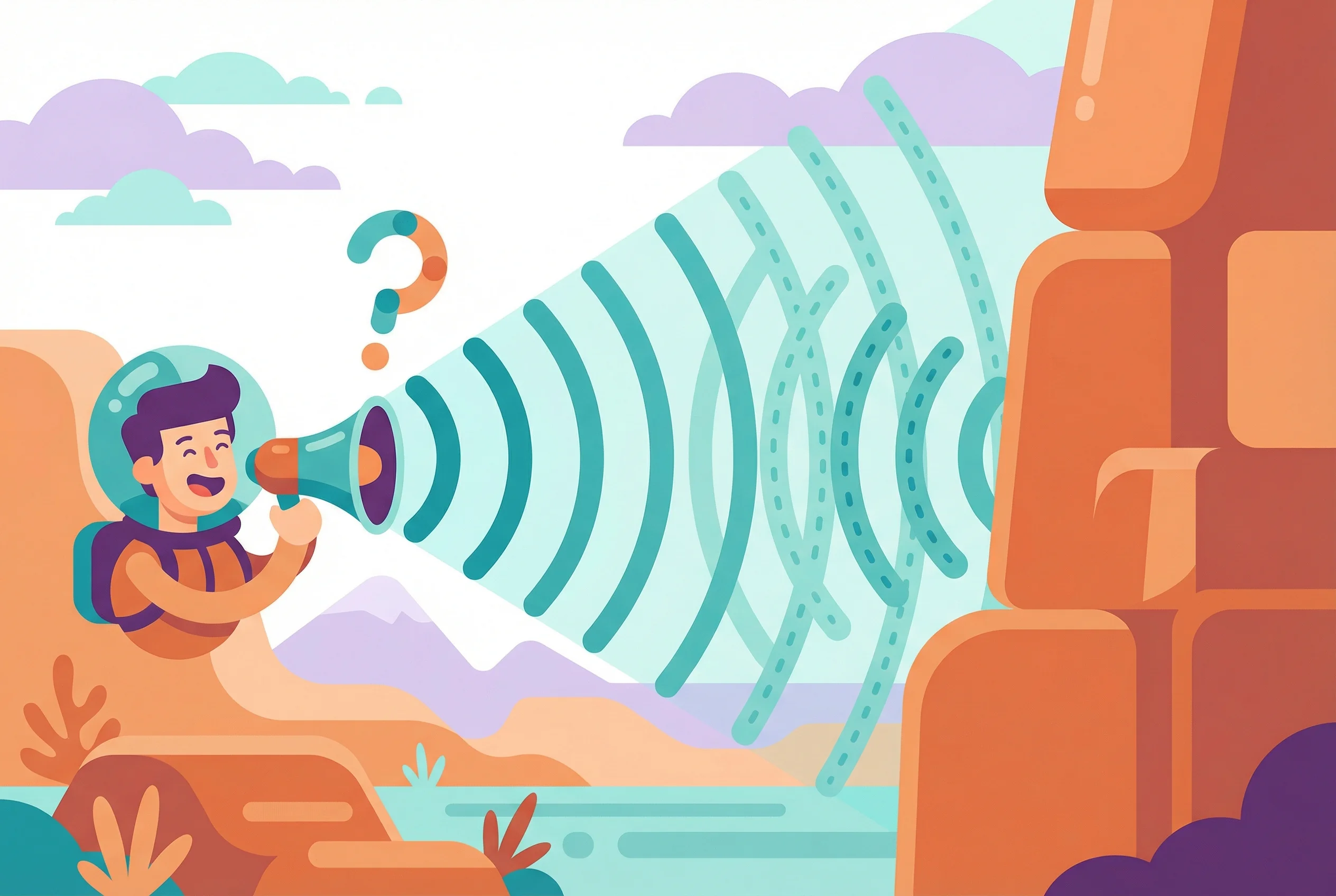
ASound bounces off surfaces
✓Correct — Sound waves reflect off hard surfaces like walls, cliffs, or buildings. The reflected sound reaches your ears after the original, creating an echo. Soft surfaces absorb sound, which is why echoes are clearer in empty rooms!
BOur ears replay sounds
✗Not quite — the answer is A. Sound bounces off surfaces.
CSound waves split apart
✗Not quite — the answer is A. Sound bounces off surfaces.
Medium
ALight photons knock electrons loose from silicon atoms
✓Correct — Camera sensors use the photoelectric effect discovered by Einstein. When photons (light particles) hit the silicon surface, they transfer their energy to electrons, knocking them loose from atoms. These freed electrons flow as electrical current, which the camera measures. More light means more electrons freed, creating stronger signals. This is why Einstein won the Nobel Prize - not for relativity, but for explaining how light can free electrons!
BLight heats up tiny metal wires that generate electricity
✗Not quite — the answer is A. Light photons knock electrons loose from silicon atoms.
CLight creates magnetic fields that induce electric current
✗Not quite — the answer is A. Light photons knock electrons loose from silicon atoms.
AThe sensor collects more light particles over the longer time period
✓Correct — Light is made of particles called photons. When the shutter stays open longer, more photons reach the sensor and accumulate, just like how a bucket fills faster if you leave the tap running longer. This accumulated light creates a brighter final image.
BThe camera lens automatically opens wider during long exposures
✗Not quite — the answer is A. The sensor collects more light particles over the longer time period.
CThe sensor becomes more sensitive to light when exposed longer
✗Not quite — the answer is A. The sensor collects more light particles over the longer time period.
ALight rays cross over when passing through the convex lens
✓Correct — When light from an object passes through a convex lens, rays from the top of the object bend downward and rays from the bottom bend upward. These rays cross at a focal point inside the lens, creating an inverted image on the camera sensor. This is basic physics of light refraction - the same principle used in the human eye, which also sees upside-down images that our brain flips right-side up!
BThe camera sensor is installed upside down
✗Not quite — the answer is A. Light rays cross over when passing through the convex lens.
CDigital processors intentionally reverse the image
✗Not quite — the answer is A. Light rays cross over when passing through the convex lens.
ALighting differences and color spill create mismatches
✓Correct — When filming with green screens, the lighting on the actor often differs from the background image's lighting. Additionally, green light reflects onto the subject (called 'spill'), creating green tinges on hair and skin. Motion blur and edge detection also make it hard to perfectly separate foreground from background, resulting in visible halos or fuzzy edges that break the illusion.
BGreen screens absorb too much light from the scene
✗Not quite — the answer is A. Lighting differences and color spill create mismatches.
CCameras can only film one layer at a time
✗Not quite — the answer is A. Lighting differences and color spill create mismatches.
AComplex scenes need more data; cartoons compress better with flat colors
✓Correct — Streaming services use 'per-title encoding' where each show gets optimized compression. A cartoon with flat colors and simple shapes can look perfect at 2 Mbps, while an action movie with explosions, fast motion, and detailed textures might need 8 Mbps for similar perceived quality. Netflix analyzes each title's visual complexity and assigns appropriate bitrates. This is why a Pixar movie looks flawless while a nature documentary might sometimes blur during rapid camera movements - it is all about how efficiently the content compresses.
BAction movies are older files with worse original quality
✗Not quite — the answer is A. Complex scenes need more data; cartoons compress better with flat colors.
CNetflix prioritizes children's content with better streaming
✗Not quite — the answer is A. Complex scenes need more data; cartoons compress better with flat colors.
AIt calculates how forces like pressure and friction affect water movement
✓Correct — The Navier-Stokes equations are fundamental physics equations that describe how fluids move by calculating the effects of pressure, viscosity (thickness), and external forces on every tiny portion of water. Computer graphics software solves these equations thousands of times per second to simulate realistic splashes, waves, and flows. This is why CGI water in movies looks so convincing - it follows real physics laws rather than being animated by hand.
BIt stores millions of pre-recorded water videos in a database
✗Not quite — the answer is A. It calculates how forces like pressure and friction affect water movement.
CIt uses AI to guess what water should look like in each scene
✗Not quite — the answer is A. It calculates how forces like pressure and friction affect water movement.
ASoftware simulates how light scatters through smoke using physics equations
✓Correct — Modern VFX software like Houdini uses computational fluid dynamics to simulate how millions of particles move, collide, and emit light. The key is simulating 'subsurface scattering' - how light penetrates smoke particles and bounces around before reaching your eye, creating that realistic glowing orange core with darker edges. These physics-based renders calculate real equations for turbulence, heat dissipation, and light behavior.
BFilmmakers film real explosions and digitally remove the dangerous parts
✗Not quite — the answer is A. Software simulates how light scatters through smoke using physics equations.
CHigh-resolution textures from photos are stretched over simple orange shapes
✗Not quite — the answer is A. Software simulates how light scatters through smoke using physics equations.
AYour brain's threat center reacts faster than your reasoning can say 'it's fake'
✓Correct — Your amygdala (emotion center) processes threats in milliseconds, triggering fear responses before your prefrontal cortex (reasoning center) can analyze 'this is just a movie.' Evolution favored fast threat responses over accuracy - better to jump at a fake snake than ignore a real one. This is why stories can create genuine emotional and physical reactions despite our conscious knowledge they are fiction.
BScreen light stimulates adrenaline glands directly through your eyes
✗Not quite — the answer is A. Your brain's threat center reacts faster than your reasoning can say 'it's fake'.
CLoud sound effects physically vibrate your heart to beat faster
✗Not quite — the answer is A. Your brain's threat center reacts faster than your reasoning can say 'it's fake'.
AOur emotional brain evolved before fiction existed, so it treats compelling stories as real
✓Correct — The limbic system (our emotional center) evolved millions of years ago to help us learn from social experiences. It processes movie characters' struggles as real social situations, triggering genuine sadness. This 'emotional learning' helped our ancestors understand consequences and build empathy, even though movies did not exist then.
BWe cry because our eyes need to release excess water when focusing on screens
✗Not quite — the answer is A. Our emotional brain evolved before fiction existed, so it treats compelling stories as real.
CSad movies contain special sound frequencies that directly trigger tear glands
✗Not quite — the answer is A. Our emotional brain evolved before fiction existed, so it treats compelling stories as real.
AIts surface is compressed, preventing cracks from spreading
✓Correct — Tempered glass is heated to over 600 degrees Celsius, then rapidly cooled with air jets. This creates compression stress on the surface while the interior remains in tension. When hit, this compression must be overcome before cracks can form and spread, making it much stronger. This is why phone screens and car windows use tempered glass.
BIt contains special metals mixed into the glass during manufacturing
✗Not quite — the answer is A. Its surface is compressed, preventing cracks from spreading.
CIt is made thicker than regular glass in all applications
✗Not quite — the answer is A. Its surface is compressed, preventing cracks from spreading.
AExact calculations take too long to render thousands of frames
✓Correct — Simulating realistic water, explosions, or cloth using exact Navier-Stokes equations or finite element methods can take hours per frame. A 2-hour movie has about 172,800 frames. Approximation algorithms like position-based dynamics can achieve similar visual results in seconds per frame, making production feasible. Pixar's movies would take decades to render with exact physics!
BExact physics looks too realistic and distracts audiences
✗Not quite — the answer is A. Exact calculations take too long to render thousands of frames.
CApproximations use less electricity and save production costs
✗Not quite — the answer is A. Exact calculations take too long to render thousands of frames.
Want the answer-click feeling without the movie theme?
MillionWhys turns small gaps in your knowledge into 10-second questions with real closure: choose, reveal, understand, and carry one new thing away.
Play live on AIgneous Million WhysFrequently Asked Questions
What counts as movie trivia here?
This set focuses on movie-adjacent science: camera sensors, lenses, green screens, CGI physics, streaming quality, echoes, and why fictional scenes can still trigger real emotions.
Are these classic movie-name questions?
No. The angle is the science behind movies, not celebrity facts or release dates. It is built for people who like the moment when a familiar scene suddenly has a mechanism behind it.
Can I use these questions for a quiz night?
Yes. Each card includes answer options and the explanation, so you can read the question aloud, let people guess, and then reveal the why.
Why does MillionWhys use questions instead of fact lists?
A question creates a small information gap. The answer closes it. That closure is what makes a fact feel satisfying instead of becoming one more loose item in a list.