

How to Be Funnier: Curiosity Beats Tricks
On this page· 17
Most advice on how to be funnier starts in the wrong place. It treats humor like a trick you perform on people: timing hacks, punchline formulas, clever lines to memorize. But in normal conversation, funny usually begins earlier. Funny people have material. They notice patterns. They bring a precise little truth into the room, then tilt it just enough that everyone sees it.
TL;DR
If you want to be funnier, stop trying to sound like a comedian and start collecting better raw material. Humor usually needs three things: something unexpected, something recognizable, and enough safety that the "violation" feels benign. Curiosity supplies the material; timing and confidence help it land.
Short answer: to become funnier in conversation, build a habit of noticing odd specifics, connect them to real human behavior, and deliver them lightly. Peter McGraw and Caleb Warren's benign violation theory argues that humor happens when something feels like a violation and also feels okay at the same time (McGraw and Warren, 2010). That is why the safest useful formula is not "say a joke." It is: true, unexpected, not cruel.
The Mistake Every "How to Be Funny" Guide Makes
The mistake is treating funny as a speaking technique. Technique matters, but only after there is something worth saying. A perfectly timed empty line still feels empty. A slightly messy line with a sharp observation can still make people laugh because everyone recognizes the truth inside it.
In everyday conversation, people are not waiting for you to perform a routine. They are waiting for the tiny relief of recognition: "Yes, that is exactly how that feels." Humor often compresses a shared experience into a shape people had not named yet. The laugh is a kind of closure. A little gap opens, the pattern clicks, and the room gets the reward.
That is why curiosity is upstream of wit. If you are not collecting gaps, contradictions, and odd details, you will over-rely on canned lines. If you are collecting them, you have material even before you try to be funny.

Funny = Unexpected + Precise + True
The "unexpected" part is obvious: if everyone can predict the sentence, it rarely lands. The "precise" part is where most people improve fastest. "Work meetings are annoying" is too broad. "Every meeting has one person who says 'quick question' and then opens a portal" is more precise. You can see the scene.
The "true" part does not mean factual like a textbook. It means emotionally recognizable. Robert Provine's laughter research helped popularize the idea that laughter is deeply social, not just a response to formal jokes; the American Psychological Association's profile notes that ordinary laughter often appears in social interaction rather than after crafted punchlines (APA Monitor). In other words, being funnier is less about joke inventory and more about tuning into the social moment.
McGraw's benign violation theory adds the safety boundary. A joke needs a little wrongness, surprise, rule-bending, or status wobble, but it also has to feel okay. Too safe and it is dull. Too sharp and it becomes a wound. Funny lives near the edge, not over the cliff.
Question 1 of 4
On a normal day, with no comedy show involved, what most often makes a person laugh out loud?
The Material Problem: Funny People Are Curious People First
Funny people are usually not walking around with more punchlines. They are walking around with more noticed reality. They catch the absurdity in ordinary systems: airport boarding groups, group chats, software updates, restaurant menus that sound like poetry written by a committee.
Curiosity gives you that feed without turning you into a performer. Ask small questions: Why do people say "no worries" when there were clearly worries? Why does every office kitchen have one mug nobody trusts? Why do we pretend to understand every parking sign on the first read? The questions are small, but they train your attention toward friction, and friction is where humor often starts.
This also keeps humor from becoming mean. When the engine is curiosity, the target is usually a pattern, not a person. You are not trying to dominate the room. You are offering a little pattern-recognition treat.
Timing Isn't a Skill, It's Confidence Plus Rehearsal
People talk about timing as if it is magic. Some of it is rhythm, but much of it is confidence plus familiarity. You pause because you know where the sentence is going. You cut the line short because you trust the listener to finish the last inch. You do not over-explain because you have said the idea to yourself before.
John Cleese's well-known creativity talk distinguishes between an open mode, where ideas can play, and a closed mode, where execution happens (transcript hosted by James Clear). That maps cleanly onto humor. Collect in open mode. Edit in closed mode. Conversation is not the time to invent every angle from zero.
Rehearsal does not mean memorizing jokes. It means noticing how you would say the thing in one clean sentence. If a line needs three paragraphs of setup, it is probably an essay, not a conversational joke.

Question 2 of 4
According to John Cleese's creativity framework, why does switching into execution mode too early tend to kill the ideas you were just exploring?
The 3 Categories That Work Everywhere
Self-effacing humor works when it lowers pressure without asking people to comfort you. "I packed for this trip like a person who has heard of weather but never met it" is safer than a spiral of self-insults. The target is a behavior, not your worth.
Observational humor works when it names a shared pattern. It is not "airports are bad." It is "airports are the only place where adults sprint, whisper, and pay thirteen dollars for almonds like the laws of society are suspended."
Callbacks work because they reward shared memory. A small phrase from earlier comes back in a new situation, and the group gets the pleasure of recognition. Callbacks are especially powerful because they are not imported material. They are made from the room itself.
Steve Kaplan's comedy materials are aimed at writers, but one useful public-facing theme is that comedy is grounded in human truth rather than detached joke mechanics (Steve Kaplan Comedy). That is why these three categories travel well. They all begin with something people recognize.
Question 3 of 4
Why does a comedian repeating a small phrase from earlier in the show get a bigger laugh than a brand-new joke?
Anti-Patterns: What Actually Makes You Unfunny
The first anti-pattern is trying too hard. People can feel when a conversation has become a stage. The second is punching down. If the joke requires someone with less power to absorb the discomfort, the room may laugh politely while trust leaves quietly. The third is forced wordplay. Puns can be delightful, but only when the groan is part of the pleasure.
The fourth anti-pattern is explaining the joke after it lands. If people laughed, let it breathe. If they did not, move on. A missed joke is usually cheaper than a rescue mission.
The fifth is making every line funny. That sounds paradoxical, but constant joking can make people stop trusting your sincerity. Humor works best as seasoning. If everything is seasoning, dinner is gone.

The Curiosity to Wit Pipeline
Here is the simplest pipeline: notice one odd thing, ask why it works that way, close the loop with a real answer, then bring back the human-shaped version. A fact by itself is not always funny. A fact plus human friction can be.
Example: learning that people ask more follow-up questions are often better liked is useful. The funny human version might be: "Apparently the secret to being charming is just doing the thing every podcast host forgets to do: listen to the last sentence." The fact gives you the pattern; the human version gives it a face.
This is also why a weekly curiosity habit works better than a joke notebook for most people. A joke notebook pressures you to be clever. A curiosity habit gives you raw material. You learn something about giraffe blood pressure, rainbow geometry, IKEA layouts, or why people laugh more socially than alone, and suddenly your brain has more hooks.

Question 4 of 4
Why do people who ask more follow-up questions tend to be better liked by the person they were talking to?
What people usually miss
The hidden move is that funny is not the opposite of serious. It is often seriousness with better compression. You noticed a real thing, cared enough to look closer, and found the angle that lets other people feel the truth without being lectured.
The second missed point is that humor needs closure. A funny observation resolves a tiny tension: "I knew something was odd about that, and now I see it." That is the same curiosity loop in miniature. Half-knowing creates the itch; the line closes it.
The third missed point is kindness. The easiest laugh is not always the best laugh. If people feel safer around your humor, they will give you more room to play. If they feel hunted by it, they will start hiding the interesting parts of themselves. That is a bad trade.
Related videos
FAQ
How can I be funnier in conversation?
Bring one precise observation, keep it short, and aim it at a shared pattern rather than a person. Then stop talking before the line needs explaining.
How do I become witty without trying too hard?
Collect more material than you use. Witty people often sound effortless because they have already noticed the pattern before the moment arrives.
What if I am not naturally funny?
You do not need a comedian's temperament. Start with curiosity: one weird detail, one honest observation, one follow-up. Funny grows from noticing before it grows from performing.
What makes a joke land badly?
It usually violates without feeling benign: too personal, too cruel, too confusing, or too far from what the room already understands. A joke can also fail simply because the setup was vague.
What does this have to do with AIgneous Million Whys?
MillionWhys gives you the raw material side of wit: tiny questions, real answers, and small closures you can carry back into conversation. It is not a comedy coach; it is a curiosity refill.
Keep Exploring
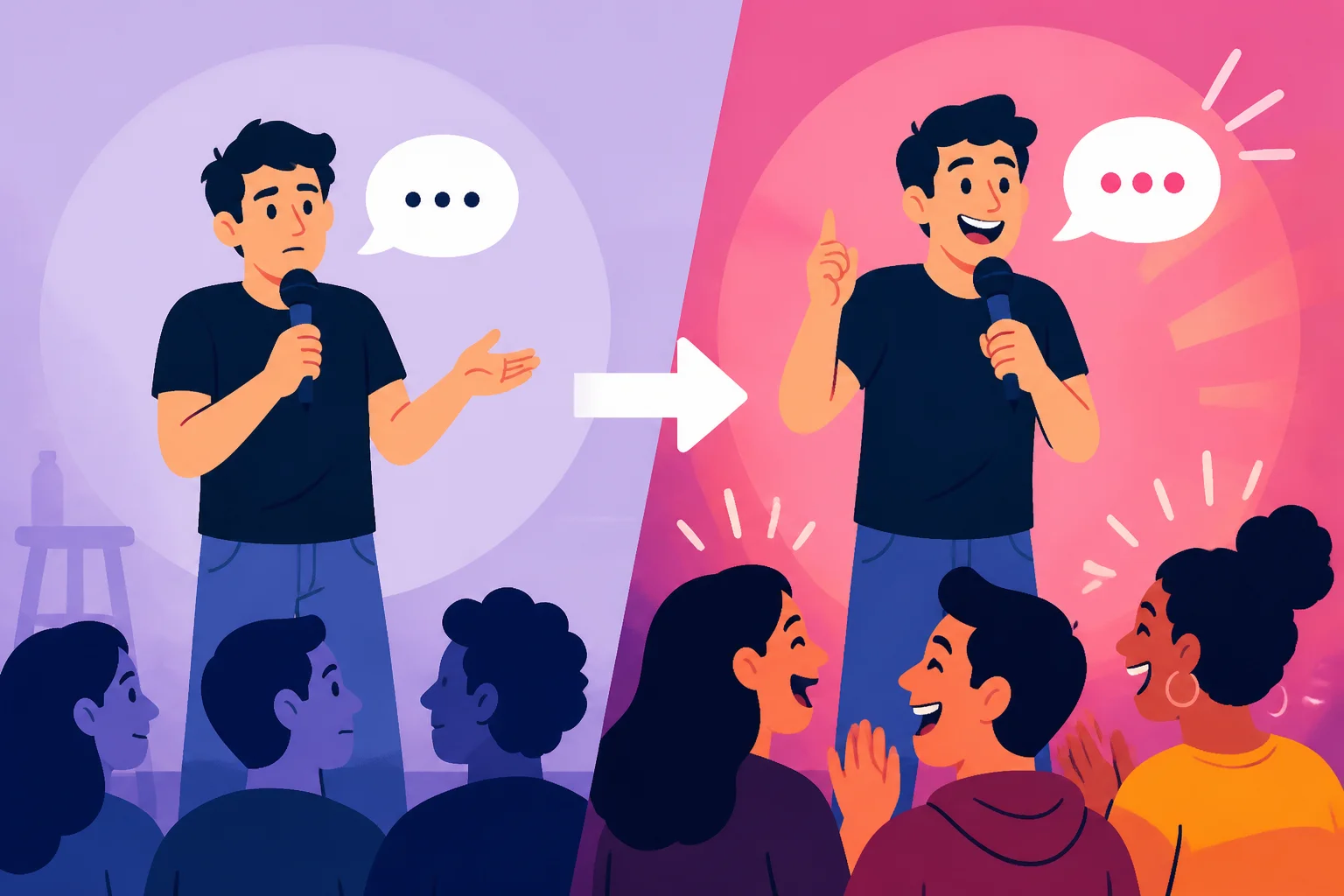
Why does a comedian repeating a small phrase from earlier in the show get a bigger laugh than a brand-new joke?
Psychology & Behavior
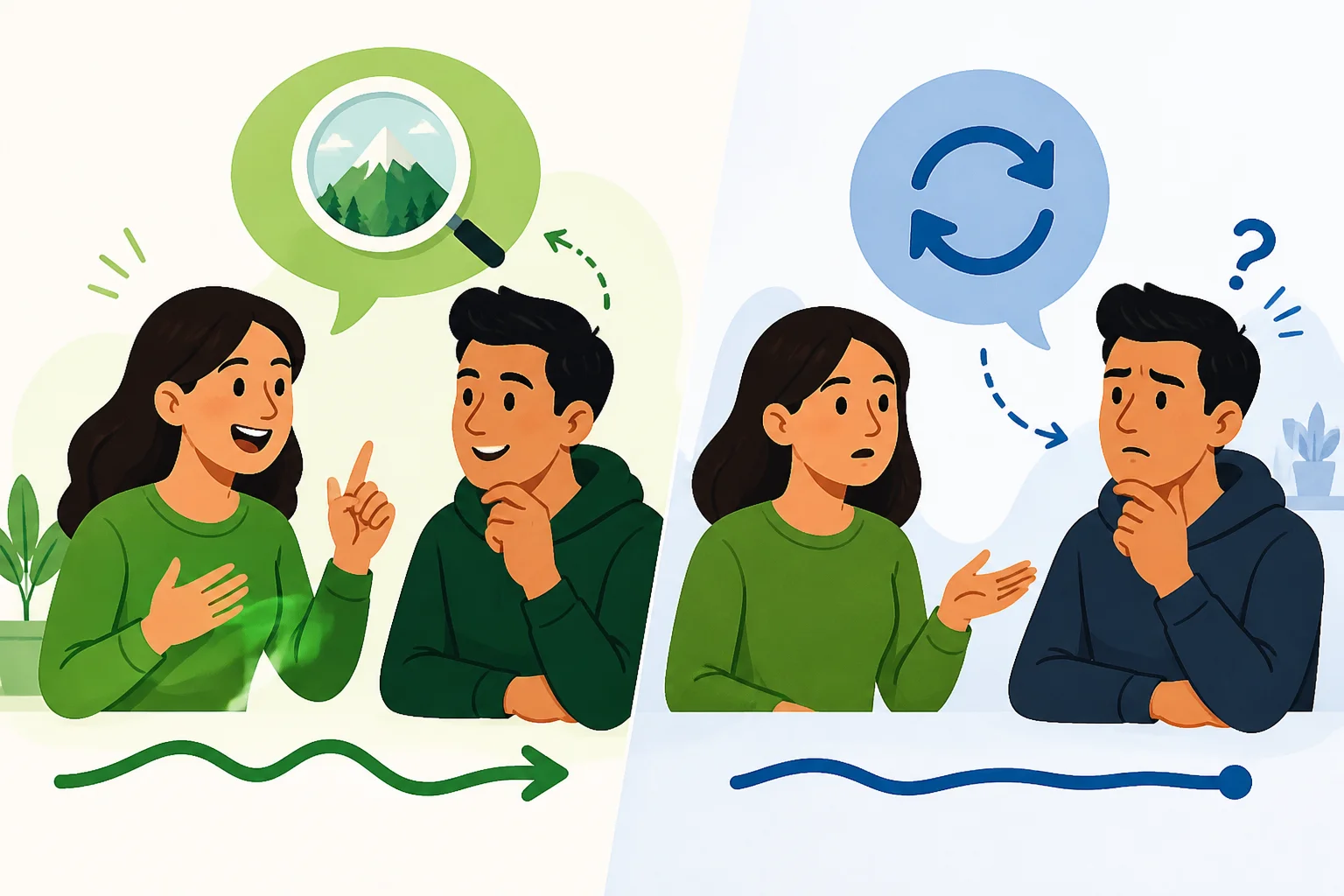
Why does asking about one specific detail someone just mentioned keep a conversation going better than asking them the same question back?
Psychology & Behavior

On a normal day, with no comedy show involved, what most often makes a person laugh out loud?
Psychology & Behavior
Related Posts
How to Be Interesting: The Curiosity Habit
How to be interesting without performing: build curiosity habits, collect small mysteries, ask better questions, and turn weekly facts into conversation fuel.
How to Keep a Conversation Going, Naturally
How to keep a conversation going without scripts: use real follow-up questions, small curiosity refills, better pauses, and graceful exits when energy fades.
Small Talk: Bring One Real Thing
Small talk gets better when you bring one real thing: a specific observation, a live question, and enough curiosity to move past empty scripts.