

Fun Facts About Me: How to Find Yours
On this page· 18
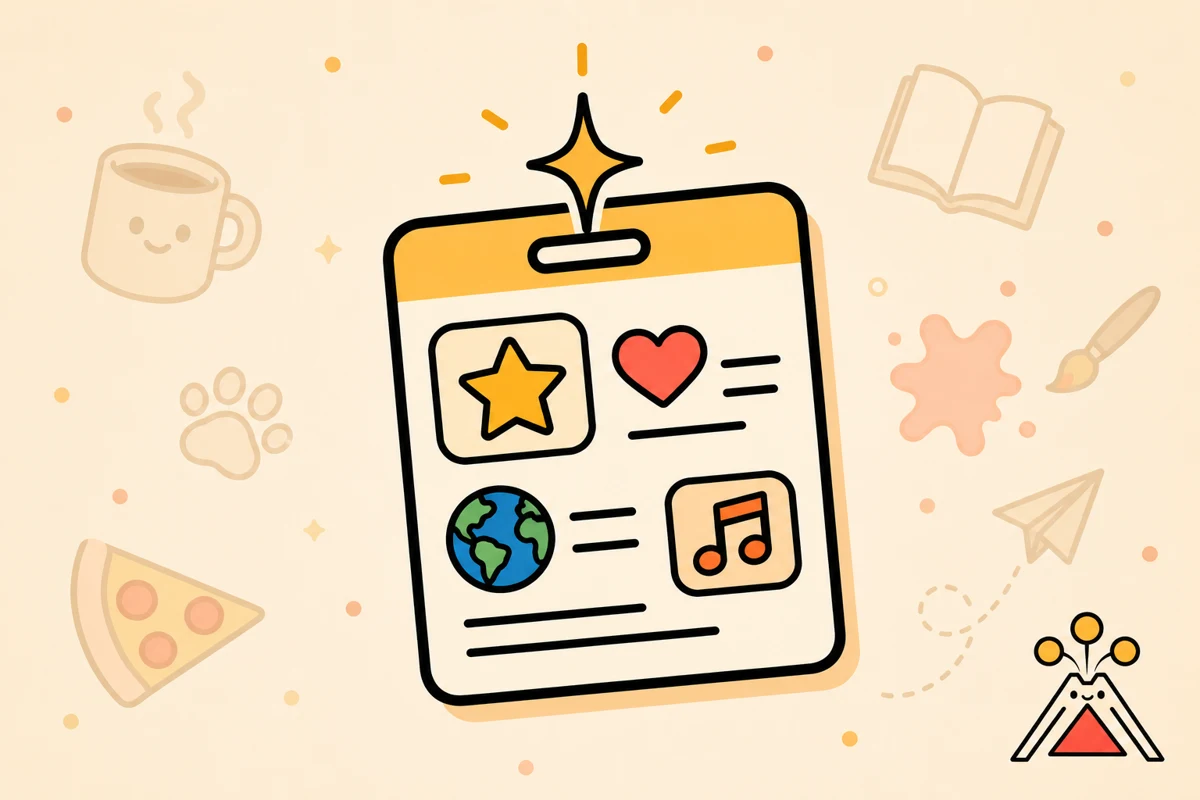
Fun facts about me usually go wrong because the prompt sounds playful but the room is not. You are standing in a meeting, a first-day circle, a date, or a group chat, and suddenly you are supposed to produce one sentence that proves you are a person. The trick is to find a true little doorway: specific enough for a follow-up, light enough that nobody feels trapped, and honest enough that you do not sound like you are auditioning.
TL;DR
A good fun fact about yourself is not random. It is a small, true, easy-to-ask-about detail that opens a real conversation. Mine your memory for odd jobs, tiny obsessions, places you have lived, things you changed your mind about, and small skills you earned the hard way.
Short answer: the best "fun facts about me" come from lived texture, not performance. Use a concrete memory, name the object or place, and leave a clean hook for the next question. "I collect maps of cities I have never visited" works better than "I like travel."
Why "Fun Facts About Me" Feels Fake Every Single Time
The prompt has a built-in contradiction. It asks for spontaneity in a forced setting. That is why so many answers become either too bland ("I like music") or too polished ("I once climbed a volcano at sunrise"). A fact that tries too hard makes the listener do social labor: now they have to admire you or laugh on cue.
Research on closeness gives a better clue. Arthur Aron and colleagues' classic interpersonal-closeness procedure used gradual self-disclosure over about 45 minutes, and the study found greater post-interaction closeness than comparable small-talk tasks (Aron et al., 1997). The important word is gradual. A good fun fact is the first rung on a ladder.
That is also why a copied list of "150 fun facts" can be useful for brainstorming but weak as a final answer. The fact only works when it belongs to you. "I have been to 12 countries" is a statistic. "I still judge airports by whether I can find soup at 6 a.m." is a person.

Question 1 of 3
Why did Aron's 1997 procedure, which had strangers answer increasingly personal questions for about 45 minutes, leave them feeling closer than pairs who did small talk for the same time?
The 3 Categories That Actually Work
The first category is the weird past job. Not necessarily paid work. Babysitting three cousins for a summer counts. Repairing bikes for neighbors counts. The value is not status. It is scene-setting. A small job gives the other person a world to enter.
The second category is the niche obsession. This is where curiosity beats self-branding. You do not need a grand hobby. You need a rabbit hole with a handle: mushroom field guides, historical menus, subway maps, fountain pens, abandoned malls, bird calls, old video-game soundtracks. Susan Cain's work on introversion pushed back against the idea that the most socially valuable person is always the loudest person in the room; Quiet argues for the value of interior depth and lower-stimulation temperaments (Susan Cain). A niche interest is often that depth made visible.
The third category is the geographical oddity: a place you lived, a route you took, a town name people mispronounce, a family move that changed your default weather. Place gives memory edges. "I grew up near the sea" is fine. "I learned to check the tide before making weekend plans" is better.

Question 2 of 3
What does Susan Cain's book Quiet argue about quieter, lower-stimulation people?
How to Mine Your Own Memory in 5 Minutes
Open a blank note and do not start with "What is impressive about me?" Start with "What have I noticed that other people might not have noticed?" That small shift keeps the exercise out of resume mode. The best material often hides in low-stakes memory: a commute, a family habit, a failed hobby, a rule you grew up with, a tiny skill you developed because life made you.
Use three passes. First, list places: cities, rooms, routes, kitchens, classrooms, waiting rooms. Second, list objects: instruments, tools, foods, clothes, books, games, collections. Third, list changes: something you used to believe, a food you learned to like, a fear you outgrew, a topic you accidentally learned too much about.
This is where AIgneous' own learning worldview matters: knowledge usually arrives as fragments first. One question, one answer, one little closure. Structure comes later. Your self-introduction can work the same way. Do not force a life thesis. Offer one fragment with a clean edge, then let the conversation build from there.
12 Prompts to Pull Your Own Fun Facts Out
These are not sample facts to copy. They are retrieval prompts. Answer one in a plain sentence, then sharpen it by adding a specific place, object, or moment.
- What is a tiny skill you learned for a weirdly practical reason?
- What object in your home has the strangest backstory?
- What topic could you explain for five minutes without preparing?
- What food, smell, or sound instantly time-travels you?
- What did you misunderstand as a child that still makes you smile?
- What place taught you a rule you still follow?
- What hobby did you quit but secretly still know too much about?
- What is the most specific thing you notice in a new city?
- What is a small inconvenience you have a strangely strong opinion about?
- What do your friends ask you for help with?
- What is one belief you changed your mind about?
- What question did you recently look up because it bothered you?
Notice the pattern: each prompt points toward a conversation, not a trophy. The Greater Good Science Center's version of the 36 questions uses prompts that invite stories rather than one-word facts (Greater Good in Action). That is the shape to borrow.

Question 3 of 3
The Greater Good Science Center's version of the 36 questions asks people to describe a moment or a place rather than name a fact. Why does that shape of question get a conversation going?
The Bad Kinds: Why "I Can Fold My Tongue" Died in 2015
Some facts are technically personal but socially dead. Body tricks, vague preferences, and generic travel counts usually end the conversation unless they come with a story. "I can fold my tongue" gives the other person nothing except a yes/no reaction. "I learned I could fold my tongue during a middle-school genetics lesson, then spent a week wrongly believing I was a science experiment" is at least a scene.
Avoid facts that make people compete. "I have been to 47 countries" can sound like a scoreboard. If travel is your fact, make it sensory: the breakfast you still miss, the transit rule you learned, the phrase you could not pronounce.
Also avoid facts that require the listener to validate your identity. "I am very empathetic" is a claim. "I once learned local bird calls because I wanted walks to feel less anonymous" lets the listener infer something about you. Adam Grant's Originals is about people championing new ideas and resisting groupthink (Penguin Random House), and that lesson scales down nicely here: originality is more convincing when demonstrated.

Icebreakers vs Interviews: Different Facts for Different Contexts
For work, choose a fact with a low awkwardness ceiling. Weird past jobs, harmless niche skills, and place-based details are safer than intense personal history.
For dates, choose something that reveals taste and invites a story. A fact about what you notice, collect, cook, rewatch, repair, or overthink gives the other person permission to answer with their own version. For interviews, keep the fact adjacent to how you work: curiosity, persistence, pattern recognition, or calm under uncertainty.
Vanessa Van Edwards' Science of People material often emphasizes openers that invite meaningful answers rather than one-word replies (Science of People). After you say your fact, can someone ask "how did that happen?" If not, revise.
The Deep Move: A Fun Fact That Reveals a Value
The strongest fun fact is not the strangest one. It is the one that quietly shows what you care about. A person who says, "I keep a spreadsheet of family recipes because I do not trust memory with important things" has told you more than a hobby. They have shown care, systems, family, and a tiny suspicion of entropy.
This is the closure people actually want from the prompt. They are not asking for a circus trick. They are asking for a handle on you. Give them one small, true handle, then let curiosity do the next move.
What People Usually Miss
The point is not to become more interesting on command. The point is to keep better material from your own life. If you spend a week noticing small questions - why a phrase annoys you, why a food tastes like childhood, why a shortcut through town feels calming - you will have better self-introductions without trying to manufacture personality. Curiosity compounds because each small answer leaves behind a better next question.
Related videos
FAQ
What is a good fun fact about me for introductions?
A good fun fact for introductions is specific, true, and easy to ask about. Try a niche hobby, a weird past job, a place-based memory, or a tiny skill you learned for an oddly practical reason.
How do I find random facts about yourself for work?
For work, choose facts that are human but not too intimate: a harmless hobby, a personal system, a city you know unusually well, or a small thing you collect. Avoid confession, humblebragging, and facts that require coworkers to perform amazement.
What is a good fun fact for an icebreaker?
The best icebreaker facts leave a follow-up path. "I know three ways to fix a zipper" is better than "I like clothes" because people can ask how you learned it, whether it works, or what broke first.
Should a fun fact be funny?
It can be, but it does not have to be. Warm, specific, and slightly surprising beats joke-shaped. If the fact depends on everyone laughing, it is fragile. If it starts a real question, it works.
What should I avoid when sharing fun facts about me?
Avoid generic preferences, status flexes, medical oversharing, and copied list answers. The fact should feel like a small piece of your life, not a line from an icebreaker worksheet.
What does this have to do with AIgneous Million Whys?
Million Whys is built around the same habit: notice one small question, get real closure, and let that answer become material for the next conversation. A daily curiosity loop gives you better things to say because it gives you better things to notice.
Keep Exploring
Why can one surprising fact make you want to keep learning, while a list of fifty random facts leaves you bored?
Psychology & Behavior
Why do you forget a person's name seconds after being introduced?
Psychology & Behavior
Why does our brain find unsolved mysteries more exciting than known facts?
Psychology & Behavior
Related Posts
Icebreaker Questions That Do Not Feel Forced
Icebreaker questions for work should make people curious, not trapped. Try safe, smart prompts for meetings, interviews, coffee chats, and human teams.
Why Are Fun Facts Interesting? Memory Science
Why are fun facts interesting? Cognitive science says surprise creates a curiosity gap, primes memory, and turns answers into satisfying closure that sticks.
How to Be Interesting: The Curiosity Habit
How to be interesting without performing: build curiosity habits, collect small mysteries, ask better questions, and turn weekly facts into conversation fuel.