Should You Stop Taking Fish Oil? What the 2026 EPA-vs-DHA Brain Study Actually Says
If you are one of the roughly 20% of American adults who swallow a fish oil capsule with breakfast, the headlines this month probably caught your eye: "Fish oil may be hurting your brain." The study behind those headlines is real, published in Cell Reports in March 2026 by neuroscientist Onder Albayram's lab at the Medical University of South Carolina. The actual finding, however, is narrower, more interesting, and far more useful than the headline suggests — and it points at a single habit upgrade worth a few minutes of your attention.
TL;DR — the actionable takeaways
A March 2026 study from MUSC found that EPA, one of the two main omega-3s in fish oil, may slow brain repair in mice with repeated mild head injuries, while DHA does not. The research does not prove fish oil is harmful for healthy adults, and the study's lead author explicitly warned against universal conclusions. The takeaways:
- Read the EPA:DHA ratio on your bottle. "Fish oil" is not a single substance. The ratio matters more than the total milligrams, and most labels bury it.
- For brain and cognition: prefer DHA-dominant formulations (DHA:EPA roughly 2:1 or 3:1), aiming for at least 500 mg DHA per day.
- If you have a history of repeated head impacts — contact-sport athletes, military, multiple concussions — talk to a clinician before continuing an EPA-heavy supplement. This is the population the study actually applies to.
- Everyone else: no change indicated. Cardiovascular and mood evidence for moderate fish oil intake (1–2 g combined EPA+DHA per day) still holds. The mouse dose has no validated human equivalent yet.
- The deeper habit: treat supplements with the seriousness you treat medication. Same molecule, different physiological state, different effect.
The Short Answer
The headlines say "fish oil hurts your brain." The study says something more precise: in mice with repetitive mild traumatic brain injury (mTBI), long-term EPA supplementation impairs the cerebrovascular repair process — it weakens blood-vessel stability, disrupts endothelial healing signals, and contributes to the kind of perivascular tau accumulation seen in chronic traumatic encephalopathy (CTE). DHA does not show these effects. None of this is established in healthy adults. The lead researcher's own framing, in his own words, is not "stop fish oil" but "biology is context-dependent."
What the Study Actually Found
The paper, titled "Eicosapentaenoic acid reprograms cerebrovascular metabolism and impairs repair after brain injury, with relevance to chronic traumatic encephalopathy," rests on three layers of evidence:
- A mouse model of repeated mild head impact. Animals on long-term fish oil supplementation showed worse spatial learning and clear vascular-associated tau accumulation in the cortex, compared to controls.
- Gene expression in the injured cortex. A coordinated downshift in genes that normally support vascular stability — extracellular matrix organization, endothelial integrity, repair signaling.
- Postmortem human CTE cortex. Tissue from neuropathologically confirmed CTE cases with histories of repetitive head impact showed disrupted fatty-acid balance and matching transcriptional changes in vascular and metabolic pathways.
The mechanism, simplified: EPA appears to suppress the inflammatory signaling that injured brain blood vessels need in order to recruit repair. DHA, the brain's structural omega-3, does not interfere.
What the study does not establish: whether the same effect occurs in humans, what dose threshold matters, or whether commonly consumed supplements reach it. Independent commentators, including internist Dr. Dung Trinh and dietitian Meridan Zerner, RD, both stressed that the study "does not prove that fish oil causes brain damage in the general population" and that the equivalent human dose "is unclear." Albayram himself was even more direct: "I am not saying fish oil is good or bad in some universal way."
Why EPA and DHA Are Not Interchangeable
This is the part of the story most consumers never learn, and it is the actionable insight.
The two main omega-3 fatty acids in fish oil look similar on a label but do very different jobs in the body:
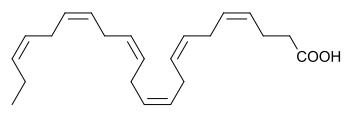
EPA (eicosapentaenoic acid, 20 carbons, 5 double bonds) is the signaling omega-3. The body converts it into a class of molecules called resolvins and protectins, which actively dampen inflammation. EPA shows the strongest evidence in cardiovascular outcomes and in adjunct treatment of depression. In brain tissue, however, EPA is present at very low concentrations.
DHA (docosahexaenoic acid, 22 carbons, 6 double bonds) is the structural omega-3. It makes up roughly 30% of the lipid in neuronal cell membranes, controls membrane fluidity, and supports synaptic function. Brain tissue contains roughly 250 to 300 times more DHA than EPA. When researchers talk about omega-3s and the brain, they are almost always talking about DHA.
The implication of the new study is a textbook case of context-dependent biology: in a healthy state, EPA's anti-inflammatory action is generally beneficial — that is why it works for cardiovascular disease. But in an actively injured state, inflammation is part of the repair signal. Suppressing it can stall the cascade that recruits repair cells and rebuilds damaged tissue. The same molecule that protects the heart may, in repeatedly concussed brain tissue, be doing exactly the wrong thing at exactly the wrong moment.
Who Should Actually Care
The study's specific scope — repetitive mild traumatic brain injury — points at a real but narrow population:
- Contact-sport athletes: American football, ice hockey, soccer (headers), rugby, MMA, boxing.
- Active-duty and veteran military personnel with blast exposure or repeated impact history.
- Anyone with a documented history of multiple concussions, including from car accidents or repeated falls.
For these groups, the right move is not panic — it is a five-minute conversation with a clinician. Review what EPA dose you are getting from supplements, consider switching to a DHA-dominant formulation, and weigh that against any cardiovascular indication you are also managing.
For the >80% of fish oil consumers without repetitive head-impact risk, no change is indicated. The cardiovascular benefit signal in moderate omega-3 intake remains. The cognitive-decline-prevention literature, which is predominantly DHA-driven, also stands. The study explicitly does not extend to you.
What "Better Fish Oil Guidance" Looks Like
If the lasting payoff of this study is one habit change, it should be: stop buying fish oil without reading the EPA:DHA breakdown.
Practical, indication-by-indication guidance, synthesized from current omega-3 nutrition literature:
- Brain and cognitive maintenance: prefer DHA-dominant formulations (DHA:EPA ≈ 2:1 or 3:1). Aim for at least 500 mg DHA per day. Higher-dose DHA (1 g+) appears in cognitive-decline studies.
- Cardiovascular indication: EPA-dominant formulations have the stronger evidence base. The standard adult dose is 1–2 g combined EPA+DHA per day.
- Depression (adjunct to standard care): EPA shows independent evidence at 1–2 g per day, with EPA fraction above ~60%.
- Pregnancy and lactation: 200–300 mg DHA per day is the well-established prenatal recommendation. Not affected by this study, which was about adult mice with brain injury.
- General healthy adults with no specific indication: two servings per week of fatty fish (salmon, mackerel, sardines, herring) likely beats any capsule, with the bonus that you also get protein, selenium, and vitamin D.
- Repeated head-injury history: read the bottle, prefer DHA-dominant, and have the clinician conversation.
The deeper habit this study should reinforce is treating supplements with the seriousness we treat medication. Dose matters. Timing matters. Individual physiological state matters. The 2026 EPA finding is a worked example of why "natural" and "harmless" are not the same word — and why the answer to "is X good for me?" is almost always "compared to what, in whom, for how long, and in what state?"
FAQ
Should I throw out my fish oil?
No. The study applies to mice with repeated head injuries and to a specific cellular mechanism. There is no evidence that healthy adults should stop fish oil, and the study's authors and independent experts explicitly cautioned against that interpretation. If you fall into a higher-risk group (contact-sport athlete, military, multiple concussions), the appropriate response is a clinician conversation, not a panic discard.
What is the difference between EPA and DHA, in plain English?
DHA is the structural omega-3 — it builds neuronal cell membranes and dominates brain tissue (about 30% of neuronal membrane lipid). EPA is the signaling omega-3 — it is the precursor to anti-inflammatory molecules and shows up in cardiovascular and mood research. Both are in fish oil; the ratio varies wildly by product.
How do I check the EPA:DHA ratio on a bottle?
Look at the supplement facts panel. Quality fish-oil products list mg of EPA and mg of DHA separately, usually under the total-omega-3 line. If a bottle only lists "Total Omega-3" without breaking out EPA and DHA, that is a red flag — either the ratio is unflattering or the product is poorly characterized. A 1000 mg fish-oil capsule that gives 180 mg EPA and 120 mg DHA is a very different product from one that gives 300 mg DHA and 100 mg EPA, even though the headline number is the same.
Is this the same as the studies that say fish oil is "useless"?
No. Those were mostly large cardiovascular trials (VITAL, ASCEND) that found modest or null effects on heart disease in low-risk populations at low doses. The 2026 MUSC study is about a specific neurological mechanism in a specific injury context — narrower scope, different question, different conclusion.
Should pregnant women change anything?
No. Prenatal DHA recommendations (200–300 mg per day during pregnancy and lactation) are well-established, independently supported, and not affected by this study. The research was specifically about EPA in adult mice with repetitive brain injury. DHA was not implicated.
What is the "context-dependent biology" idea, in one line?
The same molecule can be helpful in one physiological state and harmful in another. EPA is anti-inflammatory medicine for healthy cardiovascular tissue. EPA may be an anti-repair signal for actively injured brain blood vessels. The molecule did not change; the context did.
What does this have to do with AIgneous Million Whys?
Million Whys is built on the conviction that the most useful questions are the ones whose answers reorganize how you see something familiar. "Should I stop taking fish oil?" sounds like a panic-headline question; the answer turns out to be a small but durable upgrade to how you think about supplements in general — same molecule, different state, different effect. Each daily quiz is engineered to do that small reorganization.
Sources
- MUSC press release: study challenges widespread belief about fish oil's effects on brain (March 2026)
- Albayram et al., "Eicosapentaenoic acid reprograms cerebrovascular metabolism and impairs repair after brain injury" — Cell Reports (2026)
- ScienceDaily: Fish oil may be hurting your brain, new study finds
- Medical News Today: Fish oil supplements — could they sometimes harm the brain? (with independent expert commentary)
- EurekAlert release on the MUSC-led study
- Dyall, "Long-chain omega-3 fatty acids and the brain" — Frontiers in Aging Neuroscience (review of EPA, DPA, and DHA)
- "Importance of EPA and DHA Blood Levels in Brain Structure and Function" — PMC review