

Deep Conversation Topics That Actually Open Up
On this page· 19
Deep conversation topics are not supposed to make everyone sit in a circle and confess their childhood in the first five minutes. The good ones do something gentler: they make a small information gap visible. Someone realizes, "I know this person, but I do not know how they changed their mind," or, "I know their job, but not what they secretly notice about the world." That is where real talk starts: not with pressure, but with curiosity that has somewhere safe to land.
TL;DR
Good deep conversation topics are curious, specific, and consent-aware. They move from easy observation toward real self-disclosure, but they do not confuse depth with emotional heaviness. The best prompt gives both people a handle: a memory, a value, a changed belief, a small regret, or a question about the world that can close into a satisfying answer.
Short answer: use deep conversation topics when you want people to become more specific, not more dramatic. Start with a concrete doorway, listen for willingness, and only go deeper when the other person adds energy. A good question should feel like opening a window, not setting a trap.

The Difference Between Deep and Heavy
Deep is not the same as heavy. A heavy question asks for vulnerability before trust has arrived. A deep question gives someone a clean path into meaning while letting them choose the altitude. "What is one belief you changed your mind about?" is deep. "Tell me your biggest trauma" is not a conversation topic; it is an emotional demand wearing a question mark.
Arthur Aron and colleagues' well-known interpersonal-closeness procedure is useful here because it did not begin with the most intimate prompts. In the study summary, pairs spent about 45 minutes moving through tasks that gradually escalated in self-disclosure and relationship-building, and those tasks produced more closeness than comparable small-talk tasks (Aron et al., 1997). The mechanism is not magic. It is pacing. People can go surprisingly far when the steps are small enough to feel chosen.
That is also why many "deep questions" lists feel wrong. They skip the half-knowing zone. If the question is too shallow, nobody cares. If it is too exposed, people defend themselves. The useful middle is specific enough to pull, light enough to answer, and open enough to reveal a person.

The 3 Doors Into Deep Conversation
Door 1: a memory with a visible object
Memories become easier to answer when they attach to something concrete. Instead of "What shaped you?", ask, "What object from your childhood would explain you to a stranger?" The object protects the person from abstraction. A lunchbox, a bus route, a broken game controller, or a kitchen table can carry a lot without announcing, "Now we are being profound."
Door 2: a belief that changed
Changed beliefs are useful because they create a before-and-after story. Adam Grant's Think Again is built around the value of rethinking, and that frame is conversational gold because it lets someone be intelligent without pretending they were always right (Penguin Random House). Try: "What did you used to be sure about that now feels more complicated?" That question invites humility without making it a performance.
Door 3: a need hiding under an opinion
Nonviolent Communication is helpful here because it separates observation, feeling, need, and request. The NVC feelings and needs lists are designed to help people name what is actually happening instead of staying at vague words like "good" or "bad" (Nonviolent Communication). In conversation, that means you can move from "I hate parties" to "Do you hate parties, or do you hate not knowing where to enter?" The second version has a real door.

Question 1 of 1
Why does naming a specific feeling like 'unsettled' instead of just 'bad' actually change what the other person can do in a conversation?
20 Deep Conversation Topics That Are Not Cliche
Use these as topics, not interview bullets. Pick one, answer it yourself in a small way, then invite the other person in. Several pair a MillionWhys-style factual spark with a personal follow-up.
- A belief you inherited: What did your family or hometown teach you that you later examined?
- Coordination: Bank spark: "Why did Japanese rice farming create the cultural value of wa?" Follow-up: where has cooperation shaped your personality?
- A small envy: What do you envy in other people's daily lives, not their achievements?
- A skill with a hidden trick: Bank spark: "Why do weightlifters hold their breath?" Follow-up: what looks simple until you learn the technique?
- A private definition of success: What would count as a good year if nobody could see it?
- A place that changed your nervous system: What room, street, or landscape makes you different?
- A rule you quietly broke: Which "normal" thing did you stop accepting?
- A question you keep returning to: What mystery keeps showing up in different forms?
- An ordinary system: Bank spark: "Why do crowds in train stations naturally form walking lanes?" Follow-up: what human pattern do you keep noticing?
- A useful mistake: What did you only understand because you got it wrong first?
- A friendship pattern: Do you become closer through shared activity, long talks, or repeated tiny check-ins?
- A changed taste: What did you used to dislike that now feels meaningful?
- A comfort ritual: What small repeated action tells your body that the day is okay?
- A piece of technology that changed you: Bank spark: "Why does GPS need multiple satellites?" Follow-up: what tool quietly changed how you think?
- A sentence you still remember: What did someone say once that stayed longer than they knew?
- A value revealed by irritation: What annoys you because it violates something you care about?
- A harmless obsession: What topic could you explain for ten minutes if someone let you?
- A question about beauty: Bank spark: "Why does ice form on windows in winter?" Follow-up: what everyday thing still looks impossible to you?
- A future self: What do you hope becomes easier to talk about in five years?
- A second question: What would you ask me if you knew I would answer honestly but not dramatically?

When Deep Talk Fails: Consent and Timing
Deep talk fails when the asker treats the other person as a content source. The fix is simple: check the room. If someone gives short answers, changes the subject, jokes past the question, or starts looking for a task, believe the signal. Depth is not a prize you earn by pushing harder.
A consent-aware question has an exit ramp built in. "Do you want a real question or a light one?" works because either answer is acceptable. "What is something you changed your mind about, if anything comes to mind?" lowers the performance load and lets the person search rather than defend.
Timing matters too. Old friends can sometimes enter through memory because the shared archive is already there. New friends often do better with opinions about low-stakes things, then a second-order question. Partners may need the reverse: not more dramatic prompts, but cleaner ones. "What have we stopped asking each other because we assume we already know?" is often deeper than a random vulnerability card.
Deep Talk With Old Friends, New Friends, and Partners
With old friends, the danger is not silence; it is stale knowing. You remember the older version so clearly that you stop asking about the current one. Try questions that update the map: "What part of your life would surprise college-you?" or "What opinion of yours has become less loud?"
With new friends, go curiosity-first and biography-second. Charles Duhigg's Supercommunicators frames good conversation as a learnable skill built from noticing what kind of conversation is happening and matching it (Charles Duhigg). For a new person, that means starting where they are already animated. Ask one more question about the thing their voice changed on.
With partners, the work is often not finding a shocking question. It is making the familiar person unfamiliar again. Berkeley's overview of the Aron questions notes that the prompts were designed to create closeness in a lab setting, but the more useful everyday lesson is gradual escalation (UC Berkeley). You can use the same principle without copying the list: safe, specific, warmer, then more real.

What Makes a Deep Answer Actually Deep
A deep answer is not necessarily long. It is specific. "I value freedom" is abstract. "I get tense when my calendar has no empty rectangles because it feels like I cannot hear myself think" is deep. The second answer gives a scene, a body signal, and a need. It lets the listener understand the shape of your experience.
Specific answers also make the conversation easier to continue. They give the other person something to wonder about. Why empty rectangles? When did that start? Is that freedom, privacy, or recovery? One good answer creates more questions without draining the room.
What People Usually Miss
The common mistake is trying to "have deep conversation" as a mood. Mood is unreliable. Mechanics are better. Pick a topic with a concrete handle, answer first in a way that is honest but not overwhelming, watch for consent, and follow the part that becomes alive. Deep conversation is not a personality test. It is curiosity plus pacing.
That is why the best deep conversation topics often begin with the world, not the self. A weird fact, a social pattern, a memory object, or a changed belief gives people a shared surface. Then, if both people want to, the surface opens. The answer gives closure, and the closure reveals the next better question.
Related videos
FAQ
What are the best deep conversation topics for friends?
The best topics update what you think you already know: changed beliefs, childhood objects, private definitions of success, harmless obsessions, and questions your friend keeps returning to.
How do I ask deep questions without making it awkward?
Give the person an exit ramp. Try "Do you want a real question or a light one?" or add "if anything comes to mind." Depth should feel chosen, not assigned.
What deep questions should couples ask each other?
Ask questions that refresh the familiar map: "What have we stopped asking because we assume we know?" or "What part of you has changed quietly this year?"
Are deep conversation topics good for new friends?
Yes, if they start specific and low-pressure. Begin with opinions, small memories, and curiosities before asking for vulnerable life stories.
What does this have to do with AIgneous Million Whys?
Million Whys is built around the same engine: a visible question, a real answer, and the next gap that appears after closure. A daily curiosity habit gives you better things to ask and better things to say.
Keep Exploring
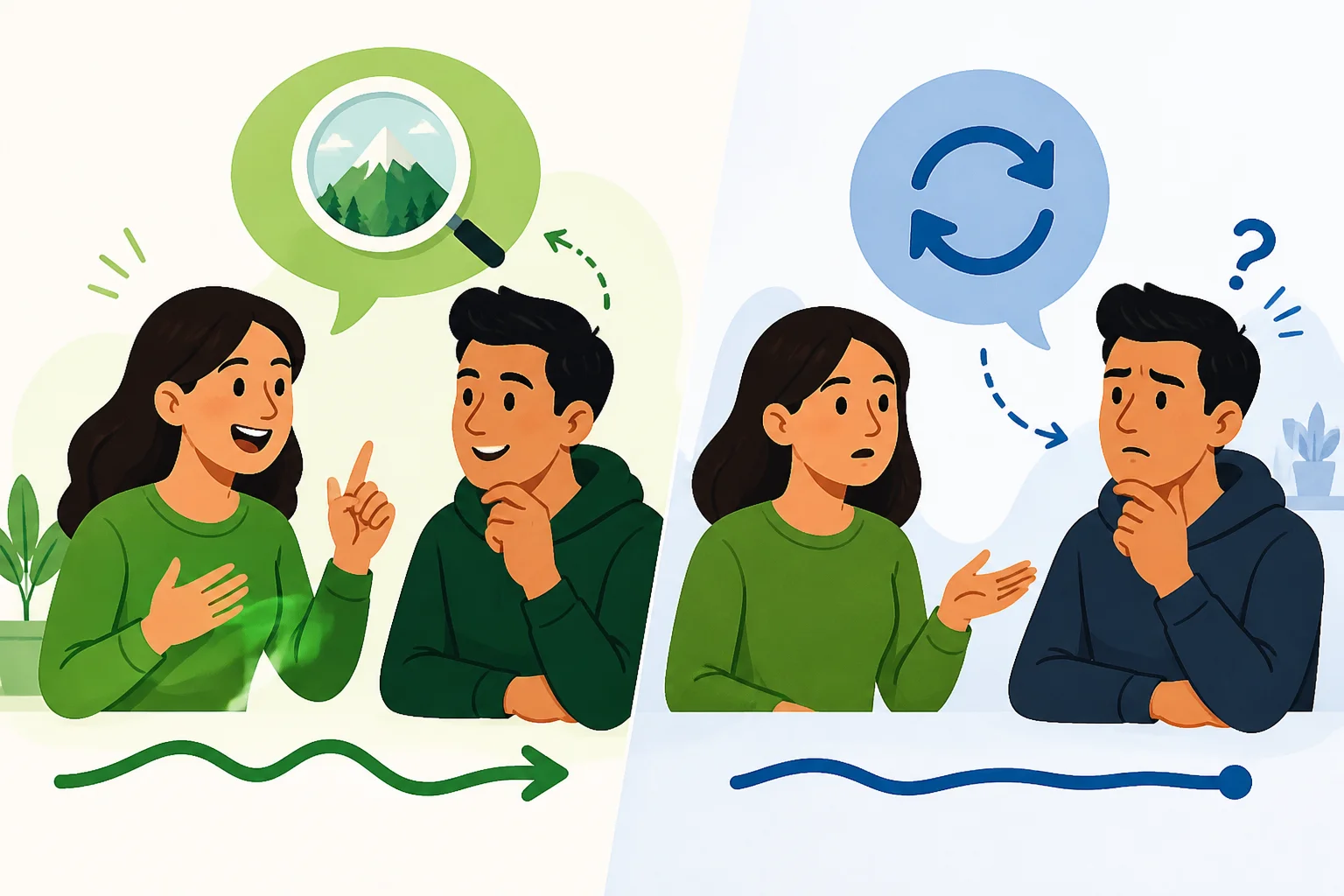
Why does asking about one specific detail someone just mentioned keep a conversation going better than asking them the same question back?
Psychology & Behavior

Why do TV producers often tell guests the general topic of an interview but not the exact questions?
Film, TV & Games

Why does a conversation stall when someone says 'My week was exhausting' and the other person immediately suggests ways to fix their schedule?
Psychology & Behavior
Related Posts
Conversation Starters That Actually Work
Conversation starters from real curiosity questions: deep, funny, weird, first-date, couple, and awkward-silence prompts you can use when talk goes flat.
How to Keep a Conversation Going, Naturally
How to keep a conversation going without scripts: use real follow-up questions, small curiosity refills, better pauses, and graceful exits when energy fades.
Icebreaker Questions That Do Not Feel Forced
Icebreaker questions for work should make people curious, not trapped. Try safe, smart prompts for meetings, interviews, coffee chats, and human teams.